PHP, or Partial Hospitalization Program treatment, is a structured day-treatment program that usually provides 4 to 8 hours of therapy per day, 5 to 7 days per week, while patients return home or to supportive housing at night. It's the middle ground many families are looking for, more support than weekly outpatient therapy, less confinement than inpatient hospitalization.
You may be standing in a doorway of decisions right now, trying to figure out whether your loved one needs more than office visits but not a hospital bed. That's where PHP fits. It gives people a full clinical day, then space to practice recovery skills in real life after hours, which is often exactly what's needed when symptoms, stress, trauma, or substance use are making daily life hard to manage.
Table of Contents
- Understanding PHP as a Level of Care
- What a Typical Day in PHP Looks Like
- How PHP Compares to Other Treatment Levels
- PHP for Co-Occurring Mental Health and Substance Use Disorders
- Getting Started with PHP Admission and Insurance
- What Makes Casa Recovery's PHP Program Different
- Common Questions About PHP Treatment
Understanding PHP as a Level of Care
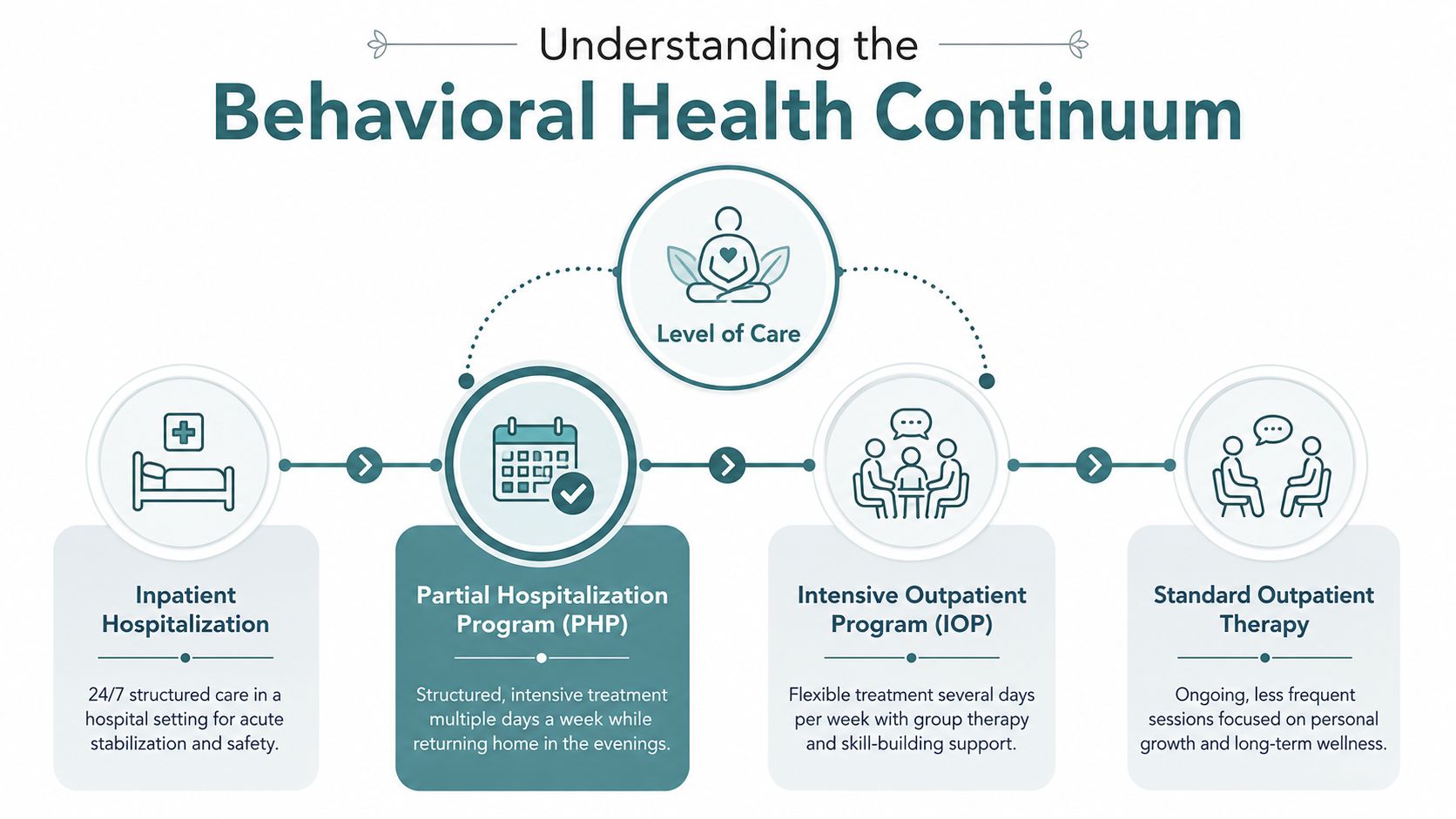
A good way to think about what is PHP treatment is to place it on the behavioral health continuum rather than treat it like a standalone label. PHP sits between inpatient hospitalization and standard outpatient therapy, which means it's built for people who need a lot of structure without 24-hour monitoring. The American Academy of Child and Adolescent Psychiatry describes PHP as typically providing at least 20 hours per week of structured treatment, often five days per week, for about 2 to 8 weeks (AACAP).
That structure matters because many people are not well served by once-a-week therapy when symptoms are active. They need more contact, more accountability, and more chances to use skills with support close by. PHP is often used as a step-down after inpatient or residential care, or as a diversion when someone is struggling but can still stay safe outside the hospital.
Practical rule: If someone needs a full treatment day but can return home safely at night, PHP is often the level of care that makes the most sense.
A simple clinical picture helps. Someone with depression, anxiety, trauma symptoms, or co-occurring substance use may be attending therapy but still spiraling between sessions. PHP gives that person a predictable schedule, frequent clinical touchpoints, and a setting where care is still intensive without being residential. Casa Recovery describes PHP as one of its outpatient levels of care for adults, and its general PHP overview aligns with the broader model of structured daytime treatment with a return home in the evening (Casa Recovery PHP).
What a Typical Day in PHP Looks Like
A PHP day is built to feel organized, not chaotic. Most programs use the day to combine therapy, skills practice, and clinical check-ins in a sequence that helps people settle in, process what's happening, and leave with a plan they can use later. Hazelden Betty Ford describes PHP as a day-treatment model that generally runs 4 to 8 hours per day, 5 to 7 days per week, with patients returning home or to supportive housing after programming (Hazelden Betty Ford).
That rhythm is important. Morning check-ins help staff understand how someone slept, whether cravings or panic were worse overnight, and whether any safety concerns need attention. Group therapy usually follows because it gives people a place to compare notes, learn from peers, and build accountability. Individual sessions then give room for private issues that don't belong in a group, such as shame, trauma history, medication concerns, or family conflict.
The pieces fit together for a reason
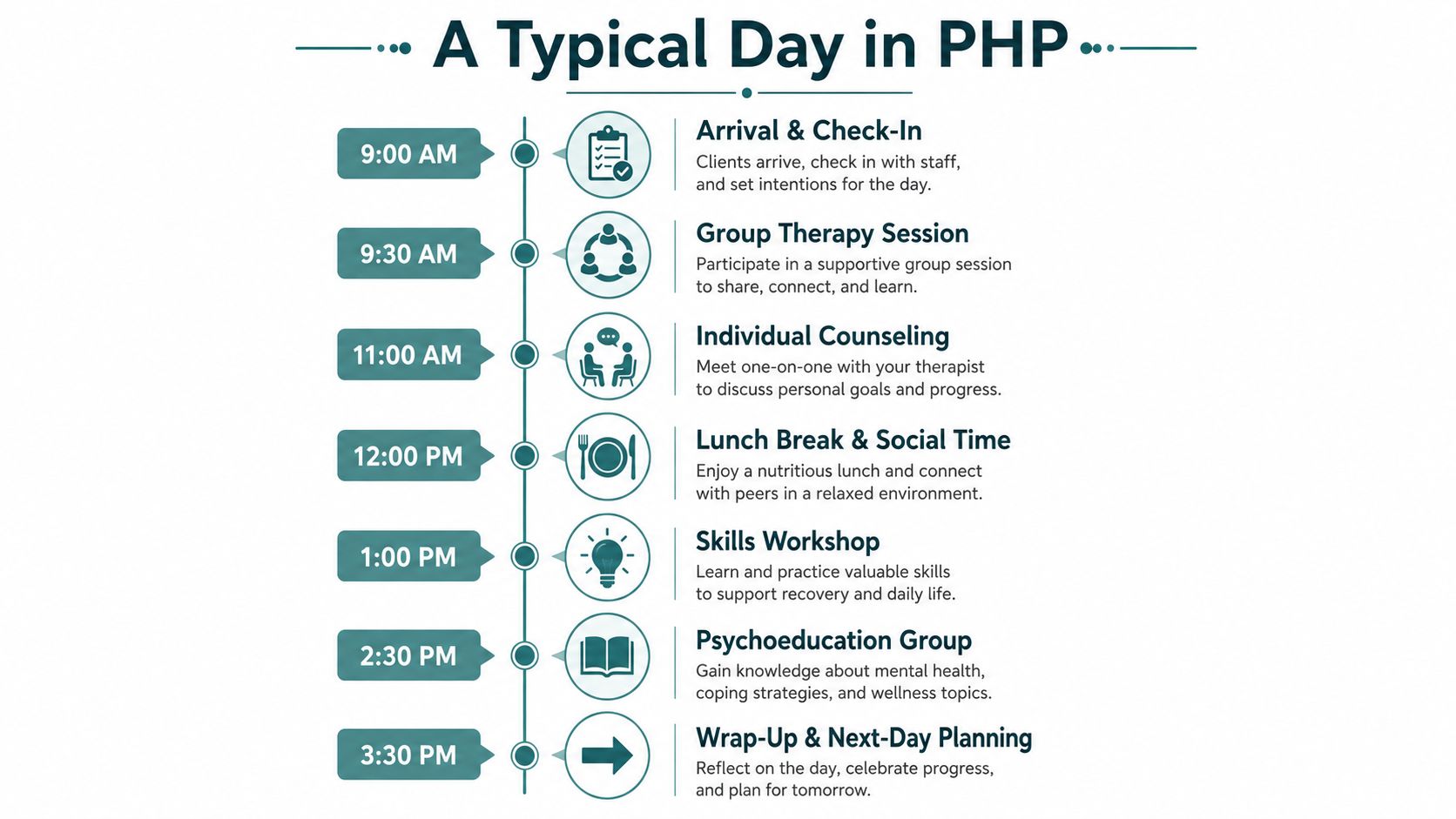
A typical day often includes several of these components, though the exact order varies by program:
- Arrival and check-in: Staff assess how the person is doing that morning and whether the treatment plan needs a quick adjustment.
- Group therapy: Clients practice communication, emotional regulation, and relapse prevention in a guided setting.
- Individual counseling: A therapist helps connect symptoms to goals, triggers, and next steps.
- Medication management: Psychiatric review helps match treatment to current symptoms and response.
- Skills training and psychoeducation: Clients learn coping tools, diagnosis education, and ways to handle stress outside the program.
- Wrap-up planning: The day ends with a review of what was learned and what needs attention the next day.
The structure can feel intense at first, but that's part of the point. PHP is designed to stabilize, not to overwhelm. Patients usually get repeated chances to practice skills in real time, then return the next day with feedback about what worked and what didn't.
How PHP Compares to Other Treatment Levels
The biggest confusion for families is usually not whether help is needed, it's which level of care fits best. PHP is more intensive than intensive outpatient care, but it's less restrictive than residential or inpatient treatment. That difference affects where someone sleeps, how much supervision they receive, and how much of the day is spent in treatment versus living life.
| Level of Care | Daily Time Commitment | Living Arrangement | Typical Duration | Best For |
|---|---|---|---|---|
| Inpatient Hospitalization | 24-hour supervision | Hospital-based | Short-term stabilization | Immediate safety concerns or need for continuous monitoring |
| Partial Hospitalization Program | About 4 to 8 hours per day | Returns home or to supportive housing | Often short-term stabilization | People who need intensive support but not overnight care |
| Intensive Outpatient Program | Fewer hours than PHP | Lives at home | Step-down or ongoing care | People who need structure while resuming more daily activity |
| Standard Outpatient Therapy | One or two sessions per week | Lives at home | Ongoing maintenance | People who are stable enough for lighter support |
Treatment planning gets practical when assessing the right level of care. If someone is still in crisis, inpatient care may be the safest starting point. If they're medically and psychiatrically stable enough to be outside the hospital, PHP can offer the structure they need without removing them from home life. If they've already improved and need less daily support, stepping down from PHP into IOP is often the next move.
The comparison between PHP and IOP is often the most useful one for families. Casa Recovery's guide on the difference between IOP and PHP is helpful if you're trying to understand how much daily structure someone needs. The general rule is simple. PHP is for higher acuity and more frequent contact, IOP is for continued support with more flexibility.
If a person can stay safe without overnight supervision, but still can't manage with weekly therapy alone, PHP is often the bridge.
PHP for Co-Occurring Mental Health and Substance Use Disorders
Many people asking about PHP aren't dealing with only one diagnosis. They may be managing depression and alcohol use, PTSD and stimulant use, anxiety and prescription misuse, or another combination that keeps feeding on itself. That's where integrated dual-diagnosis care matters, because treating the mental health condition in one place and the substance use disorder somewhere else can leave too many gaps.
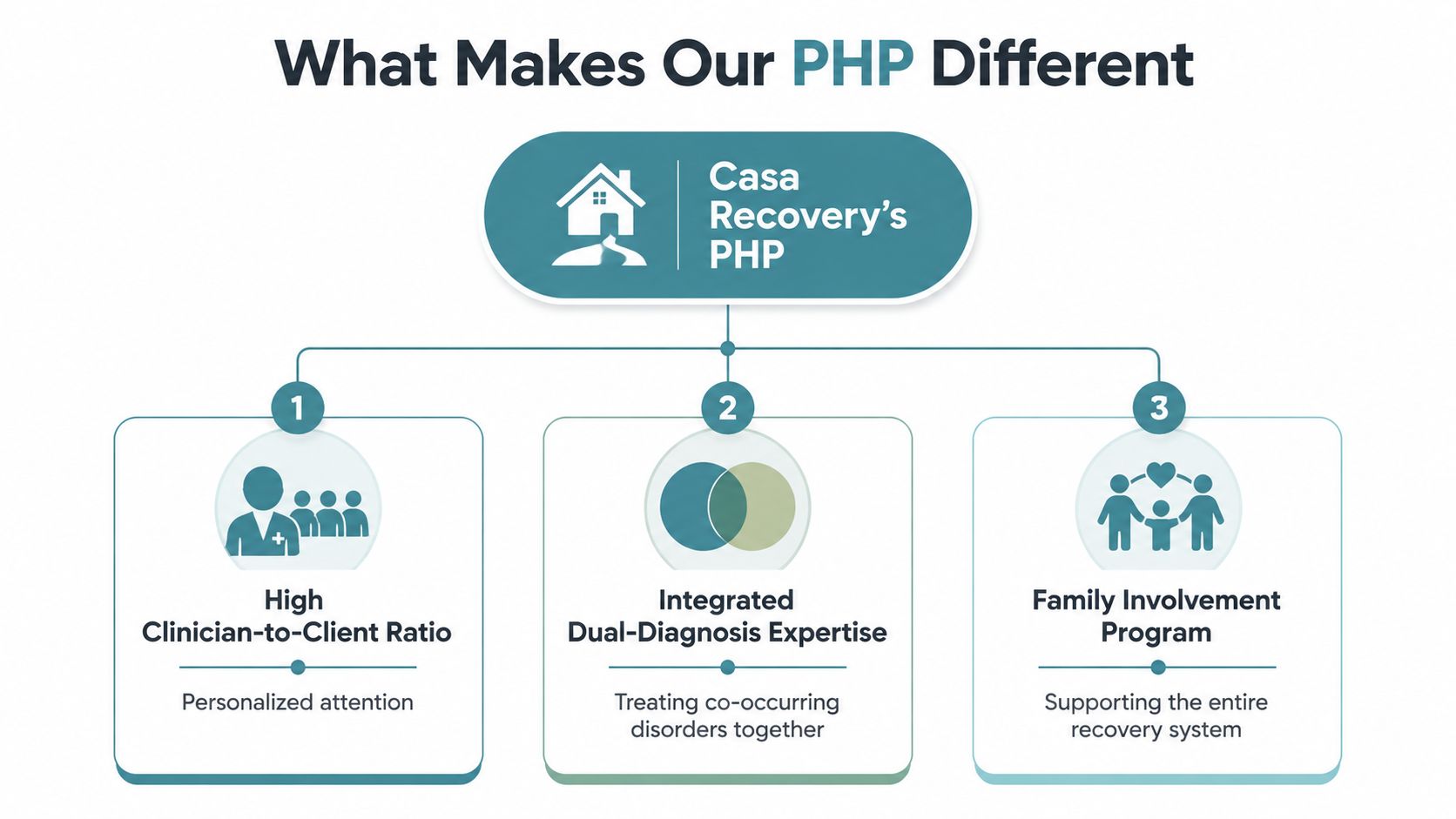
PHP is especially valuable when a program can address both issues at the same time. That usually means coordinated therapy, psychiatric medication management, relapse prevention planning, and staff who understand how symptoms interact. A person who drinks to quiet panic doesn't just need a substance use lecture. They need a clinical plan that understands the anxiety, the coping pattern, the trigger chain, and the risk of relapse during discharge.
What to look for in a dual-diagnosis PHP
A strong program should be able to answer a few direct questions without hesitation:
- Can both conditions be treated together? The program should explain how mental health and substance use care are coordinated, not separated into unrelated tracks.
- Who oversees medication and diagnosis? Psychiatric evaluation should be part of the plan when symptoms or substances complicate the picture.
- How is relapse risk handled? The team should talk plainly about triggers, cravings, safety planning, and what happens if symptoms spike.
- What does discharge planning include? A good PHP prepares someone for the next level of care instead of treating discharge like an afterthought.
Fragmented care often forces families to repeat the same story to multiple providers. Integrated care reduces that burden and keeps the treatment plan moving in one direction.
Casa Recovery is one outpatient option that explicitly offers integrated dual-diagnosis care alongside PHP and IOP, which matters for adults who need both mental health and substance use treatment under one roof. For people with trauma histories, the difference is even more important, because trauma symptoms and substance use often reinforce each other in ways that generic programs miss.
Getting Started with PHP Admission and Insurance
The first phone call is usually the hardest one. Families worry about what to say, what records will be asked for, and whether insurance will cover the program. In practice, admission usually starts with a clinical screening, then a more detailed assessment that looks at symptoms, safety, substance use history, medications, and whether PHP is the right fit.
A psychiatric evaluation may follow if the program needs to refine the diagnosis or adjust medication planning. That part can be reassuring, not scary. It gives the treatment team a chance to see the whole picture instead of guessing from a short intake call. Families should also expect questions about living situation, support at home, transportation, and whether the person can reliably attend most days of the week.
Insurance and logistics tend to settle early
Insurance verification usually happens before admission or during the intake process. Many programs work with PPO plans, and families often want to know whether a provider is in-network or out-of-network because that affects cost-sharing and paperwork. Casa Recovery's insurance information page explains that it supports verification and guidance for coverage questions, including PPO-based plans and select networks (Casa Recovery insurance coverage).
A first week in PHP often feels like adjustment rather than instant transformation. The client learns the schedule, meets the team, and begins to understand how the program handles group work, individual therapy, and medication follow-up. Families can help by keeping transportation simple, sharing accurate history, and staying available for updates when the program asks for consent-based coordination.
What Makes Casa Recovery's PHP Program Different
Not all PHP programs are built the same. Some are broad and efficient, while others are smaller and more individualized. Casa Recovery's PHP stands out clinically because it combines high therapist-to-client attention, small groups, trauma-informed treatment, and a coordinated approach to co-occurring disorders rather than treating problems one at a time.
The treatment model also includes several evidence-based modalities that can be matched to different needs. Casa Recovery lists CBT, DBT, EMDR, Brainspotting, Motivational Interviewing, art therapy, and denial management as part of its outpatient services. That matters because trauma, anxiety, mood instability, and substance use don't all respond to the same tool, and a rigid one-size-fits-all schedule can miss the underlying driver of symptoms.
Family involvement changes the tone of treatment
Family work is not just an add-on. When a loved one is involved appropriately, communication gets clearer, discharge planning gets stronger, and people at home understand how to support recovery without overstepping. For adults in PHP, that can make the difference between a plan that sounds good in session and a plan that holds up at home.
The Orange County setting also matters for many clients, especially those balancing local support with a desire for a focused treatment environment. Casa Recovery serves adults in the region and also coordinates supportive living options for out-of-area clients, which helps when someone needs structure but isn't local enough to commute easily every day.
Common Questions About PHP Treatment
How long does PHP usually last? The AACAP describes PHP as commonly lasting about 2 to 8 weeks, though the exact length depends on symptoms, safety, and progress (AACAP).
Can someone work or go to school during PHP? Usually not in a full-time way, because PHP takes most of the day. Some people can handle limited evening responsibilities, but the daytime commitment is the core of the treatment.
What if a person gets worse in PHP? The team should reassess quickly and determine whether the person needs a higher level of care. Good programs don't treat that as failure, they treat it as a clinical decision.
What should families ask before admission? Ask how the program handles dual diagnosis, medication changes, family communication, and step-down planning. Those questions tell you a lot about whether the program is prepared for real-world recovery needs.
If you're trying to decide whether PHP is the right fit for your family, Casa Recovery offers outpatient care that combines structure, trauma-informed treatment, and integrated support for co-occurring conditions. Visit Casa Recovery to learn how their PHP and related services may help your loved one move from crisis toward stable recovery.