You might be here because talk therapy has helped you name what's happening, but your body still feels braced, tight, or on edge. Maybe you've done the insight work and still notice that your shoulders stay locked up after hard conversations, or that anxiety shows up as a stomach knot before you can even think your way through it. That's often the point where people start asking whether movement therapy could be useful, not as a replacement for therapy, but as another way to help the nervous system settle enough to do deeper work.
Table of Contents
- What Movement Therapy Actually Means
- Main Approaches Within the Movement Therapy Family
- What the Evidence Says for Trauma, Anxiety, and Depression
- How a Typical Movement Therapy Session Is Structured
- Safety, Contraindications, and When to Be Cautious
- How Movement Therapy Complements EMDR, DBT, and Psychiatry
- Choosing a Movement Informed Program in Orange County
- Frequently Asked Questions About Movement Therapy
What Movement Therapy Actually Means
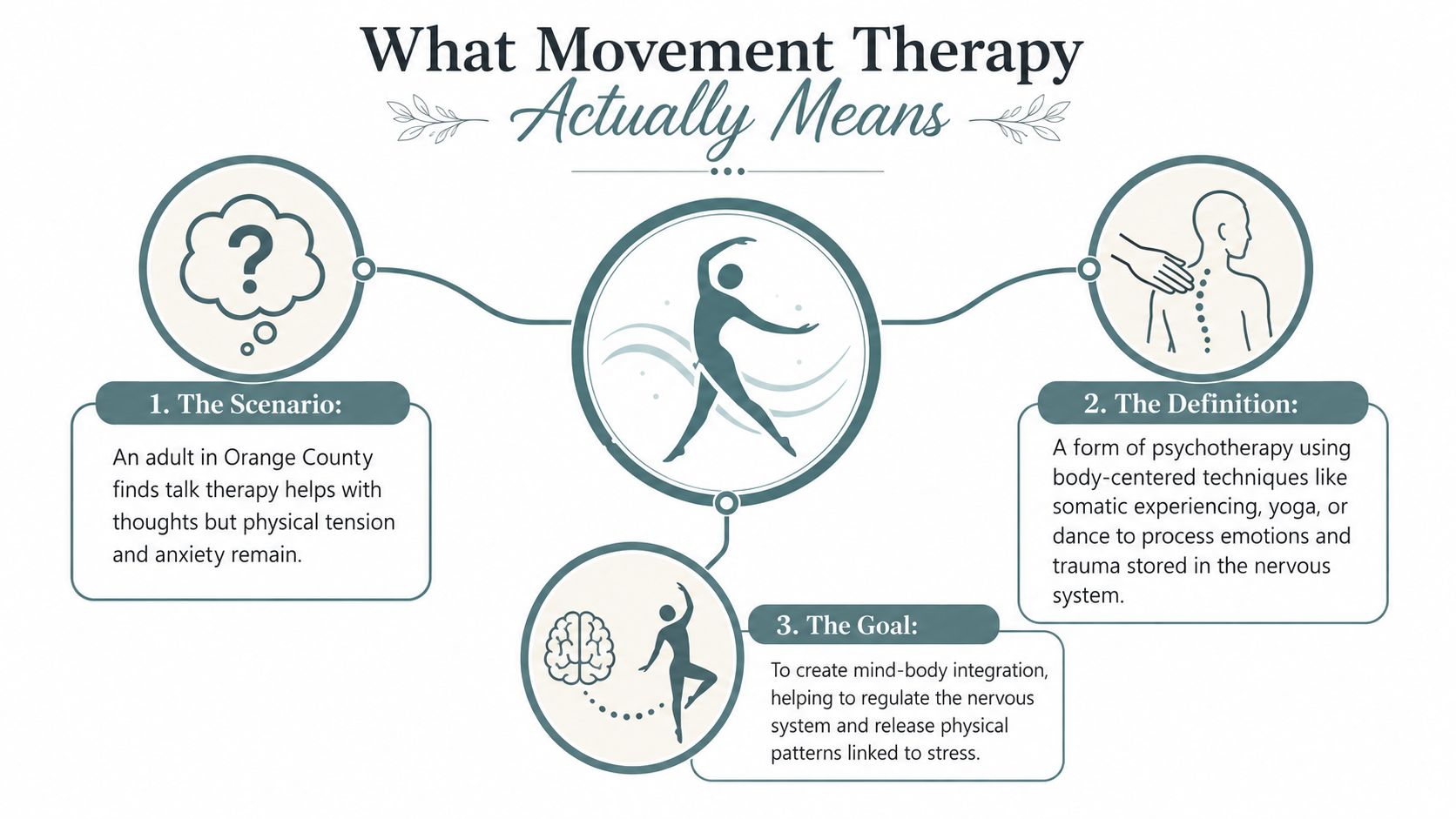
An adult in Orange County may ask about movement therapy after months of trying to talk through anxiety or trauma and still feeling tight, braced, or shut down in the body. That does not mean talk therapy did not help. It usually means the experience is living in both the story and the nervous system, and the body needs to be included in treatment.
A plain-language definition
Movement therapy is a group of approaches that uses body awareness, breath, rhythm, posture, gesture, and guided movement to help people process emotions and regulate stress. It is not a fitness class, and it is not about performing the “right” dance steps. The goal is to notice how the body responds, then use movement in a therapeutic way that supports emotional processing.
In practice, that umbrella can include dance/movement therapy, somatic experiencing, Authentic Movement, and body-based skills borrowed into therapies like CBT and DBT. The people facilitating it are usually licensed clinicians, trained therapists, or clinicians working inside a broader treatment plan, not dance instructors improvising outside a clinical frame. That distinction matters because the work can touch anxiety, trauma, shame, and body memory very quickly.
Why the field takes it seriously
The mental health field takes these approaches seriously because they fit what many clients already know from lived experience. People often feel stress in the jaw, chest, stomach, or hands before they can explain it in words. Movement therapy gives those signals a structured way to be noticed, tolerated, and processed.
A useful way to understand it is this, movement therapy is clinically promising, but it is usually best understood as an adjunct. For adults with anxiety, trauma, or co-occurring disorders, that means it often works alongside psychotherapy, psychiatry, and skills work rather than replacing them. That framing is especially important in outpatient care, where treatment has to fit real-world access, insurance, referrals, and the level of structure a person needs. Independent physical-therapy access research also points to the practical realities of access and affordability that shape care choices Duke access research.
Practical rule: If a program sells movement work as a cure-all, that is a reason to pause. Clinically grounded care usually treats it as one part of a bigger plan.
Main Approaches Within the Movement Therapy Family
The label sounds broad because it is broad. Some approaches lead with words and add movement as support, while others ask the body to lead and keep language light until the person feels regulated enough to speak.
Different methods, different feels
Dance/movement therapy often uses mirroring, rhythm, and relational movement. A session might feel collaborative and surprisingly ordinary, with the therapist reflecting a client's posture or pace to help the client feel seen without needing to explain everything. That can fit well for someone who knows what they feel but struggles to access it verbally.
Somatic experiencing is more body-led. The therapist helps the client notice sensations, track activation, and stay within a tolerable range instead of flooding the system. It's often a good fit for clients who get overwhelmed quickly, because the pace is slow and the attention is on safety and regulation.
Authentic Movement leans further into non-verbal expression, and that's exactly where caution matters. The person moves with minimal structure while being observed, then reflects on what came up. In the wrong context, that can feel exposing rather than healing, so it needs careful screening and a strong therapeutic relationship.
Body-based skills borrowed from CBT and DBT often look simpler on the surface. A therapist might guide paced breathing, grounding through the feet, opposite-action movement, or a short posture shift before a hard conversation. Those tools can be easier to integrate into everyday life because they're concrete and familiar.
If you want a grounded example of how movement and body awareness can be integrated into broader care, this overview of yoga in recovery shows how movement-based support can fit into a clinical setting without pretending to replace therapy.
Some approaches are almost entirely body-led. Others are verbal therapy with a movement layer added on top. The difference matters because the right method depends on the client's nervous system, history, and current stability.
A quick mental map
- Dance/movement therapy: relational, expressive, and often group-friendly.
- Somatic experiencing: sensation-focused, paced, and regulation-centered.
- Authentic Movement: inward, reflective, and best used with strong structure.
- CBT or DBT-informed movement skills: practical, brief, and easier to use between sessions.
What the Evidence Says for Trauma, Anxiety, and Depression
A lot of adults want a clear answer here, and that makes sense. Movement-based approaches are promising, but they are not a cure on their own. The clearest pattern in the literature is that they tend to work best as part of a broader treatment plan, where movement supports other clinical care rather than replacing it. Recent reviews suggest possible benefits for anxiety, depression, body awareness, and sensory-motor symptoms after trauma, while the evidence base is still developing JAT review.
The practical question matters just as much as the clinical one. Adults in Orange County are often deciding whether a service is accessible, affordable, and realistic to keep attending, alongside whether it fits with psychotherapy or psychiatric care. For that reason, questions about insurance, visit frequency, referral requirements, and whether the program is tied to a larger treatment plan matter as much as symptom relief. A closer look at exercise and mental health support shows the same general pattern, movement can support emotional health, but it works best when it is matched to the person and the care plan.
Where movement therapy tends to fit
For trauma and PTSD, movement therapy is often used to help clients notice body signals, rebuild tolerance for sensation, and reduce the sense of disconnection that can follow overwhelming experiences. For anxiety and panic, the benefit usually comes from grounding, regulation skills, and learning how rising activation feels before it peaks. For depression, movement can help interrupt shutdown, support body awareness, and make it easier to re-enter connection with other people.
Co-occurring substance use changes the picture. When substances have been used to numb feelings or manage arousal, body-based work can help clients notice what is happening inside without immediately escaping it. That work still needs structure and pacing, because unstructured body awareness can feel destabilizing if sobriety, sleep, or psychiatric symptoms are not yet steady.
| Condition | Typical role of movement therapy | Strength of current evidence |
|---|---|---|
| Trauma and PTSD | Adjunct for regulation, body awareness, and sensory-motor symptoms | Emerging, clinically promising |
| Anxiety and panic | Adjunct for grounding and nervous system regulation | Growing, but still not definitive |
| Depression | Adjunct for activation, embodiment, and re-engagement | Promising, especially in broader plans |
| Co-occurring substance use | Supportive tool inside integrated care | Best used as part of coordinated treatment |
For families and adults comparing options, the main point is simple. Movement therapy is usually most useful when it sits inside coordinated care, with clear goals, screening, and a therapist who understands when to slow down, when to pause, and when another level of support is a better fit.
How a Typical Movement Therapy Session Is Structured
A good movement session usually feels more contained than people expect. It's not a free-for-all, and it's not a performance. The therapist is watching for signs of overload, helping the person stay present, and adjusting the pace so the work stays useful instead of overwhelming.
The usual arc of a session
The session often starts with a check-in. The therapist may ask what the person notices in their body, how sleep has been, or where tension is landing today. That sounds simple, but it gives both people a baseline, which is important when the goal is regulation rather than intensity.
Next comes warm-up and grounding. This may include slow breathing, feeling the feet on the floor, gentle reaching, or orienting to the room. The point is to bring attention into the body without forcing anything to happen.
Then comes the focused exercise. In somatic work, that might be a pendulation exercise, where attention moves gently between a calm body area and a more activated one so the nervous system doesn't get flooded. In a DMT group, it might be a rhythm and mirroring exercise, where one person leads a simple movement and the group reflects it back in a contained way.
Therapist stance matters: the clinician is a witness and guide, not a coach pushing performance. The job is to titrate intensity so the client stays within a workable window.
After the movement, the therapist usually invites processing. That can be words, images, body sensations, or a simple check on what changed. Then the session closes with a cool-down, which may look like slower breathing, seated reflection, or a brief grounding routine so the person leaves steadier than they arrived.
What you might notice in the room
- Less talking than standard psychotherapy, but not no talking.
- Gentle pacing, especially if the person is easily activated.
- Permission to stop, rest, or modify at any point.
- Attention to choice, because choice helps restore agency in trauma work.
If you walked into a movement therapy group tomorrow, you'd probably spend more time noticing than doing. That's intentional. The work is meant to help the nervous system become more flexible, not to test endurance.
Safety, Contraindications, and When to Be Cautious
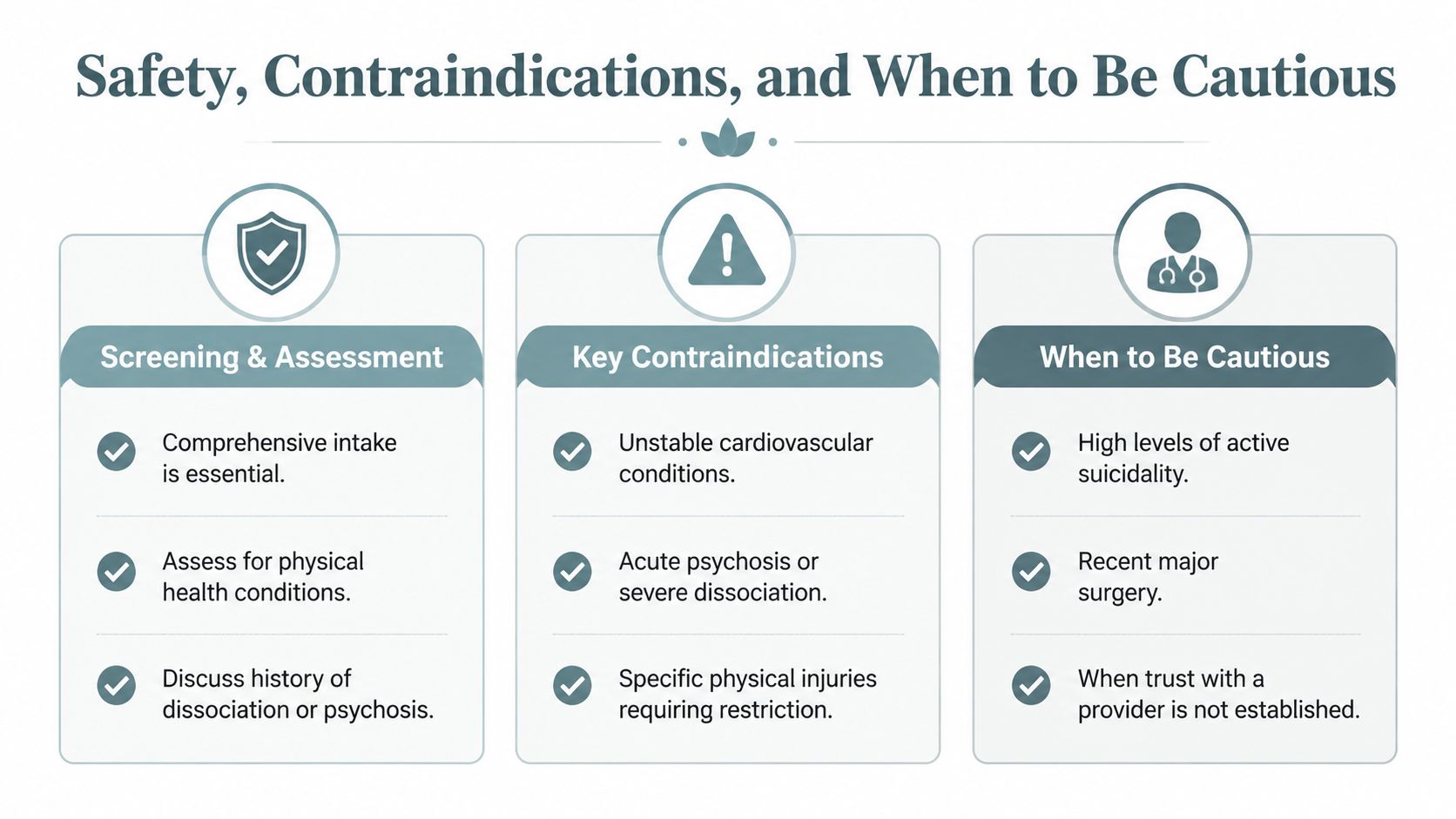
A movement therapy session can look calming from the outside and still feel too much for a specific person in the room. Safety depends on the client's current state, the structure of the session, and how well the therapist can read cues of strain, shutdown, or overload. The practical question is whether this person, right now, in this setting can use movement to settle and organize, rather than become more distressed.
That is why screening matters. A review of indications and contraindications in dance movement therapy found that improvisation is usually recommended only with a higher degree of structure, while free improvisation and Authentic Movement are most often mentioned as contraindications. Unstructured body work is not a fit for every client, especially when trauma symptoms are active or the person has trouble staying oriented in the present JAT review.
Red flags to bring up in intake
- Unstable physical health: A person should disclose cardiovascular issues, injuries, or anything that limits movement safely.
- Active dissociation or psychosis: Body-based work can become disorganizing if reality testing or present-moment awareness is already fragile.
- Recent acute trauma: Early, unstructured movement may intensify symptoms before regulation skills are in place.
- Unmanaged substance use: If intoxication, withdrawal, or instability is active, movement work needs a tighter clinical frame.
- Low trust with the provider: If the relationship isn't steady yet, body-focused interventions can feel intrusive.
Some clients do better with structured movement than with free expression. Others need more stabilization first, along with psychiatric support and slower pacing before any body-led work begins.
Outpatient care works best when the team can watch the whole picture. In programs with onsite psychiatry and medication management, clinicians can track how arousal, sleep, mood, and side effects interact with movement-based interventions instead of treating each piece in isolation. In a PHP or IOP setting, that added monitoring can help keep the work within a safe window and reduce the chance of going too far, too fast.
How Movement Therapy Complements EMDR, DBT, and Psychiatry
Movement therapy works best when it has a job. In a full outpatient plan, that job is usually to make the body more ready for deeper treatment, or to help the nervous system settle after difficult clinical work. It doesn't compete with established therapies, it supports them.
Before, during, and after deeper processing
For clients doing EMDR or Brainspotting, movement-based regulation can help build a steadier starting point. If a person arrives dysregulated, body awareness work may reduce the sense of being swept away during trauma processing. Casa Recovery's EMDR page reflects this kind of layered trauma care, where different modalities can be coordinated rather than isolated.
With DBT, movement therapy can reinforce skills that already target distress tolerance, mindfulness, and emotion regulation. A therapist may help a client practice paced breathing or grounding before a hard conversation, then use movement again after the conversation to notice what changed in the body. That makes the skills more usable outside the office.
Psychiatry still matters. Medication management can address mood, sleep, anxiety, or other symptoms that make regulation hard in the first place, while movement work gives the person a non-pharmaceutical tool they can feel in real time. Neither replaces the other.
Why integrated programs fit better
Movement therapy makes the most sense inside an integrated dual-diagnosis plan, especially when trauma, depression, anxiety, and substance use overlap. Casa Recovery's outpatient structure includes CBT, DBT, EMDR, Brainspotting, art therapy, and denial management, so movement-based work can be threaded into a larger treatment plan without disrupting the clinical stack. That matters because many adults don't need one more isolated wellness class, they need care that connects the dots.
The strongest outpatient plans don't ask one intervention to do everything. They assign each modality a clear role and keep the client anchored in a coordinated program.
Choosing a Movement Informed Program in Orange County
Orange County families usually need practical answers, not theory. If you're evaluating an outpatient program that includes movement-informed care, ask who leads the sessions, how that work fits with therapy and psychiatry, and what happens if the client gets activated or shuts down mid-session.
Questions worth asking before you enroll
- Who facilitates the movement work? Ask about clinical training, not just comfort with wellness practices.
- How is it coordinated with EMDR, DBT, or psychiatry? Movement should support the plan, not float beside it.
- Is co-occurring substance use treated at the same time? Sequential care can create gaps when symptoms overlap.
- Can family members participate? Support at home matters, especially after a hard day in treatment.
- What happens if the client feels overwhelmed? A good program should have a clear response, not just encouragement to “push through.”
For Orange County adults, PHP and IOP can be a better fit than a loose weekly class because they offer more structure, more clinical oversight, and more room to adapt care when symptoms are active. Casa Recovery's outpatient model includes a high therapist-to-client ratio, trauma-informed care, onsite psychiatry, and a formal family program, which are all relevant when movement work is part of the picture. It also accepts PPO coverage from all carriers, and is in network with Blue Shield of California/Blue Card, ComPsych, and Holman Group, with admissions guidance and supportive living coordination for out-of-area clients.
Before committing to any movement-based program, schedule a facility tour or admissions call. You'll learn more from how the team talks about screening, structure, and coordination than you will from any brochure.
Frequently Asked Questions About Movement Therapy
How often is movement therapy scheduled in outpatient care? It depends on the program. In a structured PHP or IOP, it may be woven into multiple sessions each week, or used selectively around other therapies when the team sees a regulation need.
Do I need a referral or diagnosis to start? Many programs will want an assessment, and some may need a diagnosis for insurance or clinical planning. If you're unsure, ask admissions how they handle intake and whether movement work is part of a broader treatment plan.
What if I feel awkward in my body or I've never danced? That's normal. Movement therapy isn't about skill, and it doesn't require dance experience. A good therapist keeps the exercises simple, private, and optional enough that you can stay with what feels tolerable.
How can a family member help at home? Keep it simple. Encourage regular sleep, calm routines, and brief grounding practices, and don't pressure the person to “do the exercise right.” Support works best when it respects choice, pacing, and the treatment team's guidance.
Movement therapy tends to help most when someone wants more than insight, but not less structure. It can support regulation, body awareness, and trauma recovery, yet it works best as a clinically coordinated adjunct in the right setting, with the right amount of safety and support.
If you're in Orange County and trying to decide whether movement therapy belongs in a real treatment plan, Casa Recovery offers PHP and IOP care with trauma-informed, integrated support for mental health and dual-diagnosis concerns. If you want to see how movement-informed care can fit alongside psychiatry, DBT, EMDR, and family support, visit Casa Recovery and set up a conversation with admissions.