A family member notices faint lines on a forearm during a normal conversation, or a person catches a glimpse in the bathroom mirror and feels their stomach drop. It's easy to jump straight to blame, but the more useful first move is to understand what the skin is saying, what it isn't saying, and whether the situation needs care today.
Track marks from drugs are a physical clue, not a moral verdict. They can point to repeated intravenous injection, they can also signal deeper medical risk, and they deserve a calm, practical response rather than panic or denial.
Table of Contents
- Why Track Marks Matter and What This Guide Covers
- What Track Marks Are
- Where Track Marks Appear on the Body
- How Marks Differ by Substance and Route
- Medical Complications of Repeated Injection
- Harm Reduction and Immediate First Aid
- Evidence-Based Treatment Pathways
- Practical Next Steps for Orange County Families
Why Track Marks Matter and What This Guide Covers
A spouse may notice marks near the elbow and wonder whether they are old injuries, skin irritation, or something more serious. A parent may spot them while folding laundry and not know whether to ask a question, call a doctor, or say nothing. A clinician may see the same skin pattern and immediately think about infection risk, vein damage, and whether the person needs same-day care.
Track marks matter because they are often the visible edge of a larger health story. They can look like tiny dark needle punctures with discoloration, scarring, or skin trauma, and they are commonly seen in people who inject drugs. They also point to broader medical concerns, including infection risk and damage to the veins and surrounding skin, which can affect how well blood moves through the area.
Practical rule: If the skin looks like a healed scar, that raises one question. If the area is red, swollen, draining, or painful, that is a different question entirely.
The safest way to read track marks is as a triage signal. The appearance can help you recognize repeated injection, but the bigger task is deciding whether the person needs wound care, urgent medical evaluation, or support for substance use and mental health together. For a related overview of signs a loved one may be struggling with heroin use, see Casa Recovery's guide to signs a loved one might be addicted to heroin.
What Track Marks Are
Track marks are mechanical injury patterns, not a sign of one specific drug. Repeated needle puncture damages the vein wall, the surrounding skin, and deeper tissue. Over time, that repeated trauma can lead to inflammation, clotting inside the vein, collagen buildup, thickening of the vein wall, and eventually scarred or collapsed veins that interfere with blood flow mechanical injury description of track marks.
What they usually look like
The visual pattern is often recognizable. Track marks can appear as linear discoloration, small puncture scars, bruising, or hyperpigmented streaks that follow superficial veins. Fresh lesions may heal within weeks, while repeated injury can leave permanent venipuncture scars that do not fade completely clinical presentation of track marks and healing patterns.
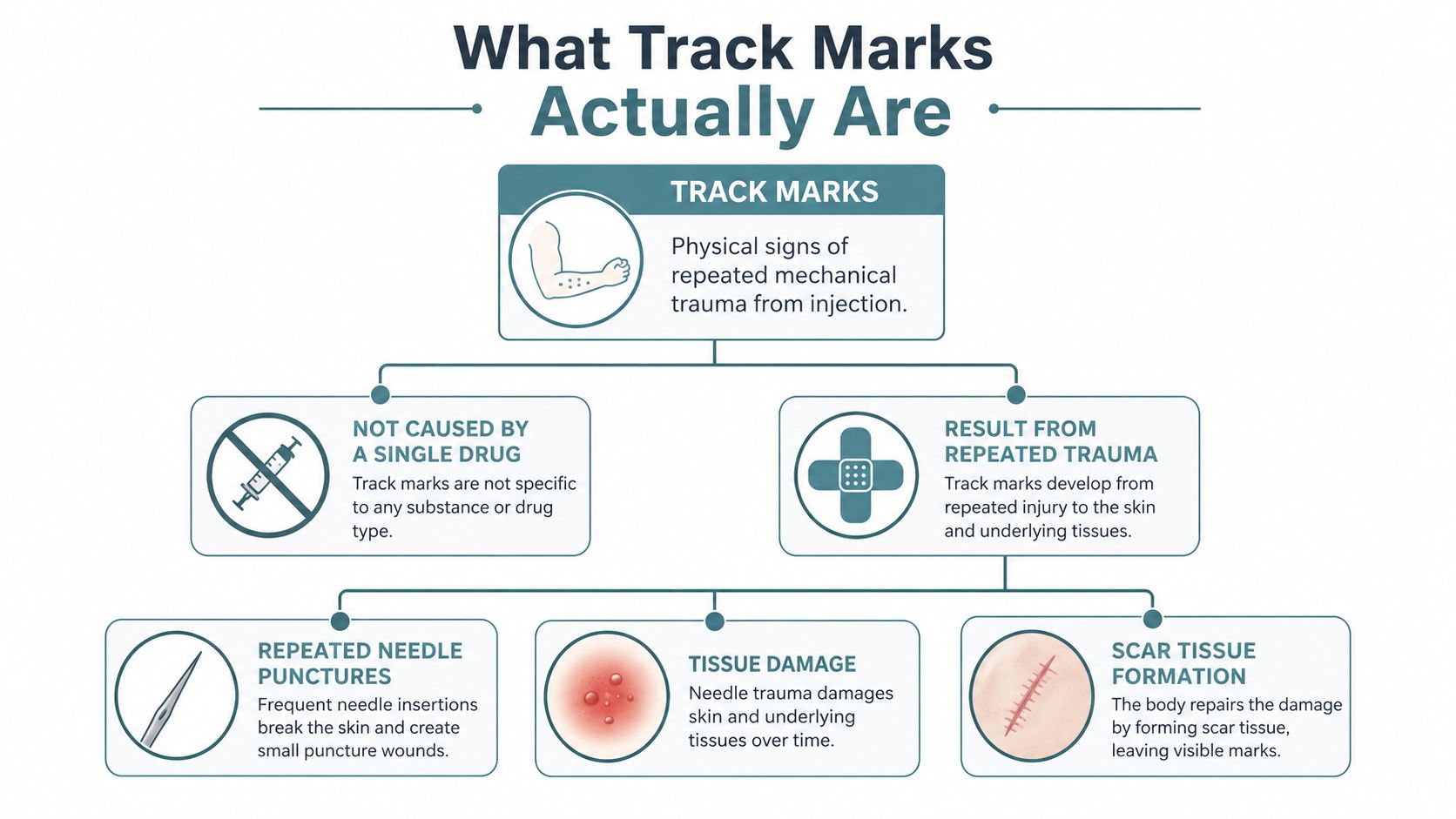
A useful clinical distinction is the shape of the injury. Skin popping, which means injecting under the skin rather than into a vein, tends to leave circular scars or ulcers rather than the linear pattern seen with intravenous use. That difference matters because skin popping often raises concern for abscesses and deeper tissue injury Merck manual discussion of injection-related skin findings.
A helpful way to describe the skin to a clinician is to say whether the marks are linear, round, fresh, healing, or paired with swelling and drainage. That small detail can change the next step.
Track marks have long been recognized in the medical literature as part of the broader pattern of injection-related skin lesions, including abscesses and injection-site injury PubMed review of injecting drug use and skin lesions. That is why the skin finding is rarely just cosmetic. It is a clue about repeated trauma and possible complications that may already be developing beneath the surface.
Where Track Marks Appear on the Body
A worried family member may notice small marks first on the inner arm crease, also called the antecubital fossa. That area has veins close to the surface, so repeated injection there is often easier at first and can leave visible skin damage later.
Why the location changes over time
As veins become scarred, collapsed, or difficult to use, injection often moves to other places. The forearms, backs of the hands, feet, legs, groin, neck, and other hidden areas may show marks. Some people also use less obvious sites, including the axillae, and skin popping can leave round scars or ulcers in places that are easy to cover Merck manual discussion of injection sites and hidden locations.
The location gives a clue about risk. Marks in the arms are common and easy to miss. Marks in the neck or groin deserve closer attention because those areas involve major vessels, and repeated trauma there can become dangerous quickly even when the skin change looks small on the surface.
A careful check goes beyond the forearms. Families and clinicians often look at the front of the arms and miss the places a person can hide. The hands, feet, lower legs, groin area if clinically appropriate, and any skin folds or covered areas may all need to be checked.
| Common site | Why it gets used |
|---|---|
| Inner elbow | Superficial veins are easy to access |
| Forearms and hands | Used when earlier sites become damaged |
| Feet and legs | Often used after arm veins are no longer reliable |
| Groin or neck | Hidden sites, but higher risk |
Clinical takeaway: The farther injection moves from the forearm, the more likely repeated vein damage has already narrowed the options.
Location is not random. It often reflects a shift from easier access to harder-to-see, higher-risk sites. That pattern helps explain why track marks matter medically even when the person has not said anything directly.
How Marks Differ by Substance and Route
A person may notice track marks after heroin, fentanyl, methamphetamine, crushed prescription opioids, cocaine, or any other injected substance. The skin pattern shows intravenous use, but it does not identify the drug on its own overview of drugs associated with track marks.
What the skin can and can't tell you
Families often hope the mark will point to one exact drug or reveal how severe the addiction is. Skin does not do that. The injury comes from the route, not the substance, so track marks from heroin and track marks from methamphetamine can look similar even when the person's use pattern, mental state, and medical risks are different.
The same person may also show different patterns over time. Short-acting stimulants can lead to more frequent injections, which can mean more repeated skin trauma. That is a tendency, not a diagnostic rule, and it should never be used to guess what someone is taking without a clinical assessment.
The route matters just as much as the drug. Skin popping means injecting under the skin or into the tissue instead of into a vein. It often leaves rounder lesions, deeper tissue injury, and a stronger link with abscesses source on skin popping and abscess signs.
| What you see | What it may mean |
|---|---|
| Linear streaks along a vein | Repeated IV injection |
| Round scars or ulcers | Skin popping or subcutaneous injection |
| Scattered bruising and punctures | Repeated trauma at the same site |
| Hidden-site marks | Effort to avoid detection or use damaged veins |
A mark can also be a clue about timing, but only in a limited way. Old scars may stay flat, pale, or slightly raised long after the injection stops, while newer sites may still look red, tender, or bruised. That difference matters because a cosmetic scar is not the same thing as an active infection. A person with only old, quiet marks may need support and treatment, while a mark that is hot, swollen, draining, or rapidly changing deserves urgent medical attention.
The most common confusion is assuming the marks prove current addiction, a specific drug, or recent use. They do not. They show that the skin has been used repeatedly for injection, and the person's current condition still needs history, exam, and sometimes lab work to understand fully.
Medical Complications of Repeated Injection
A track mark is often the part people can see, but the medical problem is usually deeper than the skin. Repeated injection can lead to skin infections, abscesses, collapsed veins, bloodborne infections, and injuries that spread beyond the original puncture site.
What can happen under the skin
The first concern is local infection. A mark that becomes more red, warm, or swollen than the skin around it may be turning into cellulitis or an abscess. An abscess is a pocket of infected fluid, and it may need drainage rather than ointment or home care.
The second concern is vein injury. Each needle pass can scar and narrow the vein, and over time that vein may collapse. When that happens, the person may shift to harder-to-see or more dangerous sites, which raises the risk of further injury.
The third concern is bloodborne disease. Shared or reused needles can pass HIV, hepatitis B, and hepatitis C from one person to another. That is why visible track marks should be read as a sign of medical risk, not just a cosmetic issue.
A deeper infection can also spread beyond the original site. Endocarditis, an infection of the heart valves, is a known complication of injection drug use, and infection can enter the bloodstream and cause whole-body illness health risks associated with IV drug use. For a broader view of the medical effects that can build up with long-term opioid use, see Casa Recovery's overview of the medical effects of long-term opioid addiction.
Some changes need same-day evaluation:
- Expanding redness rather than fading bruising
- Streaking away from the site
- Pus or foul-smelling drainage
- Fever or chills
- Pain that feels out of proportion
- Chest pain or shortness of breath
Urgent rule: If the skin changes are getting worse instead of better, do not wait for them to settle down.
Chronic venous damage matters too. Repeated injection can leave the veins scarred, fragile, and poorly working, which can set up ongoing swelling, poor circulation, and more tissue injury. Over time, track marks may point to several problems at once, infection risk, vein injury, and a substance-use disorder that may need treatment and family support.
Harm Reduction and Immediate First Aid
If someone is still injecting, the goal isn't shame. It's lowering risk today. That starts with sterile equipment, never sharing needles or cookers, and rotating sites instead of pounding the same vein until it collapses.
Basic steps that reduce harm
Use clean, single-use supplies every time. Needle exchange or syringe service programs can help people get sterile equipment and safer-disposal options. Rotating sites gives skin and veins time to recover, and it reduces the chance that one small area turns into a chronically damaged patch of tissue.
For wound care, the basics are simple. Clean the area with soap and water, cover it with a sterile dressing if the skin is open, and watch closely for the red flags listed above. If a wound is getting redder, hotter, more swollen, or starts draining pus, it needs medical attention rather than more home care.
If you're helping someone else, avoid digging for answers in the wound itself. Focus on timing, symptoms, and whether the person has fever, trouble breathing, chest pain, or worsening pain. Those details matter more than trying to decide whether the mark “looks bad enough.”
For overdose preparedness, the most important tool is naloxone. It can reverse opioid overdose, but it doesn't replace emergency care. If someone is hard to wake, breathing slowly, turning blue, or has pinpoint pupils and poor responsiveness, give naloxone if you have it and call 911 right away. The person still needs medical observation after naloxone because the overdose can return when the medication wears off.
A few practical items help families stay ready:
- Keep naloxone accessible in the home, car, and bag.
- Learn local syringe service options if the person is still using.
- Know the emergency signs before a crisis starts.
- Treat infection early instead of waiting for it to spread.
The point of harm reduction is not to normalize ongoing injection. It's to keep a small wound from becoming a life-threatening infection and to keep an overdose from becoming fatal while the person is figuring out the next step.
Evidence-Based Treatment Pathways
When track marks are present, treatment needs to fit the whole person, not just the skin. For many adults, that means dual-diagnosis care that treats substance use and mental health together, especially when depression, anxiety, trauma, or bipolar symptoms are part of the picture.
How outpatient care is usually structured
Partial Hospitalization Program, or PHP, is the most structured outpatient level. It gives full-day clinical programming without an overnight stay, which can be a strong fit when someone needs daily support but not residential care. Intensive Outpatient Program, or IOP, is a step down, with fewer hours and more flexibility while still keeping treatment active several days a week.
Below that sits individual and group outpatient therapy. That level can work when the person is medically safer, more stable, and able to use outside support between sessions.
The strongest programs don't separate psychiatric care from addiction care. They combine psychiatric evaluation, medication management, individual psychotherapy, small-group therapy, and family programming so the person isn't trying to stitch together care on their own. Trauma-informed methods like EMDR, Brainspotting, CBT, and DBT are often useful when substance use is tied to unresolved trauma or chronic emotional dysregulation evidence-based addiction treatment overview.
| Level of care | Best fit |
|---|---|
| PHP | Needs high structure and daily support |
| IOP | Needs regular care with more flexibility |
| Outpatient therapy | Needs ongoing support with lower intensity |
Family involvement matters here. Loved ones often need coaching on boundaries, communication, and what to do when a relapse warning sign appears. When the whole family has a shared plan, the person in treatment doesn't have to carry every decision alone.
If you're looking in Orange County, Casa Recovery in San Juan Capistrano is one local example of a private outpatient center that offers PHP, IOP, integrated dual-diagnosis care, psychiatric support, and family programming. The key is not the brand name. It's finding a program that treats the skin finding as a sign to assess the whole clinical picture.
Practical Next Steps for Orange County Families
The first 72 hours matter most when the situation feels unclear. Start by separating three questions. Is there an urgent medical problem right now, is the skin change likely a healed scar, and does the person need a treatment assessment for substance use and mental health together?
A simple 72-hour plan
- Check for emergency signs. Fever, chest pain, shortness of breath, spreading redness, pus, or severe swelling mean same-day medical care.
- Gather basic history. Note where the marks are, when they were first seen, whether the area is painful, and whether there's been recent use, sharing, or skin popping.
- Ask for a clinical assessment. A psychiatric and addiction-informed evaluation can help decide whether PHP, IOP, or a lower level of care fits best.
- Verify insurance and logistics. Call ahead, ask about coverage, and find out what documents the program needs.
- Plan for support. If the person is coming from out of the area, ask how supportive living options and transportation are handled.
A tour or phone screening isn't a commitment. It's a way to get facts, reduce panic, and see whether the environment feels appropriate. Families often feel relief just from hearing what a program thinks is medically urgent versus what can be handled in outpatient care.
Good next step: Bring the focus back to function. Ask what the person needs to stay safe today, not whether they've “earned” help.
A person may be ready for PHP or IOP when they can participate in treatment, don't need hospital-level medical monitoring, and still need structure, psychiatric support, or help staying sober between sessions. If they're medically unstable, intoxicated, or at immediate risk of overdose or severe infection, urgent medical care comes first.
If you're facing track marks from drugs in your family or on your own body, Casa Recovery can help you sort out what's medically urgent and what needs structured outpatient support. Visit Casa Recovery to explore PHP, IOP, and dual-diagnosis care in Orange County, and take the next step toward a safer, more supported plan.