You can be the person everyone trusts. You hit deadlines, answer messages fast, and keep the calendar full. From the outside, things look controlled. Inside, your body feels like it never fully stands down, and sleep starts to feel like a second job.
That gap between performance and relief is often what brings people to high functioning anxiety treatment. Not because life has fallen apart, but because the cost of keeping it all together has become impossible to ignore. If that sounds familiar, you're not overreacting. You're noticing that functioning and thriving aren't the same thing.
Table of Contents
- Why High Achievers Delay Anxiety Treatment
- Understanding High Functioning Anxiety and the Treatment Gap
- Evidence-Based Treatment Modalities for Anxiety
- Choosing the Right Level of Care
- Addressing Co-Occurring Substance Use in Anxiety Treatment
- What to Expect in a Structured Outpatient Program
- Taking the First Step Toward Treatment
Why High Achievers Delay Anxiety Treatment
A manager who never misses a deliverable can still lie awake at 3 a.m., replaying a sentence from a meeting. A parent can volunteer for every committee, keep the household moving, and still feel oddly flat by the end of the day. That's the part people don't see, the strain hidden beneath competence.

High achievers often wait because their symptoms don't look dramatic enough from the outside. They've learned to treat worry as fuel, and that makes treatment feel optional until exhaustion, irritability, or sleep disruption starts to leak into everything else. A person can keep earning praise while privately using more and more energy just to stay steady.
Practical rule: if you need recovery time after every successful day, the system is costing you more than it's giving back.
Fear also plays a role. People worry that seeking help will affect their reputation, their job, or the identity they've built around being “the reliable one.” The result is a delay that can last far longer than it should, even when the internal distress is obvious.
Casa Recovery's perspective on success and anxiety fits this pattern well. The central issue isn't whether someone is accomplishing things. It's whether they're doing so at the expense of sleep, peace, relationships, and the ability to feel present.
Understanding High Functioning Anxiety and the Treatment Gap
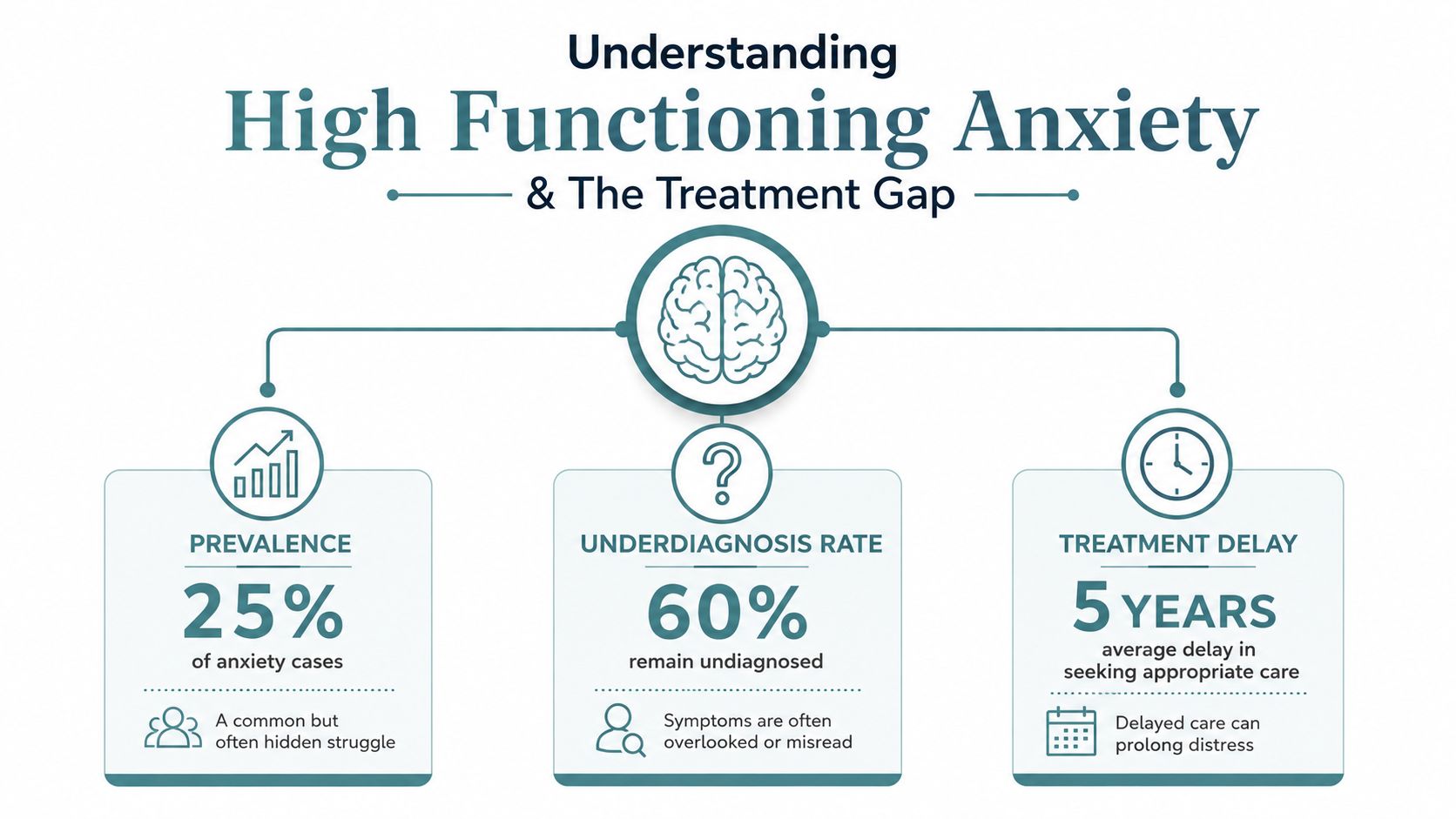
High-functioning anxiety isn't a formal psychiatric diagnosis, but the experience usually overlaps with recognized anxiety disorders. That matters because the people who appear most composed often still meet clinical thresholds for care, even if they don't label themselves as “anxious.” The mask of productivity can hide how much effort it takes to keep going.
How common anxiety disorders are
Global anxiety disorders affected an estimated 359 million people worldwide in 2021, about 4.4% of the global population (World Health Organization). In the same WHO fact sheet, only about 1 in 4 people with anxiety disorders receive any treatment, and a major 21-country World Mental Health Survey found that only 27.6% of people with a 12-month anxiety disorder received any treatment, while just 9.8% received possibly adequate treatment (WHO).
That gap helps explain why high-functioning anxiety is so often missed. If someone is still performing, they may never look like the person who needs help most urgently. In reality, they may be the person most likely to delay care until burnout forces the issue.
What functioning can conceal
In the United States, anxiety disorders remain common and often undertreated. The National Institute of Mental Health reports that 19.1% of U.S. adults had any anxiety disorder in the past year and 31.1% experienced one at some point in their lives, with past-year prevalence at 23.4% among women and 14.3% among men (NIMH). For generalized anxiety disorder, the Anxiety and Depression Association of America notes that about 6.8 million adults, or 3.1% of the U.S. population, are affected, yet only 43.2% are receiving treatment (ADAA).
Those numbers don't describe everyone with high-functioning anxiety, but they do show how common and undertreated anxiety can be in the exact settings where high achievers live and work. A person might still meet deadlines while carrying sleep disruption, irritability, emotional constriction, perfectionism, or reliance on coping behaviors that no one else sees. That is still impairment, even when it doesn't interrupt the workday in a visible way.
Evidence-Based Treatment Modalities for Anxiety
The strongest care starts with a clear match between symptoms and treatment. For adults whose anxiety looks like constant overthinking, perfectionism, and avoidance in disguise, Cognitive Behavioral Therapy, or CBT, has the best evidence base among psychotherapies. NICE recommends 12 to 15 weekly sessions at step 3 when symptoms cause marked functional impairment or haven't improved with low-intensity care, and the first-line medication is an SSRI, with an SNRI offered if the first SSRI doesn't work (NCBI Bookshelf summary of NICE guidance).
What psychotherapy actually changes
CBT helps people identify the thought loops that keep anxiety active, then practice more flexible responses. That usually includes noticing distorted predictions, reducing reassurance-seeking, and facing situations that have been avoided because they feel uncomfortable rather than unsafe. In a 2024 systematic review and network meta-analysis of 65 studies with 5,048 participants, CBT produced one of the largest symptom reductions versus treatment as usual for GAD, with SMD −0.74, 95% CI −1.09 to −0.38. It was also the only psychotherapy associated with long-term effectiveness after high-risk-of-bias studies were removed (JAMA Psychiatry).
Other approaches can fit depending on the person. DBT is useful when emotions spike quickly and the main challenge is regulation, not just worry. EMDR and Brainspotting are often used when anxiety is tightly linked to trauma. Motivational Interviewing can help when someone understands the problem intellectually but still feels stuck about changing habits.
Structured therapy works best when the goal isn't just to feel better in session. It has to change what happens on Monday morning, in the meeting, and at 11 p.m. when the mind won't shut off.
Where medication fits
Medication can lower the baseline level of arousal so therapy has room to work. SSRIs are typically first-line, SNRIs are a common alternative if the first medication isn't enough, and benzodiazepines are usually reserved for short-term crisis use only (NCBI Bookshelf summary of NICE guidance). The point isn't to sedate a person into passivity. It's to make anxious thinking less sticky so daily life stops feeling like a constant emergency.
Casa Recovery's evidence-based therapy page is one example of how outpatient care can combine psychotherapy, psychiatry, and skills work in one setting. That kind of coordination matters when someone needs treatment that's practical, not theoretical.
Choosing the Right Level of Care
Not every person with anxiety needs the same amount of structure. Someone with manageable symptoms and strong support may do well with weekly outpatient therapy, especially if the main goals are boundary-setting, sleep repair, and reducing overcommitment. Someone else may need more contact, more accountability, and a setting that interrupts the cycle of overfunctioning long enough for the nervous system to settle.
A simple way to think about levels of care
| Level of Care | Time Commitment | Best For |
|---|---|---|
| Self-directed support | A few daily habits and check-ins | Mild symptoms, good insight, stable routines |
| Standard outpatient therapy | One weekly session | People who can keep life steady while working on specific patterns |
| IOP | Multiple sessions per week | People who need structure but still have work or family responsibilities |
| PHP | Full-day clinical programming | People who need more support, close monitoring, and a stronger reset |
The difference between IOP and PHP is usually about intensity, not whether someone “counts” as sick enough. IOP gives repeated therapeutic contact while preserving more of the day for work or family life. PHP offers a fuller clinical container for people who are too depleted for standard weekly care but don't need residential treatment.
Step-down care can make treatment more sustainable
A person can start at a higher level of care and then step down as symptoms stabilize. That model helps when the problem isn't just insight, it's pattern interruption. If every weekday looks the same, structured treatment can create enough separation from routine to help the person notice what they've been ignoring.
Clinical shortcut: if your life is still technically functioning but you feel like you're holding it together with clenched teeth, a higher level of outpatient care may be appropriate before a crisis hits.
Some people also need a center that can coordinate psychiatry, psychotherapy, and family communication in one plan. Casa Recovery offers PHP, IOP, and integrated outpatient mental health care, so it can fit into a stepped approach when the goal is stabilization without losing the structure of everyday life.
Addressing Co-Occurring Substance Use in Anxiety Treatment
High-achieving adults sometimes use alcohol, cannabis, or medications to shut off the noise long enough to rest. That doesn't always look like obvious addiction, which is part of the problem. The pattern can stay hidden because the person still meets responsibilities while leaning on something to take the edge off.
Substances can create short-lived relief and longer-term confusion. They may lower tension for an evening, then make anxiety louder the next morning, which pushes the person back toward the same coping strategy. Anxiety-only treatment can miss that loop if the substance use isn't addressed at the same time.
That's why integrated care matters. In a dual-diagnosis setting, the therapist doesn't treat anxiety as if it lives in a separate box from drinking, misuse, or compulsive self-medication. Medication planning also has to account for interactions, side effects, and whether the person is trying to regulate anxiety with substances at the same time.
What integrated treatment looks like
- Concurrent psychotherapy: The therapist works on anxiety and substance use together, instead of waiting for one issue to disappear first.
- Medication management: A prescriber reviews what's being used, what's being avoided, and what combinations could complicate recovery.
- Group support: People hear their own pattern reflected back without being reduced to it.
The key idea is simple. If substances have become part of the anxiety cycle, the treatment plan needs to be broad enough to cover both. Casa Recovery's overview of the anxiety-substance link speaks directly to that overlap, especially for people who haven't yet had an obvious “wake-up call.”
What to Expect in a Structured Outpatient Program
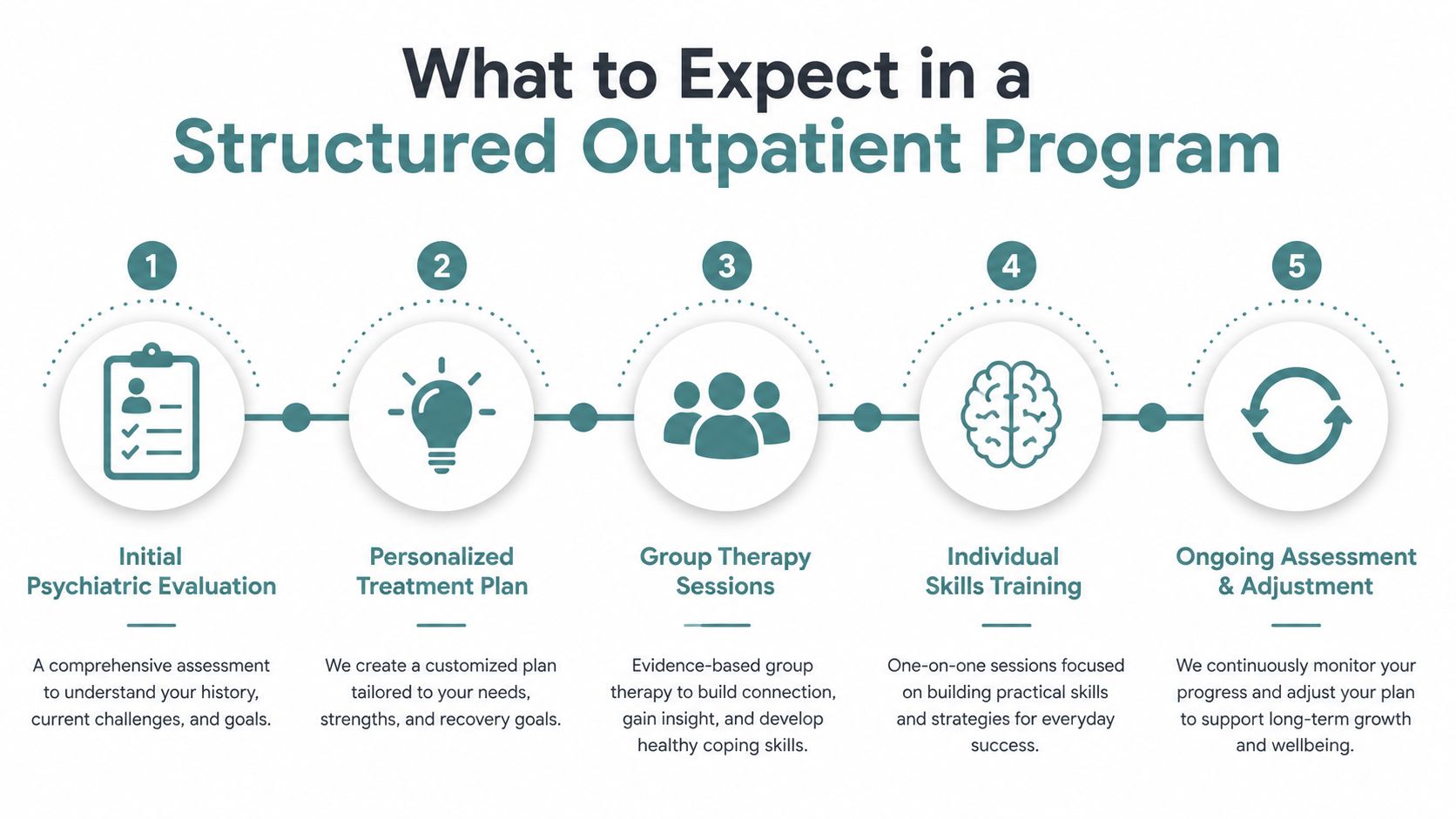
A structured outpatient setting usually feels more organized than standard therapy, but less restrictive than residential care. The first step is often a psychiatric evaluation, because the treatment team needs a sharper picture of symptoms, sleep, medication history, substance use, and functional stressors. From there, the plan is individualized rather than generic.
How the week is usually organized
- Initial evaluation. A clinician asks direct questions about worry, avoidance, sleep, work pressure, and any substances being used to cope.
- Personalized treatment plan. The team decides which therapies, medications, and goals fit the situation.
- Group therapy. Small groups give clients feedback, skills practice, and the relief of being understood by people with similar struggles.
- Individual skills training. Sessions focus on the specific habits that keep anxiety in place.
- Ongoing assessment. The team adjusts the plan as the person stabilizes or needs more support.
Family involvement can matter too. When loved ones understand what anxiety looks like in a high-functioning person, they stop confusing productivity with recovery. That can reduce pressure at home and make support more useful.
Structured outpatient programs also need to be practical. High-quality care should offer clear admissions guidance, insurance verification, and scheduling that respects work obligations when possible. For out-of-area clients, supportive living coordination can help make treatment feasible without forcing a full life interruption.
Taking the First Step Toward Treatment
Start with the simplest next action, not the biggest one. Call the program, ask about insurance verification, and request an admissions conversation so you can understand whether the setting fits your needs. If you're balancing work, family, or a move from higher care, ask directly how scheduling and step-down planning are handled.
Confidentiality concerns are common, and they're worth naming out loud. So is the fear that reaching out means you've failed. It doesn't. Seeking care while you're still functioning is often the move that protects your career, relationships, and health before the strain becomes a crisis.
If you're a referring clinician or care manager, ask about psychiatric coordination, dual-diagnosis capacity, and whether the program can support a step-down from residential treatment. If you're the one living this, you don't need to prove you're falling apart before you deserve support.
Casa Recovery provides outpatient mental health treatment in Orange County, including PHP, IOP, psychiatric evaluation, medication management, and integrated care for anxiety and co-occurring concerns. If you're looking for structured help that can fit before a crisis, visit Casa Recovery to explore whether their outpatient programs are a good next step for you.