You can look fine on the outside and still feel like your nervous system is bracing for impact every time a text goes unanswered, a partner gets quiet, or a calm moment suddenly feels unsafe. Many adults end up in therapy because they're tired of repeating the same pattern, trusting too quickly, shutting down too fast, or feeling panicked in relationships that should feel steady. Attachment trauma therapy helps make sense of that loop, then gives it a different path forward by working from safety, regulation, and repair.
Table of Contents
- Introduction to Attachment Trauma Therapy
- Understanding Attachment Trauma
- Recognizing Signs of Attachment Trauma
- Evidence Based Attachment Trauma Therapies
- Attachment Trauma Treatment Pathways at Casa Recovery
- Practical Next Steps and Local Resources
- Conclusion and Final Takeaways
Introduction to Attachment Trauma Therapy
A client might sit in the car after work, staring at a phone with no new messages, and feel a wave of dread that seems bigger than the moment. They may have tried standard therapy, read self-help books, and even learned a few communication skills, yet the same reactions keep coming back. The problem usually isn't a lack of insight. It's that early relationship wounds can train the body to treat closeness, disappointment, or silence like danger.
That's where attachment trauma therapy becomes different from generic talk therapy. The work starts by building a safe therapeutic alliance, then stabilizing emotional arousal before moving into beliefs, dissociation, and traumatic memory processing, a phased model described in reviews of attachment-trauma psychotherapy (source). For adults whose distress shows up as panic, numbness, shutdown, or unstable self-states, that sequencing matters because the nervous system has to feel safe enough to learn something new.
At a treatment center level, that often means matching the level of care to the presentation, not just the diagnosis. Some people need structured outpatient support, some need family work, and some need integrated care for trauma and substance use. Casa Recovery's approach fits that reality by using outpatient programming, trauma-informed modalities, and step-down support in Orange County.
Understanding Attachment Trauma
Attachment trauma isn't just a label for “bad relationships.” It describes what happens when the people you depended on for comfort, protection, and emotional steadiness were inconsistent, unavailable, frightening, or emotionally out of reach. The nervous system learns from repetition, so over time it can start treating closeness itself like a risk. That's why an adult can crave connection and still flinch from it.
How the nervous system learns danger
Think of early attachment wounds like a smoke alarm that became too sensitive. It doesn't wait for a real fire, it goes off when toast burns, when someone is late, or when a room gets quiet. In attachment trauma, the alarm may show up as hypervigilance, dissociation, shame, or a quick move into self-protection, even when the present moment is safe.
Reviews of attachment-trauma psychotherapy describe treatment as a sequenced clinical model. First comes the safe therapeutic relationship and autonomic regulation, then work on pathogenic beliefs and dissociative or detached self-states, then processing implicit and explicit traumatic memories (source). That sequence matters because a person can't process what happened if their body still believes it's happening now.
One underserved angle is how attachment trauma therapy should differ by presentation, especially when the main complaint is not relationship problems but depression, anxiety, dissociation, detachment, or unstable self-state shifts (source). That's why the same wound can look very different from person to person.
Practical rule: if closeness, reassurance, or conflict reliably changes how you think, feel, or function, the attachment system is probably involved.
Why the presentation can look unrelated to relationships
Many adults don't describe “attachment problems” at all. They describe panic attacks, numbness, shutdown after conflict, foggy memory, or feeling like a different version of themselves in different settings. That's not a contradiction. It's one reason attachment trauma therapy has to be individualized instead of scripted.
The newer literature also frames attachment trauma as a cascading process, not a single isolated event (source). That helps explain why a person may appear functional at work, then unravel in intimate relationships or after a small rupture with a trusted person. The task is not to force one story onto every symptom. The task is to track how the body learned to protect itself.
For a broader look at how early experiences shape adult functioning, see this overview of childhood trauma and adulthood.
Recognizing Signs of Attachment Trauma
People often expect attachment trauma to look dramatic. In real life, it's more likely to show up as a pattern that feels exhausting and confusing. You may trust too fast, then panic when things get close. Or you may stay composed on the outside while feeling a sudden inner collapse the moment someone expects emotional closeness.
Core signs to watch for
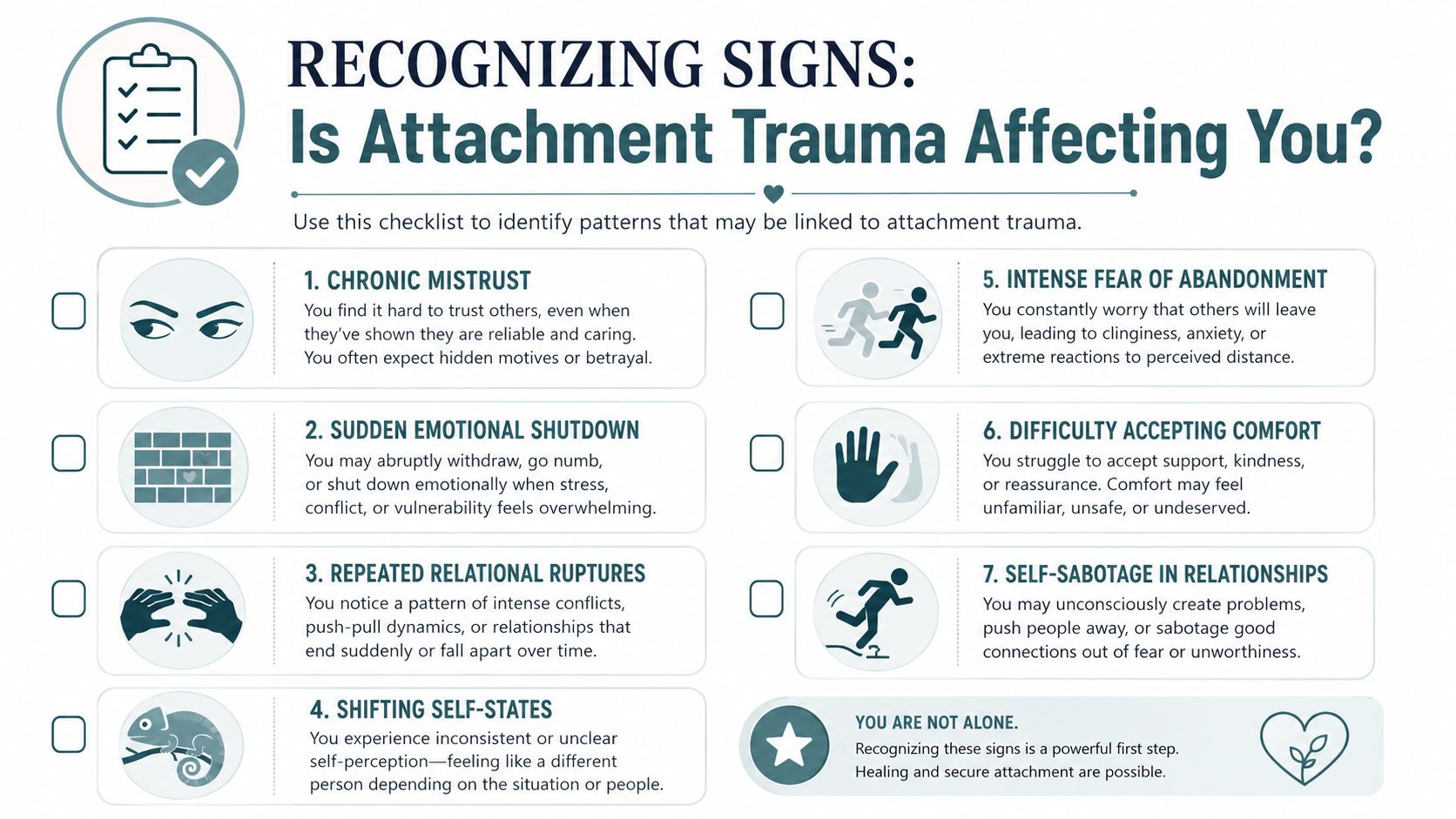
The most common clinical patterns include chronic mistrust, sudden emotional shutdown, repeated relational ruptures, and shifting self-states. A person might seem open with one therapist and guarded with another, warm in one friendship and detached in another, or certain of themselves one day and unsure the next. That inconsistency doesn't mean they're being difficult. It often means their system is switching strategies to stay safe.
A few red-flag behaviors can make the pattern clearer:
- Intense fear of abandonment. Small delays or changes feel like rejection.
- Difficulty accepting comfort. Support lands as awkward, suspicious, or overwhelming.
- Self-sabotage in relationships. Things go well, then a part of you pushes people away.
- Emotional flooding in safe settings. A calm conversation still triggers tears, panic, or rage.
- Persistent numbness. You know something is wrong, but you can't feel much at all.
- Repeated relational ruptures. Friendships, dating, or family contact keep ending in the same way.
- Shifting self-states. You feel like a different person depending on who you're with.
How assessment usually starts
Clinicians typically begin with an intake interview, trauma history review, and attention to symptom patterns over time. They listen for what happens in relationships, what happens in the body, and what happens when the person feels seen, corrected, or left alone. Because attachment trauma often involves both explicit memories and more implicit reactions, the assessment has to include more than a checklist of events.
If you're wondering when to ask for help, self-report is enough. If you keep noticing panic, shutdown, detachment, or repeated relationship collapse, that's reason to seek an evaluation. If family members, a partner, or a referral source are raising concerns about your functioning, that's enough too. You don't need to wait until everything falls apart.
Evidence Based Attachment Trauma Therapies
Attachment trauma treatment works best when the method matches the nervous system state. That sounds technical, but the idea is simple. A person who is shut down needs a different starting point than someone who is flooded with panic. A person who distrusts every helper needs more than a worksheet. They need a relationship that can hold repair when something goes wrong.
What each modality tends to target
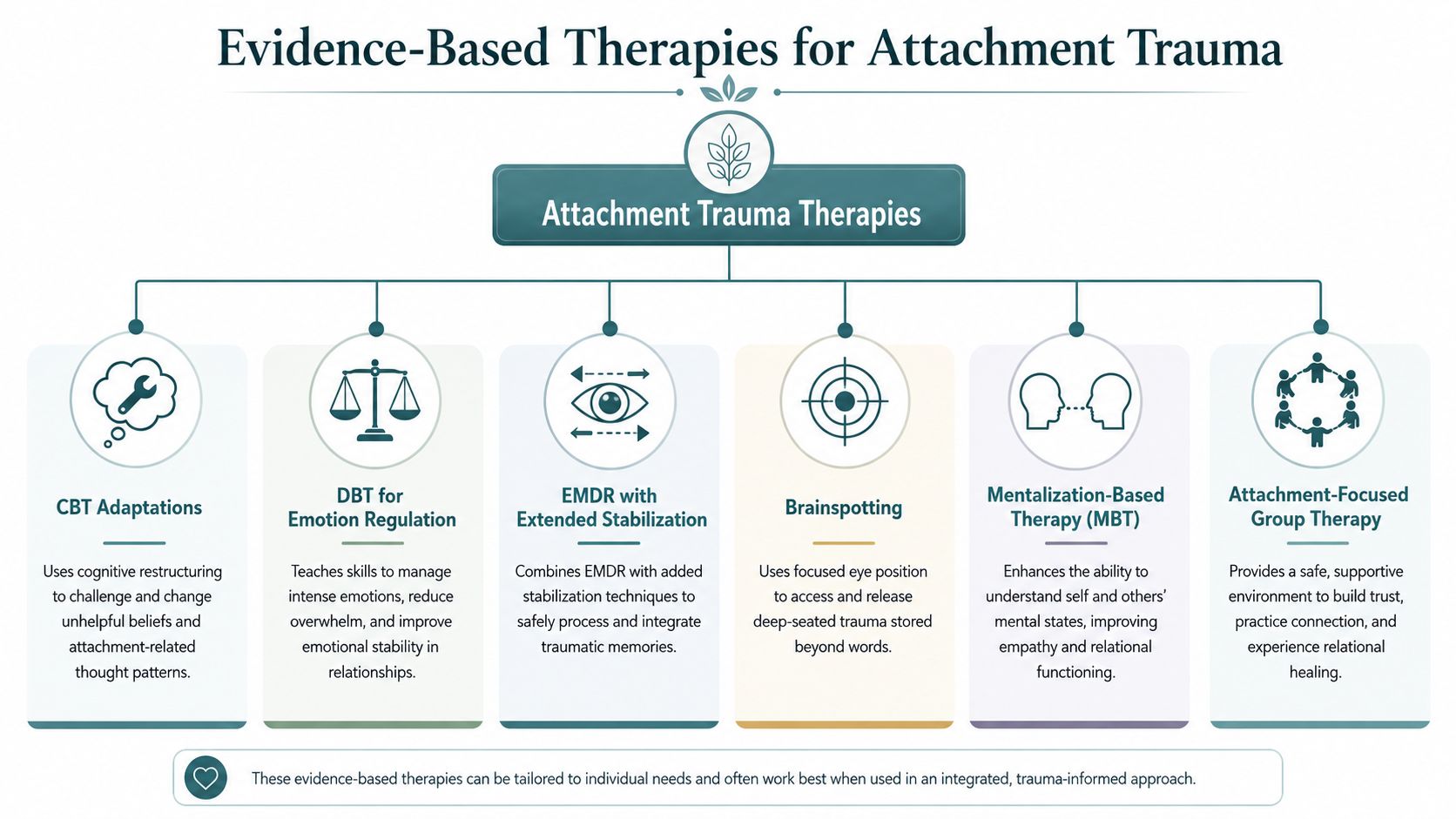
In practice, CBT adaptations can help challenge the self-blaming and threat-based beliefs that formed around early attachment wounds. DBT gives people a structure for emotion regulation, distress tolerance, and staying present when feelings spike. EMDR with extended stabilization can support trauma memory work once the person has enough grounding and trust to proceed. Brainspotting may be used to access deeper trauma material through focused attention and body-based awareness. Mentalization-Based Therapy helps a person understand their own mind and someone else's mind without jumping straight to assumptions. Attachment-focused group therapy offers relational practice in a safer, coached environment.
The 2025 review of trauma therapy emphasizes four relational domains, attachment, mentalizing, trust, and care, as core factors in healing, which means technique alone isn't the mechanism of change (source). That matters because a strong intervention can still miss the mark if the relationship feels unsafe or repairs don't happen after a rupture.
Healing tends to stall when a therapist pushes memory work before the client has enough regulation and trust to stay present.
Why sequencing matters more than brand-name modalities
The phased model described in attachment-trauma psychotherapy starts with safety and arousal stabilization, then addresses beliefs and dissociated self-states, then moves into memory processing (source). That sequence helps explain why two people can both “do EMDR” and have very different outcomes. One may need a longer preparation period. Another may need more relational repair, more grounding, or more work around shame and mistrust first.
Recent literature also notes the extension of EMDR preparation for attachment trauma, which signals a wider recognition that standard trauma protocols sometimes need extra stabilization and relationship work before processing begins (source). For many adults, the effective treatment isn't one method in isolation. It's the combination of sequencing, relationship quality, and the right clinical targets.
Attachment Trauma Treatment Pathways at Casa Recovery
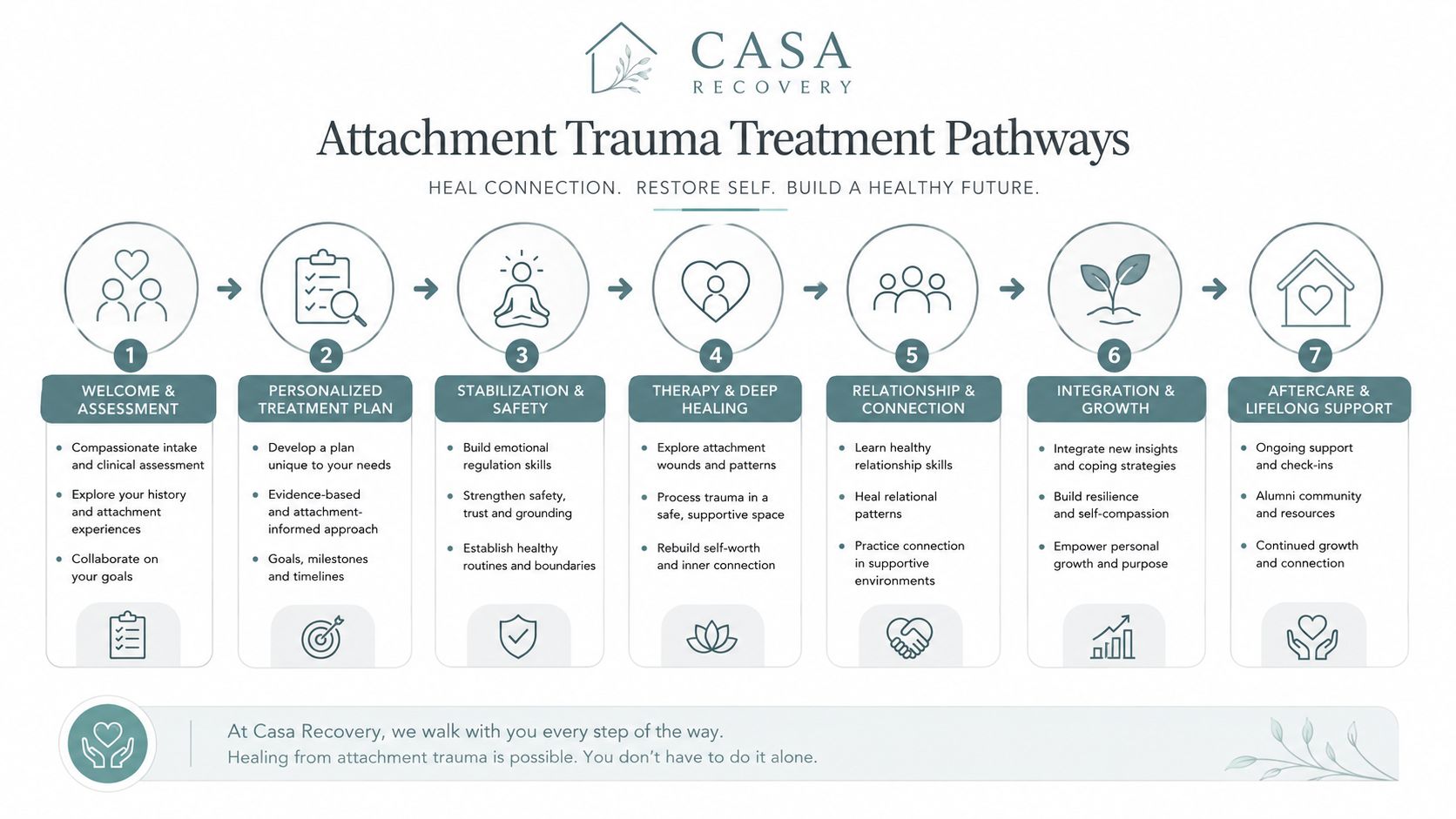
A person entering outpatient care for attachment trauma might not arrive saying, “I need help with attachment.” They may say, “I keep shutting down,” “I can't handle conflict,” or “I'm using substances when I feel overwhelmed.” In a structured setting, those symptoms get treated as signals, not failures. Casa Recovery's outpatient model includes PHP, IOP, on-site psychiatry, family work, and trauma-informed therapies such as CBT, DBT, EMDR, and Brainspotting, all organized around individualized planning and integrated dual-diagnosis care.
How step-down care can look in real life
A client might start with a full assessment, then enter PHP for daily structure when panic, dissociation, or substance use make ordinary outpatient therapy too thin. From there, they may step down into IOP once the nervous system is steadier and the person can use skills between sessions. If substance use is part of the picture, integrated dual-diagnosis care allows trauma and addiction work to happen together instead of in separate silos.
That approach fits the reality that attachment trauma often comes with fragmented treatment histories. A person may have seen one therapist for anxiety, another for addiction, and a third for family conflict. Integrated care reduces that split. It gives the treatment team one coordinated map instead of three disconnected ones.
For more about the center's evidence-based approach, see Casa Recovery's trauma treatment overview.
Why relationship quality still matters inside the program
A recent review highlights four relational domains, attachment, mentalizing, trust, and care, as core factors in trauma therapy (source). That means the program structure matters, but so does the way therapists handle rupture, pacing, and emotional honesty. If a client's attachment system expects dismissal or inconsistency, treatment has to counter that pattern repeatedly.
Casa Recovery's model is relevant here because it pairs structured outpatient levels of care with ongoing therapy and psychiatric support. The point isn't to overwhelm someone with intensity. The point is to match support to the level of instability, then reduce support gradually as the person becomes more regulated and more able to stay connected.
Practical Next Steps and Local Resources
If you're trying to figure out whether this kind of care fits, start with three questions in an intake call. Ask what the program does when a client dissociates, how it treats trauma and substance use together, and how family or support people can be involved when relationships are part of the problem. Those answers tell you a lot about whether the setting understands attachment trauma or just uses the phrase.
Before an assessment, write down the patterns you've noticed. Include panic, numbness, shutdown, sleep changes, substance use, self-sabotage, or repeated breakups, and note when they happen. If possible, bring a brief trauma history and the names of any medications or prior therapies. That gives the clinician a cleaner starting point.
If you're checking coverage, verify the exact plan type and ask whether the clinic works with your insurer before scheduling. Casa Recovery notes accepted PPO plans from all carriers, plus Blue Shield of California/Blue Card, ComPsych, and Holman Group in network, so asking about those specifically can save time. If you're outside the area, ask about tours, supportive living coordination, and step-down options before you make travel plans.
For urgent help, use local emergency services or a crisis hotline right away if you're in immediate danger or can't stay safe. For non-urgent referrals in Orange County, ask your primary care clinician, therapist, or a hospital discharge planner for trauma-informed outpatient options that can handle dissociation or dual diagnosis. A family member can also help by sharing observations from the outside, especially if you tend to minimize symptoms.
Conclusion and Final Takeaways
Attachment trauma often hides inside symptoms people don't immediately connect to relationships. Panic, numbness, dissociation, unstable self-states, and repeated relational rupture can all be part of the same pattern. The most effective care usually doesn't start with deep memory work. It starts with safety, regulation, and a relationship that can survive repair.
That's why sequencing matters so much in attachment trauma therapy. The body has to learn that connection can be steady before it can revisit what made connection feel dangerous. Modalities like CBT, DBT, EMDR, Brainspotting, mentalization-based work, and group therapy can all help, but they work best when the treatment plan matches the presentation and the therapeutic relationship stays central.
If you've been wondering why you still react so strongly even after trying other therapies, that doesn't mean you're broken. It usually means the treatment path hasn't matched the wound yet. The right support can help you rebuild trust, regulation, and connection in a way that finally feels sustainable.
Casa Recovery offers outpatient trauma treatment, PHP, IOP, and integrated dual-diagnosis care for adults who need a structured, relationship-centered approach to healing. If your symptoms show up as dissociation, panic, shutdown, or repeated relational collapse, Casa Recovery can help you explore whether a trauma-informed plan fits your needs.