You may be sitting at a kitchen table with a treatment brochure open, trying to figure out whether your life has to stop for help to start. Maybe work can't pause, maybe kids still need rides, maybe you're worried a full residential stay is too much, or maybe you're helping someone who needs care but also needs to keep living at home. Substance abuse outpatient programs are built for that reality, they give people structured clinical treatment without requiring 24-hour supervision, and they've become the main front door to addiction care in the United States.
That matters because outpatient care isn't a side option anymore. SAMHSA's 2020 treatment-services survey found that 82% of facilities offered some form of outpatient treatment, 76% offered standard outpatient care, 45% offered intensive outpatient treatment, and 14% offered outpatient day treatment or partial hospitalization. In other words, most adults looking for help will eventually encounter an outpatient level of care, whether they start there or step down into it later (SAMHSA data summary).
Table of Contents
- What Substance Abuse Outpatient Programs Actually Are
- PHP, IOP, and Standard Outpatient Explained
- Therapy Modalities Used in Outpatient Programs
- Why Dual Diagnosis Integration Changes Everything
- A Typical Week in PHP or IOP
- How to Choose a Quality Outpatient Program
- Outpatient Programs in Orange County and Casa Recovery
- Insurance, Admissions, and Your First Week
What Substance Abuse Outpatient Programs Actually Are
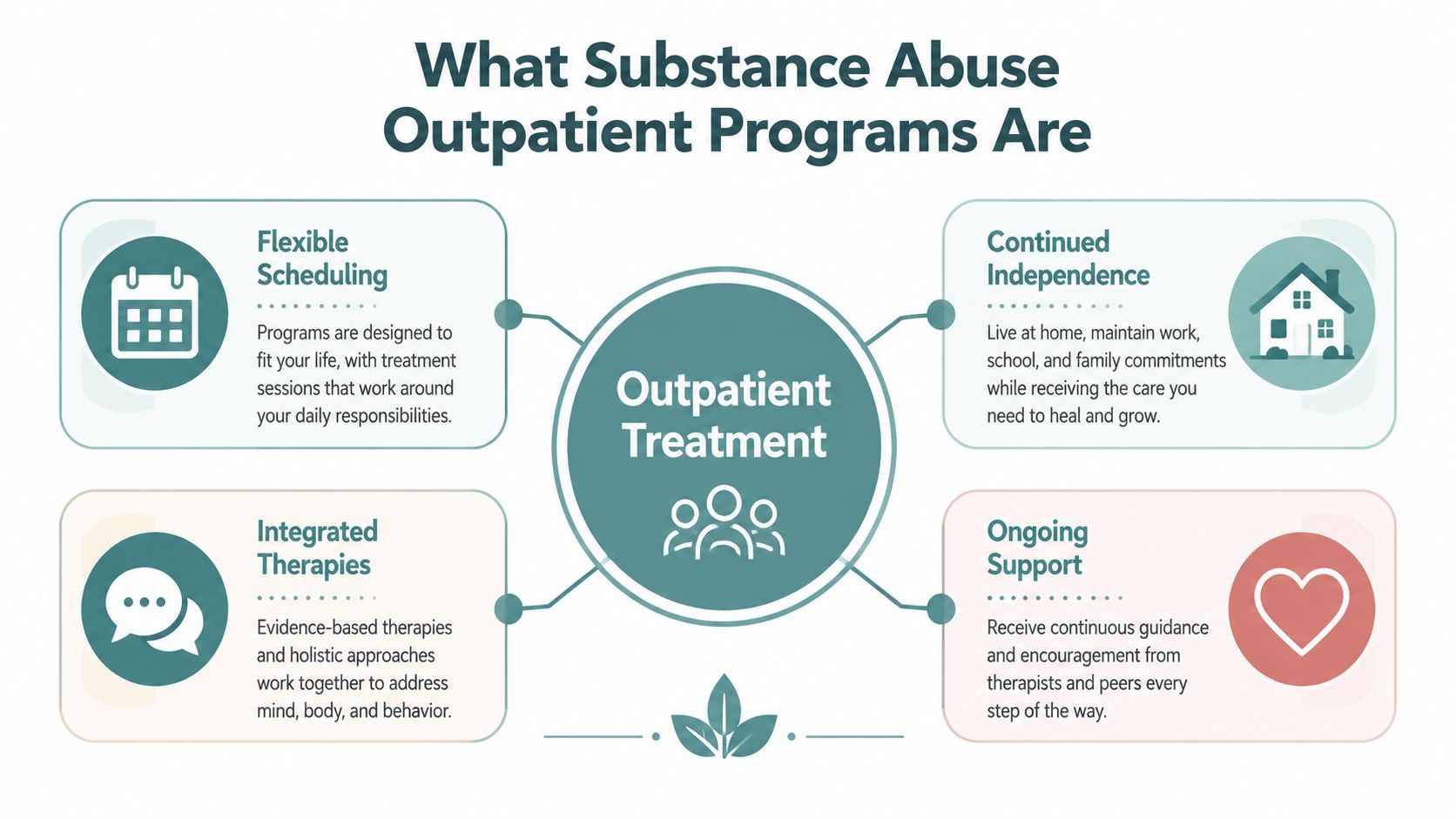
A person often starts here with a simple question, “Do I really need to live somewhere else for treatment?” The answer depends on safety, withdrawal risk, and how much structure someone needs. Outpatient programs are for adults who can live at home, in supportive housing, or with family while attending scheduled therapy, medical check-ins, and recovery support during the day or evening.
How outpatient care differs from residential treatment
Residential treatment asks a person to sleep on site and remain in a controlled environment. Outpatient care keeps the person in their usual environment, which is why it fits people who need help but not around-the-clock supervision. That difference sounds small until you think about daily life, because the outpatient model lets someone practice coping skills in the same setting where triggers, routines, and responsibilities live.
This is one reason outpatient programs have such a large footprint. The national survey data above show that outpatient care is the dominant model, not a niche one. For adults who still need to go to work, care for children, or keep a home running, outpatient treatment is often the first realistic way to enter care without stepping out of life entirely.
What the word program really means
“Program” should imply structure, not just a weekly check-in. A real outpatient program includes a planned schedule, clinical staffing, therapy, and a treatment goal that changes over time. It can involve group work, individual counseling, family sessions, medication support, and relapse-prevention planning.
Practical rule: if a place only offers a therapist appointment once a week, that may be outpatient therapy, but it isn't necessarily a full substance use outpatient program.
The strongest programs are built to help people move between levels of intensity rather than forcing an all-or-nothing choice. That stepwise design matters because recovery often begins with more support and then narrows as stability improves. When people understand that distinction early, they're less likely to compare outpatient care with residential care as if they were interchangeable.
PHP, IOP, and Standard Outpatient Explained
The cleanest way to understand outpatient treatment is by weekly hours. The ASAM framework sets the basic thresholds, with Level 1.0 regular outpatient defined as fewer than 9 hours per week, Level 2.1 intensive outpatient treatment at 9 or more hours per week, and Level 2.5 partial hospitalization at 20 or more hours per week for people with multidimensional instability who still don't need 24-hour care (GAO ASAM summary).
Reading the hours as clinical intensity
Those hours are not just scheduling details. They tell you how much therapeutic contact the person gets and how much structure the week contains. A person in standard outpatient care may need maintenance support, a person in IOP usually needs a stronger weekly dose of therapy, and a person in PHP often needs near-daytime-level stabilization while still sleeping at home.
The weekly dose of care matters because it lets clinicians match severity to structure. A person who is newly sober after a residential stay may need a more supported step-down, while someone with a stable home life and lower symptom burden may do well with less frequent sessions. That's why the same label, “outpatient,” can describe very different treatment experiences.
| Level | Weekly Hours | Typical Structure | Best Fit |
|---|---|---|---|
| Level 1.0 | Fewer than 9 | Weekly or a few weekly sessions, lighter structure | People with lower acuity who still need ongoing support |
| Level 2.1 IOP | 9 or more | Several sessions per week, often group plus individual therapy | People who need more than weekly counseling, but not 24-hour care |
| Level 2.5 PHP | 20 or more | Full-day or near-full-day programming with high structure | People with greater instability who still can live at home |
PHP versus IOP in everyday terms
PHP is usually the more intensive option. It's for people who need a lot of contact, close monitoring, and frequent therapeutic work, often while medication and mental health symptoms are being actively adjusted. IOP is less time-heavy, but still serious treatment, and it often works well for people who can manage evenings, work schedules, or family responsibilities around care.
If you want a practical comparison, this IOP versus PHP guide can help you think through the difference in schedule and structure. The key question is not which level sounds better on paper, it's which level matches the stability of the person's life right now.
Therapy Modalities Used in Outpatient Programs
People often hear therapy acronyms before they hear an actual treatment plan. That can make outpatient programs sound more complicated than they are. In practice, the modalities are tools, and each one is aimed at a different pattern of thinking, feeling, or reacting.
What CBT, DBT, and motivational interviewing do
Cognitive Behavioral Therapy, or CBT, helps people notice the loop between a thought, a feeling, and a behavior. In substance use care, that often means catching the thought that says, “I already blew it, so I might as well use again,” and replacing it with a more useful response.
Dialectical Behavior Therapy, or DBT, focuses on distress tolerance, emotion regulation, and staying steady when feelings spike. It tends to fit people who feel overwhelmed fast, get pulled into impulsive behavior, or swing between intense emotion and shutdown. Motivational interviewing is different. It isn't about pushing someone into change, it helps a person hear their own reasons for change and work through ambivalence.
Trauma-focused and body-based approaches
EMDR is often used when past trauma keeps showing up in the present, especially when memories, body reactions, or triggers remain sticky. Brainspotting is also used in trauma-informed outpatient care, and it aims to help people access and process experiences that may not come out easily in ordinary conversation. These approaches make the most sense when substance use and trauma have become tangled together.
Art therapy can fit people who struggle to put emotion into words. It won't replace direct addiction work, but it can help a person express grief, anger, shame, or fear in a less verbal way. In a strong outpatient program, these modalities don't sit on a menu as marketing terms, they appear inside a treatment plan that connects them to the person's actual symptoms.
Clinical filter: the question isn't whether a program lists many therapy names, it's whether staff can explain why a given method fits your pattern of relapse, anxiety, trauma, or mood instability.
That's the level of specificity families should expect. If a program can only say “we do evidence-based care” without explaining how the sessions work, keep asking.
Why Dual Diagnosis Integration Changes Everything
A lot of adults enter outpatient care with more than substance use. Depression, anxiety, trauma symptoms, sleep disruption, panic, and mood instability often travel with it. That is why dual-diagnosis care matters so much in outpatient treatment. If substance use is treated in one lane and mental health in another, the core problem can stay in place.
What integration looks like in real life
Integrated care means the same program addresses substance use and mental health together. A person might meet with a therapist about cravings, then with a prescriber about medication, then bring sleep problems, shame, or panic into group as part of recovery work. The goal is continuity, so the treatment team sees the full picture instead of splitting it into separate pieces.
A clinical review in PMC review and a SAMHSA data summary show that outpatient programs increasingly build co-occurring care into their structure. The larger point is straightforward, co-occurring treatment is common in outpatient settings, so a program should be prepared to address it rather than treat it as an exception.
Why separate treatment often breaks down
When one provider treats substance use and another treats depression or trauma without coordination, patients can get mixed messages. One clinician may focus on relapse risk, while another addresses mood symptoms without the full substance use context. The person in the middle then has to translate between systems while already trying to stay stable.
That is where onsite psychiatry and medication management change the day-to-day experience. A program that can review symptoms, adjust medication when appropriate, and coordinate therapy around both conditions gives people a steadier path through care. The dual-diagnosis overview shows how integrated treatment works in practice, especially when substance use and mental health symptoms keep feeding each other.
A Typical Week in PHP or IOP
A common source of anxiety is not knowing what the calendar looks like. People hear “structured treatment” and immediately wonder if they'll be sitting in a room all day or if they can still pick up their kids. The answer depends on whether they're in PHP or IOP, but both are designed to be predictable enough that life can continue around them.
What the schedule usually contains
In PHP, the week often feels like a full clinical workday. A person may attend multiple therapy blocks, skills groups, psychoeducation, and psychiatric check-ins, with family involvement folded in when needed. In IOP, the rhythm is lighter but still organized, with several sessions each week, usually centered on group therapy, individual work, and recovery skills.
The important thing is that outpatient care isn't just “show up and talk.” It usually includes:
- Group therapy, where people hear patterns in others that mirror their own.
- Individual sessions, where the therapist can focus on the person's history and goals.
- Psychiatric check-ins, when medication or symptom review is needed.
- Family contact, if the program includes loved ones in the plan.
- Skills training, where coping tools are practiced, not just discussed.
How people keep life moving
Someone in IOP may still work part-time, attend school, or manage caregiving because sessions are scheduled around the rest of the day. Someone in PHP may need more flexibility, but the goal is still the same, to preserve real-life functioning while stabilizing substance use and mental health. That's why step-down care exists, because many people don't jump from higher support straight to independence.
A helpful way to think about it is this, PHP helps a person stabilize, IOP helps them consolidate gains, and standard outpatient care helps maintain momentum. The schedule changes, but the recovery logic stays the same. If you want a concrete example of how the week can be organized, the sample weekly schedule gives a clearer sense of how treatment time fits into daily life.
How to Choose a Quality Outpatient Program
Picking a program is less about polished branding and more about asking hard, practical questions. Two outpatient programs can use the same terms, but one may offer coordinated, trauma-informed care while the other gives you a generic weekly group and a list of referrals. The difference shows up in outcomes, not in brochures.
The first questions to ask
Start with licensing and staffing. Ask whether the program is licensed, who provides therapy, whether psychiatry is available, and how much direct contact clients get with clinicians. If the answer is vague, that usually tells you something important.
Then ask about the treatment model. A quality program should be able to explain how it handles co-occurring disorders, whether trauma-informed care is part of the core approach, and which modalities are available rather than just listed on the website. Families should also ask how the program includes loved ones, because recovery at home works better when communication is intentional.
Red flags that show up fast
A one-size-fits-all treatment plan is a warning sign. So is a program that avoids direct answers about staff-to-client ratio, aftercare planning, or insurance. If every question gets routed through a sales team and no one can explain how the actual week is structured, keep looking.
Simple test: ask, “What would the first two weeks look like for someone with depression, alcohol use, and trauma symptoms?” A strong program can answer that without sounding scripted.
Insurance and fees deserve the same level of clarity. If a program can't explain coverage, authorizations, or what happens if something changes mid-treatment, that's not a small problem. It's part of whether the care is accessible enough to continue.
Outpatient Programs in Orange County and Casa Recovery
Orange County families often compare programs across San Juan Capistrano, South County, and the broader Los Angeles or San Diego areas. In that search, the question isn't just geography, it's whether the program can handle severity, dual diagnosis, and family involvement without making people patch the rest together on their own.
What to look for locally
For adults in this region, the best outpatient fit usually has three things. First, a clear PHP or IOP structure. Second, integrated psychiatric and therapy services for co-occurring symptoms. Third, a plan for families and step-down support so recovery doesn't end when the last group ends.
That's where program design matters more than size. A smaller program can sometimes give tighter clinical attention than a larger one, especially when therapists, psychiatry, and group work are coordinated instead of siloed. For out-of-state clients, the practical question is whether the program can also support housing coordination and smooth transitions, not just admit them.
One local example
Casa Recovery in San Juan Capistrano offers outpatient PHP and IOP, integrated dual-diagnosis care, onsite psychiatry, trauma-informed modalities such as EMDR and Brainspotting, family programming, and support for local and out-of-state clients. It's one option among several in the area, but it reflects the kind of coordination many families are searching for when they want substance use and mental health treated together.
If you're comparing Orange County programs, use the same checklist for every call. Ask whether they can explain the level of care, the therapies, the psychiatric support, and the family role in plain language. The right answer should sound specific, not polished.
Insurance, Admissions, and Your First Week
A family calls after finally deciding outpatient care is the right next move. The person on the phone is tired, worried, and probably not thinking clearly about benefits, forms, or schedules. A good admissions team lowers that stress by making each step plain, so the process feels organized instead of uncertain.
What happens before day one
Insurance verification usually comes first. Ask whether the program is in-network with your plan, whether it accepts PPO coverage, and what it needs to confirm benefits. If prior authorization is required, or if you are considering out-of-network care, get clear answers before the first appointment is set.
Then ask what to bring. Most programs ask for identification, insurance information, medication lists, and any recent discharge paperwork. If family involvement is part of the plan, staff may also ask for contact information or invite a relative into an early planning conversation.
Small details matter here. A missing medication list can slow intake, and unclear insurance information can delay the first session. The admissions process should reduce those obstacles, not add to them.
What the first week usually feels like
The first few days usually focus on assessment, orientation, and getting used to the schedule. Staff review symptoms, recovery history, safety concerns, and treatment goals, then place the person into the right group or track. That early work matters because therapy, psychiatry, and family support should all point toward the same clinical target.
For many families, the first week feels a little like learning the rules of a new care setting. There is paperwork, yes, but there is also a clinical reason for it. The team is trying to understand whether the person needs more structure, where psychiatric symptoms fit into the picture, and how much family support should be built in from the start.
Casa Recovery states that it accepts PPO coverage from all carriers and is in network with Blue Shield of California, ComPsych, and Holman Group. If you are comparing programs in Orange County, use those same questions everywhere you call. Ask how quickly admissions move, how family is included, and what the first week will require from the person entering care.
If you are weighing outpatient care for yourself or someone you love, start with direct questions instead of waiting for the right moment. Casa Recovery offers PHP, IOP, dual-diagnosis care, and family-centered outpatient support in Orange County, and you can review the details at Casa Recovery before making a call.