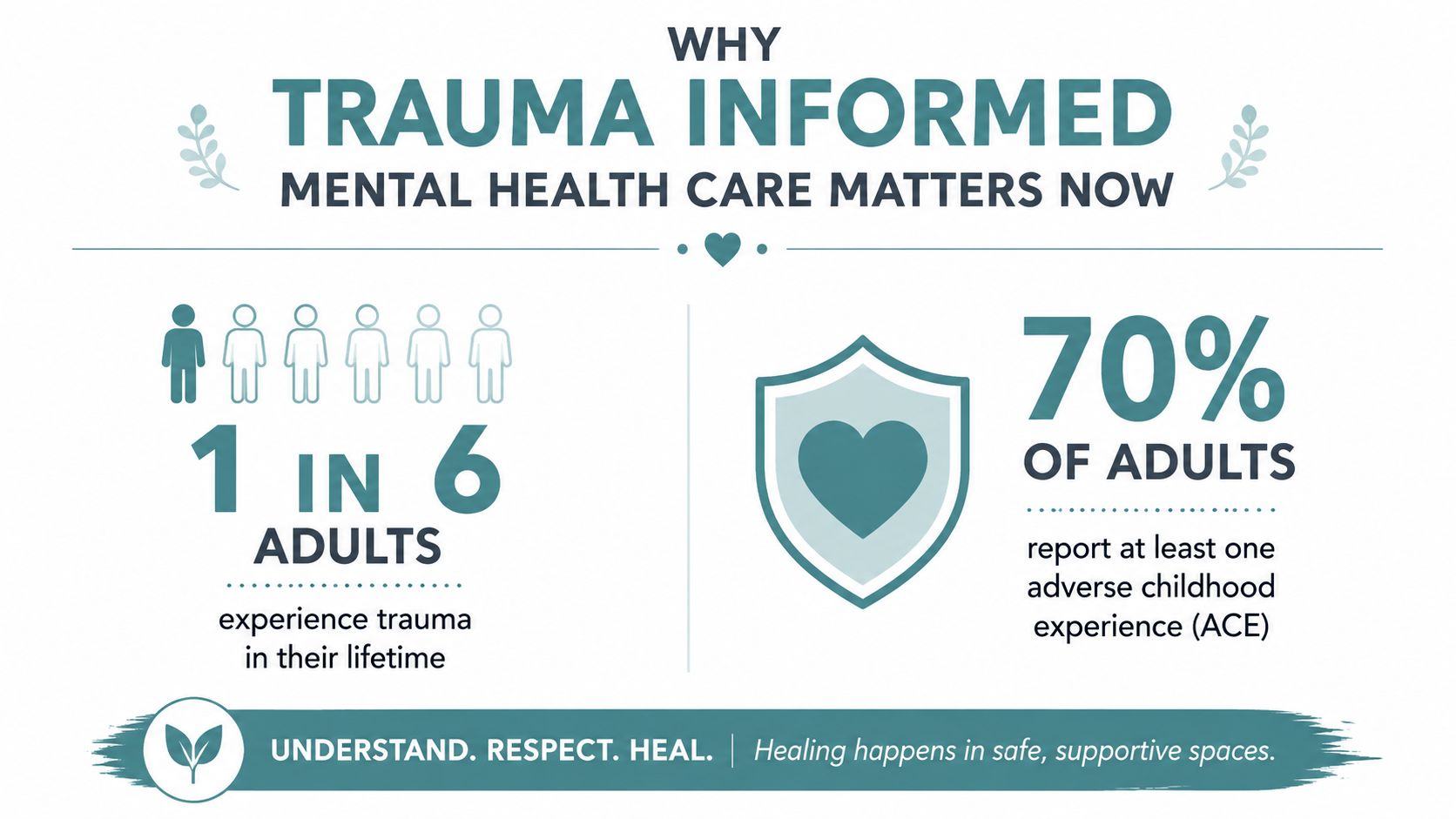
Trauma exposure is common enough to change how mental health care should be delivered. In one major U.S. study cited by NCBI, 61% of men and 51% of women reported at least one lifetime trauma, and another national sample found nearly 90% of U.S. adults had experienced traumatic events when assessed with a highly structured survey. Globally, the World Health Organization reported 70.4% lifetime trauma exposure across 24 countries, with an average of 3.2 traumas per person NCBI review.
That scale matters because trauma informed mental health care is not a niche specialty for a small group of patients. It's a framework for delivering care that assumes trauma may be part of the clinical picture, even when someone comes in for depression, anxiety, substance use, relationship stress, or mood instability. When a program understands that reality, it can make treatment feel safer, clearer, and less likely to repeat the kinds of experiences that push people away from care.
Table of Contents
- Why Trauma Informed Mental Health Care Matters Now
- The Core Principles That Define Trauma Informed Care
- What the Evidence Actually Shows About Outcomes
- How Trauma Informed Care Works in PHP and IOP Settings
- Evidence-Based Trauma Therapies and Psychiatric Integration
- What to Look for When Choosing a Trauma Informed Provider
- Trauma Informed Care in Practice at Casa Recovery
Why Trauma Informed Mental Health Care Matters Now
The reason this model matters is simple. Trauma isn't rare, and it isn't neatly separated from the reasons people seek treatment. In the NCBI review, PTSD prevalence in U.S. adults is estimated at about 8%, but high-risk groups can show much higher rates, and among people with PTSD, 88% of men and 79% of women have at least one other behavioral health diagnosis NCBI review.
Trauma informed care is a framework, not a single therapy
That distinction gets lost in a lot of marketing. Trauma informed mental health care doesn't mean one specific technique, one trauma group, or one branded protocol. It means the whole setting is designed to recognize trauma's impact and reduce the chances that care itself becomes overwhelming, confusing, or shaming.
A trauma-informed program pays attention to how intake is done, how questions are asked, how crises are handled, how information is shared, and how much choice the patient has. In practice, that can change whether a client feels ambushed by assessment or feels guided through it with enough predictability to stay engaged.
Practical rule: If a program treats trauma as an add-on topic instead of a design principle, it usually isn't trauma informed in any meaningful way.
That matters for outpatient programs too. Adults entering PHP, IOP, psychiatric care, or dual-diagnosis treatment often bring layered histories, and those histories can affect attendance, trust, medication adherence, group participation, and willingness to speak openly. A trauma-informed setting doesn't assume avoidance is resistance, it asks what happened and what conditions help the person stay in treatment.
The Core Principles That Define Trauma Informed Care
The widely used principles are straightforward, but the details matter. A program can say it values safety and still run group sessions that feel chaotic. It can say it supports people having agency and still make every decision feel one-sided. The true test is whether the daily experience matches the language.
What each principle looks like in real care
Safety is not only about locked doors or secure buildings. It also means emotional safety, which shows up when clinicians explain what they're about to ask, avoid shaming language, and respond calmly when a client becomes overwhelmed. People often misunderstand this as “being soft.” It's about reducing unnecessary threat so the brain can stay engaged in treatment.
Trustworthiness and transparency means people get clear explanations about rules, goals, limits, and next steps. When a therapist explains why a question matters, or a psychiatrist walks through how medication decisions are made, the client is more likely to stay involved instead of feeling controlled.
Peer support brings lived experience into the treatment culture. That can lower isolation and make recovery feel less abstract, because clients see that other people have worked through similar pain without being defined by it.
Collaboration and mutuality changes the power dynamic. Instead of “we know, you comply,” the stance becomes “we work this out together.” That's especially important when a person has a history of being ignored, coerced, or dismissed.
Voice, choice, and agency appear in small but meaningful ways, like offering options in how to participate, what to focus on first, or who should be included in communication. Choice is not the absence of structure, it's structure with room for consent.
Cultural, historical, and gender responsiveness is the piece that keeps trauma care honest. A provider should not assume the same meaning of privacy, eye contact, family involvement, or authority for every patient. For more on how this gets applied in clinical settings, see Casa Recovery's clinical best practices.
How to read a program description
If a provider uses the right terms, look for evidence that the terms shape behavior. A strong description will mention staff training, coordinated communication, flexible pacing, and respectful intake practices. A weak one usually stays vague and leans on comforting phrases instead of describing what clients experience.
A trauma-informed environment should feel predictable without feeling rigid. That's the balance many patients notice first.
What the Evidence Actually Shows About Outcomes
The hardest question is the most important one. Does trauma-informed care improve symptoms, or does it mainly improve the way care is delivered? The honest answer is that the evidence is still mixed.
A 2021 systematic review of 33 studies found inconsistent evidence that trauma-informed interventions improve psychological outcomes such as PTSD, depression, and anxiety PLOS ONE review. That doesn't mean the model has no value. It means many programs speak as if the clinical payoff is settled when the research is still uneven.
Why the evidence gap matters for families and patients
People comparing PHP or IOP programs often hear broad promises. They may be told a place is trauma informed, but not told which parts of care are measured. That's a problem, because a philosophy can sound good even when the evidence for symptom change depends on the specific therapy, the therapist's skill, and the patient's presentation.
The review also points to a deeper issue, the field still lacks clear comparative data on which organizational elements matter most. In plain language, we know trauma-informed design is widely valued, but we don't yet have a clean formula that says exactly which combination of policies, training, or group structure produces the best outcome for every person.
How to interpret provider claims
A careful reader should separate framework claims from treatment claims. A framework claim sounds like, “We train staff to recognize trauma, reduce re-traumatization, and support choice.” A treatment claim sounds like, “This approach will reduce PTSD, depression, and anxiety.” Those are not the same statement.
If a website promises symptom improvement from trauma-informed care alone, ask what therapy, what population, and what evidence they're citing.
That's especially useful for families. A program can be respectful and still need to pair the framework with evidence-based therapies, psychiatric evaluation, and individualized planning. The strongest centers are usually the ones that explain the limits of the model instead of overselling it.
How Trauma Informed Care Works in PHP and IOP Settings
A patient arrives for a PHP intake after a difficult stretch of panic, insomnia, and drinking to cope. In a traditional setup, the first hour can feel like a rapid-fire interrogation. In a trauma-informed setup, the clinician slows the pace, explains the purpose of each question, and lets the patient know they can pause.
What a trauma-informed day can feel like
In PHP, the structure is usually more intensive, with a full-day clinical rhythm. In IOP, treatment is lighter but still organized enough to support change. In both, the trauma-informed version pays attention to transitions, because transitions are where many people get overwhelmed.
That means group facilitators avoid forcing disclosure early. They set clear expectations, name confidentiality limits, and watch for signs that a topic is activating shame or dissociation. If a person becomes dysregulated, the team responds with grounding and de-escalation rather than treating the reaction as noncompliance.
A dual-diagnosis patient often needs this kind of integration. Substance use, mood symptoms, and trauma are frequently tangled together, so splitting them into separate lanes can create gaps. Integrated care is more coherent, because it treats the person as one clinical picture instead of three separate problems.
Why step-down care matters
PHP and IOP also work as step-down levels after more restrictive treatment. That transition can be emotionally rough, especially for people who have relied on constant structure. Trauma-informed programming helps by keeping expectations clear and by preserving continuity in therapy, medication support, and family communication.
Many readers get confused. They assume “less intensive” means “less supportive.” In practice, a good step-down program should still feel coordinated, especially when someone is rebuilding safety at home and relearning daily routines.
For a practical comparison of outpatient intensity, the guide on PHP versus IOP for trauma, depression, and anxiety is useful because it shows how level of care should match current function, not just diagnosis.
Evidence-Based Trauma Therapies and Psychiatric Integration
Trauma-informed care is the container. The therapies inside the container do the clinical heavy lifting. That's why it helps to separate the philosophy from the modalities, because patients often need both.
How the main therapies differ
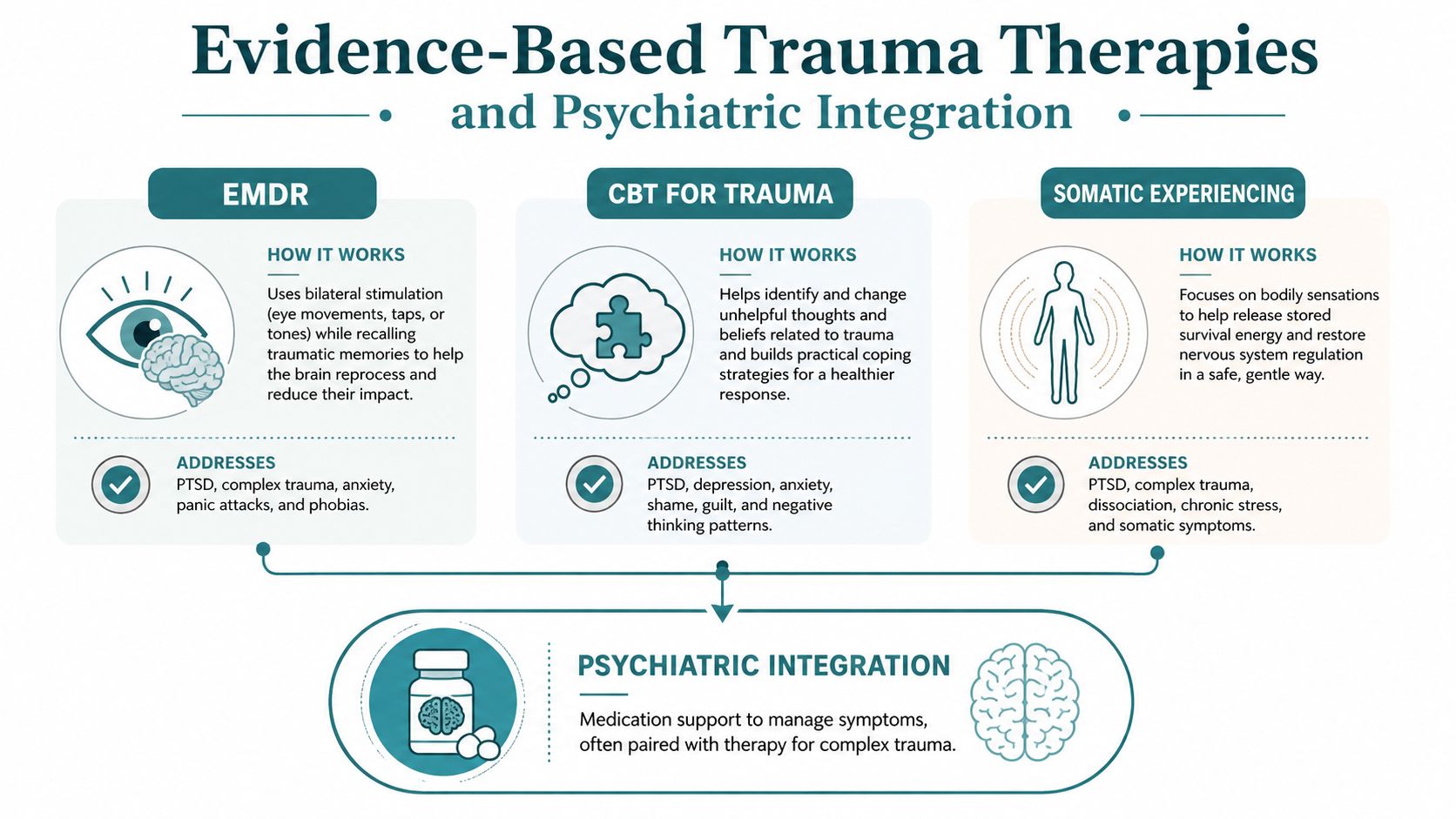
Cognitive Behavioral Therapy helps people identify thoughts, beliefs, and behaviors that keep distress going. In trauma care, it can help a client notice how avoidance, hypervigilance, or self-blame shape everyday decisions. Sessions are usually structured and practical, which appeals to people who want a clear map.
Dialectical Behavior Therapy is especially useful when emotion swings, impulsivity, or self-harm risk are part of the picture. It focuses on skills, like distress tolerance and emotion regulation, so the person has tools to use between sessions. That matters when trauma has made feelings feel unmanageable.
EMDR uses bilateral stimulation while the client focuses on traumatic material. People often choose it when they want a trauma-processing approach that doesn't rely mainly on talking through every detail. It can be a fit for PTSD and related anxiety presentations.
Brainspotting is another trauma-focused approach used in outpatient settings. It works with focused attention and the body's response patterns, which some patients find helpful when words alone don't reach the core experience.
Why psychiatry belongs in the same conversation
Trauma, mood symptoms, and substance use can blur diagnosis. That's one reason onsite psychiatric evaluation matters. A careful prescriber can refine the picture, watch how symptoms change over time, and coordinate medication with psychotherapy instead of treating medication as a stand-alone fix.
That coordination is also practical. A person whose sleep, panic, or depression is interfering with therapy may need medication support so they can participate more fully. Another person may need a slower diagnostic process because trauma symptoms are overlapping with another psychiatric condition. Either way, psychiatric integration helps treatment stay individualized.
For a broader look at how somatic approaches fit into this mix, this overview of somatic experiencing for PTSD shows why body-based work is often paired with talk therapy rather than used as a replacement.
What to Look for When Choosing a Trauma Informed Provider
The easiest way to evaluate a provider is to ask concrete questions and listen for concrete answers. If the response stays broad, the program may value the idea of trauma-informed care more than the actual delivery of it. If the response is specific, the program is usually easier to trust.
Questions that reveal how the program really works
Start with staff training. Ask what trauma-specific training clinicians receive, how often it's refreshed, and how supervisors support implementation. Training matters because trauma-informed care can't survive on goodwill alone.
Then ask how safety and choice show up day to day. A good answer might mention pacing during intake, predictable group structure, or options for how a client participates. If the answer sounds like a slogan, keep asking.
You should also ask about collaboration with other services. Trauma-informed care works best when psychiatry, individual therapy, group therapy, and family involvement are coordinated rather than siloed. That's especially important for co-occurring conditions.
A few more useful questions:
- How do you screen for trauma without overwhelming people?
- What evidence-based therapies are available onsite?
- How are crises handled, especially if someone gets activated in group?
- What ongoing supervision or consultation do clinicians receive?
- How do you adapt care for different cultural, linguistic, or family backgrounds?
Red flags worth taking seriously
Vague language is one. A provider that says “we're trauma informed” but can't explain the clinical workflow is not giving you enough to evaluate. Another red flag is a high-volume model that leaves little room for individualized care.
Sequential treatment for co-occurring disorders is another concern. If a program says substance use has to be fixed before trauma can be addressed, or vice versa, that can create delays and drop-off. Integrated care is usually more realistic for adults whose symptoms overlap.
Families should pay attention too. A solid family program gives education, communication pathways, and realistic expectations, not just reassurance. The same applies to cultural humility. If the provider can't describe how it handles language, identity, migration, discrimination, or historical trauma, the program may be too narrow for the people it serves.
Trauma Informed Care in Practice at Casa Recovery
Casa Recovery is one example of how a trauma-informed outpatient setting can be built around structure, psychiatry, and individualized planning. The center offers PHP, IOP, and dedicated mental health tracks, with small groups and a high therapist-to-client ratio that support safety and collaboration. It also integrates psychiatric evaluation and medication management onsite, which matters when trauma, mood symptoms, and substance use are all part of the picture.
The program uses evidence-based modalities including CBT, DBT, EMDR, and Brainspotting, and it pairs individual psychotherapy with small-group work and psychoeducation. Its family program adds therapy, education, and ongoing communication, which helps align the home environment with treatment goals. For adults who need step-down structure in Southern California, that combination gives a clear example of trauma-informed care functioning as both a framework and a service model.
If you're comparing outpatient programs for yourself or a loved one, visit Casa Recovery to review its PHP, IOP, and mental health treatment options, then ask how each service supports safety, choice, and coordinated care. A good trauma-informed program should be able to explain its approach clearly, and Casa Recovery is one place to start that conversation.