Yes, stress can cause lightheadedness. 16.9% to 23.2% of people have dizziness at some point in life, and in one large U.S. sample, 24.6% of 4,147 adults reported dizziness or balance problems in the previous 12 months (PMC review).
You're in a meeting, on a call, or standing in line after a rough night, and your head suddenly feels floaty. Your body is reacting to stress in a real, measurable way, and that reaction can include a faint, off-balance, or “not quite here” feeling.
Table of Contents
- When Stress Makes the Room Spin
- The Physiology Behind Stress-Induced Lightheadedness
- How Common Is Stress-Related Dizziness
- Warning Signs That Require Medical Attention
- Practical Self-Management Techniques for Immediate Relief
- When Professional Treatment Becomes Necessary
- Finding Structured Mental Health Care in Orange County
When Stress Makes the Room Spin
A client sits down for a difficult performance review, hears the first few comments, and then feels the floor shift under them. Their heart is racing, their breathing is shallow, and the world seems a little farther away than it was a minute ago. That kind of moment can feel frightening, but it isn't unusual.
Stress can cause lightheadedness because the body doesn't separate emotional strain from physical threat very well. When the nervous system senses danger, it can produce symptoms that feel medical even when the trigger is emotional. The sensation is real, not imagined, and it often shows up during arguments, deadlines, crowded spaces, or panic-heavy periods.
Practical rule: if the lightheaded feeling starts during stress and eases when you calm your breathing, stress is a strong suspect.
That doesn't mean every episode should be brushed off. Dizziness can come from several different places, including the inner ear, circulation, medications, and anxiety. The challenge is learning which pattern fits the moment in front of you.
The clearest clue is context. Stress-related lightheadedness often arrives with fast breathing, muscle tension, a racing pulse, or a sense of unreality. It may fade once you sit, slow down, and stop feeding the anxiety loop.
The sections below separate the body's response from the symptoms that deserve urgent attention, then move into concrete relief strategies and the kinds of treatment that help when the pattern keeps coming back.
The Physiology Behind Stress-Induced Lightheadedness
Stress doesn't just “feel” overwhelming, it changes what the body is doing. Acute sympathetic activation, the same fight-or-flight system that prepares you to run or defend yourself, shifts blood toward skeletal muscle and away from functions the body treats as less urgent in the moment. That shift can leave you feeling faint, foggy, or slightly detached from your surroundings. Casa Recovery stress overview
What hyperventilation changes
Stress often changes breathing first. When someone starts breathing too fast or too shallowly, arterial carbon dioxide drops, and that drop can trigger respiratory alkalosis and cerebral vasoconstriction. In plain language, the blood vessels feeding the brain narrow, a little like a garden hose turned down at the tap.
That narrowing reduces cerebral blood flow enough to create the classic floaty, off-balance feeling. Some people notice tingling in the fingers, blurred vision, or a sense that they might faint even when they're not losing consciousness. The experience is physical, not just emotional.
The vestibular system can also become more sensitive during stress. When the brain is already on alert, ordinary motion, a quick head turn, or standing up too fast can feel exaggerated. That's one reason anxious dizziness can seem to appear “out of nowhere” even though the nervous system has been building toward it.
Why the sensation feels so convincing
The body treats this cascade like a warning signal. Fast breathing, reduced carbon dioxide, and autonomic arousal combine into a sensation that tells the brain something is wrong, which then makes the brain become even more alert. That feedback loop is why people often say, “I got lightheaded, then I got scared, then it got worse.”
The symptom is real, and the mechanism is real. Slowing the breathing pattern can directly interrupt one of the main drivers of the feeling.
That's the important clinical takeaway. If the symptom appears during stress and improves when the breathing pattern is corrected, the physiology fits the story.
How Common Is Stress-Related Dizziness
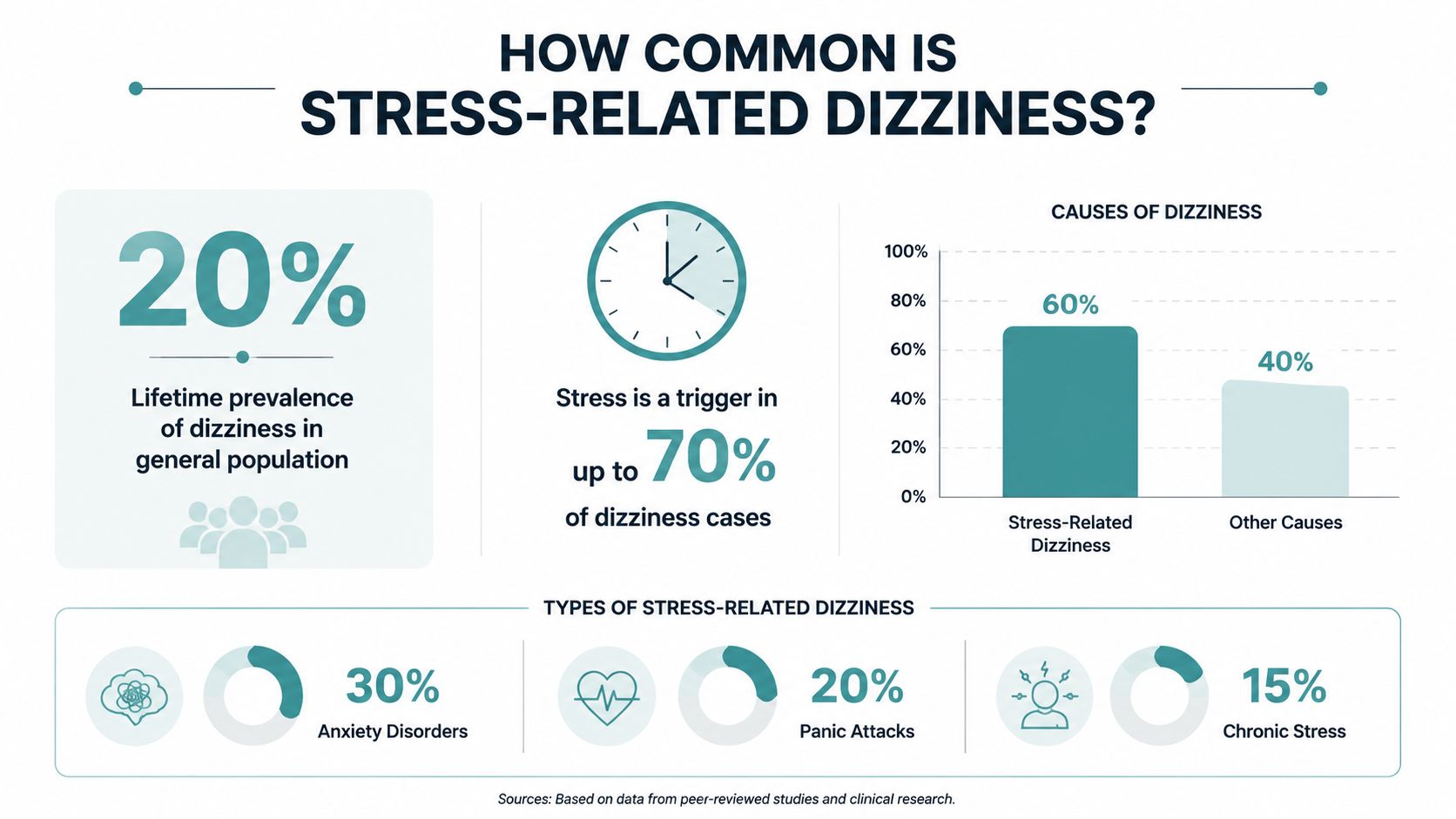
Dizziness is common enough that clinicians usually treat it as a symptom with several possible causes, not as a single diagnosis. A population-based study in the National Health and Nutrition Examination Survey found that dizziness or balance problems were reported by a meaningful share of adults, and broader reviews show that lifetime dizziness prevalence in the general population ranges from 16.9% to 23.2%. A symptom that appears this often rarely points to just one explanation.
Stress and anxiety are part of the pattern
Research also shows a clear overlap between dizziness and anxiety. In one review, 28.3% of people with dizziness had comorbid anxiety disorders, and related neurology reviews describe psychophysiological dizziness as accounting for about 10% to 25% of dizziness cases seen in specialty clinics (PMC review). That does not mean anxiety is the only cause. It does mean the connection is common enough that clinicians look for it early.
The relationship can go in both directions. Adults with an anxiety disorder were reported to be 2.17 times more likely to develop benign paroxysmal positional vertigo over 9 years of follow-up than adults without anxiety disorders (Healthline clinical summary). A person may start with stress-related lightheadedness, then begin to fear the next episode, and that fear can make the next episode feel stronger. That pattern is familiar in panic disorder, where bodily sensations and alarm feed each other, and it is one reason structured care sometimes matters more than reassurance alone. If you want a fuller explanation of that cycle, see this overview of panic disorder.
How to think about the pattern
Stress-related lightheadedness often has a recognizable rhythm. It may appear during emotional strain, ease when breathing slows, and fade in waves instead of staying fixed at one level. That is different from dizziness caused by an inner ear problem or a cardiovascular issue, which may follow a clearer movement trigger, a fainting episode, or another new physical sign.
A practical way to judge the pattern is to ask whether the symptom tracks with stress, whether calming the breath changes it, and whether anything else is happening that does not fit an anxiety episode. Breathing techniques can help interrupt the physiologic spiral, while repeated or disabling episodes may point to a need for more structured treatment, such as a partial hospitalization program, intensive outpatient care, or dual-diagnosis treatment when anxiety and substance use are both involved. The goal is not to guess. It is to match the pattern to the right level of care before the cycle becomes harder to break.
Warning Signs That Require Medical Attention
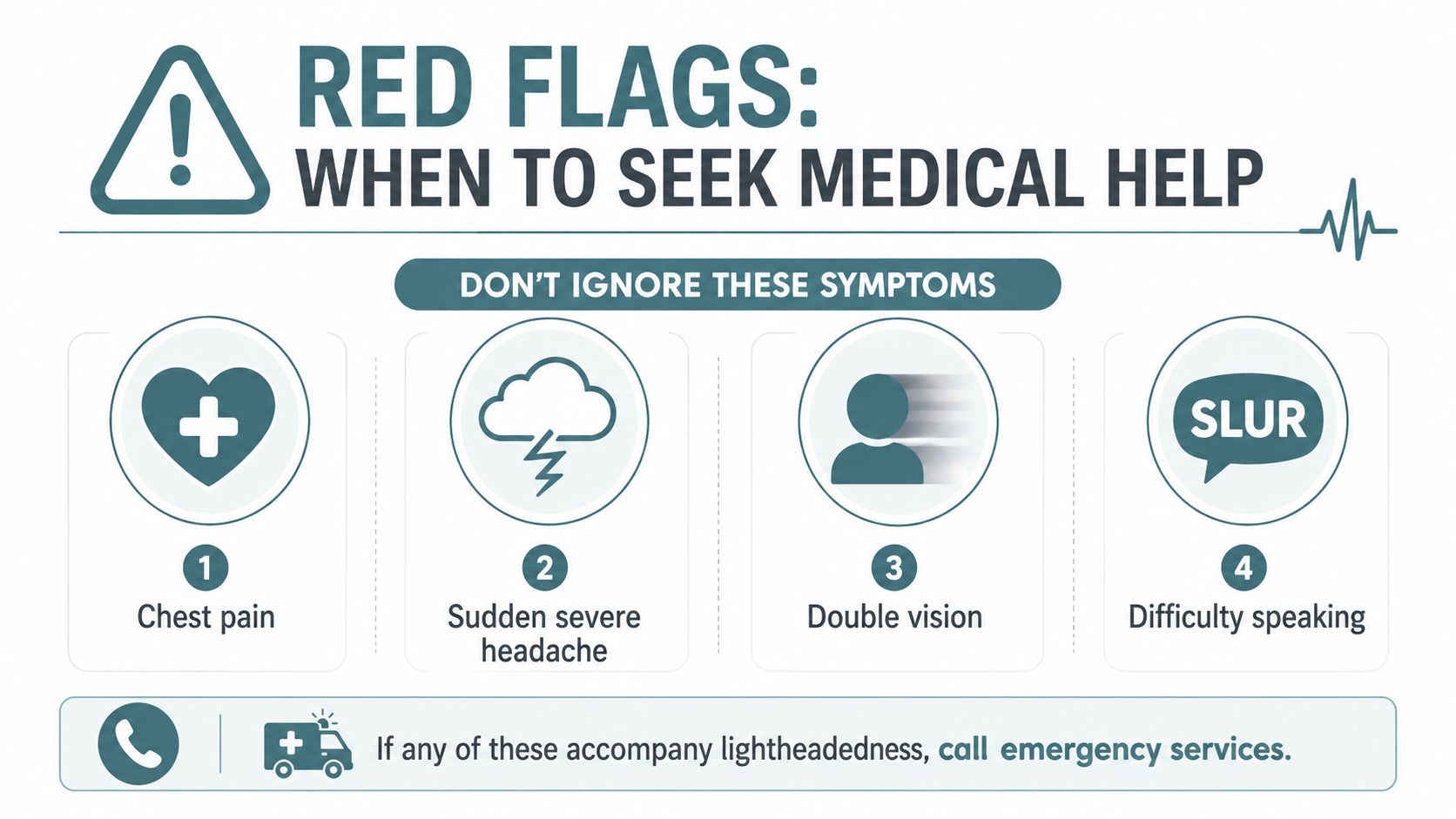
Lightheadedness becomes more concerning when it appears with other symptoms that point away from stress alone. Chest pain, sudden severe headache, difficulty speaking, one-sided weakness, fainting, irregular heartbeat, or persistent vomiting all deserve prompt medical evaluation. If those signs show up together, it's safer to treat the episode as urgent.
What makes a symptom pattern more serious
New, worsening, or unexplained dizziness should never be dismissed too quickly. Heart rhythm problems, blood pressure changes, neurological conditions, inner ear disorders such as BPPV, and medication side effects can all produce a dizzy or faint feeling. Stress may still be part of the story, but it shouldn't be the only explanation until a clinician has ruled out other causes.
If the lightheadedness happens after a medication change, after a head injury, or during a period of illness, the threshold for care should be lower. The body gives clues, and the job is to listen to the ones that don't match an ordinary anxiety episode.
If the symptom comes with speech trouble, weakness, chest pain, or passing out, don't try to power through it.
A simple decision rule
When you're deciding whether to wait it out, ask three questions. Is this new? Is it getting worse? Is anything else happening that doesn't belong in a typical stress reaction? If the answer to any of those is yes, call a clinician promptly or seek urgent care.
For readers who worry that panic symptoms are “just in their head,” it can help to review the difference between panic physiology and a dangerous medical event. A clear explanation of panic disorder can be useful context, especially when symptoms overlap, and you can find that at this overview of panic disorder.
The goal isn't to scare yourself. It's to avoid missing a serious problem while still recognizing when stress is the likely driver.
Practical Self-Management Techniques for Immediate Relief
When lightheadedness starts, the first move is physical, not mental. Sit down or lie down right away so you don't add a fall risk to the symptom itself. Then bring your attention to your breathing, because the breathing pattern is often what keeps the sensation going.
Reset the breathing pattern
Diaphragmatic breathing works best when it's slow and steady. Try inhaling through the nose for a count of four, pausing briefly, then exhaling for a count of six. Longer exhales help counter the fast, shallow breathing that can drop carbon dioxide and intensify the floaty feeling.
A fixed point can also help. Pick one object in the room and keep your eyes on it while you breathe, especially if the sensation is paired with visual wobbliness. That gives the nervous system one stable reference while the rest of the body settles.
Ground the body, then the mind
The 5-4-3-2-1 sensory method is useful when panic is feeding the dizziness. Name five things you see, four you can touch, three you hear, two you smell, and one you taste. It works by shifting attention away from scanning for danger and toward specific sensory details.
If your muscles are clenched, try a brief progressive relaxation sweep. Tighten the shoulders for a few seconds, then release. Do the same with the jaw, hands, and legs. That can reduce the physical tension that keeps the stress response switched on.
- Sit or lie down first: Prevent a fall and give your body a signal that it's safe to settle.
- Breathe more slowly than feels natural: A longer exhale can help reverse hyperventilation.
- Sip cold water: The act of swallowing and the temperature change can be grounding.
- Focus on one object: Visual steadiness can reduce the sense that the room is moving.
- Use sensory anchoring: The 5-4-3-2-1 method pulls attention out of the panic loop.
- Release muscle tension on purpose: A body that softens often helps a mind that's spiraling.
Lifestyle habits matter too. Consistent sleep, steady hydration, less caffeine, less alcohol, and regular movement all lower baseline vulnerability. For a broader nervous-system reset approach, some readers also benefit from practical guidance like nervous system regulation strategies.
When Professional Treatment Becomes Necessary
Self-management helps when lightheadedness is brief and clearly tied to stress, but it has limits. If the episodes keep returning, interfere with work or driving, or show up alongside ongoing anxiety, depression, trauma symptoms, or substance use, professional care makes sense. At that point, the issue isn't just the symptom, it's the pattern behind it.
What treatment addresses
Evidence-based therapy can target the thoughts and body responses that keep the cycle alive. Cognitive Behavioral Therapy helps people notice catastrophic thinking, avoidant behavior, and hypervigilance, then replace those patterns with more workable responses. Dialectical Behavioral Therapy adds skills for emotion regulation, distress tolerance, and staying present when the body starts to spiral.
Psychiatric evaluation can also matter when symptoms are severe or when multiple problems overlap. A clinician may need to sort out whether anxiety, depression, medication effects, trauma, or a combination is driving the episodes. In some cases, medication management is part of the plan, especially when symptoms are strong enough to block daily functioning.
Why dual-diagnosis care matters
When stress and dizziness are tangled up with alcohol or drug use, treating only one side usually falls short. Dual-diagnosis care addresses substance use and mental health together, instead of asking the person to solve one problem before touching the other. That matters because many people use substances to quiet anxiety, then feel even more unstable afterward.
Treatment works better when the body, the mood, and the coping habits are all assessed together.
A structured program can also help when there's a trauma history. Trauma can keep the nervous system in a near-constant state of alert, which makes lightheadedness more likely and more distressing. Therapy then becomes less about “calming down” and more about retraining a system that's been stuck on high alert.
Finding Structured Mental Health Care in Orange County
For adults in Orange County who need more than self-help, Casa Recovery in San Juan Capistrano offers outpatient mental health care with Partial Hospitalization Program and Intensive Outpatient Program options, plus integrated dual-diagnosis treatment, onsite psychiatry, family support, and trauma-informed therapies such as EMDR and Brainspotting. That kind of structure can be a fit when lightheadedness is part of anxiety, panic, burnout, or a broader stress pattern that keeps interrupting daily life.
Choosing the right level of care
A PHP can make sense when someone needs full-day structure and close clinical support without inpatient hospitalization. An IOP is often a step-down option for people who still need regular therapy, skills work, and accountability while returning to work, school, or family responsibilities. The right level depends on how often the symptoms happen, how much they disrupt life, and whether there are co-occurring concerns that need coordinated treatment.
Casa Recovery also emphasizes individualized treatment planning and a high therapist-to-client ratio, which can matter when symptoms are complex rather than textbook-simple. The center accepts insurance verification support, and its family program gives relatives a clearer role in recovery instead of leaving them guessing how to help.
If lightheadedness is part of a larger anxiety or stress problem, the next step is a clinical assessment rather than more guesswork. A care team can sort out whether the pattern fits panic, trauma, substance-related instability, or something else that needs medical or psychiatric attention.
If stress-related lightheadedness is disrupting your day, Casa Recovery offers outpatient care that can help you connect the symptom to the underlying pattern. Visit Casa Recovery to learn about PHP, IOP, dual-diagnosis support, and trauma-informed treatment in San Juan Capistrano.