You've got the intake form open, the therapist's website in another tab, and a number in your head that feels higher than your weekly budget can handle. You want help, but you also need to know whether you can keep showing up after the first appointment without sacrificing rent, groceries, or the other bills that don't pause for mental health.
Sliding scale therapy exists for that exact moment. It's a way for a practice to adjust fees based on income and financial need, so care can stay within reach without turning every session into a crisis about cost.
Table of Contents
- What Sliding Scale Therapy Actually Means
- How Sliding Scale Fees Are Actually Calculated
- Why Sliding Scale Spots Are Harder to Get Than They Look
- Asking for Sliding Scale and Negotiating the Real Rate
- How Sliding Scale Compares With Insurance, Clinics, Telehealth, and Scholarships
- Finding Sliding Scale and Affordable Care in Orange County
- Your Next Step Toward Affordable Outpatient Care
What Sliding Scale Therapy Actually Means
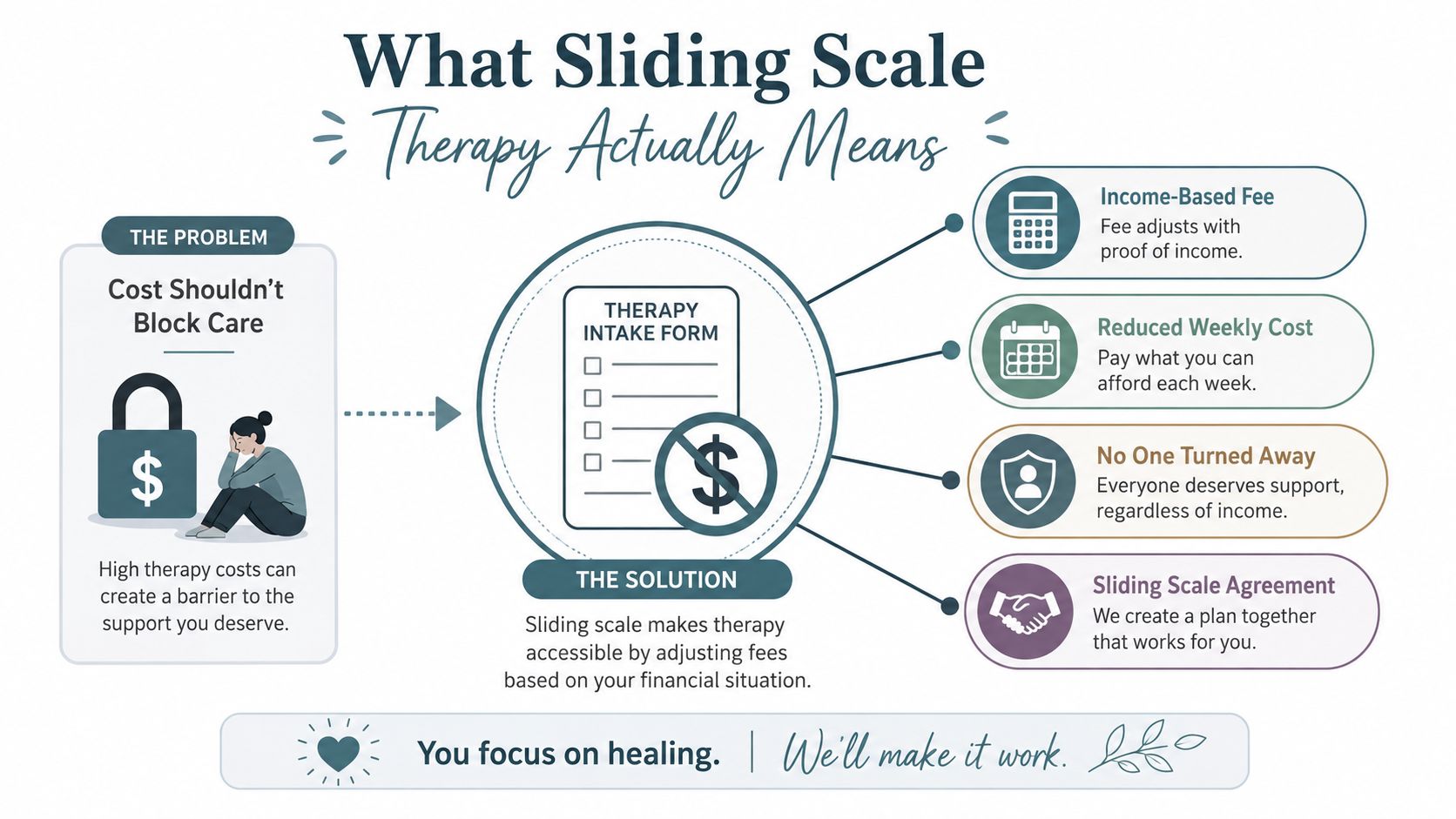
A lot of people hear “sliding scale” and think it means a therapist is being informal about pricing. It doesn't. It usually means the practice has a written, income-based fee policy that adjusts what a client pays after looking at income, household size, or another stated eligibility rule.
That matters because sliding scale therapy sits between a few other common payment models. A flat private-pay fee stays the same for everyone. An insurance copay is set by the health plan. A pro bono slot is typically free, and those are often limited. Sliding scale is different because the fee changes, but within a structure the practice can explain.
The 2019 U.S. federal survey data in the brief show why this model is part of the mainstream, not a fringe exception. About 80% of mental health treatment facilities offered at least one form of financial assistance, with 18.8% offering only sliding-scale fees, 18.4% offering only free services, and 42.7% offering both treatment facilities survey summary. That same source says roughly 20% offered no assistance at all, which is one reason affordability still depends on asking the right questions.
Who usually uses it
Sliding scale is most useful for people who can't cleanly fit into one insurance lane. That often includes uninsured clients, underinsured clients, gig workers, students, people between jobs, and anyone whose income moves around month to month.
Practical rule: If a session fee would make you skip care, ask about a sliding scale before you decide therapy is out of reach.
Practices offer it for a few reasons. Some want to widen access in their community. Others use it as part of a mission-driven private practice model. Some clinics also see it as a way to keep a training pipeline open, or to balance higher-paying and lower-paying clients while staying financially viable.
For a basic look at what a one-on-one therapy visit can include, this overview of individual therapy at Casa Recovery helps put session-based care into context. The key point is simple, though. Sliding scale therapy is not a vague discount, it's a defined pricing policy, and if the fee still fits your budget after asking, it's worth pursuing.
How Sliding Scale Fees Are Actually Calculated
Sliding scale fees look mysterious from the outside, but most practices build them the same way they'd build any other rate card. They start with a full fee, then set a fee floor, then place a small number of income-based tiers in between.
The tier structure
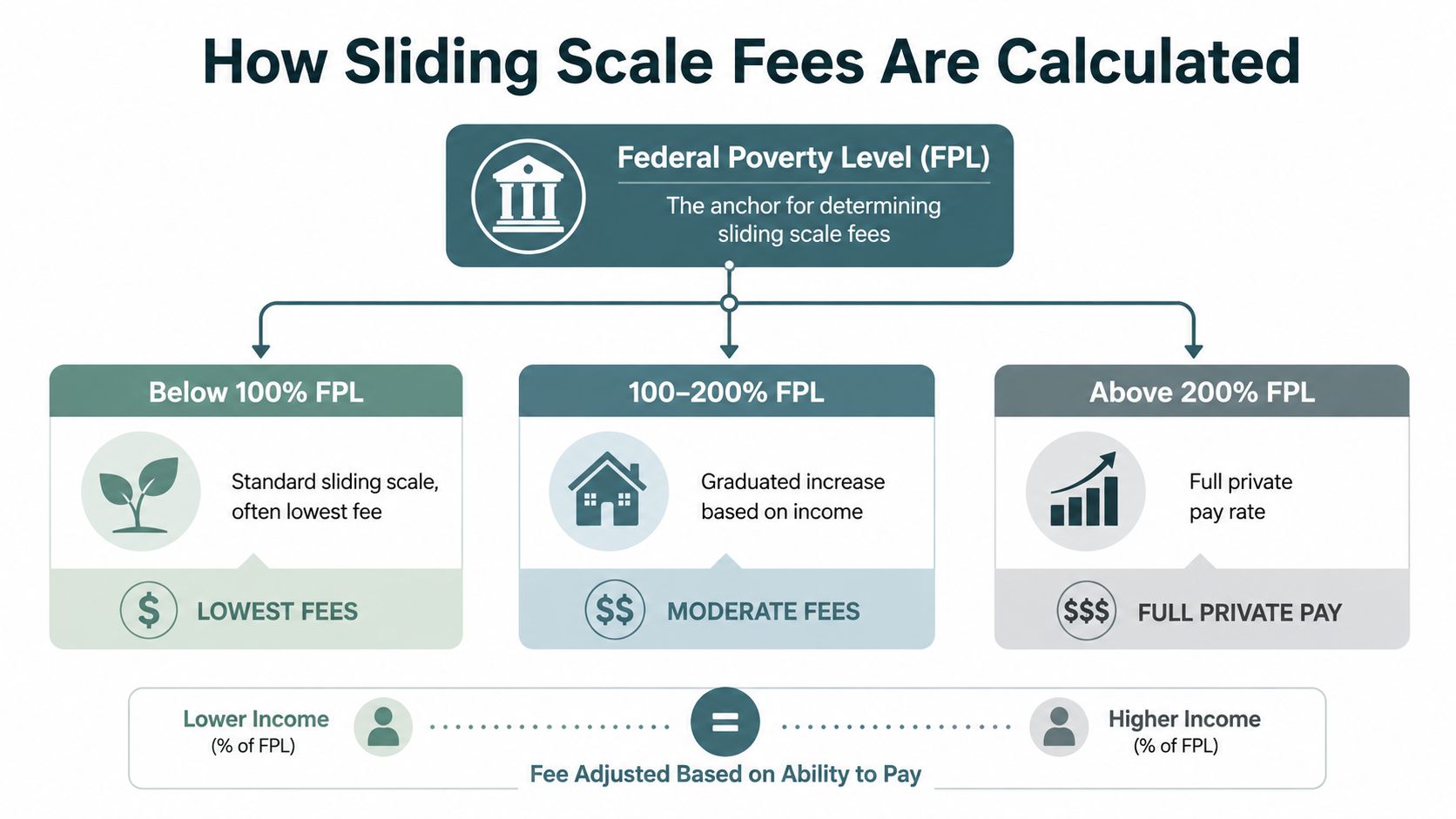
The most common setup is a 3 to 5 tier model. Many practices tie those tiers to the Federal Poverty Guidelines or to household income bands, then sort clients into ranges rather than negotiating from scratch every time. That makes the policy easier to explain, easier to document, and less arbitrary for both sides.
A useful way to think about it is a utility bill rate schedule. Everyone is using the same service, but the rate changes depending on the category you fall into. A lower tier doesn't mean the work is worth less, it means the practice has decided that some clients need a lower access point.
The bottom of that scale is the fee floor, and that's the number that keeps the practice stable. It needs to cover clinician compensation, overhead, no-show load, and admin time. If a reduced-fee session falls below the true cost of delivering care, every extra client in that tier deepens the loss. If the bottom tier stays above cost and the number of reduced-fee slots is limited, the model can stay both humane and sustainable.
How to read a quote
If a practice gives you a number that feels off, ask what tier it falls into and what the scale is anchored to. A low fee at one clinic can land in the same tier as a much higher fee at another, because their fee floors are different. That's not a contradiction, it's a reflection of different operating costs and different margins.
The most reliable practices also review their scale at least yearly, because costs and poverty guidelines change. That annual recheck is part of what keeps the policy honest. If a clinic can't explain its tier logic at all, you're probably looking at an informal discount, not a real sliding scale.
Why Sliding Scale Spots Are Harder to Get Than They Look
The phrase “sliding scale available” can sound like an open invitation. In practice, it usually means a managed resource. Practices often cap reduced-fee slots at about 10 to 20% of caseload, and some models go as high as 20 to 30% depending on the practice's margin and client mix reduced-fee policy guidance.
Why the cap exists
The cap isn't there to be stingy. It's there because reduced-fee care has to coexist with fixed overhead, therapist pay, and the realities of no-shows and scheduling gaps. If a clinic opened unlimited reduced-fee slots, it could quickly run into a staffing or cash-flow problem.
That's why the client questions are more practical than philosophical. How many reduced-fee openings are active right now. How long do they stay open. Do they get reevaluated after intake. The usual public-facing description rarely answers those questions, even though they determine whether a spot is usable.
Reduced-fee care is often limited by design, not by lack of compassion.
What clients should expect
A slow response doesn't always mean a practice is ignoring you. It may mean someone is checking eligibility, confirming which slot is open, or verifying whether the income picture fits the policy. Some clinics also re-evaluate fees mid-treatment when a client's financial situation changes, so the starting rate may not stay fixed forever.
That's why a “yes, we offer sliding scale” answer should be followed by a second question. Ask whether there's an opening right now. If there isn't, ask whether there's a waitlist or a backup referral. A clear policy will usually survive those questions without getting defensive.
For therapists, the operational side is straightforward. For clients, it can feel uncertain. The important thing is not to assume that paperwork or delay means rejection. Often it means the slot is scarce, and scarcity is part of how the model stays alive.
Asking for Sliding Scale and Negotiating the Real Rate
The first message matters. If you wait for the office to volunteer a discount, you may never hear about one. A direct, respectful ask is usually the fastest way to find out whether the practice has any reduced-fee capacity left.
What to say first
Keep it simple. Tell the clinic you're looking for care, that cost is a barrier, and that you want to know whether they currently offer sliding scale therapy. If they do, ask what documents they use to confirm eligibility, and whether the reduced-fee slot is available now or only on a waitlist.
Bring a few basics with you if they ask for proof of income. Recent pay stubs are the easiest option for steady employment. Tax returns can help if your income is more seasonal. If your income is irregular, a written statement may be enough for some practices, especially when the policy is designed to be flexible rather than rigid.
What to ask if the first number still feels too high
If the published minimum is beyond reach, don't stop at “I can't afford that.” Ask whether the practice can offer a different cadence, a longer schedule between sessions, group options, or a referral to a lower-cost clinic. If your financial situation changes later, ask for a documented re-evaluation instead of waiting and hoping the fee will adjust on its own.
Here's a simple checklist you can copy into your notes app before you call:
- Current income proof: recent pay stubs, tax return, or a written statement for irregular income.
- Eligibility question: whether sliding scale slots are open right now.
- Policy question: how often the practice reviews fees.
- Backup plan: one lower-cost referral if the slot is full.
- Rate flexibility: whether a different visit rhythm would lower the total monthly cost.
If the answer is still no, that doesn't mean the door is closed everywhere. It means that one office has hit its limit. A clear ask often gets you a quicker answer, and sometimes a more honest one than the website does.
How Sliding Scale Compares With Insurance, Clinics, Telehealth, and Scholarships
Sliding scale is useful, but it isn't the only route to affordable mental health care. The right option depends on how urgent the need is, whether you already have insurance, and how much structure the treatment has to include.
For readers trying to decide where to begin, the comparison below keeps the trade-offs visible.
| Option | Best For | Main Trade-Off |
|---|---|---|
| Sliding scale therapy | Weekly outpatient therapy when you need a lower session fee and direct access to a clinician | Reduced-fee spots are limited and may require income verification |
| Private insurance | People with active coverage who want predictable copays and network-based care | Network limits, prior authorization friction, and possible out-of-network gaps |
| Community clinics | Clients who need deep fee reduction and can wait a bit longer for an opening | Waitlists and fewer modality choices |
| Telehealth subscription platforms | People who want low monthly cost and simple individual therapy access | Usually less suited to psychiatry, family programming, or higher-acuity care |
| Scholarships or grants | Clients entering a program that can accept application-based financial aid | Paperwork, renewal requirements, and no guarantee of approval |
Insurance often makes sense when the plan is usable and the provider is in network. Community clinics can be a lifeline when the budget is extremely tight. Telehealth can be a good bridge for straightforward outpatient therapy, especially when transportation is a barrier.
If you're checking benefits, the insurance coverage guide for mental health at Casa Recovery is a good model for the kind of details to verify before you commit. The important distinction is this, sliding scale therapy helps with session cost, while insurance and clinic systems help with access structure. Those are related, but not the same.
Which door to try first
If you need weekly therapy and your income is unstable, sliding scale or a community clinic is often the first call. If you need medication management, insurance-based care usually becomes more important. If you need help this week, use every route at once. If you need PHP or IOP-level structure, don't assume a low-fee weekly therapy slot will solve the problem by itself.
Finding Sliding Scale and Affordable Care in Orange County
Orange County has more than one lane for affordable outpatient mental health care, but the lanes serve different needs. County behavioral health services, community clinics, training clinics tied to universities, private practices with sliding scale policies, and faith-based or nonprofit counseling centers all exist in the same ecosystem, but they don't move at the same speed.

What to look for locally
Start by matching the setting to the need. If you want weekly outpatient therapy and cost is the main barrier, a sliding-scale private practice or community clinic may be enough. If you need more structure, that same search should expand to programs that can verify insurance, discuss admissions, and help you understand what level of care makes sense before you get stuck in the wrong doorway.
That's where Casa Recovery fits in the local picture. It's a private mental health and dual-diagnosis treatment center in San Juan Capistrano that offers PHP, IOP, dedicated mental health programming, onsite psychiatry, and admissions guidance. The center accepts PPO plans from all carriers, plus Blue Shield of California/Blue Card, ComPsych, and Holman Group in network, and it also coordinates supportive living options for out-of-area clients affordable mental health care.
Why higher-acuity care changes the pricing question
Sliding scale makes the most sense when one clinician is delivering one session at a time. PHP and IOP are different. They can involve multiple sessions per week, medication management, family programming, and coordinated clinical support, which makes fee reduction harder to offer at the same level as weekly therapy.
That doesn't mean affordability disappears. It means the route usually shifts from “find a reduced session fee” to “verify insurance and find a structured program that can meet the acuity.” For dual-diagnosis, trauma, or other complex presentations, that distinction matters. A low-cost weekly appointment may be better than nothing, but it's not always enough.
If you're in Orange County and trying to sort through options, use the location first and the intensity second. Ask who can take you now, who can verify benefits quickly, and who can tell you whether your situation calls for outpatient therapy, IOP, or PHP. The right answer is usually the one that matches both your budget and your clinical need.
Your Next Step Toward Affordable Outpatient Care
If cost has been the reason you've delayed care, don't treat that as a personal failure. Treat it as a logistics problem that needs a real plan. Start by naming your acuity level, then call one sliding-scale practice, one community clinic as backup, and your insurer to confirm whether any out-of-network reimbursement is available.
If you're weighing PHP, IOP, or dual-diagnosis care, ask a structured program for a verified benefits check and admissions guidance instead of guessing from a website. Sliding scale therapy is a useful tool, but it works best when it's part of a bigger access plan, not the only one.
Casa Recovery offers structured outpatient mental health and dual-diagnosis care in Orange County, including PHP, IOP, and insurance verification support for people who need more than weekly therapy. If you're comparing sliding scale therapy with higher-acuity options, visit Casa Recovery to see how verified benefits and admissions guidance can help you choose the next step with less guesswork.