If you're staring at a therapist search page, a plan summary, and a long list of phone numbers, you're not alone. Many Orange County families start out looking for affordable mental health care and end up wondering why the lowest advertised price doesn't seem to match what insurance will pay. The question usually isn't just, “What's cheap?” It's, “What care can we afford without getting stuck in another round of bills, denials, or gaps in treatment?”
That tension is real. In KFF's analysis, among insured adults with fair or poor mental health, 44% of those who missed needed care said cost was the reason, and 37% said their insurance would not cover the care they needed, which shows how often coverage rules get in the way even when people do have insurance coverage (KFF analysis). For a family trying to help a spouse, a teen, or a parent, the challenge is rarely just finding a provider. It's finding the right level of care that your plan will support.
Table of Contents
- What Affordable Really Means in Mental Health Care
- Your Guide to Payment Options in California
- Comparing Mental Health Service Types
- A Step-by-Step Plan to Find Care in Orange County
- How Casa Recovery Makes Quality Care Accessible
- Frequently Asked Questions About Accessing Care
What Affordable Really Means in Mental Health Care
A lot of people search for the lowest session fee and call it a day. That's understandable, especially if you're already overwhelmed, but a low sticker price can be misleading. A $60 visit that turns into repeated out-of-pocket charges, surprise out-of-network bills, or a program that doesn't match the severity of the symptoms can end up costing more than a more structured option that fits your insurance better.

Affordability is about the full course of care
In mental health, affordable should mean financially manageable from the first call through stabilization, not just for one appointment. That includes your deductible, copay, whether the provider is in-network, and whether your plan needs pre-authorization for a higher level of care. If your insurance plan covers a service poorly, the true cost can jump fast even when the first visit looks manageable.
That's why families often need to think in terms of total cost of care. If a person needs several visits, medication management, or a more structured outpatient program, the upfront quote is only part of the picture. A good fit is one where the treatment intensity matches the condition and the payment structure doesn't force the person to stop before they're stable.
Practical rule: if the first provider you find is cheap but can't treat the real problem, the care isn't truly affordable. It's just lower priced.
Value matters more than the cheapest option
For outpatient therapy, the average self-pay price for a 60-minute psychotherapy visit was $174 in 2021 (Inseparable). That number helps explain why people hesitate before starting treatment, especially when they know therapy may be a multi-session process rather than a one-time appointment. Once you add transportation, missed work, and the possibility of switching providers, the “cheap” option can become the expensive one.
The better question is whether the care is likely to help the person move forward without constant interruptions. For some people, brief counseling is enough. For others, more structured support is the more economical choice because it reduces repeated starts and stops. In that sense, affordability and quality belong together.
Your Guide to Payment Options in California
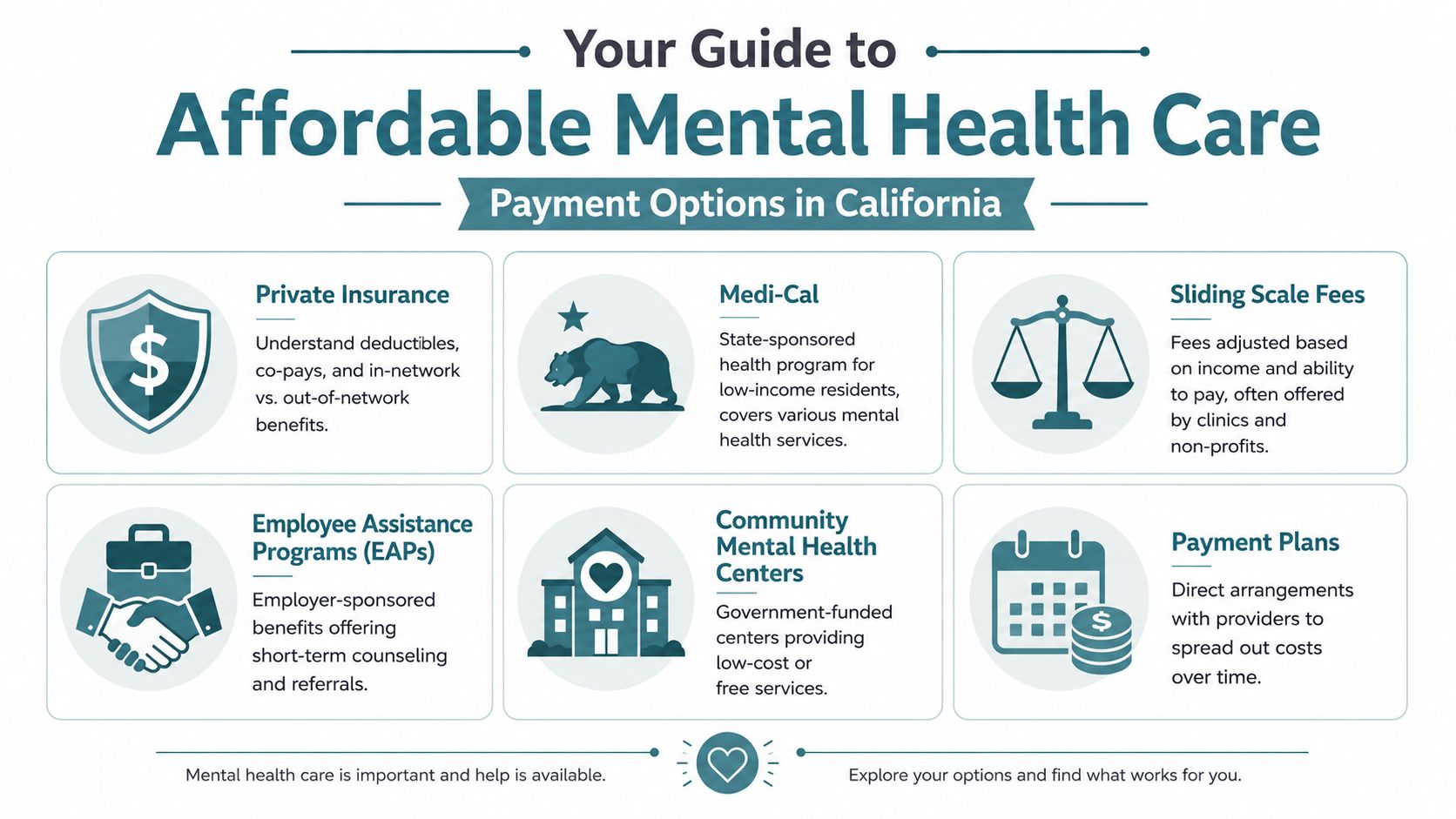
Paying for mental health care in California often starts with a simple task, but the language makes it feel harder than it is. The main goal is to find out which payment path gives you the widest access without creating a financial surprise later. If you live in Orange County, you'll usually hear about PPO insurance, Medi-Cal, sliding-scale fees, Employee Assistance Programs, and sometimes direct payment plans.
The main ways people pay
Private insurance, especially PPO coverage. PPO plans can give you more flexibility in choosing providers, but you still need to confirm what counts as in-network and whether the plan covers outpatient mental health, PHP, or IOP. Ask about your deductible, copay, coinsurance, and any requirement for pre-approval before you book. For one practical example of how a provider may help with that process, see insurance coverage for mental health.
Medi-Cal. Medi-Cal is the public coverage option many Californians rely on when income or circumstances qualify them. Coverage can support mental health services, but the best next step is always to confirm which local providers accept it and whether the service you need is available at the right intensity.
Sliding-scale fees. These fees are adjusted based on income and ability to pay. They're common in community clinics and nonprofit settings, and they can help if you don't have insurance or if your plan leaves a large gap. The tradeoff is that availability and specialty depth can be limited.
Employee Assistance Programs, or EAPs. EAPs usually offer short-term counseling and referrals through an employer. They can be a good bridge when someone needs immediate support, but they're usually not designed as the whole answer for long-term or higher-acuity treatment.
Why payment assistance still matters
SAMHSA found that in 2010, about 80% of mental health facilities offered either free care or a sliding-fee scale, and that figure was even higher, 88.0%, in outpatient centers (SAMHSA). That tells you something important. Affordable pathways exist, but they're not always obvious on a website or in a search result.
Affordable care often exists in pieces, not as one perfect listing. The family's job is to ask the right questions until those pieces become usable.
Comparing Mental Health Service Types
A common mistake is assuming mental health care means only weekly therapy. That works for some situations, but not all. When symptoms are more severe, when substance use is part of the picture, or when someone needs closer clinical oversight, a more structured program can be the more sensible option, even if it sounds more intensive at first.
The comparison below helps separate the service levels so you can match the need to the setting. If you want a deeper look at the difference between structured outpatient options, review the difference between IOP and PHP.
| Service Type | Best For | Typical Schedule | Common Cost Structure |
|---|---|---|---|
| Telehealth or weekly outpatient therapy | Mild to moderate concerns, maintenance support, or follow-up care | Usually one session at a time | Copays, coinsurance, or self-pay per visit |
| Community clinic or sliding-scale counseling | Budget-sensitive clients needing basic support | Usually weekly or as available | Reduced fee based on income |
| Intensive Outpatient Program, or IOP | People who need more structure than weekly therapy but don't need all-day care | Several sessions per week | Often billed as a program, usually tied to insurance benefits |
| Partial Hospitalization Program, or PHP | People needing more daily structure, stabilization, and frequent clinical oversight | Full-day outpatient treatment on scheduled days | Often requires benefits review and possible authorization |
| Dual-diagnosis treatment | Co-occurring mental health and substance use concerns | Depends on the program level | Usually linked to broader outpatient coverage |
Choosing the right level of care
The goal is not to pick the cheapest line on the chart. It's to choose the least intensive setting that can still safely support the person. If someone is struggling to function, missing work or school, cycling through crises, or dealing with substance use at the same time, a simple weekly appointment may not be enough.
That's the main reason affordability has to include clinical fit. A lower-intensity option that repeatedly fails can create more cost, more stress, and more time lost. A structured program can sometimes be the more affordable path because it gets the person to a steadier baseline sooner and with less trial-and-error.
A Step-by-Step Plan to Find Care in Orange County
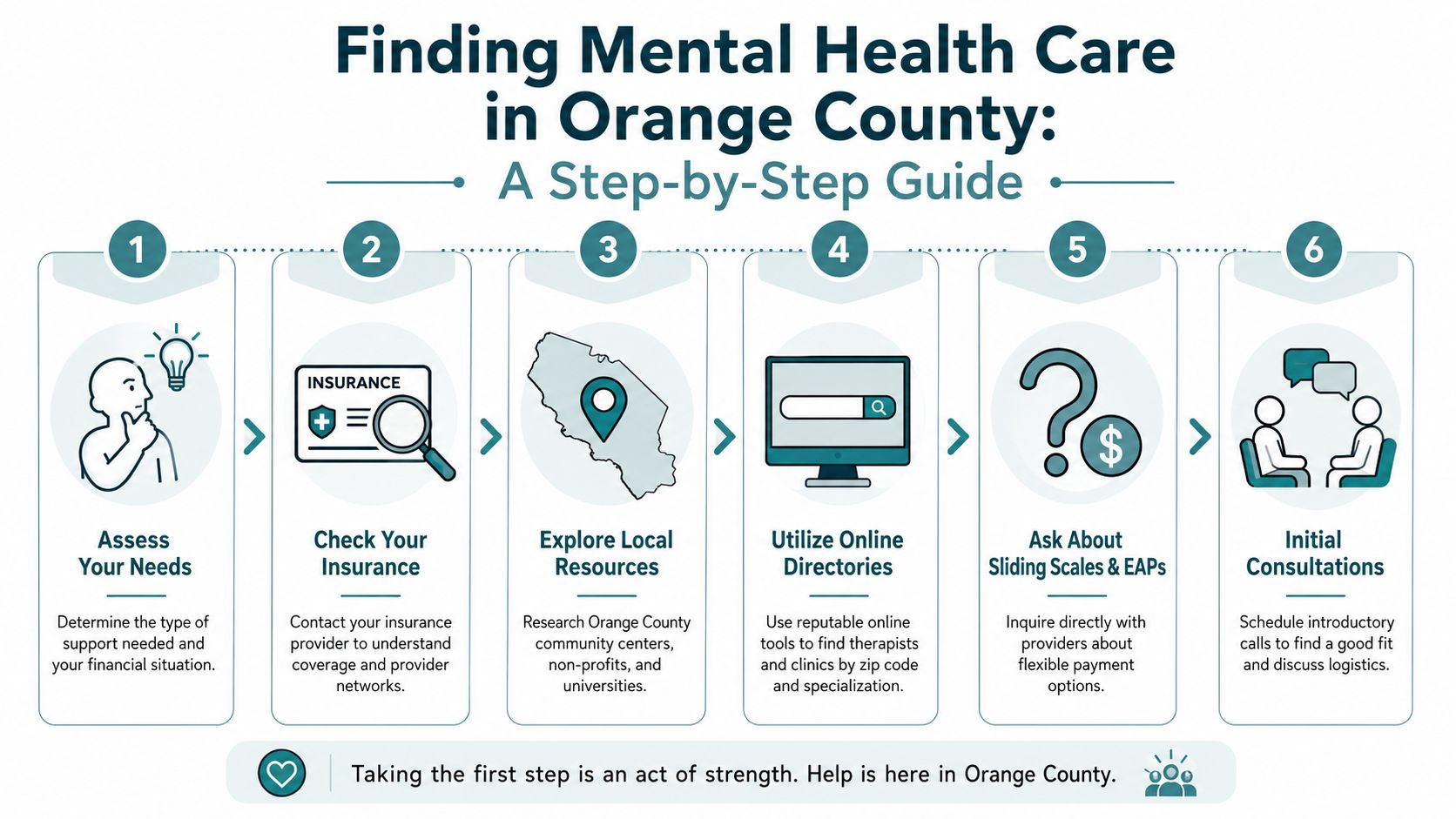
The search gets easier when you stop treating it like a general internet problem and start treating it like an insurance and access problem. The same first move involves checking the plan directly instead of guessing from a website. That matters because even a strong provider match can become unaffordable if the benefit design doesn't line up with the service.
Start with your insurer
Call the number on the back of the insurance card and ask specific questions, not just “Do you cover therapy?” Ask whether outpatient mental health, medication management, IOP, or PHP are covered, and whether the provider must be in-network. If the answer changes depending on the service level, write it down.
Use this script if it helps:
- Ask about benefits: “What mental health services are covered under my plan?”
- Ask about network status: “How do I confirm whether a provider is in-network?”
- Ask about cost-sharing: “What deductible, copay, or coinsurance applies?”
- Ask about authorization: “Does this level of care require pre-authorization?”
- Ask about limits: “Are there session limits or medical necessity rules I should know about?”
The reason this step matters is simple. Affordability is shaped as much by coverage rules and billing surprises as by the advertised session price, so insurance verification has to come first (AAMC).
Then compare providers with the plan in mind
Once you know the benefit rules, use directories and provider websites to narrow the field. Look for the exact services listed, the age group treated, whether psychiatry is available onsite, and whether the center supports co-occurring concerns. If a person may need more than supportive counseling, make sure the provider offers that level of care and not just general therapy.
A treatment center's admissions line should be able to explain how they verify benefits, what documents they need, and what the next step is after the first call. If the conversation stays vague, keep moving. A clear admissions process often saves time later, especially when family members are helping coordinate care.
Use Orange County resources with a plan
For local residents, community directories, county resources, and provider comparison tools can help, but they work best after the insurance check. That's where many families get stuck. They collect names first and only later discover that the provider doesn't accept the plan, doesn't offer the needed level of care, or has a wait that doesn't fit the situation.
A useful way to stay organized is to sort options into three buckets, covered now, possible with higher cost, and not a fit. That keeps the search grounded and helps you avoid repeating the same intake story over and over.
How Casa Recovery Makes Quality Care Accessible
Orange County families often need one provider who can treat more than one layer of the problem. That might mean depression plus substance use, trauma plus anxiety, or a situation where weekly therapy has already fallen short. Casa Recovery fits into that picture as one option for adults who need structured outpatient care with clinical oversight, including PHP, IOP, and dual-diagnosis treatment.

Why insurance verification changes the experience
For families, the hard part is often not deciding whether help is needed. It's figuring out what the plan will support without creating a financial mess. Casa Recovery's admissions process includes insurance verification, which matters because the difference between “covered” and “not covered” can determine whether a family can move forward at all.
The practical value here is that insurance is handled as part of the intake conversation, not as an afterthought. That can reduce confusion around eligibility, benefits, and next steps. It also helps families avoid the classic problem of paying for the first visit before they know whether the larger treatment plan is financially realistic.
Where structured care fits
Structured outpatient care can be the right answer when weekly therapy won't be enough. PHP and IOP give people more contact, more monitoring, and more support than traditional once-a-week counseling, which can matter when symptoms are serious or when there's co-occurring substance use. Casa Recovery also coordinates psychiatric evaluation and medication management, which helps connect therapy with medical oversight.
The total value isn't just the treatment room. It also includes the family program, supportive living coordination for some clients, and an integrated approach that keeps the plan from becoming fragmented. For families trying to balance quality with affordability, that combination can be easier to manage than piecing together multiple separate providers.
Frequently Asked Questions About Accessing Care
What should I do if my insurance denies a mental health claim
Start by asking for the denial in writing and reviewing the stated reason carefully. Then call the insurer and ask what documentation is needed to appeal, whether the denial was based on medical necessity, network status, or authorization, and whether a different level of care would be treated differently. Keep copies of every call, date, and name, because billing disputes get easier when the record is organized.
If the provider office can help, ask them to resubmit with clearer clinical notes or to explain the service more precisely. A denial doesn't always mean the care is inappropriate. Sometimes it means the paperwork and the coverage language didn't line up the first time.
Are telehealth IOP programs as effective as in-person ones
Telehealth can be a practical option for people who need structure but can't easily travel, especially when work, caregiving, or transportation get in the way. The better question is whether the program offers the right clinical support, clear group structure, and appropriate follow-up. For some people, virtual care removes barriers. For others, in-person treatment is better because it creates more accountability and fewer distractions.
If you're choosing between formats, ask about attendance expectations, crisis response, and how the program handles medication coordination and family involvement. The format matters, but the clinical design matters more.
How do I help a loved one who doesn't want treatment
Start with one concrete concern, not a speech about everything that's wrong. People who are resistant usually respond better to a short, calm conversation about a specific problem, like panic, sleep loss, missed work, or drinking that's getting harder to control. If they still refuse, keep the door open and offer one next step, such as a phone consultation or an insurance check.
You can also focus on logistics instead of persuasion. Offer to sit with them during the first call, help gather insurance information, or ask questions with them. That reduces the friction that often keeps people from acting.
Why does affordability feel harder before the first appointment
Because the first appointment isn't the whole cost. The average self-pay price for a 60-minute psychotherapy visit was $174 in 2021, which is why the first call should include insurance verification, coverage questions, and an estimate of what the full treatment path may cost (Inseparable). If the plan includes several visits or a structured program, understanding benefits early helps prevent avoidable surprises.
The clearest path is usually the simplest one. Check the plan, confirm the level of care, and ask what the total financial picture looks like before you commit.
If you're ready to stop guessing and want help figuring out what your insurance may cover, contact Casa Recovery and ask the admissions team to verify benefits and talk through the right level of care for your situation.