
Some nights your spouse is up talking fast, making plans that sound brilliant at 2 a.m., insisting they don't need sleep and getting irritated when you question anything. Other weeks, the same person can barely get out of bed, stops answering texts, forgets bills, and looks at you as if you're asking for too much just by wanting a normal conversation.
If you're living in that kind of swing, you're probably exhausted. You may still love your spouse very much and also feel angry, scared, lonely, and guilty for feeling all of it at once. That mix is common. It doesn't mean you're failing them. It means you've been trying to carry something heavy for a long time.
Guidance for dealing with a bipolar spouse frequently offers broad advice like “be supportive” or “encourage treatment.” Support matters, but support without structure turns into chaos fast. What helps is a framework: know the patterns, communicate differently depending on mood state, create a written plan before the next crisis, protect your own functioning, and know exactly when home support is no longer enough.
Table of Contents
- Living on an Emotional Rollercoaster
- Recognizing the Patterns of Bipolar Disorder
- Communicating Through the Highs and Lows
- Creating a Collaborative Crisis and Safety Plan
- Setting Boundaries to Protect Your Well-Being
- When and How to Involve Professional Help
Living on an Emotional Rollercoaster
A lot of spouses start by telling themselves the same story. Maybe work stress caused the irritability. Maybe the spending spree was a one-time lapse. Maybe the withdrawal is just burnout. Then the pattern repeats, and your home starts revolving around mood shifts you can't predict and can't control.
You begin to scan for clues. How much did they sleep? How fast are they talking? Are they affectionate today or suddenly cold? Did they just make a realistic plan, or are they building toward something bigger and riskier? This kind of hypervigilance wears people down. It turns marriage into monitoring.
You can love your spouse and still admit that the relationship has become unstable.
That honesty matters because denial is expensive. It costs trust, money, peace, and sometimes safety. It also traps the non-bipolar partner in a cycle of reacting late. By the time you realize, “This is an episode,” the argument has already happened, the money is already spent, or the crash has already landed.
The work is to stop treating each crisis like an isolated event. Bipolar disorder often creates recognizable patterns. When you learn those patterns, your decisions get cleaner. You stop arguing with symptoms as if they were ordinary marital disagreements. You stop waiting for insight from someone whose judgment may be impaired in that moment. And you stop measuring your success by whether you can calm them down single-handedly.
Recognizing the Patterns of Bipolar Disorder
The fastest way to get lost in this marriage is to call every mood shift “just stress” or every conflict “just the disorder.” Neither is accurate. You need to learn what bipolar symptoms look like in daily life, especially in the small changes that show up before a full episode.
For a broader clinical overview, it helps to review the basics of bipolar disorder and how it affects mood, behavior, and functioning. In marriage, though, symptoms often appear less like textbook categories and more like recurring relationship disruptions.
What shows up in a marriage
Mania or hypomania often appears as acceleration. Your spouse may need less sleep, talk faster, interrupt more, jump between ideas, become unusually charming or irritable, and push for sudden decisions. In a marriage, that can look like late-night business schemes, impulsive spending, sexual boundary changes, grand promises, or explosive anger when you try to slow things down.
Depression usually looks like narrowing. Energy drops. Communication gets sparse. Hygiene, work, parenting, paperwork, and emotional responsiveness may all decline. What feels personal to you may be illness-driven shutdown, but that doesn't mean its impact on the household is small.
This strain is not minor. Marriages involving a partner with bipolar disorder face exceptionally high instability, with different sources estimating that 80% to 90% of these marriages end in divorce, according to Remedy Psychiatry's review of bipolar disorder and relationships.
Signs of Manic vs. Depressive Episodes in a Spouse
| Behavioral Area | Signs of Mania / Hypomania | Signs of Depression |
|---|---|---|
| Sleep | Sleeping far less, insisting they aren't tired | Sleeping much more, or struggling to get up |
| Speech | Rapid, pressured, hard to interrupt | Slowed, brief, delayed responses |
| Spending | Impulsive purchases, risky financial decisions | Avoiding bills, ignoring financial tasks |
| Mood at home | Euphoric, agitated, unusually confident, easily angered | Flat, hopeless, withdrawn, tearful, irritable |
| Relationship behavior | Intensely affectionate one day, combative the next, unrealistic plans for the future | Emotionally distant, low libido, less responsiveness |
| Activity level | Multiple projects at once, restless, nonstop movement | Low motivation, unfinished tasks, reduced functioning |
| Insight | Denies a problem, resists limits | May feel ashamed, defeated, or like a burden |
Why early pattern recognition matters
Early warning signs matter more than dramatic moments. A spouse is often easier to help at “sleep is slipping, speech is speeding up, and they're getting unusually driven” than at “they've already blown up the week.” Common early clues include sleep changes, increased energy, or withdrawal. Those are the kinds of signs clinicians watch for because they often show up before the crisis gets obvious.
Practical rule: Track patterns, not isolated incidents. One bad night may be stress. A cluster of changes is different.
I often tell couples to stop asking, “Is this really bipolar?” and start asking, “What pattern is emerging, and what does it usually lead to in our house?” That question is less emotional and more useful. It moves you from confusion to response.
Communicating Through the Highs and Lows
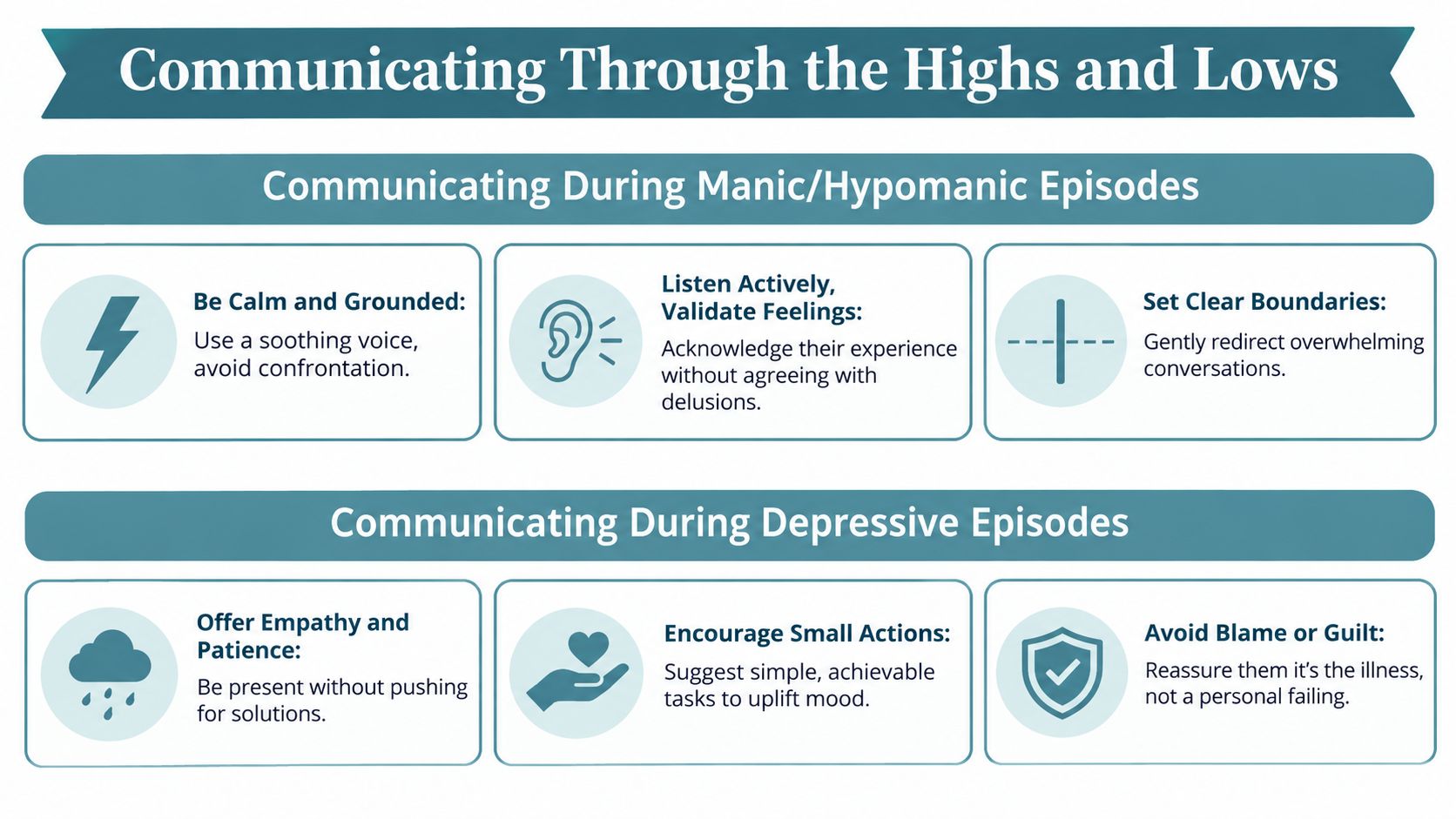
Communication with a bipolar spouse only works when you adjust your goal. During stability, the goal is planning. During an episode, the goal is reducing damage and keeping connection without feeding chaos.
Research supports the value of this approach. Practicing transparent and open communication about bipolar symptoms and needs can reduce conflict by approximately 40%, according to this review on managing bipolar disorder in relationships. If communication in your marriage has turned into accusation, panic, or circular arguments, that number should get your attention.
A useful companion resource is this guide to communication techniques used in family therapy, especially if every serious talk now turns defensive.
During stable periods
Stable periods are when you discuss treatment, routines, warning signs, finances, parenting decisions, and what each of you wants the other to do if symptoms return. This is also when “I” statements help.
Try language like:
- State impact clearly: “I feel scared when you stop sleeping because I've seen where that can lead.”
- Ask for collaboration: “I want us to agree on what we do if your sleep changes for several nights.”
- Name a specific request: “If I notice the warning signs we listed, I need you to call your psychiatrist with me.”
These conversations should be brief, concrete, and written down afterward. Don't turn them into a referendum on the entire marriage.
During an active episode
When your spouse is manic, hypomanic, or experiencing significant depression, don't chase logic the way you would in a normal disagreement. They may not have full access to judgment, emotional regulation, or perspective. Your job in that moment is not to win accuracy. It's to reduce escalation.
Try this instead:
- Use calm tone over content: Lower your voice. Slow your pace. Keep sentences short.
- Validate emotion, not distortion: “I can see you're overwhelmed.” That's different from agreeing with a delusional or unrealistic belief.
- Set one limit at a time: “I'm going to pause this conversation if the yelling continues.”
- Offer one next step: “Let's sit down, get some water, and call your doctor.”
For depressive periods, avoid interrogating them about motivation. Use gentler prompts: “I'm here.” “Let's do one thing, not ten.” “Can I sit with you while you take your medication?” Small asks beat inspirational speeches.
Don't ask an actively symptomatic spouse to have a highly rational marriage conversation. Ask for the next safe, doable step.
What usually makes things worse
Three habits reliably inflame the situation:
Labeling in the moment
Saying “You're manic” or “This is your bipolar talking” often triggers shame, rage, or shutdown.Arguing facts at full speed
If they're escalated, fact-checking every claim rarely brings them back. It usually broadens the fight.Using stored resentment as evidence
“This is just like last year” may be true, but in the middle of an episode it becomes fuel, not insight.
Communication can help a lot. It cannot replace treatment, sleep regulation, or containment when symptoms are building.
Creating a Collaborative Crisis and Safety Plan
Couples usually wait too long to make a crisis plan. They tell themselves they'll “handle it if it happens again.” Then the next episode hits, both people are upset, and every decision feels personal. That's exactly when judgment is weakest.
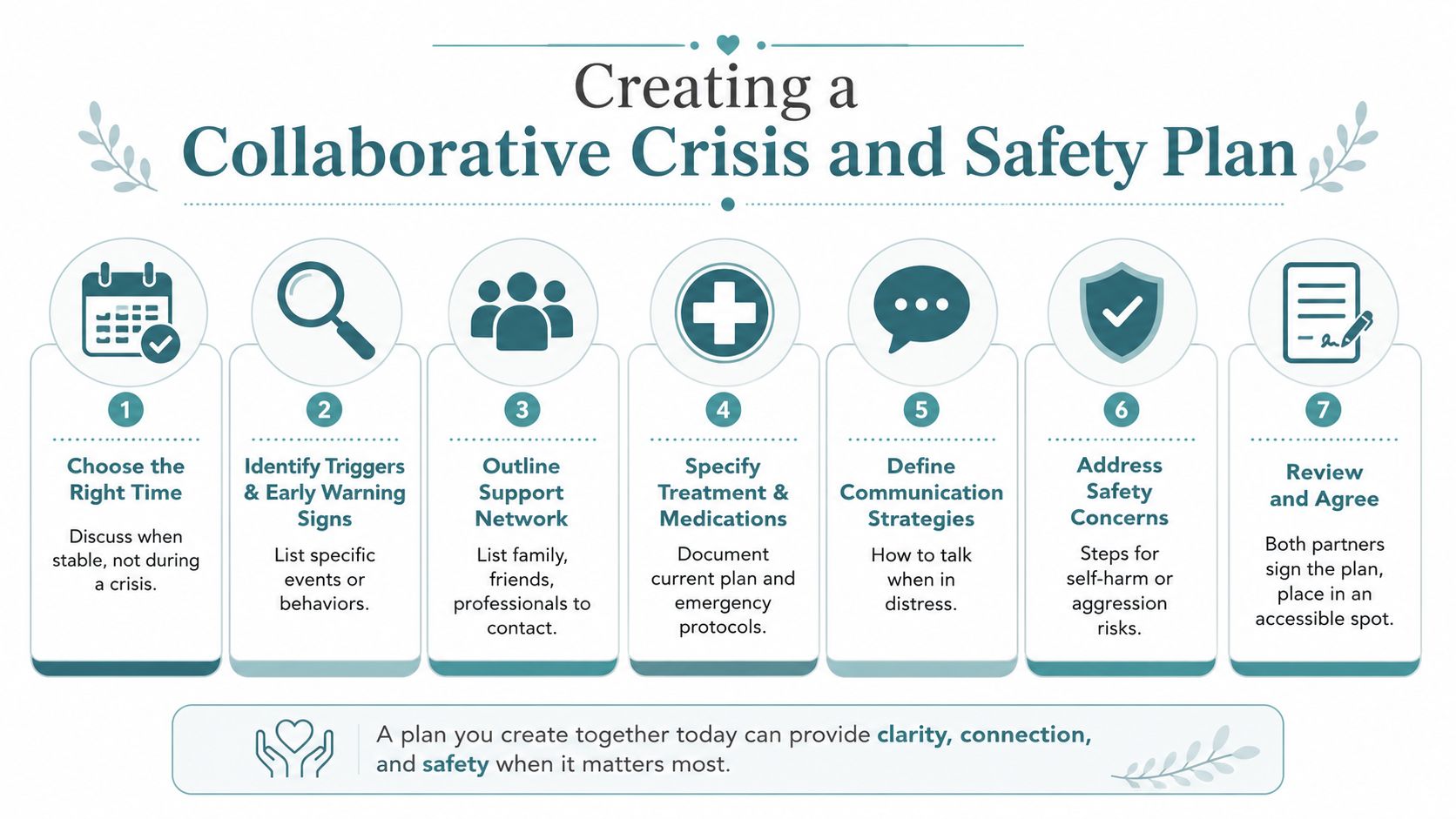
A better approach is to make the plan while your spouse is stable and able to participate. This kind of structured preparation matters. A methodology that includes identifying early warning signs and creating a pre-established crisis plan reduces relapse rates by approximately 30% when combined with consistent daily routines, according to clinical guidance published through PubMed Central.
If you need a model for organizing that document, this resource on mental health treatment planning is a useful starting point.
Build the plan while things are calm
The first rule is simple. Don't create a safety plan in the middle of an argument, a spending spree, or a depressive shutdown. Build it during a window of stability, when both of you can think clearly and agree on language.
Keep it short enough to use. One to two pages is often better than a long, detailed document nobody reads in a crisis.
What the written plan should include
A practical plan usually includes these items:
- Early warning signs: Write the specific changes that usually happen first in your spouse, such as sleeping less, talking faster, withdrawing, skipping meals, or becoming unusually driven.
- Clinical contacts: List psychiatrist, therapist, primary support people, pharmacy, and preferred urgent care or hospital information.
- Medication and treatment details: Include current medications, prescribing clinician, and what your spouse agrees should happen if symptoms escalate.
- Financial protections: Decide in advance how to limit damage if spending becomes impulsive. That may include account monitoring, temporary spending limits, or separating essential household funds.
- Home safety steps: Write down what happens if verbal aggression, driving risk, self-harm concerns, or substance use enters the picture.
- Children and family logistics: Decide who handles pickups, school communication, and temporary caregiving if your spouse becomes unstable.
The part couples avoid but need most
Most plans fail because they stop at “encourage treatment.” Encouragement is not enough. You need pre-agreed escalation steps.
That means spelling out consequences and actions, not vague hopes. For example:
- If sleep changes and agitation rise, the psychiatrist gets called that day.
- If your spouse becomes verbally aggressive, you end the conversation and leave the room or house.
- If spending behavior starts, access to shared discretionary funds changes immediately.
- If safety concerns rise, you contact crisis services or seek a higher level of care.
A crisis plan isn't controlling when it's collaborative and written in advance. It's protective.
Daily routines also belong in the plan. Sleep, meals, medication timing, and predictable structure often do more for stability than couples expect. Routine won't cure bipolar disorder, but it reduces the amount of chaos your household has to absorb.
Setting Boundaries to Protect Your Well-Being
Many spouses think boundaries are unkind because the ill partner is suffering. In practice, the absence of boundaries usually creates a far harsher outcome. Without limits, the healthier partner becomes the manager, protector, cover story, emotional punching bag, and cleanup crew. That role doesn't save the marriage. It corrodes it.
This is the caregiver trap. It's serious, and it's common. According to the International Bipolar Foundation discussion of marriage and bipolar disorder, the caregiver trap leads to burnout in 60% of long-term spouses, while couples therapy using CBT and DBT modalities achieves a 65% success rate in maintaining relationship stability over two years.

Boundaries are not punishments
A boundary says what you will do to protect safety, dignity, and function. It does not try to force another adult into perfect behavior. That distinction matters.
“I won't stay in a conversation where I'm being screamed at” is a boundary.
“You need to stop being manic right now” is not.
Good boundaries are clear, behavioral, and enforceable. They don't depend on your spouse agreeing in the moment. They depend on you following through.
Examples of firm boundaries that help
Some of the most necessary boundaries in bipolar marriages are uncomfortable to set because they challenge old roles.
- Verbal abuse boundary: If name-calling, intimidation, or threats start, you end the interaction immediately.
- Treatment participation boundary: If your spouse repeatedly refuses agreed treatment steps during deterioration, you shift from discussion to escalation.
- Financial boundary: Shared money for essentials gets protected. You don't keep exposing rent, food, or childcare funds to impulsive behavior.
- Substance use boundary: If alcohol or drugs are worsening symptoms, you stop pretending they are a side issue. They become part of the treatment threshold.
The mistake many spouses make is explaining the boundary over and over instead of enforcing it once. Repetition often sounds like negotiation. Boundaries work when they are calm and boring.
Your job is not to prove that the boundary is fair. Your job is to keep it.
Protecting your own mind and body
If you want to know how to deal with a bipolar spouse without losing yourself, start here. Keep your own therapy. Keep your own medical care. Keep a friend you can speak openly with. Keep parts of your identity that are not organized around your spouse's symptoms.
You also need relief from constant vigilance. If every evening becomes symptom surveillance, your nervous system stays activated. Over time, that can look like irritability, sleep problems, numbness, resentment, or a strange inability to tell when something is urgent versus familiar chaos.
Self-protection isn't disloyal. It's what allows support to remain support instead of martyrdom.
When and How to Involve Professional Help
There's a point where a spouse cannot stabilize this at home, no matter how loving or informed they are. That point comes sooner than many families admit. The pattern is usually clear: repeated escalation, poor insight, treatment refusal, increasing risk, or a home environment that no longer feels safe or workable.
One of the biggest gaps in public advice is that it tells spouses to encourage help without explaining what to do when encouragement fails. As noted by New View Mental Health's discussion of living with a bipolar spouse, content often fails to address the mechanisms for enforcing boundaries when a spouse refuses care, leaving partners without actionable guidance on when to use PHP or mobile crisis teams as a consequence rather than a suggestion.

When home management is no longer enough
Professional escalation becomes necessary when your spouse's symptoms are outpacing what your home can safely contain.
Common signs include:
- Function is collapsing: They can't manage daily responsibilities, basic self-care, or consistent reality-based decision-making.
- Risk is rising: Driving, spending, aggression, psychotic symptoms, self-harm concerns, or severe substance use are entering the picture.
- You are becoming the whole system: You're monitoring sleep, medications, appointments, money, work excuses, and family stability by yourself.
- Every conversation turns into a standoff: There's no meaningful collaboration left, only pleading, bargaining, or crisis response.
This is when the question changes from “How do I convince them?” to “What level of care matches what is happening right now?”
What PHP IOP and family care are for
Partial Hospitalization Program (PHP) is for people who need intensive daily structure but don't require inpatient hospitalization. It can be appropriate when symptoms are acute, routines are collapsing, and the person needs close clinical monitoring, medication support, and multiple therapeutic contacts in a week.
Intensive Outpatient Program (IOP) is a step below that. It fits people who still need substantial support and accountability but can function with less daily structure.
If substance use is mixed in, dual-diagnosis care matters because untreated substance use can keep destabilizing mood treatment. Medication conversations also need to be grounded in real education, especially when a spouse is fearful, ambivalent, or inconsistent. For families trying to understand mood stabilizer options more clearly, this guide on understanding Lamictal and lithium treatment can help frame those discussions in a more informed way.
Family programming matters too. Not because the family caused the illness, but because the household often needs retraining. Families need help learning what to say, what not to say, how to respond to warning signs, and how to align around treatment rather than splitting into rescuer, critic, and avoider roles.
If they refuse help
This is the hardest part. You may not be able to force treatment unless legal safety thresholds are met in your area, but you can stop participating in the illusion that nothing serious is happening.
That often means shifting from repeated persuasion to a clear sequence:
State the concern once, specifically
“Your sleep is gone, your speech is racing, and home is not stable.”Offer the next clinical step
“I want you assessed today.”Name the boundary if they refuse
“If you refuse assessment and the behavior continues, I'm calling the crisis team and protecting the finances.”Follow through
Not angrily. Not theatrically. Just consistently.
If your spouse is becoming dangerous to themselves or others, severely disorganized, or unable to maintain basic safety, use emergency or crisis resources in your area immediately. Don't debate your way through a situation that has already become unsafe.
If your family needs more than advice and is ready for structured support, Casa Recovery offers outpatient mental health and dual-diagnosis care in Orange County, including PHP, IOP, onsite psychiatry, trauma-informed therapy, and a family program that helps spouses and loved ones respond with more clarity and less chaos.