When searching for the best anxiety depression medication, the useful starting point isn't a brand name. It's a treatment hierarchy. The evidence base is unusually consistent on one point: for both generalized anxiety disorder and major depressive disorder, SSRIs and SNRIs are commonly recommended as initial medications. Among these, escitalopram and duloxetine have demonstrated the most substantial effect sizes in meta-analyses, according to a BMJ systematic review and meta-analysis.
That finding matters because public discussions often flatten medication choice into “what works fastest” or “what has the fewest side effects.” Real prescribing is more complicated. A person with depression and no substance use history may tolerate a standard SSRI pathway. A person with anxiety, insomnia, alcohol misuse, and panic symptoms may need a different sequence, tighter follow-up, and more caution around short-acting relief medications.
The hardest cases often sit in that overlap. Anxiety and depression are common co-occurring conditions, but treatment becomes less straightforward when substance use is also present. The medication itself may still be familiar. The context changes everything.
Table of Contents
- Introduction to Best Anxiety Depression Medication Choices
- Medication Class Overview for Anxiety and Depression
- Comparing Efficacy Onset and Dosing Across Medication Classes
- Safety Side Effects and Substance Use Interactions
- Clinical Use Cases for Medication Selection
- Selecting Monitoring and Adjusting Medication
- Integrating Medication with Casa Recovery Care
Introduction to Best Anxiety Depression Medication Choices
Nearly half of people with a mental illness will also experience a substance use disorder at some point in their lives, according to SAMHSA. That overlap changes what “best anxiety depression medication” means in practice.
A useful medication plan is not a search for one winning drug. It is a clinical matching process based on diagnosis, dominant symptoms, prior response, side-effect tolerance, suicide risk, and the presence or absence of alcohol or drug use. In dual-diagnosis care, the usual ranking of medications can shift. A drug with strong symptom efficacy may move down the list if it increases sedation, worsens misuse risk, or makes adherence less likely during early recovery.
First-line treatment still often starts with antidepressants that can address both conditions with one prescription, but selection gets more selective when substance use is part of the case. Benzodiazepines, for example, can reduce anxiety quickly, yet that short-term benefit may be outweighed by dependence risk, cognitive impairment, or interaction with alcohol and other sedatives. By contrast, slower-acting options may fit better if they support stabilization without adding a new risk pathway.
| Medication Class | Common Role in Anxiety and Depression | Typical Clinical Position | Main Limitation |
|---|---|---|---|
| SSRIs | Core treatment for anxiety and depression | First-line | Delayed benefit, early side effects possible |
| SNRIs | Core treatment, often useful when anxiety is prominent | First-line | Can be activating for some patients |
| Atypical antidepressants | Targeted alternatives or adjuncts | Second-line or tailored first choice | Fit depends heavily on symptom pattern |
| Benzodiazepines | Rapid symptom relief for select cases | Short-term, limited use | Dependence risk |
| Buspirone | Non-benzodiazepine anxiolytic option | Select anxiety cases | Not a broad depression treatment |
| Mood stabilizers | Used when mood disorder complexity exists | Diagnosis-dependent | Require careful monitoring |
| Antipsychotics | Augmentation or specific symptom targets | Reserved or adjunctive | Side-effect burden requires caution |
The paradox is straightforward. The medications that can calm symptoms fastest are not always the safest choices for patients with co-occurring addiction risk. That is why dual-diagnosis prescribing depends less on isolated efficacy rankings and more on a full risk-benefit assessment across mood, anxiety, sleep, cravings, trauma symptoms, and day-to-day functioning.
At Casa Recovery, medication planning is tied to the broader treatment setting rather than handled as a stand-alone prescription decision. Clinicians can compare symptom change with therapy engagement, relapse risk, sleep disruption, and adverse effects in real time, which often leads to more precise adjustments. Readers who want a broader framework for psychiatric prescribing can review Casa Recovery's guide to mental health medication types.
Clinical lens: The best medication is the option that improves anxiety and depressive symptoms while remaining safe, sustainable, and realistic for the patient's recovery context.
Medication Class Overview for Anxiety and Depression
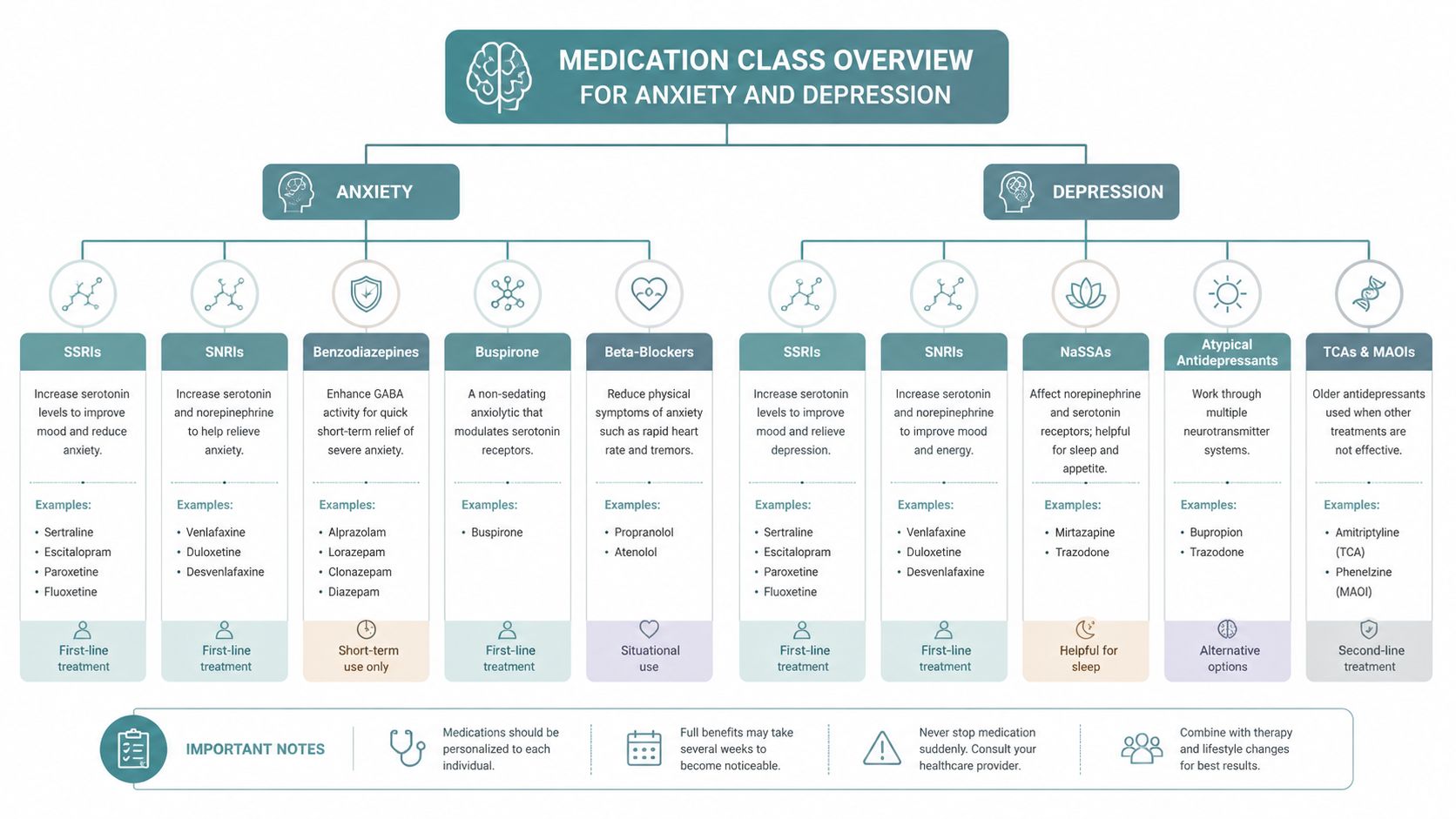
Medication classes look interchangeable online. They aren't. Each class has a different place in the treatment sequence, and each creates different tradeoffs for people managing anxiety, depression, or both.
Why first-line still means SSRIs and SNRIs
SSRIs increase serotonin signaling. Representative drugs include sertraline, escitalopram, and fluoxetine. They remain the backbone of treatment because they cover both anxiety and depressive syndromes, they're familiar to prescribers, and they have a broad evidence base.
SNRIs affect serotonin and norepinephrine. Venlafaxine and duloxetine are common examples. In practice, clinicians often consider them when anxiety is paired with depressive symptoms, low energy, or pain-related complaints, though the exact fit depends on the patient rather than a single symptom cluster.
The practical reason these classes dominate is simple. They can serve as one-platform treatments for conditions that frequently overlap. That matters when clinicians want to avoid layering multiple drugs too early.
For readers who want a broader psychiatric prescribing framework, Casa Recovery's overview of types of medication for mental health gives a useful high-level map of how these categories are typically used.
Where the other classes fit
Atypical antidepressants don't form one clean biological family, but they matter because they can solve problems SSRIs and SNRIs don't. Bupropion is often discussed when energy, motivation, or sexual side effects are part of the decision. Mirtazapine often enters the conversation when sleep and appetite are central concerns. Their value is in profile matching.
Benzodiazepines work quickly and can reduce acute anxiety, but speed creates risk. In patients with panic symptoms and no substance-use concerns, a prescriber may use them sparingly. In dual-diagnosis care, that same choice can become much harder to justify because misuse, tolerance, and relapse risk matter as much as symptom relief.
Buspirone occupies a narrower lane. It's an anxiolytic, not a broad-spectrum antidepressant. Some clinicians consider it when they want to avoid benzodiazepines and need a non-sedating anxiety option.
Mood stabilizers and antipsychotics usually don't sit at the front of routine anxiety or uncomplicated depression treatment. They become relevant when the diagnosis widens, such as bipolar-spectrum concerns, severe agitation, marked mood instability, or treatment resistance.
Medication classes are best understood as tools with different jobs. The mistake is treating them as if they were ranked products on a single list.
Comparing Efficacy Onset and Dosing Across Medication Classes
Comparative efficacy matters, but it can mislead if you interpret it too strictly. A medication can outperform placebo in a meta-analysis and still feel slow, partial, or disappointing in an individual patient. That isn't a contradiction. It's how psychiatric treatment often works in real life.
What efficacy data really tells you
For major depressive disorder, antidepressants are more efficacious than placebo, but the summary effect sizes are generally modest. The same evidence base also supports a point that patients often discover only after a frustrating first trial: combining medication with psychotherapy often improves response and helps reduce relapse, and the highest risk for suicidality occurs in the first two weeks after starting treatment or after a dose change according to the review on antidepressant efficacy and safety.
That combination finding changes how the “best” medication question should be asked. The better question is often: which medication gives this person the best chance of staying engaged in therapy long enough for both treatments to work together?
Another important distinction is onset. Standard antidepressants usually don't provide immediate relief. Patients often need education on the difference between early side effects, early subtle improvement, and full therapeutic effect. Without that framing, many stop too early or judge the medication too harshly.
Onset time and dosing comparison
The table below summarizes how clinicians usually think about timing and dose strategy across classes. Exact dosing decisions vary by patient, diagnosis, age, medical history, and concurrent substance use. Because this article is grounded only in verified data, the ranges below are intentionally qualitative rather than numerical unless specific figures were provided.
| Medication Class | Typical Onset | Usual Dose Range |
|---|---|---|
| SSRIs | Often gradual, with fuller effect commonly taking weeks | Start low, then titrate based on response and tolerability |
| SNRIs | Similar to SSRIs, often gradual over weeks | Start conservatively and increase as tolerated |
| Pregabalin | Can be considered when anxiety response is the key target | Individualized dosing based on anxiety treatment plan |
| Benzodiazepines | Rapid symptom relief | Lowest effective dose, short duration when used |
| Buspirone | Gradual rather than immediate | Scheduled dosing rather than as-needed use |
| Atypical antidepressants | Varies by medication | Drug-specific titration based on symptom target |
| Antipsychotic augmentation | Used after inadequate response to primary treatment | Low-dose adjunctive strategy when indicated |
The practical consequence is that initiation and evaluation have to be separated. Starting a medication is not the same thing as concluding whether it works. Prescribers typically assess three distinct questions:
- Can the patient tolerate it? Early nausea, agitation, sedation, or activation may shape whether a medication is viable.
- Is there partial movement? Better sleep, fewer panic spirals, or less morning dread may appear before full remission.
- Is the plan still coherent? If adherence is poor, alcohol use is active, or psychotherapy isn't underway, apparent medication failure may be partly a systems problem.
Practical rule: Judge the medication only after you've judged the context. Poor sleep, ongoing substance use, missed doses, and no therapy support can all make a reasonable first-line medication look ineffective.
A careful start also reduces preventable dropouts. Low initial dosing, clear side-effect counseling, and scheduled follow-up often matter as much as the molecule itself.
Safety Side Effects and Substance Use Interactions
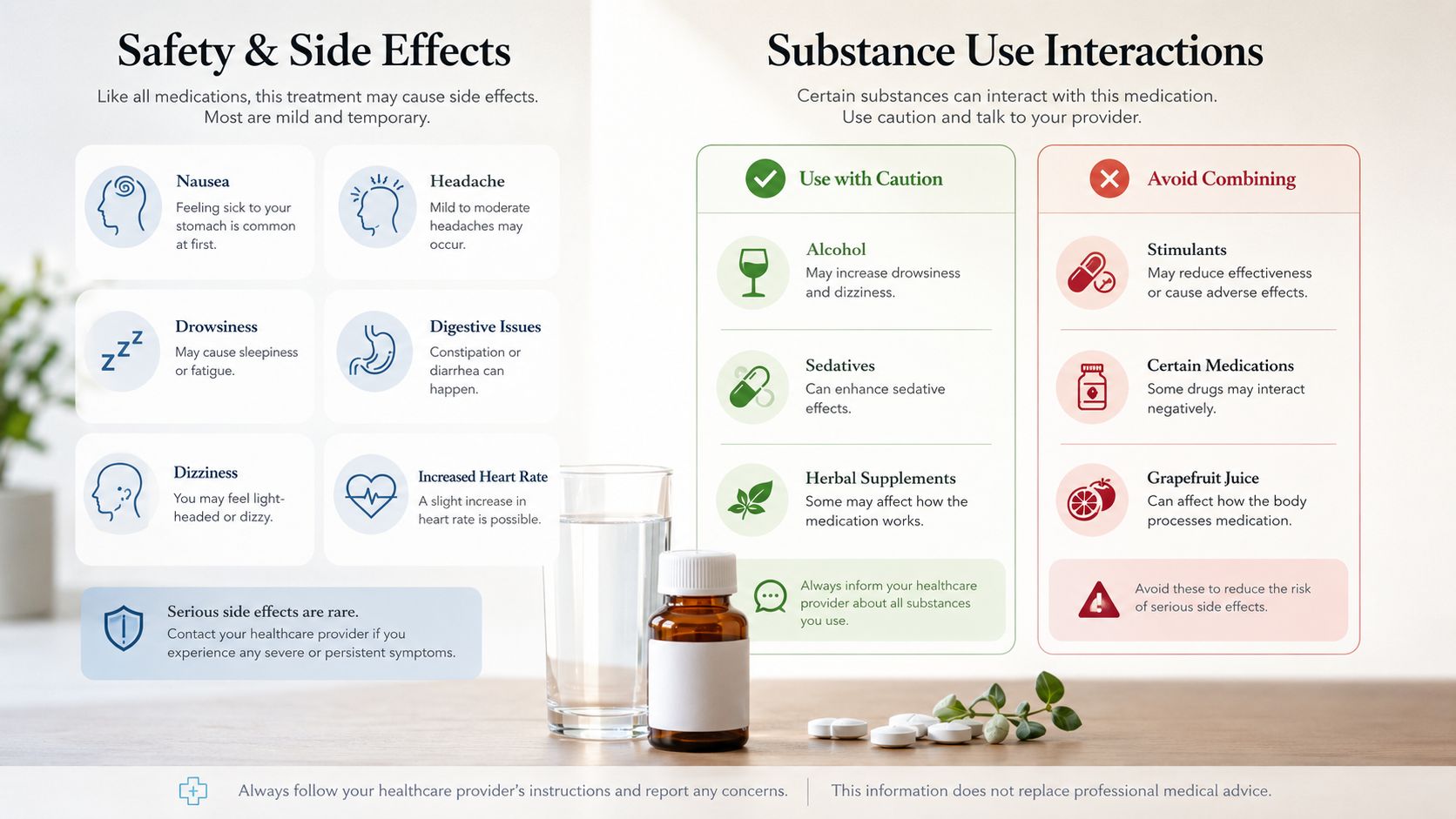
The medication that looks strongest on a chart may be the wrong choice if it creates relapse risk, worsens sedation, or becomes impossible to monitor safely. Safety isn't a separate issue from efficacy. In dual-diagnosis care, it often decides the entire treatment path.
The dual-diagnosis medication paradox
The most under-discussed problem in medication selection is the dual-diagnosis medication paradox. Standard first-line medications still matter, but SSRIs and SNRIs often require dosage adjustments or adjunctive strategies when substance use disorders co-occur, and this nuance is rarely addressed in mainstream treatment summaries, as discussed in the review on co-occurring anxiety and substance use treatment complexity.
That finding changes how clinicians interpret common complaints such as “the SSRI isn't working” or “the anxiety medication makes things worse.” In a dual-diagnosis setting, the medication may not be failing in a simple sense. Active alcohol use, opioid use, withdrawal states, poor sleep, and fluctuating adherence can all distort response and tolerability.
Benzodiazepines show the paradox clearly. General anxiety articles often present them as either obviously helpful or obviously dangerous. The clinical truth is narrower. They may still have a role as limited tools for predictable, acute panic triggers, but their dependence liability makes them a poor fit for many people with substance-use vulnerability.
Risk points clinicians watch closely
A safety-focused medication plan usually includes several layers of review.
- Misuse potential: Benzodiazepines require special caution when a person has current or past substance misuse.
- Sedation burden: Alcohol and sedating medications can compound impairment, making nighttime “self-medication” especially risky.
- Diagnostic drift: Irritability, impulsivity, unstable sleep, or substance-related mood swings can mimic primary psychiatric conditions and alter prescribing logic.
- Monitoring needs: Mood stabilizers and antipsychotics can be appropriate in selected cases, but they require structured follow-up because benefit and burden both need active review.
Some interactions are less dramatic but still important. A patient may report more anxiety after starting treatment when the issue is activation, caffeine use, cannabis effects, or withdrawal overlap rather than true medication intolerance. That's why prescribers in integrated settings often ask about timing, dose changes, substance use patterns, and sleep before changing the drug.
Safety decisions get better when the clinician can separate psychiatric symptoms from intoxication, withdrawal, and relapse behavior. Without that distinction, medication changes can chase the wrong problem.
Clinical Use Cases for Medication Selection
Medication choice becomes clearer when you stop asking which drug is “best” in general and start asking which tradeoff is easiest for a specific patient to live with.
When tolerability should drive the decision
Consider a patient with generalized anxiety, low mood, and a history of stopping medications quickly because of side effects. In that scenario, sertraline deserves serious attention because it ranked first for minimizing withdrawals due to adverse events in generalized anxiety disorder in the NIHR summary of network meta-analysis findings. That doesn't make it universally superior. It makes it strategically useful when staying on the medication is the first hurdle.
A different scenario is depression with concurrent alcohol misuse. Here, the first-line framework still matters, but the prescriber has to think beyond symptom labels. Sedation, adherence variability, and relapse triggers may matter more than textbook efficacy. In these cases, a slower, more monitored SSRI initiation can be more defensible than chasing quick relief.
Readers comparing individualized antidepressant choices may find Casa Recovery's guide on how to choose an antidepressant that fits a person's needs useful because it frames selection around symptom profile and real-world fit rather than brand familiarity.
When stronger anxiolytic benchmarks matter
Now take a patient with chronic anxiety, prominent physical tension, and repeated partial responses to SSRIs. In that case, venlafaxine and duloxetine have shown slightly stronger anxiolytic benchmarks than SSRIs in network meta-analyses. That doesn't mean every anxious patient should move to an SNRI first. It means SNRIs may deserve earlier consideration when anxiety remains the dominant clinical problem.
A third case is acute panic with predictable triggers. The wrong move is turning that into a blanket endorsement of benzodiazepines. The better move is to separate immediate symptom control from long-term treatment. If a rapid-response drug is used at all, it should usually sit inside a broader plan that also addresses baseline anxiety and depression with longer-horizon treatment.
The most defensible prescribing decision is often the one that solves the patient's main barrier to staying in care, not the one that looks strongest in an abstract ranking.
Selecting Monitoring and Adjusting Medication
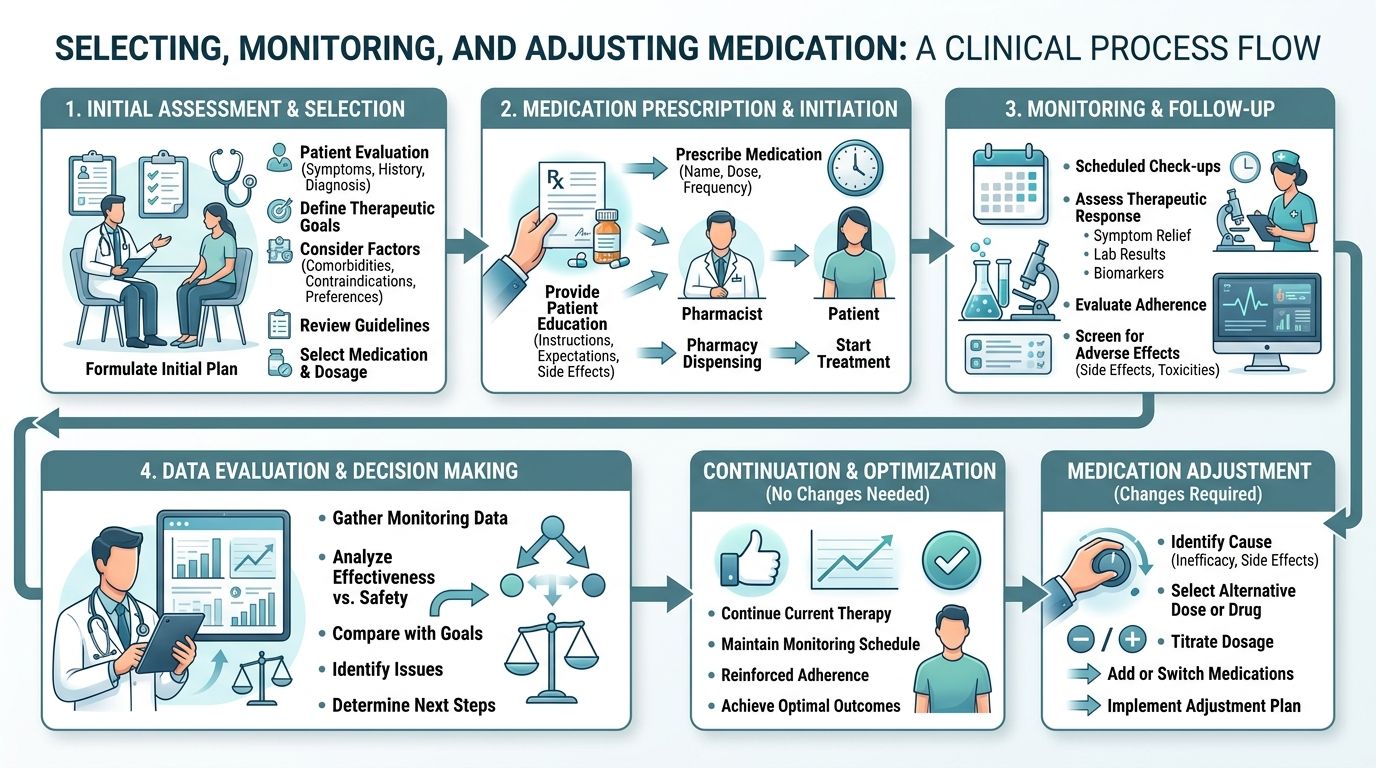
Good medication management is a sequence, not an event. The first prescription is a hypothesis. Monitoring is how clinicians test whether that hypothesis is right.
A practical adjustment pathway
A strong adjustment process usually starts with a few simple commitments.
- Define the target symptoms clearly. “Feel better” is too vague. Fewer panic episodes, less hopelessness, improved sleep, and restored daily function are better markers.
- Track early tolerability separately from benefit. A patient can have transient side effects and still be on the right drug.
- Schedule follow-up around known risk windows. Early treatment and dose changes require closer contact because the first stretch of treatment often determines adherence.
- Decide what counts as partial response. If sleep improves but mood doesn't, that still informs the next move.
That last point matters in routine practice. Prescribers don't just ask whether the medication worked. They ask where movement happened, where it stalled, and whether therapy, substance use, or environment is suppressing progress.
For patients seeking more structured psychiatric follow-up, Casa Recovery's page on psychiatry for mental illness treatment reflects the kind of ongoing medication review that tends to support better adjustment decisions.
When augmentation enters the picture
Some patients do everything right and still don't remit on first-line monotherapy. That's the point where augmentation becomes clinically important rather than theoretically interesting.
In treatment-resistant depression, adding aripiprazole at 2 mg/day to an SSRI produced greater remission rates than SSRI treatment alone, 54% versus 39% at eight weeks, without increased metabolic risk, based on the verified evidence summarized for this article. That doesn't make augmentation a default next step for everyone. It makes it a serious option when an initial antidepressant produces inadequate recovery despite a fair trial.
Other advanced strategies may include referral for neuromodulation or reassessment of the diagnosis itself. The key is not to confuse non-remission with randomness. There is usually a structured next move.
A stalled response should trigger a review of diagnosis, adherence, side effects, therapy engagement, and substance use before it triggers a reflexive medication switch.
Integrating Medication with Casa Recovery Care
Co-occurring anxiety, depression, and substance use create a medication paradox. The same drug that reduces panic or improves mood can also obscure relapse warning signs, worsen sedation, increase misuse risk, or complicate trauma treatment if prescribing happens in isolation.
Casa Recovery's integrated model matters because medication decisions are judged against more than symptom checklists. Prescribers, therapists, and program staff can compare medication effects with day-to-day functioning, including attendance, participation in group work, emotional regulation, craving patterns, sleep, and family conflict. That wider view changes clinical judgment. A partial antidepressant response may look less convincing if alcohol use is rising. A sedating medication may look less acceptable if it reduces anxiety but weakens therapy engagement or daytime functioning.
This approach is especially relevant in dual-diagnosis care, where first-line psychiatric logic often needs revision. A medication that is reasonable in general outpatient psychiatry may be a poor fit when overdose risk, benzodiazepine misuse history, stimulant use, or unstable housing are part of the case. Integrated care allows the team to choose an individualized plan based on competing risks, expected benefit, and the patient's actual treatment setting, rather than treating anxiety or depression as separate from substance use.
Documentation quality also affects safety. Teams treating co-occurring disorders need information that is specific enough to support medication changes, relapse prevention, and therapy planning, without spreading unnecessary personal detail. Resources on de-identification in medical notes are useful because they show how clinical teams can protect privacy while preserving the information needed for coordinated care.
The practical question is not which medication is the best anxiety depression medication. The better question is which medication strategy still makes sense when trauma symptoms, relapse vulnerability, psychotherapy goals, and level of care all need to line up at the same time.
If you're looking for structured outpatient treatment that combines psychiatry, medication management, trauma-informed therapy, and dual-diagnosis care in one setting, Casa Recovery offers PHP and IOP programs in Orange County designed for adults who need more than a disconnected medication appointment.