You may be functioning well on paper while your body remains stuck in the past. You get through work, answer messages, care for your family, and keep appointments, yet a sudden noise, difficult conversation, sleepless night, or unexpected reminder can leave you tense, detached, angry, or unable to concentrate. After living this way for years, many adults wonder whether therapy will help or whether they'll be asked to retell everything from the beginning.
Trauma therapy for adults isn't one fixed procedure. It's an adaptable course of care that can include symptom stabilization, trauma processing, medication support, substance use treatment, relationship work, and gradual transitions between levels of care. The most useful starting point depends on what's happening now, what you've already tried, and what your nervous system can safely tolerate.
Table of Contents
- What Trauma Therapy for Adults Actually Means
- Evidence-Based Modalities and How They Differ
- Levels of Care from Outpatient to PHP and IOP
- What to Expect Week by Week in Treatment
- Co-Occurring Substance Use and Integrated Care
- Choosing the Right Program and Asking the Right Questions
- When Therapy Does Not Seem to Work and What Comes Next
What Trauma Therapy for Adults Actually Means
Trauma therapy is an umbrella term for clinical work that helps an adult process traumatic experiences, reduce trauma-related symptoms, and regain control over daily life. It can address nightmares, intrusive memories, avoidance, panic, irritability, emotional numbness, shame, relationship difficulties, and the feeling that danger is always close.
Trauma exposure is widespread. The World Health Organization's overview of PTSD estimates that around 70% of people worldwide experience a potentially traumatic event during their lifetime. The same source reports that 3.9% of the global population has experienced PTSD at some point in life, while about 5.6% of people exposed to trauma develop PTSD. In settings marked by severe adversity, such as violent conflict or war, PTSD rates rise to 15.3%, according to the WHO.
Those figures help explain why trauma therapy must serve adults with very different histories. Some people have symptoms after a single car crash, assault, medical event, or disaster. Others have lived through prolonged abuse, neglect, coercive relationships, displacement, or repeated exposure to danger. Developmental trauma can begin early in life and influence emotional regulation, self-image, attachment, and expectations of other people.
The label matters less than the current pattern
A diagnosis can guide treatment, but it shouldn't determine the entire plan. A clinician will also look at whether you're sleeping, using substances to cope, dissociating, avoiding reminders, experiencing suicidal thoughts, managing work and relationships, and able to remain present when distress rises.
Someone with a single-incident trauma may be ready for focused memory processing relatively soon. Someone with complex trauma may first need help building stability, recognizing triggers, setting boundaries, and reducing crisis patterns. Neither person is doing therapy incorrectly. Their nervous systems are starting from different places.
Practical rule: Effective trauma care should challenge you without repeatedly overwhelming you.
Trauma-informed care means clinicians account for safety, choice, trust, collaboration, and the effects of trauma throughout treatment. You can learn more about what trauma-informed care involves before contacting a program. Trauma-specialized care goes further by using specific methods designed to treat trauma symptoms and traumatic memories.
Think of treatment as a menu rather than a single prescription. The menu may change as your symptoms change. You might begin with individual outpatient therapy, add psychiatric care or substance use support, step into a more structured program during a difficult period, and later return to less intensive treatment.
Evidence-Based Modalities and How They Differ
Different trauma therapies target different parts of the problem. Some focus directly on traumatic memories, some address beliefs formed after the event, and others help you recognize and regulate physical responses. A responsible clinician won't promise that one method works for everyone.
A 2020 network meta-analysis found that EMDR had one of the largest post-treatment effects compared with a waitlist, with an SMD of -2.07 and a 95% credible interval of -2.70 to -1.44. Trauma-focused CBT also performed strongly, with an SMD of -1.46 and a 95% credible interval of -1.87 to -1.05. Both approaches showed sustained effects at one to four months. These findings come from the UCL record of the network meta-analysis, and they support structured care while still leaving room for individual fit.
What happens in the room
EMDR, or eye movement desensitization and reprocessing, asks you to bring a traumatic memory, associated beliefs, emotions, and body sensations to mind while following bilateral stimulation, often guided eye movements. The therapist helps you notice what arises without requiring a detailed verbal account of every part of the event.
Prolonged exposure uses gradual, planned contact with avoided memories and reminders. The purpose isn't to force you into distress. It's to help your brain learn that remembering or approaching a reminder isn't the same as being in present danger.
Cognitive processing therapy, or CPT, focuses on “stuck points,” such as beliefs that you should have prevented the event, that nobody can be trusted, or that the world is entirely unsafe. You examine these conclusions and develop a more accurate understanding without minimizing what happened.
Trauma-focused CBT combines cognitive work with behavioral strategies. DBT skills, including distress tolerance, emotion regulation, and grounding, can help adults manage intense arousal between processing sessions. Somatic and sensorimotor approaches pay closer attention to posture, movement, breathing, tension, shutdown, and other body-based responses.
The Casa Recovery guide to recommended trauma therapy can help you compare common options, but a clinician still needs to match the method to your history, symptoms, substance use, prior response, and tolerance for structure.
| Modality | What happens in sessions | Best-fit client |
|---|---|---|
| EMDR | Structured memory work with bilateral stimulation | Adults who prefer less detailed verbal retelling |
| Prolonged exposure | Gradual work with avoided memories and reminders | Adults able to practice planned exposure with support |
| CPT | Identifying and revising trauma-related beliefs | Adults troubled by guilt, shame, mistrust, or rigid conclusions |
| Trauma-focused CBT | Cognitive and behavioral strategies for trauma symptoms | Adults seeking a structured skills-and-processing approach |
| Somatic or sensorimotor therapy | Tracking body sensations, impulses, movement, and regulation | Adults whose symptoms are strongly physical or dissociative |
| DBT skills | Practicing grounding, distress tolerance, and emotional regulation | Adults who need stronger coping tools before or alongside processing |
No modality has universal superiority. The right question is whether the approach is evidence-based, appropriately paced, and responsive when your symptoms don't follow the expected path.
Levels of Care from Outpatient to PHP and IOP
Trauma treatment can happen at different levels of intensity. These levels aren't rankings of commitment or personal strength. They're structures designed to provide the amount of support you need while preserving as much independence as is safe.
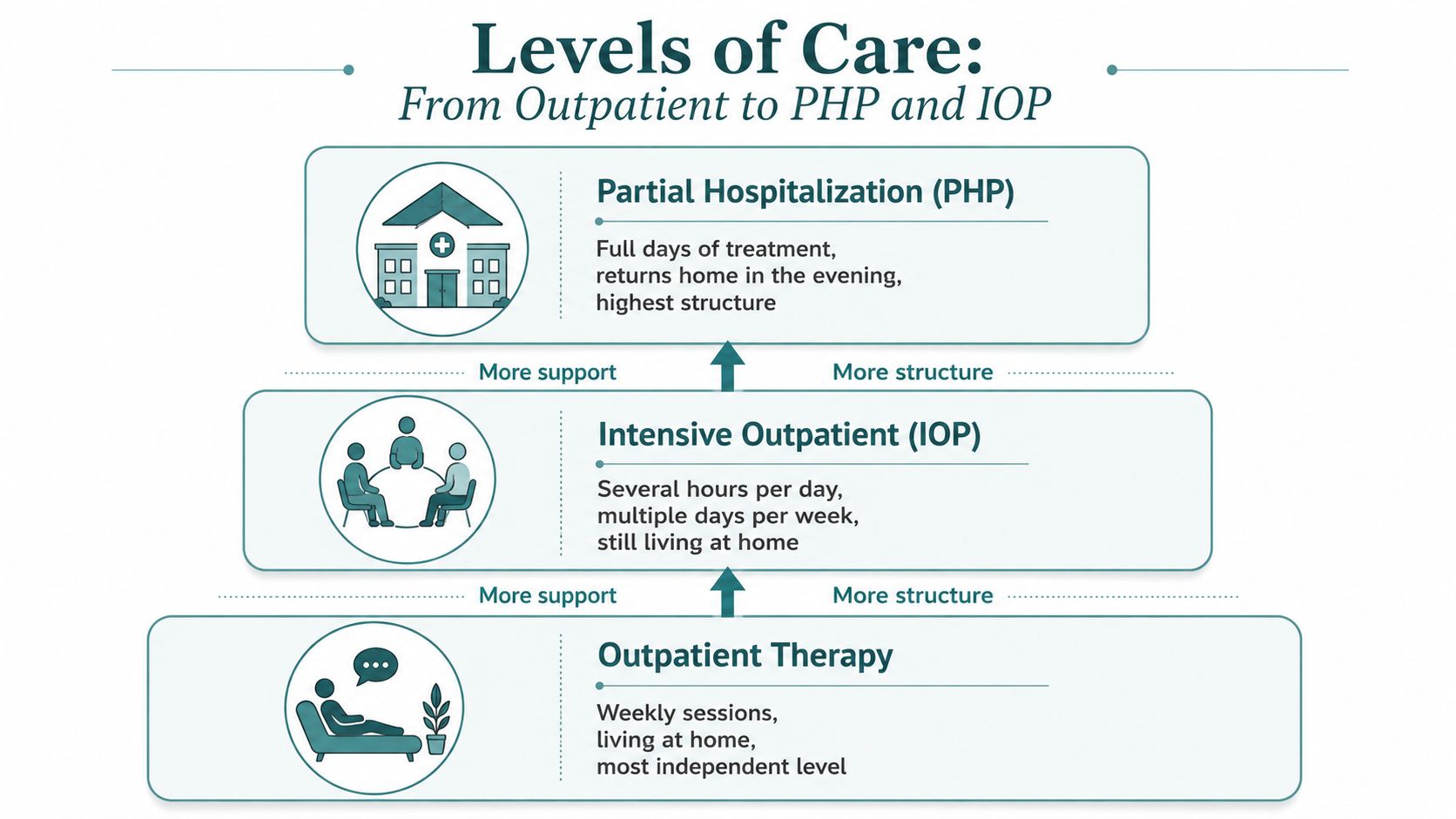
Outpatient therapy usually means meeting with one therapist for individual sessions, often once or twice a week. You live at home, maintain your normal schedule as much as possible, and practice skills between appointments. This can fit adults who are medically and psychiatrically stable but still struggle with trauma symptoms that interfere with sleep, relationships, or work.
Intensive outpatient treatment, or IOP, provides several treatment hours across multiple weekdays. Adults typically participate in a combination of group therapy, individual therapy, psychoeducation, and care coordination while continuing to live at home. IOP can help when weekly therapy isn't enough structure, but a full-day program isn't necessary.
Partial hospitalization, or PHP, offers the highest structure of these outpatient options. Treatment occupies most of the day, may include psychiatric services and medication management, and the client returns home in the evening. PHP can support adults stepping down from residential treatment or those whose symptoms have disrupted daily functioning enough to require close monitoring and coordinated care.
How clinicians choose the starting point
A clinician considers symptom intensity, safety concerns, substance use, medical needs, occupational demands, family support, and your ability to use coping skills outside treatment. You might start in outpatient care and step up if nightmares, panic, substance use, or self-harm urges become harder to manage. You might also begin in PHP and move to IOP, then outpatient therapy, as stability improves.
The difference between IOP and PHP often comes down to daily structure, treatment hours, psychiatric support, and how much supervision you need. A step-down plan should be discussed early, because leaving an intensive program without a clear next level can create an avoidable gap.
A higher level of care isn't a failure of outpatient therapy. It's a change in the support plan.
What to Expect Week by Week in Treatment
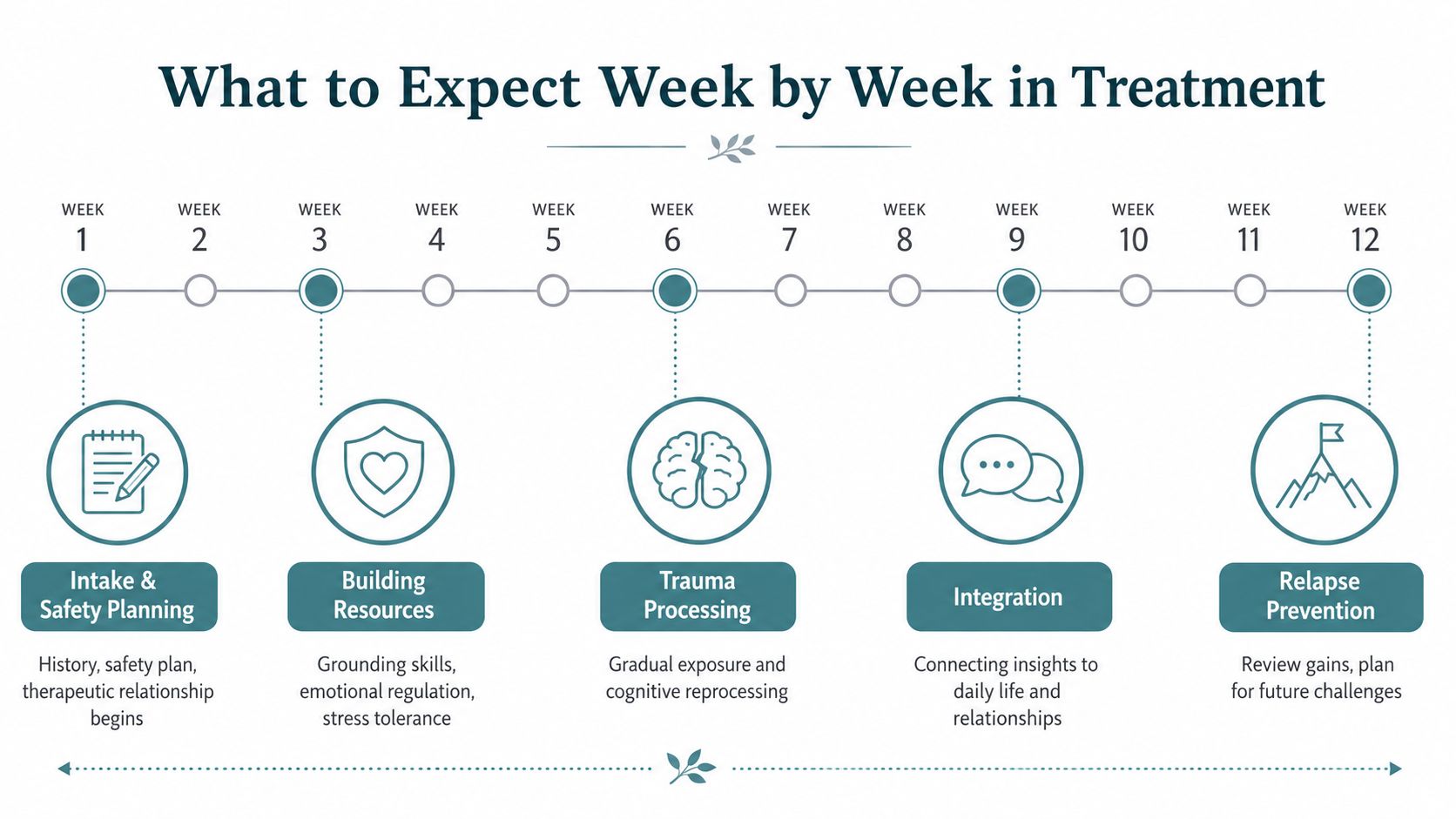
A typical course doesn't move in a straight line, and the exact sequence varies by modality and diagnosis. The following twelve-week arc is a useful orientation, not a promise that every adult will process trauma on the same schedule.
In the first session, expect assessment rather than an immediate deep dive into the worst memory. The therapist may ask about your current symptoms, sleep, medications, relationships, work, substance use, safety, and previous treatment. You'll begin discussing what happens when you become flooded, numb, detached, or unable to calm down.
The early phase builds usable stability
During approximately the second through fourth weeks, sessions may focus on grounding, sleep routines, breathing, emotion labeling, and identifying your window of tolerance. The window of tolerance is the range in which you can think, feel, and remain connected to the present without becoming overwhelmed or shutting down.
You may practice naming five things you see, placing both feet on the floor, using temperature or movement to reduce arousal, or creating a plan for after-hours symptom spikes. For an adult with a job or family responsibilities, these tools matter because distress rarely waits for the next appointment.
Missing a session doesn't erase progress, but it gives the clinician useful information. The team may need to examine transportation, childcare, work demands, avoidance, side effects, or whether the current schedule is realistic.
Processing and consolidation require pacing
Around the middle of treatment, memory reprocessing, exposure, cognitive work, narrative work, or somatic interventions may begin. Some sessions feel productive, while others leave you tired, irritable, or emotionally raw. A difficult week isn't automatically evidence that therapy is harming you, but repeated flooding deserves prompt discussion and a pacing adjustment.
Later sessions focus on applying changes to daily life. You may notice that a reminder still feels unpleasant but no longer controls your behavior, or that you can handle conflict without immediately escaping or attacking. Treatment then turns toward relapse prevention, recognizing early warning signs, maintaining coping routines, and coordinating a transition to less intensive care.
Co-Occurring Substance Use and Integrated Care
Many adults use alcohol, stimulants, opioids, cannabis, or prescription medication to manage hyperarousal, insomnia, intrusive memories, emotional pain, or dissociation. The substance may provide short-term relief while creating additional problems with mood, sleep, cravings, health, relationships, or treatment attendance.
Integrated care addresses trauma and substance use through one coordinated plan. The team may combine trauma therapy, craving management, psychiatric evaluation, medication support, relapse prevention, and skills training. Sequential care treats one condition first, often postponing trauma processing until substance use has stabilized. Parallel care may involve separate providers who don't consistently coordinate, which can leave the adult responsible for connecting conflicting recommendations.
Clinicians historically delayed trauma processing because intoxication, withdrawal, medical instability, or severe cravings can make exposure-based work unsafe or impossible to use effectively. That caution still matters. However, delaying all trauma treatment can also leave the underlying driver of substance use untouched.
A 2023 systematic review concluded that trauma-focused psychological intervention combined with substance use disorder treatment is the most effective approach for PTSD symptoms in adults with both conditions. The review also found that average gains are smaller and dropout is higher than in PTSD-only populations. Its recommendations, available in the systematic review of integrated PTSD and substance use treatment, state that people shouldn't be excluded solely because they have a substance use disorder. Readiness for trauma processing should be assessed individually, with craving management planned before exposure-based work begins.
Readiness is a clinical assessment, not a pass-or-fail test
A person may be ready for stabilization and coping work even when they aren't ready for intensive memory processing. Another adult may be medically stable, motivated, and able to manage cravings with support, making integrated trauma work appropriate sooner.
Medication-assisted treatment, when clinically indicated, can serve as a bridge rather than a barrier. So can a safety plan, withdrawal management, frequent check-ins, family involvement, and a temporary adjustment in treatment intensity.
| Dimension | Integrated care | Sequential care |
|---|---|---|
| Treatment plan | One coordinated plan addresses both conditions | Substance use is treated before trauma work |
| Trauma processing | Begins when clinically appropriate and individually paced | Usually delayed until a sobriety or stability threshold |
| Safety focus | Combines craving, medical, psychiatric, and trauma assessments | Concentrates first on substance-related stabilization |
| Main advantage | Reduces disconnected care and addresses linked symptoms together | Can provide clear stabilization when immediate substance-related risk is high |
| Main concern | Requires skilled coordination and careful pacing | Trauma drivers may remain untreated during the first phase |
Adults with partial prior treatment don't necessarily need to start over. A new team can review what helped, what was intolerable, what remained unfinished, and which supports need to be added.
Choosing the Right Program and Asking the Right Questions
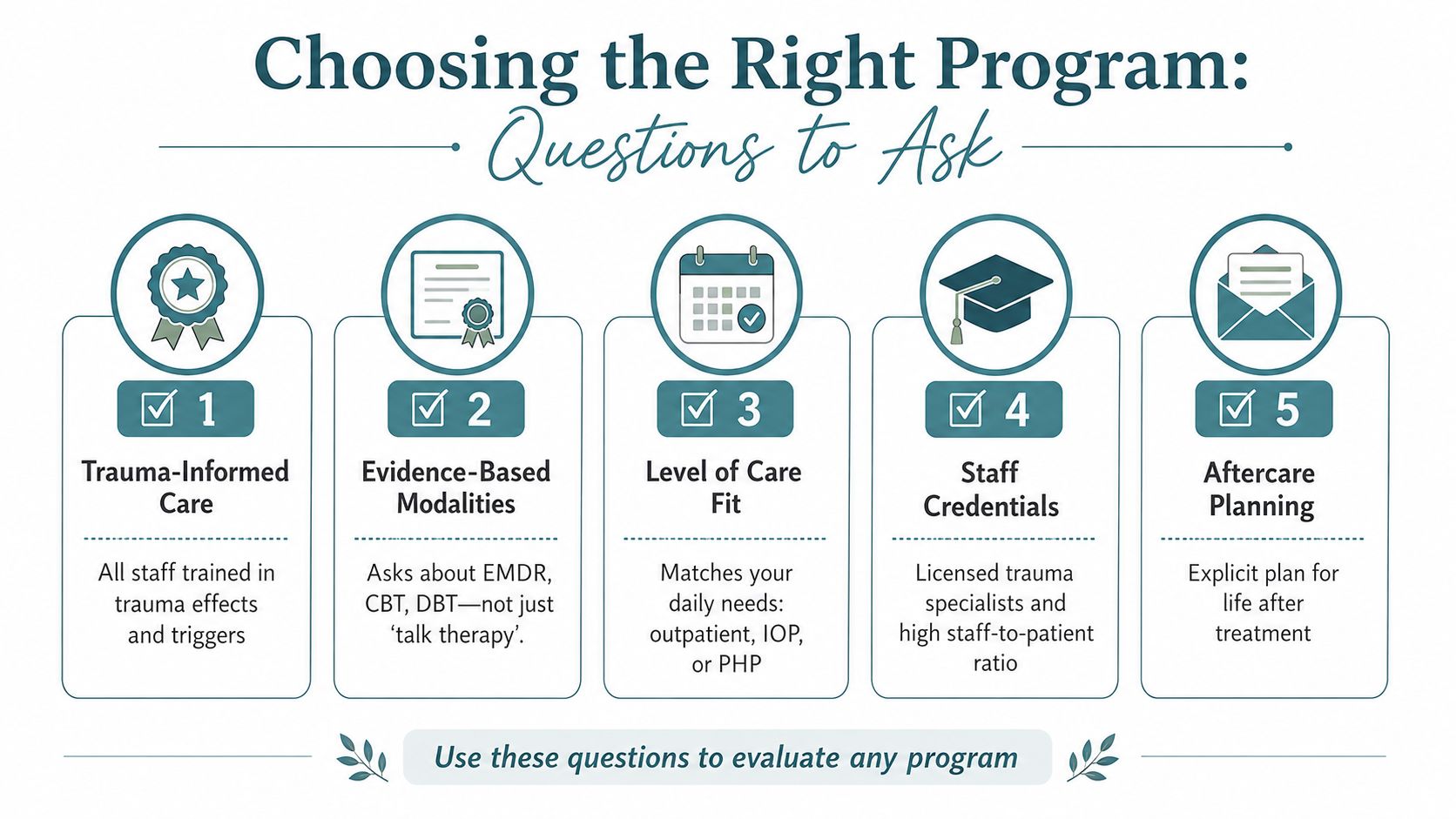
Start by separating trauma-informed from trauma-specialized care. Trauma-informed staff understand how trauma can affect behavior, trust, communication, and emotional regulation. Trauma-specialized clinicians have additional training and experience with particular methods, such as EMDR, CPT, prolonged exposure, DBT-PE, or somatic approaches.
A program can be respectful and safe without offering the modality you need. Ask direct questions before enrolling.
Clinical fit comes first
Confirm that the clinicians are licensed for the services they provide and ask who will manage psychiatric evaluation, medication changes, and urgent concerns. Find out whether the program offers individual trauma therapy, skills groups, family sessions, and care coordination.
Ask whether the team treats co-occurring substance use directly. If you take medication for opioid or alcohol use disorder, need withdrawal support, or have a history of relapse during trauma work, the program should explain how those needs fit into the treatment plan.
Useful intake questions include:
- Modalities: Which trauma therapies do you provide, and what training does each clinician have?
- Pacing: How do you decide when to begin trauma processing?
- Progress: How will we measure improvement in symptoms and daily functioning?
- Adaptation: What happens if the first modality doesn't help or causes too much distress?
- Medication: Are psychiatric evaluation and medication adjustments handled within the program or through an outside provider?
- Family support: Can a partner or family member participate in education, therapy, or planning?
- Attendance: How do you respond to missed sessions, relapse, or a sudden increase in symptoms?
- Transition: What does step-down care look like after PHP or IOP?
Practical details determine follow-through
Ask for insurance verification and a clear explanation of expected out-of-pocket costs before admission. Confirm the location, transportation demands, group schedule, evening availability, and telehealth options. A theoretically appropriate program won't help if the commute, work conflict, or family responsibilities make regular attendance unrealistic.
Adults in Orange County may also want to ask whether a local PHP or IOP can reduce travel and make step-down care easier to maintain. California programs must follow applicable California Department of Health Care Services standards, so ask how the program handles licensing, clinical oversight, medication management, and safety procedures.
Casa Recovery is one Orange County option that offers PHP, IOP, individual and group therapy, psychiatric services, family programming, and integrated treatment for co-occurring mental health and substance use concerns. Its listed modalities include CBT, DBT, EMDR, Brainspotting, Motivational Interviewing, art therapy, and denial management.
When Therapy Does Not Seem to Work and What Comes Next
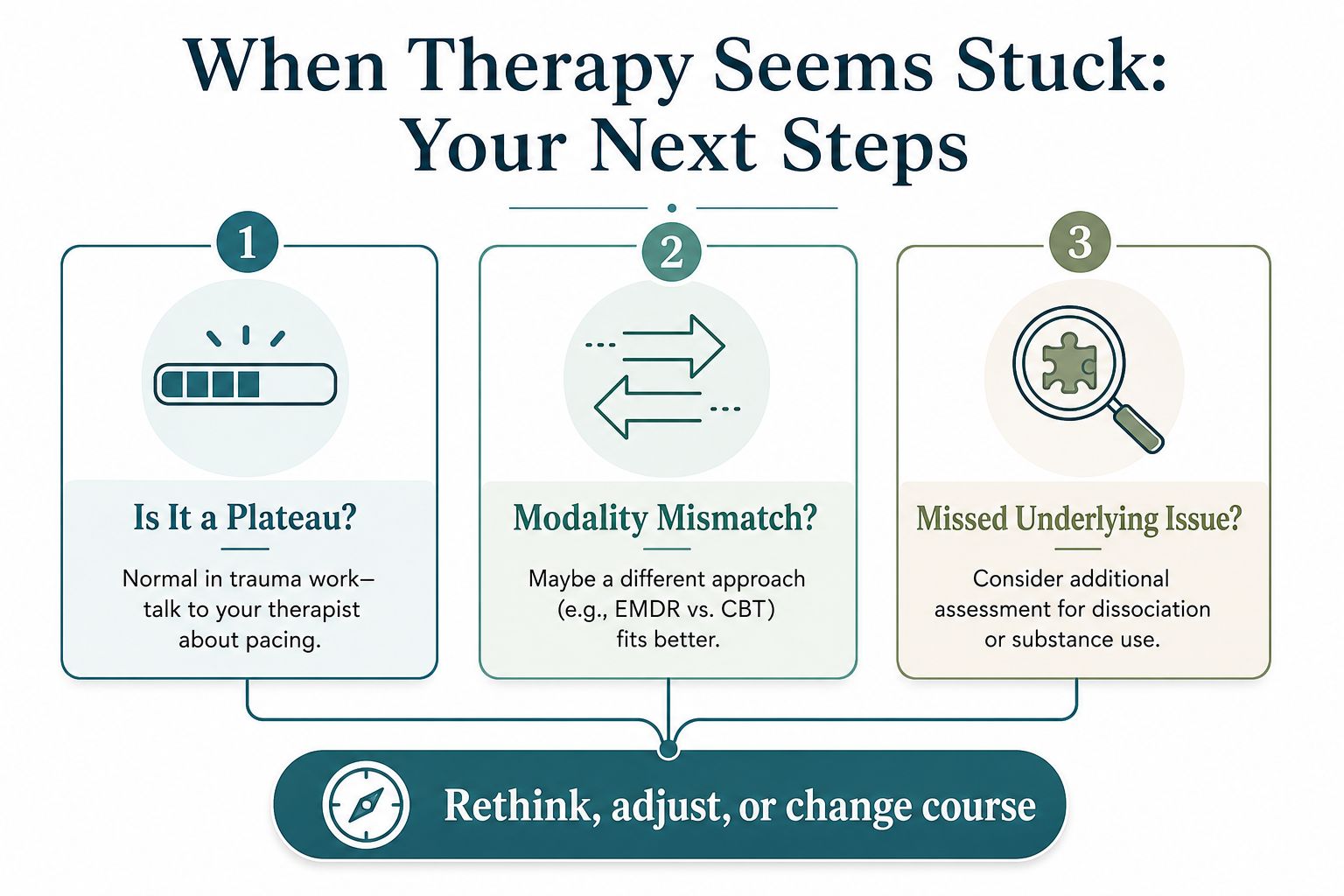
A flat outcome doesn't mean you're incapable of healing. It may indicate a temporary plateau, a mismatch between the method and your presentation, untreated substance use, insufficient structure, an unrecognized dissociative pattern, or a therapeutic relationship that never became secure enough for difficult work.
Reviews continue to describe trauma-focused therapy dropout at about 17% to 21% across trials, according to the 2026 UKPTS research review. The same review cites civilian non-response at around 39% overall. These figures shouldn't be used to predict your outcome, but they do challenge the idea that starting an evidence-based therapy guarantees quick remission.
Review the treatment rather than blaming yourself
Ask what happened in the prior course of care. Did you receive structured trauma treatment, or mainly supportive conversation? Did sessions include skills for managing arousal between appointments? Was substance use treated at the same time? Did you stop because of side effects, scheduling, cost, worsening symptoms, or a lack of trust?
The trauma type may also matter. A method that fits a circumscribed event may need modification when symptoms involve prolonged exposure to danger, developmental trauma, chronic shame, dissociation, pain, depression, or unstable relationships.
Recalibration creates more options
A clinician may slow the pace, change modalities, add medication management, increase the level of care, or coordinate substance use treatment. A second opinion can clarify whether the previous course was incomplete or whether a different formulation makes more sense.
For complex PTSD and treatment-resistant cases, recent reviews increasingly emphasize phase-based or integrated approaches rather than relying on pure exposure alone. An ISTSS-linked review of traumatic stress treatment also describes major access barriers in low- and middle-income settings and identifies options such as TMS and vagus nerve stimulation as emerging rather than settled first-line treatments. That distinction matters. Newer technology may be worth discussing in selected circumstances, but established trauma-focused psychotherapy remains central to routine care.
A stalled treatment is information. It tells you what needs to be reassessed, not what you're worth.
You may need more structure, a different therapist, integrated dual-diagnosis support, or a period focused on stabilization before processing resumes. Recovery rarely follows a perfectly smooth line, but recalibrated care can create a workable starting point without erasing the progress you've already made.
Casa Recovery offers adults in Orange County structured PHP and IOP treatment, trauma-focused psychotherapy including EMDR, psychiatric support, family programming, and integrated care for co-occurring substance use. Visit Casa Recovery to review your options and request guidance on the level of care that fits your current needs.