You're halfway through an ordinary conversation when your chest tightens. A harmless question sounds threatening, your thoughts speed up, and you snap before you've decided to respond. Later, after the tension passes, you may feel exhausted, numb, and unable to move from the couch. You might wonder whether you're too sensitive, too angry, or just lazy.
The window of tolerance offers a different explanation. It describes the range of nervous-system arousal in which you can feel emotions, think clearly, connect with other people, and respond to stress without becoming flooded or shutting down. Trauma can push you outside that range, sometimes into intense activation and sometimes into collapse. Understanding the pattern can reduce shame, but it shouldn't replace a careful clinical assessment.
Table of Contents
- Recognizing When You Have Left Your Window of Tolerance
- The Neurobiology Behind the Window of Tolerance
- Signs of Hyperarousal and Hypoarousal
- How Trauma Narrows Your Regulation Capacity
- Evidence-Based Strategies to Expand the Window
- When a Narrow Window Is Not the Whole Story
- How Structured Outpatient Programs Support Trauma Recovery
Recognizing When You Have Left Your Window of Tolerance
A person outside their window may look inconsistent from the outside. In the morning, they're sending urgent messages, arguing over small details, and checking the door repeatedly. By evening, they're staring at the ceiling or scrolling without absorbing anything. Both states can come from the same nervous system trying to manage perceived danger.
Hyperarousal often feels like too much energy with nowhere safe to go. Your heart may race, your muscles may stay tense, and your mind may search for threats. You might interrupt people, become unusually irritable, replay a conversation, or lie awake because your body doesn't feel permitted to rest.
Hypoarousal moves in the opposite direction. You may feel emotionally flat, detached from your body, foggy, or unable to start basic tasks. A person in this state may care about an appointment but still be unable to shower, answer a message, or make a simple decision.
Trauma-related symptoms can include both patterns, as described in this overview of PTSD signs and symptoms. The nervous system doesn't always choose one response permanently. A conflict can produce agitation first and numbness later, or a person can move between the states during the same day.
A useful reframe: Your reaction may be protective rather than defective. That doesn't mean every reaction is harmless, but it does mean shame isn't a treatment plan.
The middle zone isn't a state of constant calm. You can still feel grief, anger, fear, or excitement while staying connected to the present. The difference is access to choice. Inside the window, you have a better chance of pausing, noticing what's happening, and selecting a response that fits the situation.
Start by tracking patterns rather than assigning yourself a permanent label. Note what happened, what you felt in your body, whether you became activated or disconnected, and what helped you return. That information can give a trauma-informed clinician a more useful picture than the statement “I'm dysregulated.”
The Neurobiology Behind the Window of Tolerance
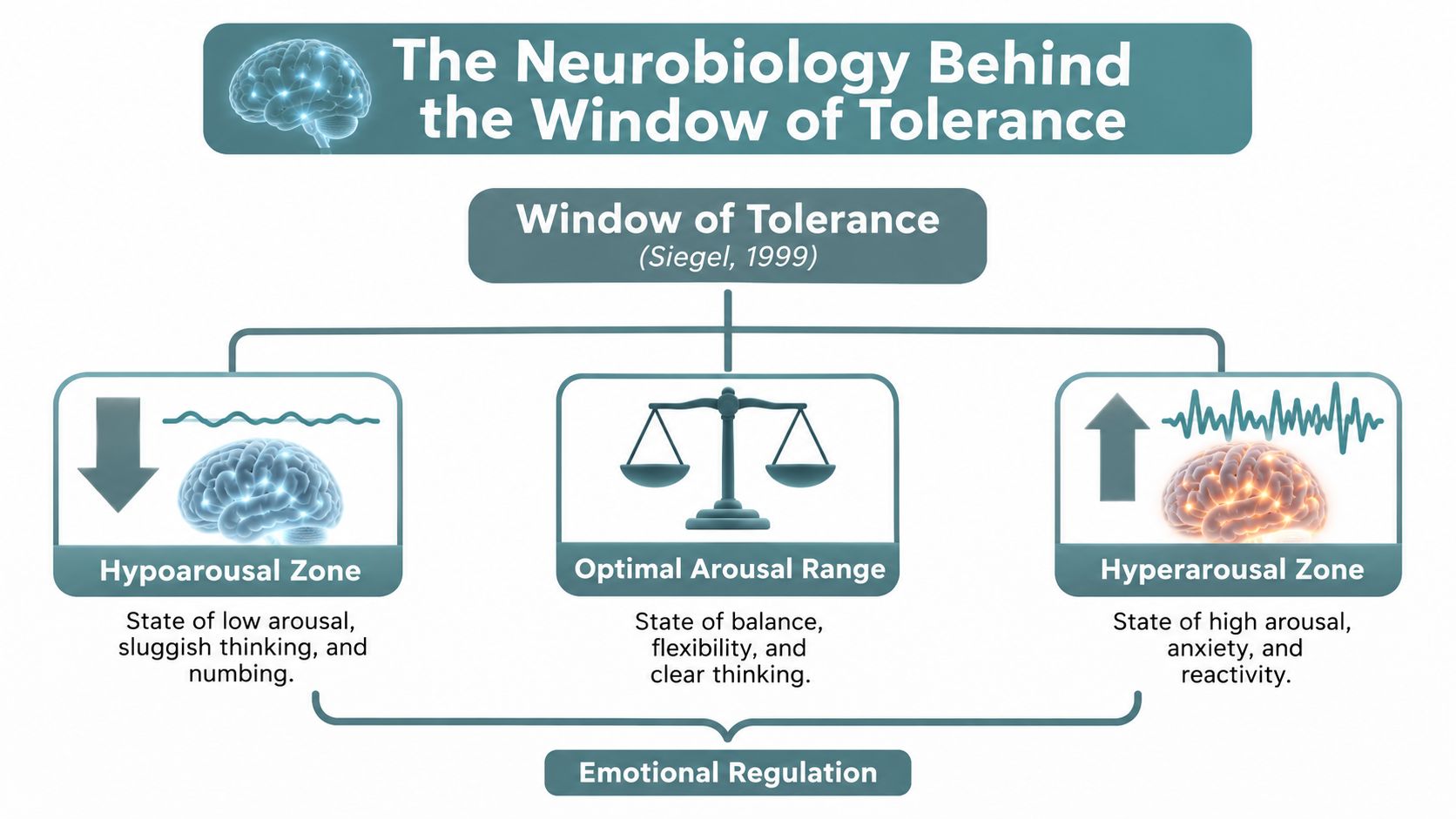
Psychiatrist Daniel J. Siegel is widely credited with the phrase “window of tolerance,” commonly associated with his 1999 book The Developing Mind. The model describes an optimal arousal range in which a person can process emotions and respond to stress without becoming overwhelmed or shutting down, as outlined in this historical and clinical explanation of the window of tolerance.
A thermostat makes the idea easier to understand. A comfortable room isn't defined by one exact temperature. It has a usable range. When the temperature moves too high, the system needs cooling. When it drops too low, the system needs warming. Your nervous system also responds to changing conditions, although human arousal is shaped by memory, context, bodily state, and relationships.
The upper edge
Hyperarousal is associated with sympathetic activation, the pattern commonly described as fight or flight. The body prepares for action. Attention narrows toward possible danger, breathing may change, muscles may tighten, and thinking can become quicker but less flexible. That response can be useful during an immediate threat, yet disruptive when it continues after the threat has passed.
The lower edge
Hypoarousal involves a reduction in energy, connection, or awareness. People may describe freezing, shutting down, or dissociating. The experience isn't “being relaxed.” A regulated person can remain present and responsive, while someone in hypoarousal may feel unreachable even to themselves.
The model is dynamic, not a permanent personality description. Sleep, current stress, social safety, physical health, and treatment response can all affect where your edges sit on a particular day. Later trauma education connected the framework with autonomic regulation, polyvagal theory, and skills-based stabilization, while also emphasizing that the model is clinically useful without being a numeric scale.
Social connection can offer another practical clue. When you're regulated, you may find it easier to make eye contact, hear another person's tone accurately, ask for help, and stay curious during disagreement. Polyvagal theory has influenced how clinicians discuss these patterns, though the window of tolerance itself remains a broad clinical framework rather than a standardized laboratory measurement.
Signs of Hyperarousal and Hypoarousal
The two states can look opposite, but neither should be diagnosed from a checklist alone. A symptom may arise from trauma, anxiety, sleep disruption, depression, medication effects, substance use, or a medical condition. Look for patterns, triggers, duration, and changes in functioning.
| Hyperarousal Signs | Hypoarousal Signs |
|---|---|
| Racing thoughts and rapid internal speech | Brain fog and slowed thinking |
| Irritability, anger, or emotional outbursts | Emotional numbness or flatness |
| Panic sensations or intense fear | Dissociation or a sense of unreality |
| Hypervigilance and threat scanning | Feeling disconnected from the body |
| Muscle tension and restlessness | Fatigue and reduced initiative |
| Difficulty falling or staying asleep | Social withdrawal and reduced engagement |
| Impulsive reactions or urgent problem-solving | Trouble making decisions or completing tasks |
| Feeling constantly “on edge” | Feeling checked out or distant |
Hyperarousal often brings a strong urge to do something immediately. You may demand reassurance, send several messages, clean obsessively, leave a conversation, or confront someone before you know what you need. The body can interpret uncertainty as an emergency, even when the present situation is manageable.
Hypoarousal often removes the sense of urgency altogether. You may understand that a bill, meal, or work task matters, yet feel no usable energy behind that knowledge. Dissociation can make time feel strange or leave you aware of events without feeling fully present.
Some people alternate between the two. A survivor may become intensely alert after hearing a familiar sound, then lose contact with their emotions once the reaction becomes too strong. A family member might misread the first state as aggression and the second as indifference, when both may reflect nervous-system protection.
A short observation can help: “Am I flooded, absent, or present enough to choose?” If you're flooded or absent, postpone major decisions when possible and use support rather than forcing yourself through the episode.
How Trauma Narrows Your Regulation Capacity
Persistent stress and trauma can narrow the window of tolerance, while safety and healing can widen it, as described in this trauma education resource on autonomic regulation. Repeated threat activation teaches the nervous system to detect danger quickly and return to baseline slowly. A relatively small trigger can then produce a response that seems much larger than the present event.
This pattern is especially relevant for people with relational trauma histories, including childhood abuse, neglect, domestic violence, or early medical trauma. Research discussing the relationship between trauma and autonomic dysregulation has examined childhood abuse, adult PTSD, chronic dysthymia, and chronic anxiety disorders in relation to these patterns (reviewed clinical findings).
Adaptation, not a life sentence
A narrowed window is an understandable adaptation to repeated unsafety. The body is attempting to prevent another overwhelming experience, not deliberately making daily life difficult. That adaptation can change, but change usually depends on repeated experiences of safety, reliable co-regulation, and treatment paced to the person's capacity.
Co-occurring substance use or mood instability can make the cycle more complicated. A person may use alcohol or another substance to quiet activation, then experience more disrupted sleep, emotional volatility, or withdrawal-related distress. Someone with significant mood symptoms may also need psychiatric assessment alongside psychotherapy, rather than treating every shift as a trauma trigger.
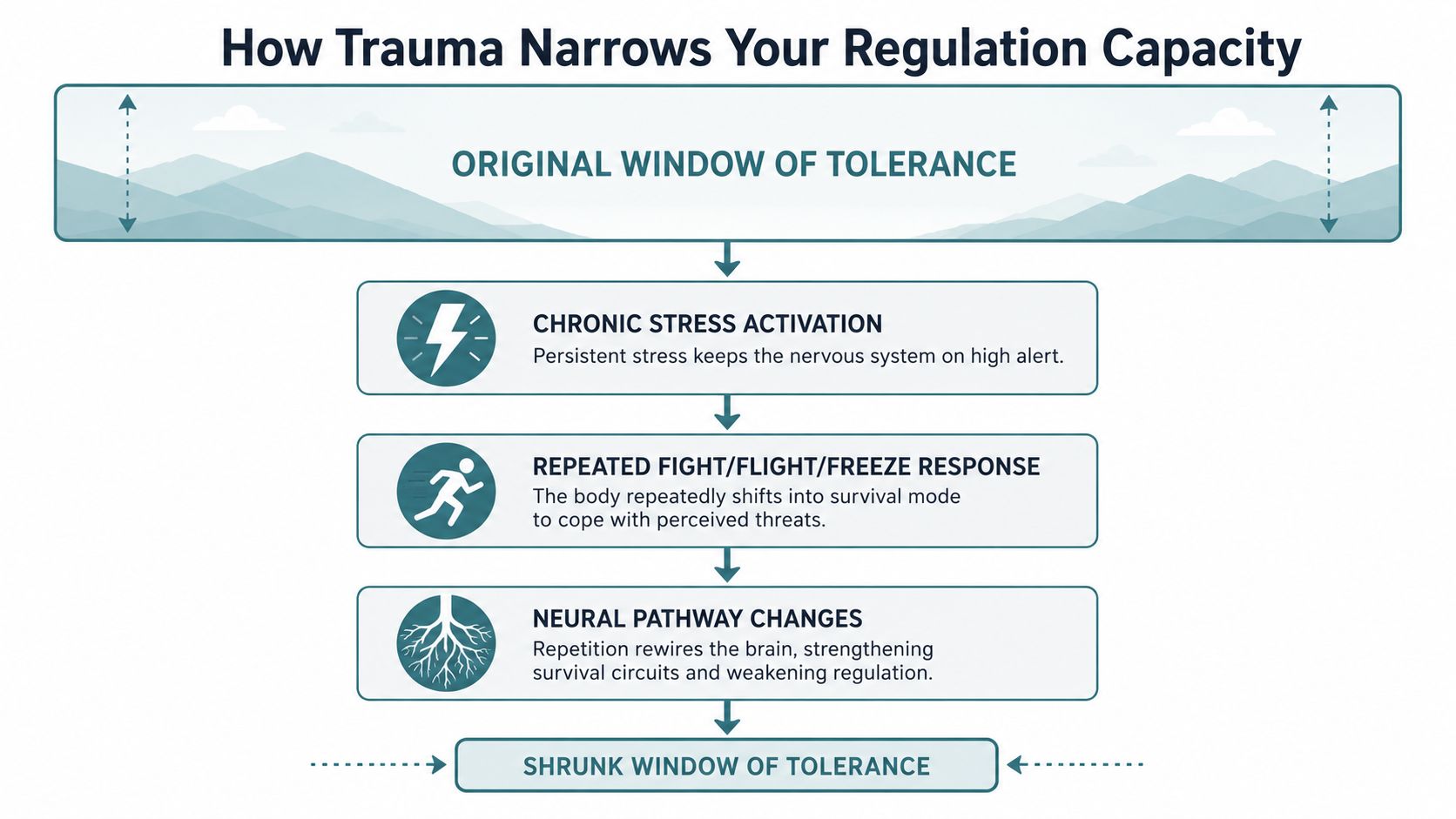
This is why many trauma clinicians use phased care. Stabilization comes before intensive memory processing. The person learns to notice activation, return to the present, tolerate manageable emotion, and use support before therapy asks them to approach the most painful material.
Clinical principle: Processing should be paced to the client's ability to remain oriented, connected, and within a tolerable range of arousal.
Evidence-Based Strategies to Expand the Window
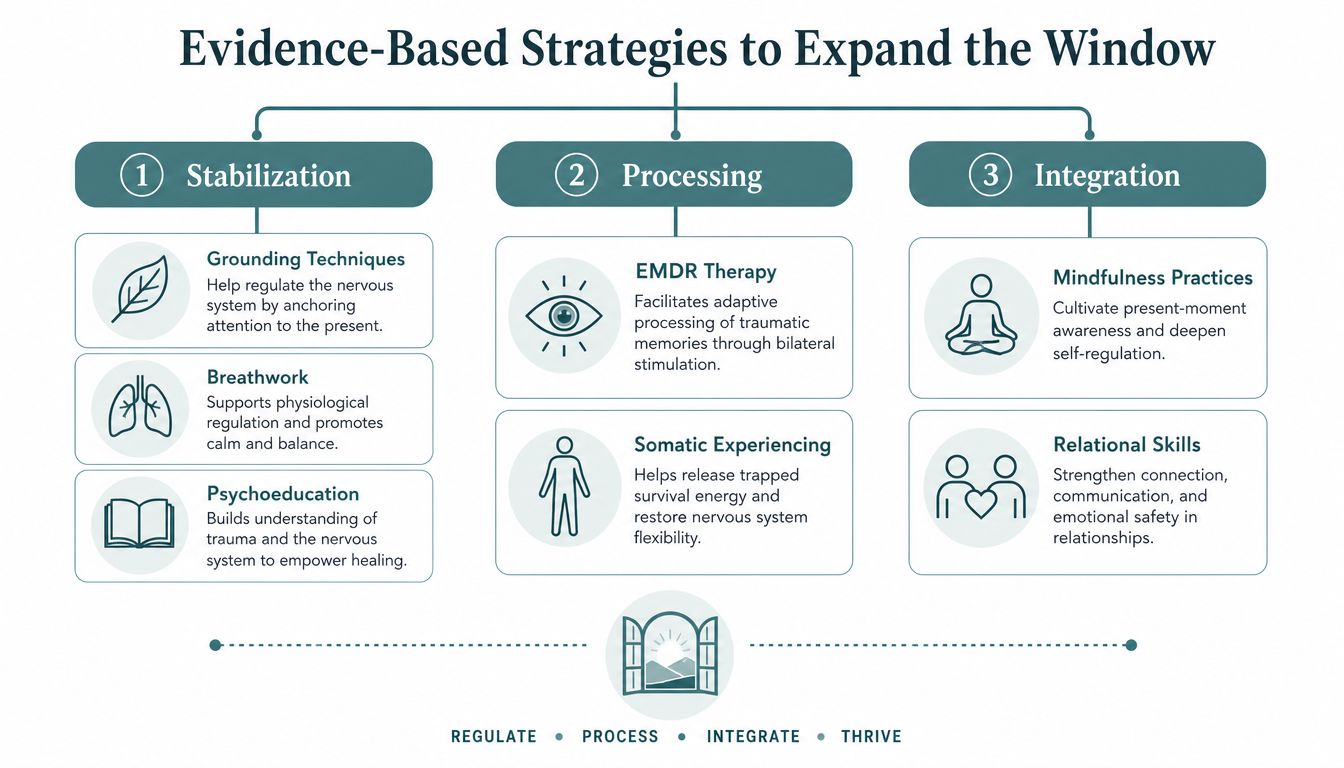
Expansion doesn't mean becoming immune to stress. It means developing more capacity to notice activation, remain present with manageable discomfort, and return to regulation after leaving the window. Trauma therapy guidance emphasizes stabilization, titration, graded exposure, mindfulness, somatic tracking, and co-regulation rather than forcing emotional intensity (psychotraumatology guidance on the window of tolerance).
Begin with stabilization
Grounding gives the brain current sensory information. Press your feet into the floor, describe objects in the room, notice the support of the chair, or hold a textured item. If you're dissociating, orienting to the room may be more useful than closing your eyes and focusing inward.
Breathwork can also support regulation, but it isn't universally calming. Some people with panic become more distressed when they monitor breathing closely. Try a gentle, unforced exhale and stop if the exercise increases fear, dizziness, or disconnection.
Somatic tracking means observing sensations without immediately interpreting them as danger. You might notice warmth in your face, pressure in your chest, or tension in your jaw and describe the experience in neutral language. A therapist can help you distinguish observation from flooding.
For more practical examples, review these nervous-system regulation tips. Safe relationships matter as much as solo skills. A calm person who listens without escalating can help you stay oriented while your body settles.
Move toward processing carefully
Once stabilization is dependable enough, a clinician may consider trauma-focused methods. EMDR can support reprocessing of traumatic memories, while Cognitive Behavioral Therapy can address interpretations such as “I'm always in danger” or “I can't trust anyone.” Dialectical Behavioral Therapy teaches distress tolerance, emotional regulation, and interpersonal skills.
Somatic approaches, including Somatic Experiencing, focus on physical cues and pacing. Brainspotting is another trauma-focused approach some programs use. The appropriate method depends on symptoms, history, dissociation, current safety, and the clinician's assessment.
Medication doesn't expand the window by itself, but psychiatric evaluation may identify conditions or symptoms that interfere with sleep, mood stability, anxiety control, or substance-use recovery. Medication management can be coordinated with therapy when clinical assessment indicates it may help.
Practice integration in ordinary life
Integration happens when skills become usable outside the therapy room. You might pause before replying to a difficult message, recognize that you're becoming flooded, and ask for a break instead of escalating. You might notice shutdown earlier and take a small orienting action, such as standing, turning on a light, or contacting a safe person.
Keep the practice modest. A regulation exercise that works during mild activation may fail during severe dissociation or panic. That doesn't mean you've failed. It means the level of support needs to match the level of dysregulation.
When a Narrow Window Is Not the Whole Story
The window of tolerance is helpful, but it's often presented with more precision than the evidence supports. The model is difficult to measure objectively, and it doesn't provide universally accepted biomarkers or standardized thresholds, as discussed in this recent expert critique of the framework.
That matters because “my window is narrow” can become a catch-all explanation. Panic disorder, dissociation, burnout, depression, medication effects, sleep problems, substance use, and medical conditions can overlap with trauma-related arousal. A trauma history may be relevant without being the sole cause of every symptom.
Ask what changes the pattern
A dynamic view is more useful than a fixed label. Does the reaction appear mainly after trauma reminders, or does panic arise unexpectedly? Do you lose continuity of memory or sense of identity, or are you just exhausted after prolonged demands? Does sleep restore some capacity, or does the problem persist regardless of rest and context?
These questions don't diagnose anything. They help identify what deserves professional evaluation. Social safety, sleep, current stress, and treatment response can all shift arousal, so a difficult week doesn't prove permanent nervous-system damage.
The model also can't tell you how much care you need. Seek prompt clinical support if dissociation persists, daily functioning is seriously impaired, self-harm thoughts appear, or substance use has become your primary way to regulate. If you're in immediate danger or may act on thoughts of harming yourself, contact emergency services or a crisis service in your area.
Remember: A nervous-system framework should open the door to assessment, not close it with a self-diagnosis.
How Structured Outpatient Programs Support Trauma Recovery
A person may understand grounding skills yet still become overwhelmed by a trauma reminder, miss sleep, misuse substances, or lose contact with daily routines. Complex trauma often needs a dependable treatment setting where clinicians can observe these shifts and adjust care. Structured outpatient programs may combine stabilization, skills practice, psychiatric assessment, medication coordination, individual psychotherapy, group support, and family involvement without making trauma processing the first or only step.
Treatment usually proceeds in phases. Early work can focus on safety, sleep, substance-use assessment, emotional regulation, and practical routines. As the client can remain present for longer, clinicians may consider EMDR, Brainspotting, CBT, DBT, or individual trauma psychotherapy. Co-occurring substance use or mood instability calls for integrated care, since treating trauma alone may leave the regulation cycle unchanged.
Family sessions address the environment surrounding the client. Relatives can learn to read irritability, withdrawal, or numbing as signs of a changing nervous-system state rather than evidence of bad character. Communication planning can then reduce avoidable escalation and support recovery between appointments.
Casa Recovery provides trauma-informed outpatient services, including Partial Hospitalization and Intensive Outpatient care, mental health treatment, dual-diagnosis support, psychiatric services, individual and group therapy, and family programming. Adults considering structured support can learn more about Casa Recovery's mental health IOP.

A suitable program should explain how it assesses symptoms, paces trauma work, treats co-occurring conditions, coordinates medication, and measures progress through daily functioning. Needing structured help to stay safe, connected, and functional is information about the level of support required, not a personal failure.
Casa Recovery offers structured outpatient mental health and dual-diagnosis care with trauma-informed therapy, psychiatric coordination, skills-based groups, and family support. Visit Casa Recovery to explore available programs and request guidance about an appropriate level of care.