You've found a mental health program that seems appropriate, and you have an insurance card in your hand. The next question sounds simple: “Is this covered?” In outpatient mental health and dual-diagnosis care, that question has several parts. Your policy may be active, yet your plan might require authorization for Partial Hospitalization Program (PHP), limit Intensive Outpatient Program (IOP) benefits, or treat the facility as out of network.
The insurance verification process is designed to uncover those details before treatment begins. A careful review can clarify eligibility, benefits, authorization requirements, network status, and possible patient responsibility, giving the family and admissions team a more realistic path forward.
Table of Contents
- Why Insurance Verification Takes Longer Than You Expect
- How the Insurance Verification Process Works Step by Step
- Documents and Information You Need to Provide
- Why Active Coverage Does Not Guarantee Treatment Approval
- Common Pitfalls and How Patients Can Avoid Them
- How Verification Results Shape Your Treatment Plan
- What to Expect When Casa Recovery Verifies Your Coverage
Why Insurance Verification Takes Longer Than You Expect
A parent calls a treatment center after a difficult night. Their adult child needs structured mental health care, perhaps with support for substance use as well. The family provides the insurance card, answers intake questions, and expects a quick confirmation. Instead, the admissions coordinator explains that verification may take time.
That pause can feel frustrating, especially when the need for treatment is immediate. The coordinator may be checking the policy through a payer portal, speaking with an insurance representative, confirming behavioral health benefits, and determining whether PHP or IOP requires separate authorization. The team also needs to match the patient's identity and policy information precisely, because a small discrepancy can produce an inaccurate eligibility result.

What happens during the waiting period
Verification isn't a single yes-or-no question. The admissions team may need to establish:
- Active coverage: Whether the policy is in force for the anticipated admission and service dates.
- Behavioral health benefits: Whether the plan includes outpatient mental health and substance use treatment.
- Level-of-care coverage: Whether the plan recognizes PHP, IOP, or another outpatient category.
- Network status: Whether the facility participates in the plan, and whether out-of-network benefits apply.
- Authorization rules: Whether the payer requires clinical review before treatment starts.
- Patient responsibility: How deductibles, coinsurance, copayments, and exclusions could affect the family.
The distinction matters because eligibility errors can quickly lead to denials, rework, and delayed care. One industry review reported that up to 20% of initial claims contain eligibility errors, while denial rates increased by 23% over three years, according to the industry review of insurance verification in healthcare.
Practical rule: A delay before admission is often safer than a rushed answer that creates a surprise bill or leaves authorization incomplete.
A thorough review protects the patient from assuming that an active policy guarantees payment. It also helps the provider identify missing information before clinical staff build a treatment schedule around coverage that may not apply. The goal isn't to slow care. It's to make the financial and administrative pathway clear enough that treatment can begin with fewer avoidable interruptions.
How the Insurance Verification Process Works Step by Step
At a specialized mental health facility, verification usually follows a sequence. Each step answers a different question, and the later steps depend on the accuracy of the earlier ones.
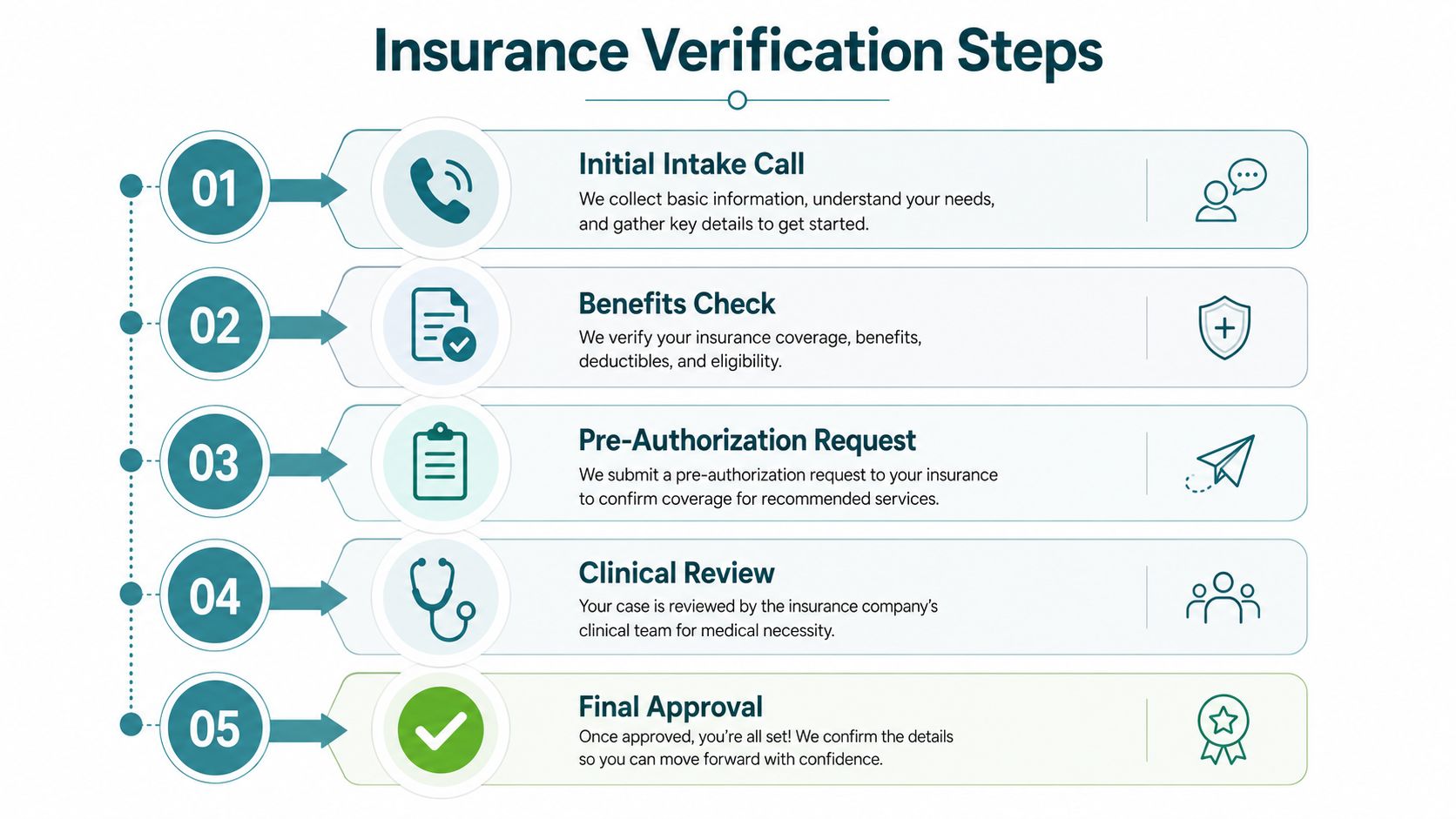
Step 1, the initial intake call
The process begins with a conversation about the patient's symptoms, treatment history, safety concerns, substance use, and current needs. The admissions coordinator also gathers the patient's legal name, date of birth, contact details, policy information, and the type of program being considered.
This conversation gives the clinical and admissions teams context. Someone needing full-day structure may be considered for PHP, while someone who can maintain more independence may be evaluated for IOP. Insurance verification doesn't replace clinical assessment, but it helps the team understand which benefits and authorization rules may apply to the proposed care.
Step 2, the benefits check
The coordinator contacts the payer through an online portal or by phone. The review typically checks whether the policy is active, which company manages behavioral health benefits, and whether the facility is in network.
The team then asks about the specific service category. Inpatient care, standard outpatient therapy, PHP, and IOP aren't interchangeable because they all involve mental health treatment. The coordinator may also check deductibles, coinsurance, visit limitations, exclusions, and out-of-network terms.
Step 3, the authorization request
If the payer requires prior authorization, the facility prepares the information needed for review. That may include the diagnosis, symptoms, functional impairment, treatment history, proposed services, and clinical rationale for the requested level of care.
Step 4, the clinical review
A payer's clinical reviewer evaluates whether the requested treatment meets the plan's criteria. The reviewer may approve the request, ask for additional information, authorize a different level of care, or decline the request.
Step 5, the final approval and patient briefing
The admissions team records the determination and explains what it means. A confirmation should identify the approved service, applicable dates, network status, authorization conditions, and any estimated patient responsibility. Families should remember that an authorization is not always a guarantee of final payment. Claims still depend on accurate billing and the plan's terms.
Documents and Information You Need to Provide
Verification can't start reliably without accurate inputs. Before calling a treatment center, gather the insurance card, a photo ID, policyholder information, and any clinical or referral documents connected to the admission.
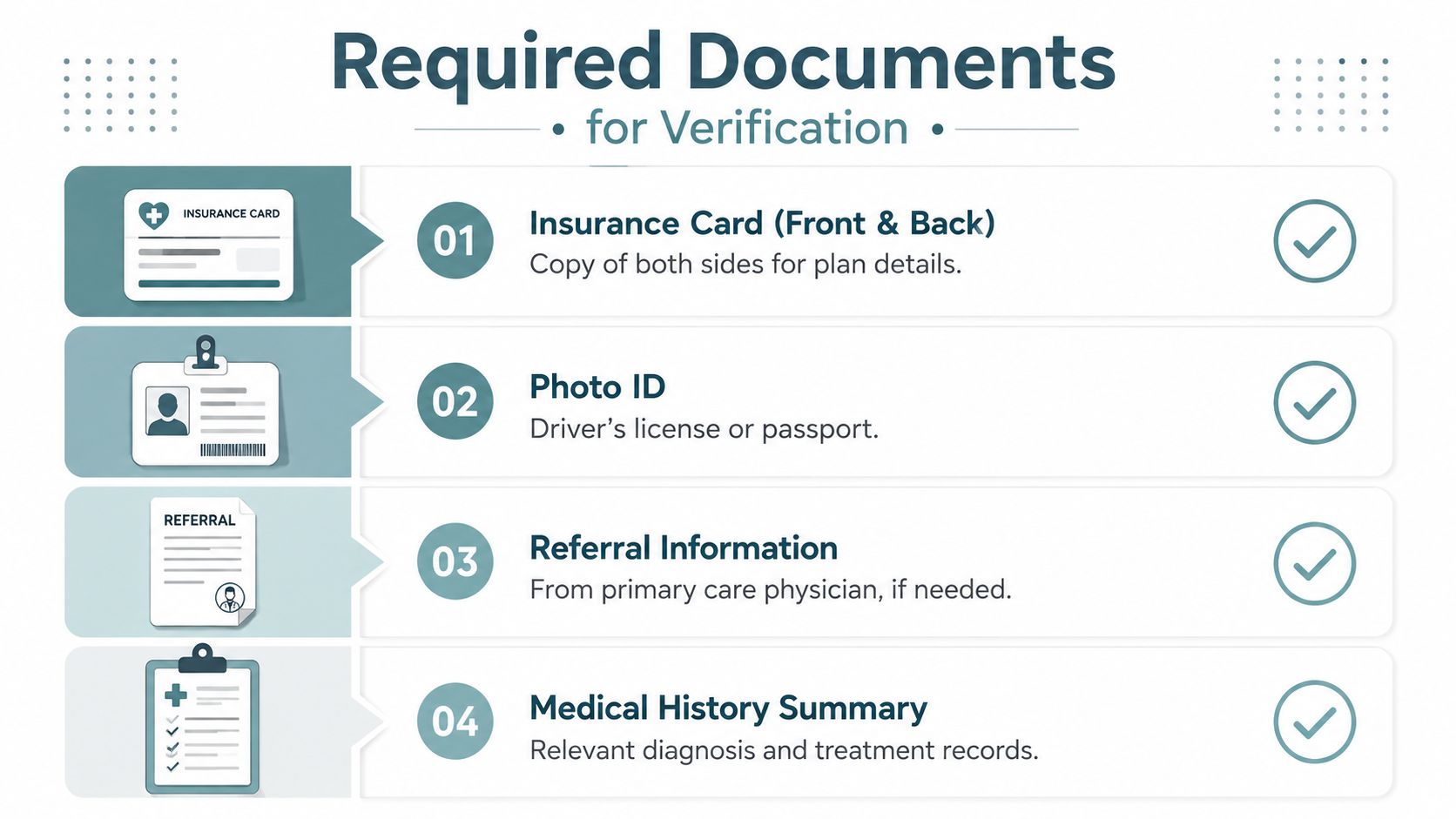
The insurance card
Provide clear images of the front and back of the card. The front may show the member ID, group number, payer name, and policyholder details. The back may list claims or behavioral health contact information. If the card has changed, send the newest version rather than relying on an older file.
Policyholder details
The patient may not be the policyholder. The admissions team may need the policyholder's full legal name, date of birth, employer information, and relationship to the patient. This helps the payer match the request to the correct account.
Personal identifiers
Give the patient's legal name exactly as it appears in the payer's system, along with the date of birth and current address. Some payers or verification workflows may also request a Social Security number. Ask how sensitive information will be transmitted, and use the facility's secure process rather than sending personal data through an unprotected channel.
Clinical and referral records
A referral from a primary care physician may be required by the plan or may help establish the reason for treatment. A concise medical history, current medication list, prior treatment information, and relevant diagnosis records can help the clinical team describe the requested PHP or IOP level accurately.
Small data errors can create large delays. A misspelled name, incorrect member ID, or outdated address may return an inactive result even when coverage exists.
Use a written checklist before the call. If the plan has a separate behavioral health administrator, provide those details too. Families can also review Casa Recovery's admissions payment information so they know what financial questions to raise during the conversation.
Why Active Coverage Does Not Guarantee Treatment Approval
A family may receive an “active” result during verification, then learn that the insurer will not approve the proposed PHP or IOP at the selected facility. The result confirms that the policy exists for the relevant date. It does not confirm that the plan will pay for this level of outpatient mental health or dual-diagnosis care.
It helps to separate the review into distinct checks: eligibility, benefits, network status, and authorization. Casa Recovery's mental health insurance coverage information can help families identify the insurance questions to raise before treatment begins.
| Review | Main question | What can still go wrong |
|---|---|---|
| Eligibility | Is the policy active for the relevant date? | The policy may be inactive, changed, or assigned to another payer. |
| Benefits | Does the plan include the requested service? | PHP, IOP, mental health, and substance use benefits may follow different rules. |
| Network | Is the facility participating? | Out-of-network coverage may be limited or unavailable. |
| Authorization | Does the payer approve the proposed care? | The payer may request records, change the level, or decline the request. |
These checks matter because outpatient therapy and structured programs are often handled differently. A plan may cover routine counseling but apply separate criteria to PHP. It may cover behavioral health treatment while requiring another company to manage authorization. A dual-diagnosis program can also prompt questions about how mental health and substance use services are classified under the policy.
Prior authorization is a significant control point across major U.S. coverage markets. A 2026 KFF analysis found that insurers denied 12% of standard prior authorization requests in Medicare Advantage, 14% in Medicaid managed care, and 18% in ACA Marketplace plans, as reported in KFF's analysis of prior authorization metrics. Denial rates varied among insurers within those markets, so the patient's specific plan can matter as much as the broad insurance category.
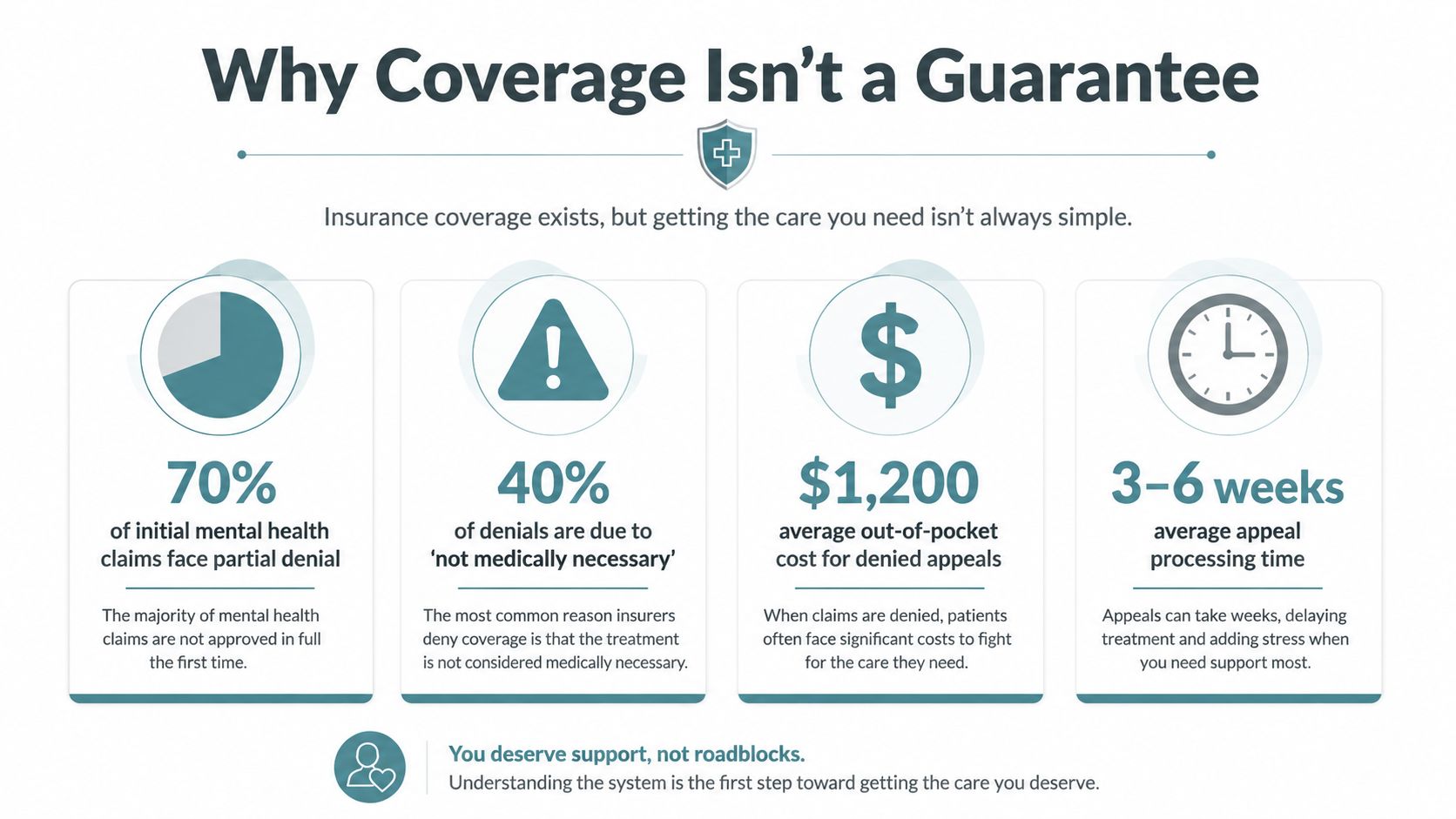
Washington's prior authorization reporting requirements also show why denial volume, approval rates, and turnaround times affect access to care. The Washington prior authorization report places authorization delays in the broader context of healthcare access. For someone seeking PHP or IOP, the practical question is whether the plan recognizes the proposed care as covered, appropriate, authorized, and payable at the selected facility.
Common Pitfalls and How Patients Can Avoid Them
Most verification problems come from assumptions. Families may hear “mental health is covered” and reasonably believe every mental health service follows the same rules. Payers often separate services by setting, intensity, provider status, diagnosis, and authorization requirements.
Ask about the exact program
Don't ask only whether behavioral health is covered. Ask whether the plan covers Partial Hospitalization Program services, Intensive Outpatient Program services, dual-diagnosis treatment, psychiatric care, group therapy, and medication management. Request the payer's terminology for the service because the facility and insurer may describe the same program differently.
Confirm network status and alternatives
Ask whether the facility is in network for the specific plan, not just the insurance company's brand. If it's out of network, ask about the deductible, coinsurance, reimbursement method, single-case agreements, and whether the plan requires an in-network alternative first.
Start before the admission date
Eligibility and benefits can change after an appointment or admission is scheduled. One workflow benchmark recommends checking coverage at scheduling and re-checking about 48 hours before the visit, particularly for plans with higher coverage turnover such as Medicaid and ACA Marketplace products, as described in this automated insurance verification workflow guide.
Find the behavioral health administrator
An employer-sponsored plan may use a separate behavioral health organization. The medical insurance card might not display the contact information needed for mental health authorization, so ask the insurer who manages behavioral health benefits.
Get the result in writing
Record the representative's name or reference number, the date of the call, and the answers given. Ask the admissions team what remains pending. If a referral is required, contact the referring clinician promptly. If authorization is delayed, ask whether the facility can submit additional clinical information or clarify the requested level of care.
How Verification Results Shape Your Treatment Plan
Verification results influence treatment planning because they connect clinical need with payer rules. The clinical team may recommend PHP because the patient needs full-day structure, frequent monitoring, psychiatric support, and coordinated therapy. The payer may authorize that level, request more documentation, or approve IOP instead.
That outcome doesn't automatically end the treatment conversation. The admissions team and clinicians can compare the authorized benefit with the patient's actual needs and discuss a safe, clinically appropriate path.
Three common planning outcomes
PHP is authorized. The patient can begin the structured program, subject to the authorization dates and any continued-stay review. The team should track those conditions rather than assume the approval remains open indefinitely.
IOP is authorized or clinically appropriate. IOP can provide recurring therapy, skills work, psychiatric support, and step-down structure while the patient continues living outside the program. If symptoms or functional difficulties indicate a need for more intensity, clinicians may submit updated documentation for PHP review.
The requested service isn't covered as expected. The family may explore out-of-network benefits, a different participating provider, a single-case agreement, a revised authorization request, or another payment arrangement. The appropriate option depends on safety, clinical need, plan language, and available resources.
This is why verification is more than a billing task. It helps the admissions and clinical teams set realistic expectations before treatment starts, while giving the family a chance to ask about cost exposure and continuity of care. The plan should never be built around an unconfirmed assumption that “active” means “approved.”
What to Expect When Casa Recovery Verifies Your Coverage
When a family contacts Casa Recovery, the admissions conversation begins with the patient's needs and the type of support being considered. The team gathers insurance details, reviews the potential PHP, IOP, mental health, or dual-diagnosis pathway, and contacts the payer to clarify eligibility, benefits, network status, and authorization requirements.
The admissions coordinator should explain what has been confirmed and what remains subject to payer review. If the plan doesn't cover the exact service or facility as expected, the family can discuss out-of-network terms, authorization questions, and available financial options instead of discovering the gap after treatment begins.
Casa Recovery provides outpatient mental health and dual-diagnosis programming, including PHP and IOP, with psychiatric evaluation, medication management, individual therapy, group treatment, and family involvement. Its insurance verification and admissions page gives families a direct starting point for submitting coverage information and asking specific questions about the next step.
The most useful preparation is simple: have both sides of the insurance card available, use the patient's exact legal information, identify the policyholder, gather relevant clinical records, and describe the level of care being considered. A clear verification result won't remove every payer decision, but it can replace uncertainty with a documented plan.
Casa Recovery offers structured PHP and IOP care for adults seeking outpatient mental health and integrated dual-diagnosis treatment, with admissions support that helps clarify benefits and authorization requirements. Visit Casa Recovery to begin a confidential conversation about insurance verification and appropriate next steps.