You're lying in bed, replaying a conversation that ended hours ago. Your body feels tired, but your mind keeps producing one more worry, one more self-criticism, or one more possible disaster. Opening a blank notebook sounds simple until you realize you don't know whether to vent, analyze the thought, list what you're grateful for, or avoid the topic completely.
Journaling for mental health can help create enough distance to notice what's happening inside you. It isn't a cure, a replacement for treatment, or a requirement to write beautifully. Used with the right structure and pacing, it's a practical skill for emotional awareness, coping, and communication with your care team.
Table of Contents
- Why Journaling for Mental Health Works and What to Expect
- Choosing the Right Journaling Format for Your Goals
- Building a Sustainable Journaling Routine That Sticks
- Staying Safe With Trauma Informed Journaling Practices
- Using Journaling Alongside Therapy PHP IOP and Medication
- Your Next Seven Days and When to Reach Out for Support
Why Journaling for Mental Health Works and What to Expect
Writing can turn a tangled internal experience into something you can observe. You might begin with, “I feel awful,” then notice that the feeling includes fear about tomorrow, shame about a mistake, tightness in your chest, and a need for reassurance. Naming those pieces doesn't erase them, but it can make the experience less shapeless.
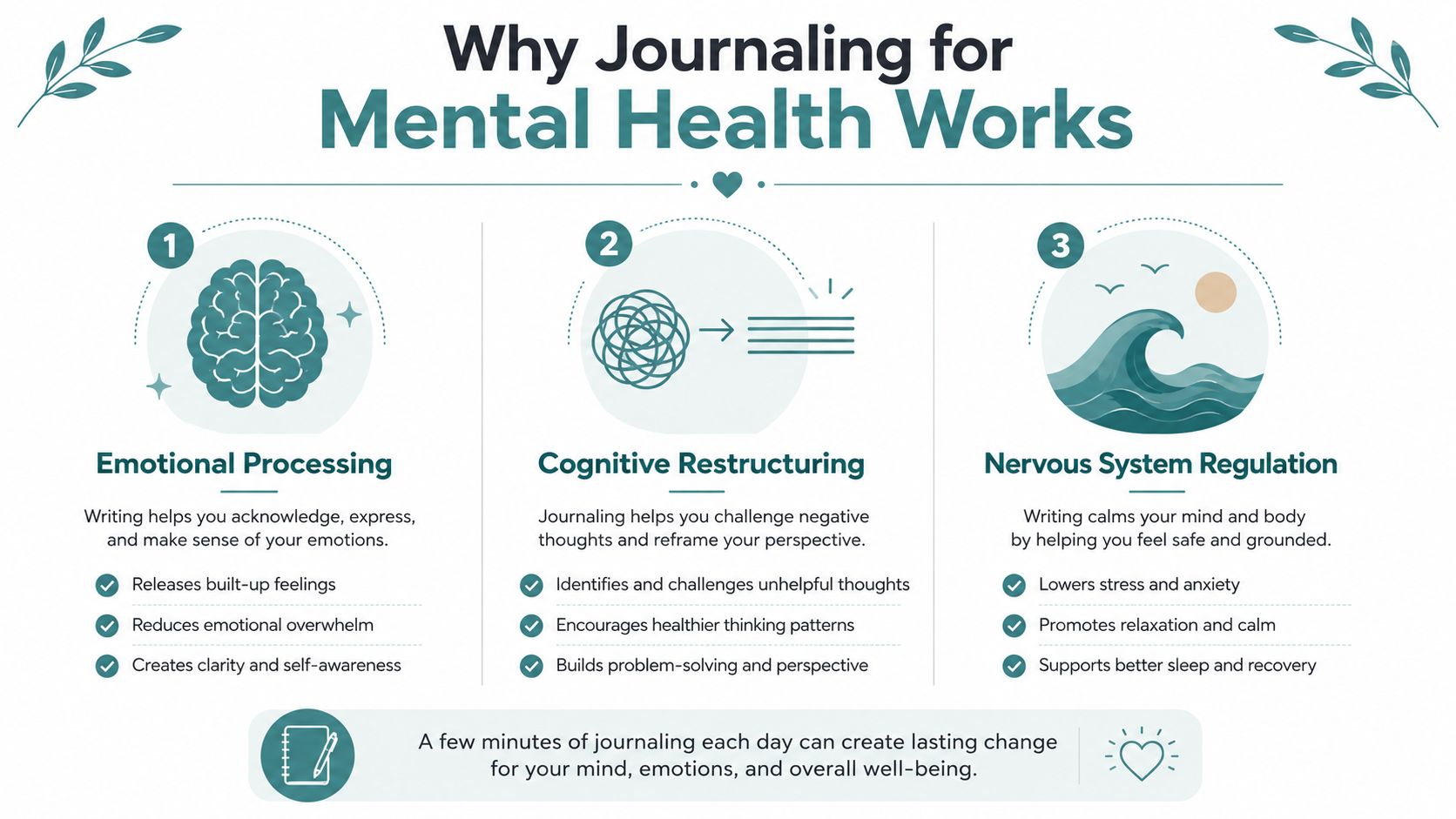
Three processes often make structured writing useful:
- Emotional processing: You put feelings, sensations, and needs into words instead of leaving them to circulate as an undifferentiated alarm.
- Cognitive restructuring: You examine an automatic thought, the evidence supporting it, and a more balanced response.
- Nervous system regulation: Slowing down, orienting to the present, and pairing reflection with grounding can help you shift from immediate reaction toward deliberate choice.
A 2022 meta-analysis of journaling interventions found an average statistically significant 5% reduction in mental-health symptom scores compared with control groups, with larger average effects for anxiety at 9% and PTSD at 6%, and a smaller effect for depression at 2%. The findings are a useful reminder that journaling can produce measurable benefits while still being modest, especially when compared with the expectations people sometimes place on self-help practices. Read the 2022 meta-analysis of journaling interventions for the full clinical context.
The evidence for expressive writing is similarly nuanced. A 2023 meta-analysis of 31 experimental studies involving 4,012 participants found a small but significant overall effect on depression, anxiety, and stress symptoms, with Hedges' g = -0.12 and a 95% confidence interval of [-0.21, -0.04]. The same source contrasts that result with an earlier 2006 meta-analysis that found no meaningful long-term health effect, showing why journaling should be viewed as a targeted adjunct rather than a guaranteed treatment. The 2023 expressive writing meta-analysis explains that shift toward smaller, more carefully interpreted effects.
A useful mindset: The purpose isn't to produce an impressive entry. The purpose is to notice what you need and choose a helpful next response.
Journaling may fit you if you want a private way to identify patterns, prepare for therapy, or practice a specific coping skill. It may not fit in its current form if writing consistently leaves you flooded, dissociated, compulsively checking your thoughts, or unable to sleep. You can adjust the method, shorten the session, or ask a clinician to help you choose a safer format. Mindfulness can also complement this work, as described in how mindfulness affects mental health.
Choosing the Right Journaling Format for Your Goals
A blank page asks you to make too many decisions at once. A format gives the writing a job. Choose one primary method based on your current goal, rather than switching among every style in a single sitting.
Expressive writing for emotional processing
Expressive writing gives you room to describe an emotionally difficult experience, the feelings connected to it, and what it means to you. It can be useful when you're carrying grief, anger, shame, or a major transition and need language for the experience.
A simple entry might read:
“I'm angry that I had to act fine today. Under the anger, I feel lonely and afraid that asking for support will burden people. What I need tonight is quiet, food, and one honest text to someone safe.”
This format doesn't require graphic trauma detail. If a memory feels destabilizing, write about present-day emotions, body sensations, triggers, or needs instead.
CBT thought records for anxious or depressive thinking
A CBT thought record is more analytical. It separates the event from the interpretation your mind attached to it.
Use this sequence:
- Situation: My supervisor sent a short message.
- Automatic thought: I'm in trouble and everyone thinks I'm incompetent.
- Emotion and intensity: Fear and shame, described in your own words.
- Evidence: What supports the thought, and what doesn't?
- Balanced response: A short message doesn't prove I'm in trouble. I can ask for clarification and wait for more information.
- Next action: Reply tomorrow after reviewing the request.
The aim isn't forced positivity. It's accuracy and flexibility.
DBT diary cards for emotion regulation
A DBT diary card tracks what happened in a day, including emotions, urges, behaviors, and skills used. It's particularly useful when your treatment includes distress tolerance, mindfulness, emotion regulation, or interpersonal effectiveness.
An entry could include:
- Emotion: panic and anger
- Trigger: conflict with a family member
- Urge: send several angry messages
- Skill used: paced breathing and a pause before responding
- Outcome: the conversation continued later with fewer accusations
- Skill to practice: describe feelings without judging the other person
Gratitude and strengths-based prompts
Gratitude writing focuses attention on support, meaning, or moments of relief. It shouldn't be used to dismiss pain. You can acknowledge a difficult day and still record one thing that helped, such as a safe conversation, a meal, a walk, or the decision to rest.
| Format | Best for | Time per entry | Watch outs |
|---|---|---|---|
| Expressive writing | Emotional processing and life transitions | A brief, contained session | Avoid forcing detailed trauma narration |
| CBT thought record | Anxiety, self-criticism, and rigid interpretations | A focused review of one situation | Don't turn it into endless reassurance-seeking |
| DBT diary card | Emotion tracking, urges, and skills practice | A short daily check-in | Track patterns without judging yourself |
| Gratitude or strengths prompts | Wellbeing, support, and benefit-finding | A few focused lines | Don't use gratitude to silence real distress |
The best format is the one that matches the problem in front of you. The 2022 review found clearer signals for anxiety and PTSD than for depression, so someone with depression shouldn't interpret a limited response as personal failure. Journaling works best when it supports a broader plan that may include therapy, medication, skills training, and clinical monitoring.
Building a Sustainable Journaling Routine That Sticks
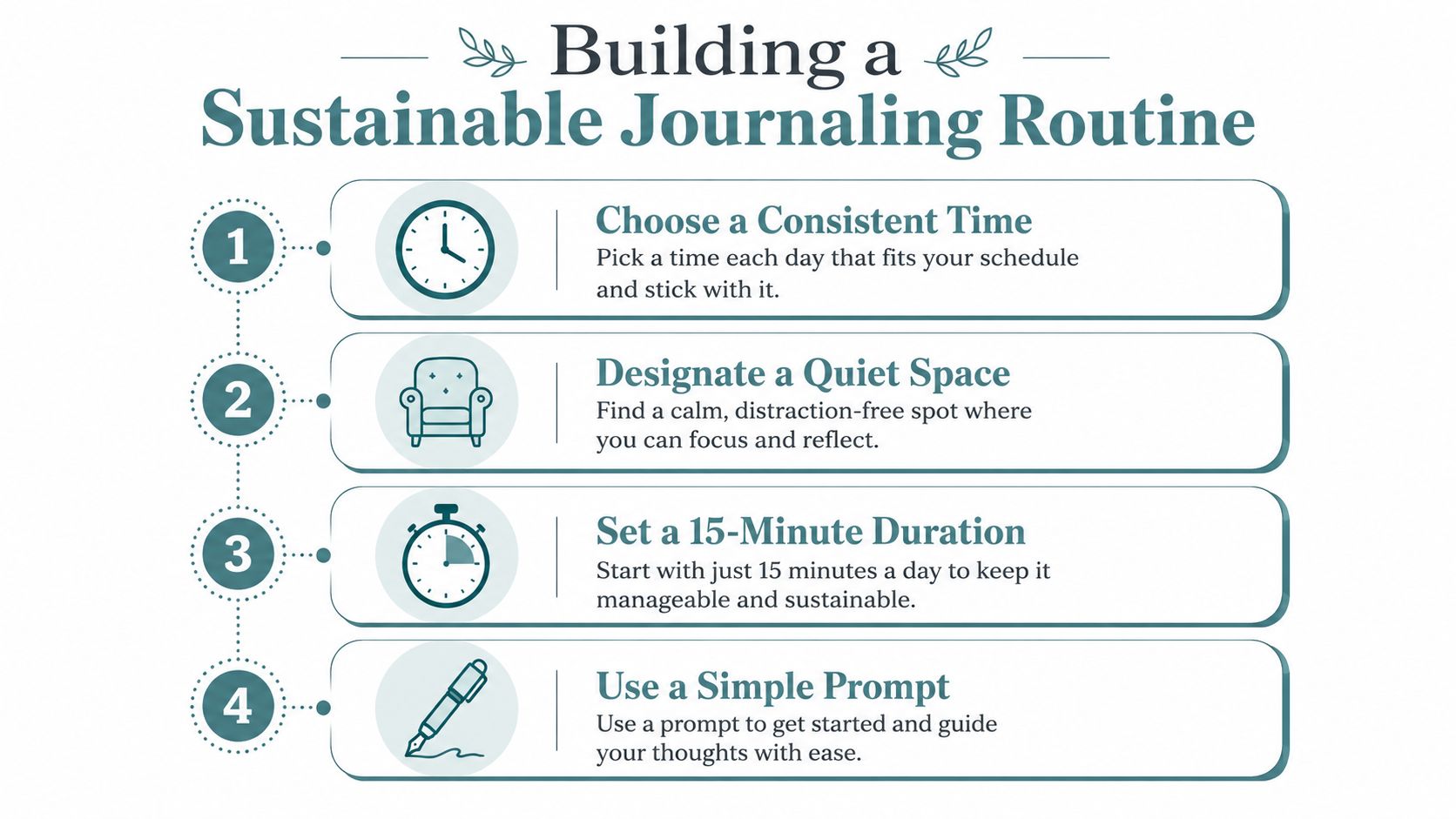
A routine becomes sustainable when it asks little enough of you on difficult days and still gives you useful information. Pick a consistent time connected to something you already do, such as after brushing your teeth, during a scheduled break, or before a therapy appointment. Keep the notebook, phone, or computer where you'll see it, and protect privacy with a locked device or a secure physical location.
Many included journaling trials used short, scheduled writing sessions repeated over multiple weeks, often with prompts related to emotional processing or benefit-finding, as described in the systematic review and meta-analysis of 20 randomized controlled trials. A practical adaptation is a 15-minute session, but you can shorten it when your energy or safety requires that.
Three formats in daily use
| Goal | Opening prompt | What to write | Closing question |
|---|---|---|---|
| CBT reflection | “What happened, and what did I tell myself it meant?” | Separate facts, automatic thoughts, feelings, evidence, and a balanced response | “What action fits the facts?” |
| DBT tracking | “What emotion or urge is strongest right now?” | Note triggers, urges, behaviors, skills, and outcomes | “What skill might help next time?” |
| Expressive processing | “What am I carrying emotionally?” | Describe feelings, sensations, needs, and meaning without forcing a solution | “What would help me feel more supported?” |
Try this structure tonight:
- Arrive: Write the date and one sentence about your current state.
- Focus: Choose one prompt, not every concern in your life.
- Reflect: Notice the emotion, thought, body sensation, and need.
- Close: Record one grounding action or practical next step.
On a low-motivation day, use a minimum entry: “Today I feel ____. My body feels ____. One thing I need is ____.” A short entry still gives you a point of contact with yourself. If perfectionism appears, deliberately stop after the planned time rather than expanding the entry to make it feel complete.
You can also use a weekly rhythm that leaves room for flexibility. For example, use a thought record after a distressing event, a diary card for brief daily tracking, and expressive writing only when you have enough stability and support. Don't make journaling another test you can fail.
Digital tools can make entries searchable and convenient, while paper may feel less distracting. AI-assisted journaling can offer prompts, but it can't reliably assess crisis risk, replace a clinician, or guarantee privacy. Review the tool's data practices, avoid entering identifying details, and treat automated reflections as suggestions rather than clinical conclusions.
Staying Safe With Trauma Informed Journaling Practices
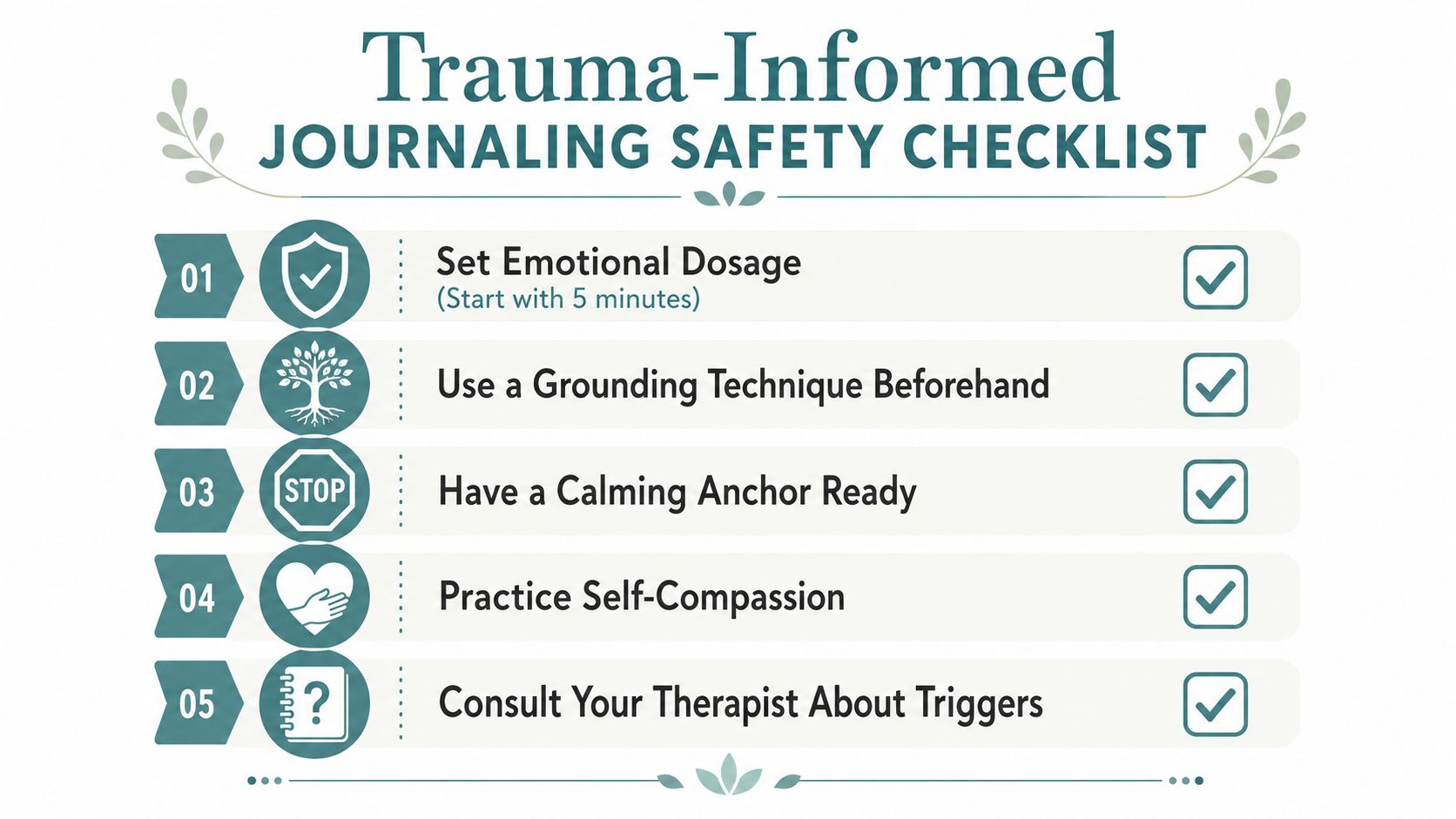
Trauma-informed journaling starts with dosage, not disclosure. You don't owe the page every detail of what happened. The safer question is often, “What am I noticing now?” rather than “How can I describe the entire memory?”
Before writing, orient to the room. Name objects you see, feel your feet against the floor, or hold a cool drink. Decide in advance what you'll do if the intensity rises. That might include stopping, contacting a support person, taking a shower, eating, walking, or using a skill from therapy.
Use an emotional stoplight
- Green: You can notice feelings while staying connected to the room and your present identity. Continue with a contained prompt.
- Yellow: You're becoming tense, numb, detached, panicked, or repetitive. Shift to body sensations, present safety, or a neutral activity.
- Red: You feel dissociated, overwhelmed, unable to function, unsafe, or unable to stop escalating thoughts. Stop writing and contact your clinician, crisis support, or emergency services as appropriate.
Flooding can happen when the emotional material exceeds your ability to stay oriented. Rumination can also look like processing while repeating the same accusation, prediction, or question without reaching insight. If writing increases nightmares, sleep disruption, urges to self-harm, substance use, or isolation, treat that as information, not evidence that you need to push harder.
Safety boundary: You can pause a journal entry without finishing the story. Stopping is a regulation skill, not avoidance by definition.
Avoid rereading traumatic material immediately after writing. Close with a present-focused statement such as, “I'm in my room, it's today, and I'm choosing one supportive action.” Keep entries private, especially if another person might use them to monitor, threaten, or shame you. A clinician can help you decide whether to bring the full entry, a summary, or only a pattern to session. Trauma-informed mental health care emphasizes pacing and support rather than emotional endurance contests.
If you're at immediate risk of harming yourself or someone else, journaling isn't the next level of care. Contact emergency services or an appropriate crisis resource in your area, and tell a trusted person what's happening.
Using Journaling Alongside Therapy PHP IOP and Medication
More writing isn't automatically better care. A long, unstructured vent can temporarily release pressure while also reinforcing rumination, intensifying anger, or leaving you activated without a plan for recovery. The value comes from matching the entry to a treatment goal and reviewing patterns with people who can help you interpret them safely.
Bring a concise summary to therapy instead of assuming your clinician needs every page. You might mark one recurring thought, one trigger, one skill that helped, and one question you want to explore. In CBT, a thought record can give the session a specific starting point. In DBT, a diary card can show where urges rise and which skills you used. Trauma-focused clinicians may prefer present-focused tracking until you have enough stabilization for deeper processing.
For psychiatry appointments, track observations rather than conclusions. A useful note might include:
- Date and general mood
- Sleep quality and changes
- Medication taken as prescribed, if relevant
- Noticeable benefits or unwanted effects
- Anxiety, cravings, or other symptoms
- Skills or supports used
- Questions for the prescriber
Don't change medication based on a journal entry. Share concerns with your prescriber, who can evaluate them alongside your history, current symptoms, and other medications or substances.

PHP and IOP programs can give journaling a clear place between sessions. A participant might complete a DBT diary card before group, write down a situation to discuss in individual therapy, or record how a grounding exercise affected the body. In coordinated outpatient care, journal information can support communication among therapists, psychiatrists, skills groups, and family programming without turning the journal into surveillance.
A structured mental health IOP may be appropriate when symptoms interfere with daily functioning but you need care that fits alongside life outside treatment. Ask your team what to record, what remains private, and which signs should prompt a same-day call. If entries show worsening safety concerns, inability to complete basic responsibilities, escalating substance use, or symptoms that don't respond to your current plan, discuss whether a higher level of support is needed.
Your Next Seven Days and When to Reach Out for Support
Start with a small experiment, not a promise to become a different person.
- Day one: Name your current emotions, body sensations, and immediate needs.
- Day two: Complete a CBT-style record for one stressful situation.
- Day three: Use a DBT check-in to track an urge and one skill.
- Day four: Write about a moment of relief, support, or personal strength.
- Day five: Describe a trigger without narrating traumatic details. End with a grounding action.
- Day six: Record one pattern you've noticed and one question for therapy or psychiatry.
- Day seven: Review only what feels safe. Ask what helped, what intensified distress, and what you want to change.
Use an existing habit as your anchor, set a timer, and keep the closing ritual consistent. At the end of the week, choose one format to continue rather than judging the quality of your writing. If the practice feels compulsive, destabilizing, or increasingly isolating, pause and bring that observation to a clinician.
Caregivers can support journaling without demanding access to private pages. Offer a quiet notebook, ask whether the person wants company, and say, “Would you like help finding support?” Don't read over their shoulder or treat the journal as proof of recovery. Encourage professional help when the person's functioning, safety, sleep, substance use, or ability to care for themselves is worsening.
For adults and families in Orange County, PHP or IOP may provide structured support when weekly therapy isn't enough. Psychiatric evaluation can help clarify symptoms and medication needs, while family programming can improve communication around care. Casa Recovery offers trauma-informed PHP and IOP, psychotherapy, psychiatric evaluation and medication management, dual-diagnosis care, and supportive living coordination, with insurance verification and admissions guidance available.
Choose one prompt today, write for a contained period, and bring any concerning pattern to someone qualified to help. Journaling can become a bridge between what you notice alone and the care you receive with others.
Casa Recovery provides trauma-informed outpatient mental health and dual-diagnosis care, including PHP, IOP, therapy, psychiatric support, and family programming. If you want help using journaling safely alongside treatment, visit Casa Recovery to explore programs and request guidance about next steps.