You just got home from an appointment with a new prescription in your hand, and now the questions start piling up. Will this help, or will the side effects be worse than the symptoms? How long should it take to notice a difference, and who do you call if sleep, appetite, or anxiety changes in a way that feels off?
That mix of hope and uncertainty is exactly why psychiatric medication management needs structure. Good care is not just picking a pill, it's building a plan for safety, follow-up, and adjustment so the medication has a real chance to work. In outpatient settings, especially when people are moving between therapy, PHP, and IOP, that structure can make the difference between drifting and staying on track.
Table of Contents
- Getting Started with Psychiatric Medication Management
- Understanding Psychiatric Medication Management Basics
- Managing Medication Safety Side Effects and Co Occurring Disorders
- Integrating Psychiatry with PHP and IOP at Casa Recovery
- Preparing for Your Medication Management Appointment
- Tracking Progress and Long Term Outcomes
- Wrapping Up Your Medication Management Journey
Getting Started with Psychiatric Medication Management
The first appointment often feels like a small turning point. A person may arrive with depression, anxiety, or both, hoping for relief but worried about side effects, stigma, and whether the diagnosis is even right. That uncertainty is normal, and it's one reason people do better when medication care is organized instead of rushed.
Why the first plan matters
A prescription is only the beginning. Psychiatric medication management includes the initial evaluation, the choice of medication, and the follow-up that shows whether the plan is working. Without that follow-up, a person can stop too early, miss a dose change, or spend weeks guessing whether a symptom is part of the illness or part of the medication.
The stakes are greater than commonly understood. A University of British Columbia summary reports that only 6.9% of people worldwide with mental health or substance-use disorders receive effective treatment, and the treatment pathway breaks at several points, from recognizing the need for care to reaching minimally adequate treatment and then effective treatment (UBC summary). That's why support has to be practical, not abstract.
A medication plan works better when the patient knows who to call, what to track, and what changes matter.
For people stepping into outpatient care, that support can include therapists, prescribers, family members, and, in some settings, structured programs that keep everyone aligned. Casa Recovery's outpatient model fits that pattern by pairing psychiatry with therapy and family involvement inside PHP and IOP, which helps reduce the feeling that you're managing everything alone.
Understanding Psychiatric Medication Management Basics
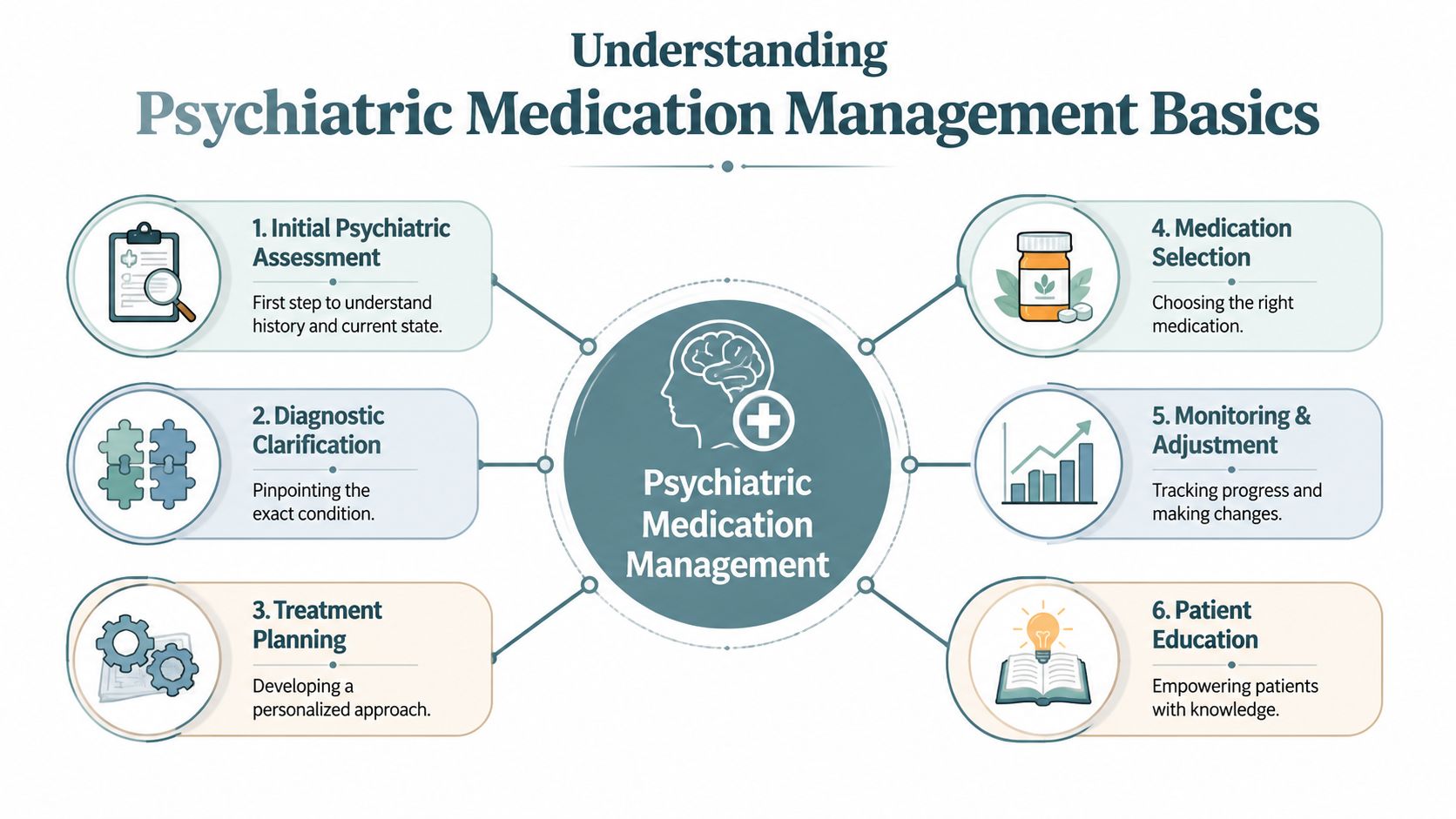
Medication management is a decision-making process. The clinician starts with a psychiatric assessment, asks about symptoms, medical history, prior treatment, sleep, substance use, and daily routine, then narrows the diagnosis before choosing a medication. That choice should fit the person, not just the diagnosis label.
Medication care is closer to tuning than turning on a switch
A useful analogy is a musical instrument. You don't force a violin into harmony with one dramatic move, you tune it, listen, adjust, and listen again. Medication works the same way. The right drug at the wrong dose may feel too sedating, too activating, or ineffective, so the prescriber may adjust timing, amount, or even the medication itself.
That process is why monitoring matters. Follow-up visits, symptom ratings, and sometimes lab work help the clinician separate improvement from noise. If a person says, “I'm sleeping more, but I'm still anxious,” that's useful data, not a failure.
A few common parts of the process are easy to miss:
- Initial psychiatric assessment, to sort out what's happening now and what's happened before.
- Diagnostic clarification, because depression, anxiety, bipolar disorder, trauma, and substance use can overlap.
- Treatment planning, which should match goals, safety needs, and daily life.
- Medication selection, based on evidence and the person's history.
- Monitoring and adjustment, so the regimen doesn't stay static when symptoms change.
- Patient education, because people do better when they understand the plan.
For a plain-language overview of medication types, Casa Recovery's guide to medication options for mental health can help people compare categories before an appointment. And if you're looking at the broader workforce behind access, even telepharmacy jobs show how medication support is expanding beyond the traditional office visit.
Managing Medication Safety Side Effects and Co Occurring Disorders
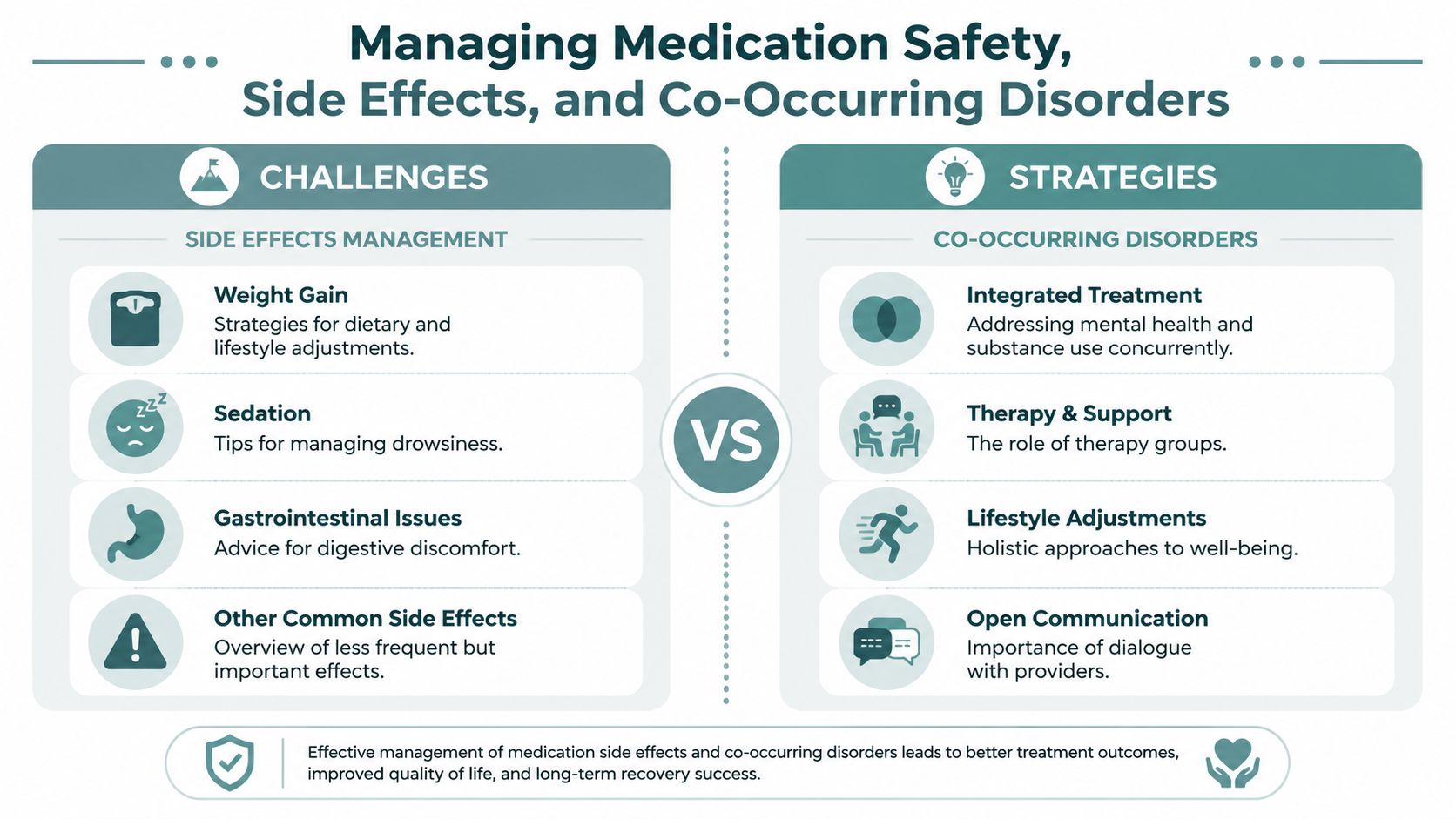
Side effects can feel discouraging because they often show up before the benefit does. Someone may notice nausea, drowsiness, restlessness, or appetite changes and assume the medication isn't right. Sometimes that's true, but sometimes it just means the plan needs a small adjustment rather than a full stop.
When side effects need attention
The safest response is to treat side effects as information. A person who feels overly sedated in the morning may need a timing change. Someone with stomach upset may need a slower titration or a different medication. The key is not to guess in isolation, it's to report patterns clearly.
Practical rule: If a side effect changes daily functioning, sleep, or safety, bring it up right away instead of waiting for the next routine visit.
Polypharmacy raises the stakes further, especially when a mood disorder and substance use disorder are both in the picture. A psychiatric polypharmacy white paper reports that switching from dual antipsychotic therapy to monotherapy succeeds in about two-thirds of patients, which supports careful deprescribing when combination treatment isn't clearly justified (polypharmacy white paper). The point isn't to strip meds away, it's to simplify only when it's safe to do so.
Co-occurring disorders need one coordinated plan
When someone is treating both mental health symptoms and substance use, separate plans can clash. One provider may be trying to reduce anxiety, while another is worried about misuse, interactions, or withdrawal. That's where integrated treatment matters. Casa Recovery's dual diagnosis program is relevant here because it keeps both conditions in view instead of treating them as unrelated problems.
The safest medication decisions usually involve three questions. Does the drug help enough to justify the side effects? Does it fit the rest of the regimen? And can the patient realistically take it in a stable way? If the answer to any of those is shaky, the plan should be revisited.
Integrating Psychiatry with PHP and IOP at Casa Recovery
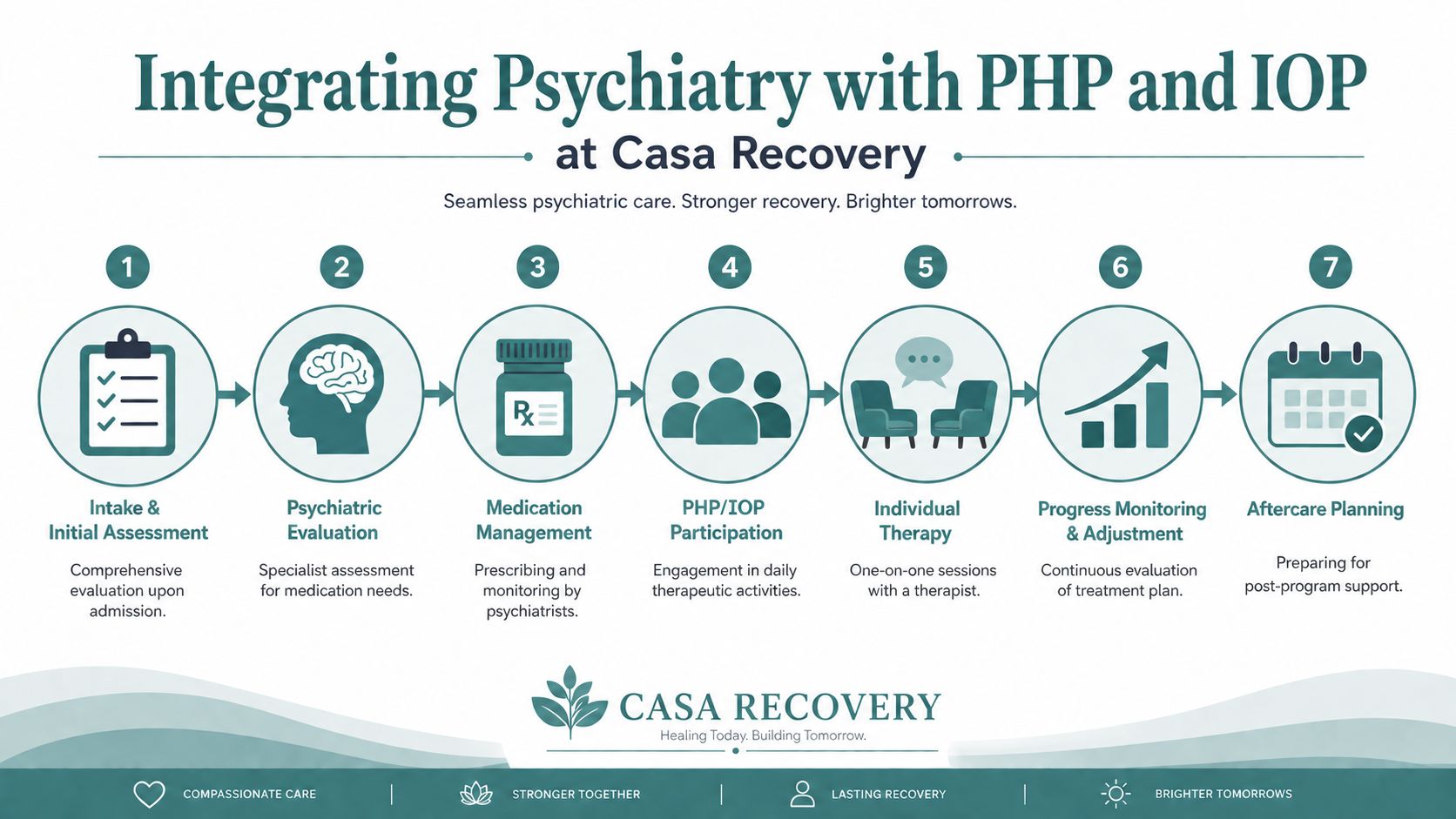
Outpatient medication care works best when the psychiatrist can see the full clinical picture. In PHP and IOP, that means medication decisions aren't happening in isolation. The prescriber can hear what's happening in therapy groups, what shows up in individual sessions, and what family members are noticing at home.
Why onsite psychiatry changes continuity
Major reviews emphasize that closing the mental health treatment gap requires stronger integration of psychiatry and therapy, telepsychiatry, and structured follow-up (integrated care review). That matters in PHP and IOP because people are often stepping down from a higher level of care, or stepping up from standard outpatient visits, and they need the medication plan to travel with them.
Casa Recovery uses onsite psychiatry inside its outpatient structure, so medication changes can be discussed alongside therapy goals rather than weeks later in a separate office. That kind of coordination helps when symptoms shift quickly, especially during stabilization, because the therapist, psychiatrist, and family support can stay aligned on the same treatment target. For readers comparing program levels, Casa Recovery's IOP overview gives context on how that step-down structure fits into treatment.
Family involvement makes the plan more usable
Families often notice the first real-world signs of change. They see if someone is sleeping at odd hours, skipping meals, getting more irritable, or losing follow-through with appointments. When family education is built into the program, those observations can become useful clinical input instead of a source of conflict.
That's one reason integrated outpatient care is more than a convenience. It gives the medication plan a place to live in everyday reality. The psychiatrist can adjust treatment, the therapist can reinforce coping skills, and family members can learn what support looks like without overstepping.
Preparing for Your Medication Management Appointment
A good appointment starts before anyone walks into the office or logs into telehealth. Bring a simple list of current medications, past psychiatric medications, allergies, and any medical conditions that could affect treatment. If you've been prescribed medication before, include what helped, what didn't, and what side effects made you stop.
Questions that are worth asking
The strongest appointments usually happen when the patient asks direct questions. Not every question needs to be clinical. Some of the most useful ones are about daily life and safety.
- What should I expect first? Ask when the medication usually starts to help and what early changes are normal.
- What side effects should I watch for? Get clear guidance on which symptoms are routine and which need a call.
- What happens if I miss a dose? That answer is different for different medications, so don't assume.
- Will this interact with anything else I take? Include supplements, sleep aids, and substances.
- How will we know if it's working? Ask what symptoms or behaviors should improve first.
If you're choosing between treatment settings, ask how the clinic handles PHP, IOP, and follow-up scheduling. A family member can help by writing questions down, joining the visit if appropriate, and helping track symptoms after the appointment. That kind of support is especially useful when anxiety makes it hard to remember details in the moment.
Make the visit easier to use
A symptom tracker is one of the simplest tools you can bring. Even a few notes on sleep, mood, panic, cravings, appetite, and energy can make a prescriber's job much easier. It also gives you a baseline, which matters when you're trying to tell whether the medication is helping or whether the problem is something else entirely.
If you're considering an outpatient program, it also helps to ask practical questions about insurance, transportation, and whether family sessions are part of the model. The more those details are sorted out early, the less likely it is that medication care gets derailed by logistics.
Tracking Progress and Long Term Outcomes
Progress in medication management should be measured over time, not by a single good or bad day. The American Psychiatric Association defines adequate acute-phase antidepressant treatment as at least 84 days of continuous use within 114 days after the first prescription, and continuation-phase treatment as 180 days within 231 days after start (APA measure). Those benchmarks matter because early stop-start use can blur the picture and make it hard to know whether a medication was effective.
What progress looks like in real life
Progress isn't always dramatic. For one person, it may mean fewer panic spikes. For another, it may mean getting up on time, finishing meals, or making it through a workday without crashing. Those changes can be tracked through rating scales, journals, lab work when relevant, and honest check-ins about function.
A quick way to judge whether a plan needs attention is to compare three things:
| What to watch | What it can tell you |
|---|---|
| Mood or anxiety symptoms | Whether the main problem is easing |
| Sleep, energy, and appetite | Whether side effects are interfering |
| Follow-through with daily tasks | Whether the medication is helping function, not just feelings |
People sometimes think long-term care means staying on the same medication forever. It doesn't. It means keeping the regimen tied to actual outcomes, then adjusting if the benefit fades, side effects grow, or life circumstances change.
Medication follow-up is most useful when it asks one simple question, “Is this helping the person live better?”
That's especially true after step-down from PHP or IOP, when the support structure gets lighter. The goal is to keep the gains from stalling once the person returns to ordinary routines.
Wrapping Up Your Medication Management Journey
The best psychiatric medication care is steady, specific, and coordinated. It starts with a thoughtful evaluation, then continues through monitoring, side-effect management, and honest follow-up. When psychiatry is integrated with therapy and family support, people don't have to guess what the next step is.
That's the core value of a structured outpatient model. It gives the patient a place to bring questions, the family a role in support, and the prescriber enough context to make smart changes instead of hurried ones. If you're in that first nervous phase, the right plan can turn uncertainty into a workable routine.
A CTA for Casa Recovery. If you're ready to talk through psychiatric medication management, verify insurance, or ask about PHP and IOP placement, reach out to Casa Recovery's admissions team and start with a clear evaluation.