Topiramate is not a standard first-line anxiety medication, and the clinical evidence for anxiety is limited and mixed, even though it may be considered in specific situations such as co-occurring alcohol use disorder. In one small open trial of generalized social phobia, 11 of 23 patients (47.8%) met responder criteria, but that was an uncontrolled study, not a definitive anxiety trial (PubMed study on topiramate in social phobia).
If you've been handed a prescription for topiramate, or you've seen it mentioned online after therapy and standard anxiety medicines didn't fully help, the mix of hope and uncertainty can feel frustrating. You may be trying to figure out whether this medication is a smart next step, a risky detour, or something that only makes sense for a very specific kind of anxiety picture. The answer depends on the symptom pattern, the other diagnoses in the background, and how carefully a psychiatrist follows you once treatment starts.
Table of Contents
- Understanding Why This Question Matters
- How Topiramate Works in the Brain
- What the Clinical Evidence Shows
- Dosing, Side Effects, and Safety Considerations
- Comparing Topiramate to Standard Anxiety Treatments
- Integrating Medication with Therapy and Recovery
- When to Seek Psychiatric Evaluation and How Integrated Care Helps
Understanding Why This Question Matters
A person often reaches this question after a long stretch of trying to get steady. They may have taken a medication for migraines or seizures, then noticed their body felt less revved up. Or they may have gone through the usual anxiety treatments and still felt stuck in hypervigilance, panic, or a constant sense of being on edge.

Why topiramate enters the conversation
Topiramate comes up because it changes brain signaling in a broad way, not because it's a standard anxiety drug. It's most often known as an anticonvulsant, and its use in anxiety is off-label, which means clinicians may prescribe it even though anxiety isn't one of its main labeled uses.
That makes the question especially confusing for patients. A medication can have a real neurologic effect and still not be a good general answer for anxiety disorders. In practice, topiramate tends to appear when anxiety is tangled up with other problems, such as trauma symptoms, alcohol use, migraines, or symptom clusters that look more like hyperarousal than everyday worry.
Practical rule: if a medication is being considered because a person feels overactivated, overstimulated, or difficult to settle, the medication question is really about nervous-system regulation, not just “treating anxiety” in the abstract.
Why the answer is rarely a simple yes or no
The most important thing to understand is that topiramate can help some people and worsen others. That's why a careful prescriber won't treat it like a routine first choice. The goal is to match the medication to the symptom pattern, the risks, and the treatment history.
If anxiety is the main problem, the evidence base matters. If alcohol use disorder, PTSD features, or another neurologic issue is also present, the conversation changes. That's why topiramate for anxiety deserves a more nuanced discussion than many medication lists give it.
How addiction affects the brain and behavior is a useful lens for understanding why one medication might help in a dual-diagnosis picture while still being a poor fit for primary anxiety alone.
How Topiramate Works in the Brain
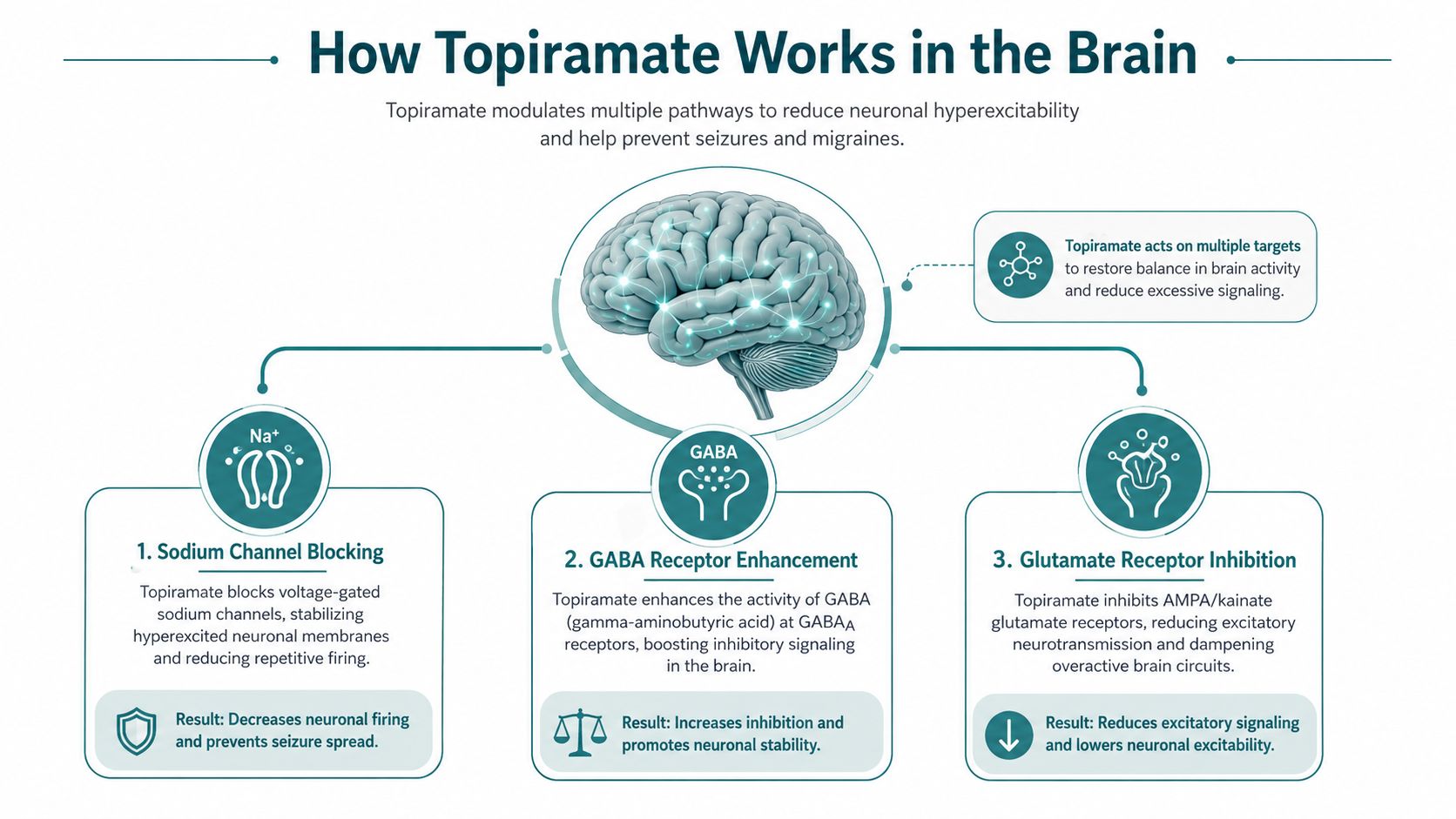
Topiramate affects several brain systems at once, and that multi-target action is the reason it sometimes gets discussed for anxiety-like symptoms. The FDA label describes effects on voltage-dependent sodium channels, GABA-A activity, AMPA/kainate glutamate receptors, and carbonic anhydrase II and IV (FDA label). In simple terms, it pushes the brain away from excessive firing and toward more inhibition.
A plain-language way to think about it
Think of an overactive nervous system like a room where the lights are too bright, the music is too loud, and several people are talking at once. Topiramate doesn't work like a traditional dimmer switch. It affects multiple parts of the electrical setup so the overall level of stimulation may drop.
That's why some clinicians see a plausible role for it in symptoms like hyperarousal, cue-triggered reactivity, or a “revved-up” body state. Independent reviews also note that topiramate may increase cerebral GABA concentrations and reduce glutamate release, with additional effects on calcium currents and pH-sensitive ion channels (FDA label).
Why it doesn't behave like an SSRI
SSRIs and SNRIs are built around serotonergic and norepinephrine pathways, which is why they're first-line for many anxiety disorders. Topiramate works differently. That difference matters because a drug can feel biologically calming without having the same reliability as standard anxiety medicine.
Clinical takeaway: topiramate is most plausible when anxiety looks like overactivation more than a primary serotonin-driven anxiety disorder.
That is why the drug gets studied more often in trauma-related or dual-diagnosis settings than in straightforward generalized anxiety. The mechanism creates a possibility, but it doesn't guarantee a useful result for a given person.
What the Clinical Evidence Shows
The evidence for topiramate in anxiety is best described as thin, mixed, and condition-specific. The clearest positive signal comes from a 2005 open trial in generalized social phobia. In that study, 11 of 23 patients (47.8%) met responder criteria on the Clinical Global Impressions-Improvement scale, 12 completers included 9 responders (75.0%), the intent-to-treat sample showed 26.1% remission, and Liebowitz Social Anxiety Scale scores dropped by 29.4% (PubMed study on topiramate in social phobia). Those numbers are interesting, but the study was uncontrolled and small, so they suggest a possible signal rather than a dependable answer.
What that means in real life
An uncontrolled trial can point to a treatment effect, but it cannot show that the medication caused the change. People may improve for many reasons, including time, placebo response, concurrent therapy, or the natural course of symptoms. For that reason, guideline-based practice still does not place topiramate among recommended first- or second-line treatments for anxiety disorders.
The stronger quantified data come from PTSD research rather than primary generalized anxiety disorder trials. In a chronic PTSD study, topiramate produced a 37.4% reduction in total CAPS scores compared with 4.7% for placebo, and the reported effect size was 1.63 (PTSD review and data summary). That is a notable signal, but PTSD is not the same thing as generalized anxiety.
How to interpret the PTSD findings
Later analysis found only a small and statistically significant reduction in hyperarousal symptoms, with SMD = 0.35 and 95% CI 0.029 to 0.689, while effects on re-experiencing and avoidance were not statistically significant. That pattern fits the clinical idea that topiramate may be more relevant for activation and arousal than for core generalized anxiety.
| Topiramate Evidence Summary | ||
|---|---|---|
| Condition | Evidence Quality | Key Finding |
| Social phobia | Limited, uncontrolled | Small open trial showed a possible responder signal and symptom reduction |
| PTSD | Mixed, stronger than primary anxiety data | Some trials showed large symptom reduction, but later synthesis found only a small hyperarousal effect |
| Primary generalized anxiety | Weak | Current practice does not place topiramate among recommended first- or second-line options |
One review of psychiatric medication management from Casa Recovery highlights why this kind of evidence needs careful interpretation in practice, because the same medication may fit one clinical picture and miss another (Casa Recovery psychiatric medication management). The takeaway is not that topiramate “doesn't work.” It is that the evidence is not strong enough to make it routine, and the most useful signals appear in specific symptom patterns rather than in broad anxiety care.
Dosing, Side Effects, and Safety Considerations
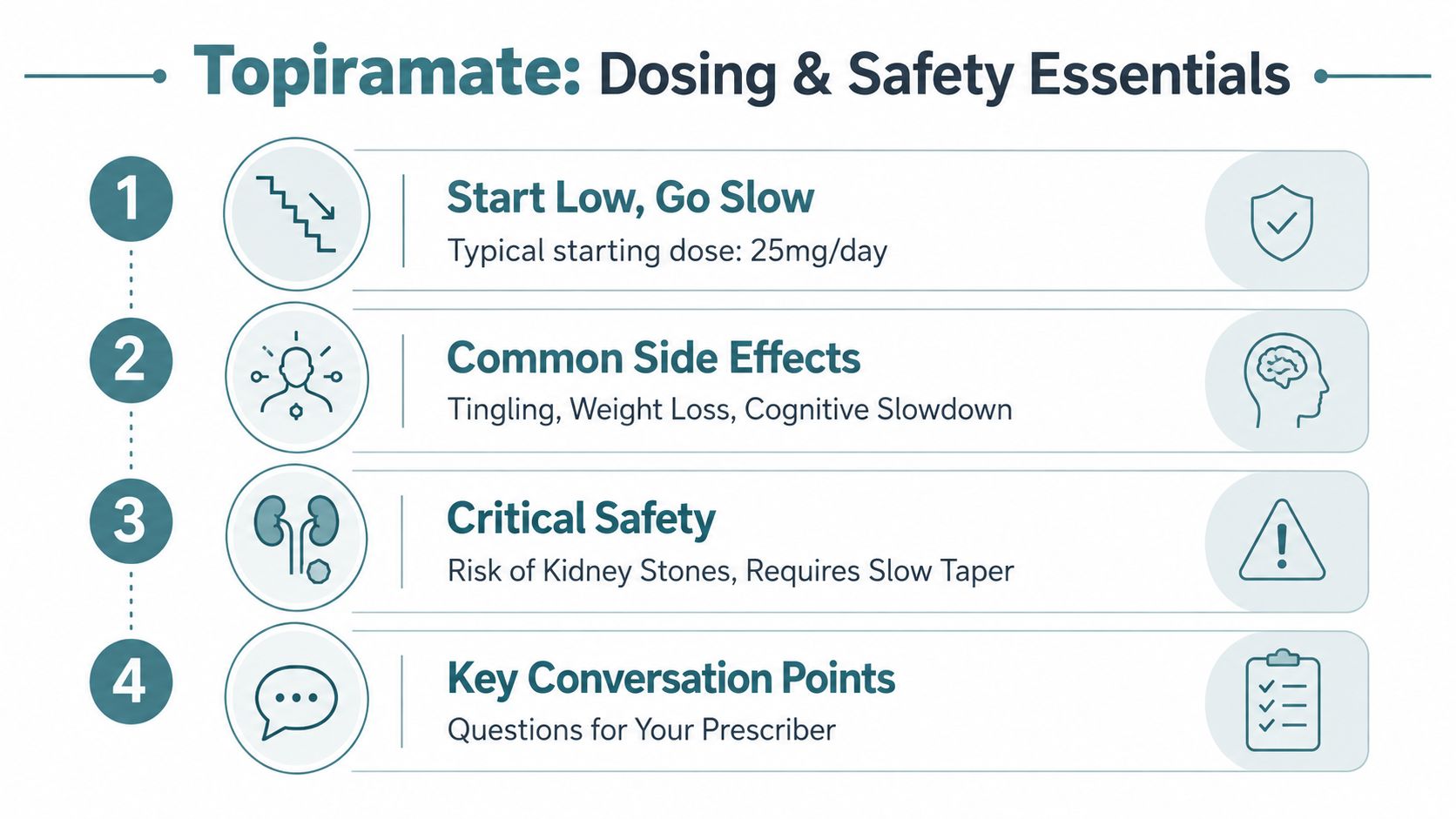
Topiramate is one of those medications where how you start can matter as much as whether you start it. Clinicians usually titrate slowly because side effects often show up early and can be dose-related. A cautious start helps separate a temporary adjustment period from a medication that may not be a good fit.
What patients usually notice first
The most common practical issues are tingling, cognitive slowing, word-finding difficulty, and sometimes reduced appetite or fatigue. Those effects can be annoying, but for anxious patients they can also feel alarming, because a new internal sensation can be easy to misread as a warning sign.
Topiramate can also worsen anxiety in some patients. A published case review describes a possible panicogenic effect related to carbonic-anhydrase inhibition, and it also notes new-onset panic attacks associated with topiramate (case review). That is one reason it is not used like a routine calming medication.
If a medication makes you feel foggy, off balance, or more panicked about your own body, that side effect matters clinically. It is not something to push through without a conversation.
Safety questions that deserve a direct answer
Topiramate is not only about anxiety and cognition. It also raises broader safety questions, including metabolic issues, kidney stones, and pregnancy-related risk discussions. Those topics should come up before the first dose, not after side effects begin.
The official product information also lists anxiety as an adverse event in topiramate-treated patients, and a large postmarketing review noted that only 13.2% of psychiatric patients responded positively overall, while 51.3% discontinued because of adverse reactions. In a safety summary discussed in a PTSD review, those tolerability problems were a major reason the medication could not be used broadly for anxiety-related care (PTSD review and safety summary). That is a reminder that side effects can decide whether any possible benefit is reachable.
- Ask about the target symptom: know whether the goal is panic, hyperarousal, irritability, or a dual-diagnosis symptom cluster.
- Ask about the stop point: know which side effects mean pause the drug rather than wait it out.
- Ask about daily functioning: think about work, school, driving, and communication demands.
- Ask about alcohol: if alcohol use is part of the picture, say so directly. It changes the risk-benefit conversation.
Medication management in psychiatry works best when it is tied to side-effect monitoring, not just prescription writing. If a prescriber does not talk through these issues clearly, the plan probably is not specific enough yet.
Comparing Topiramate to Standard Anxiety Treatments
A person with persistent anxiety may hear about topiramate after standard medications have already been discussed, or after anxiety appears alongside alcohol use, trauma symptoms, or medication side effects that have made other options harder to use. That is usually the right frame for this question. Topiramate belongs on the edge of anxiety treatment, while SSRIs, SNRIs, and sometimes benzodiazepines sit much closer to the center. The comparison works best when it starts with what each medication is meant to do.
Where each medication fits
| Anxiety Treatment Comparison | |||
|---|---|---|---|
| Treatment | Evidence for Anxiety | Typical Use Case | Key Considerations |
| Topiramate | Limited and mixed, with stronger signals in PTSD-related hyperarousal than in primary anxiety | Select cases, especially when symptoms overlap with alcohol use disorder or trauma-linked activation | Cognitive side effects, possible paradoxical anxiety, slow titration |
| SSRIs and SNRIs | Stronger evidence base for common anxiety disorders | First-line treatment for generalized anxiety, panic, social anxiety, and related conditions | May take time to work, can cause activation or GI side effects early |
| Benzodiazepines | Effective for short-term relief | Acute panic or short-term bridging in selected cases | Sedation, dependence risk, memory issues, careful prescribing needed |
The table shows why topiramate is usually discussed differently from standard anxiety medications. SSRIs and SNRIs have the clearest place in ordinary anxiety care because they have been studied across several common anxiety disorders and are usually the first medications psychiatrists consider. Benzodiazepines can calm distress quickly, which is why they still have a narrow role, but that speed comes with dependence, sedation, and memory concerns that make them a poor long-term fit for many patients.
Topiramate does not fit neatly into either group. It is not a standard antidepressant-style anxiety medication, and it is not a rescue medication for acute panic. That makes its role more selective, especially when a patient has already tried usual options, has side effects that limit other treatments, or has a symptom pattern that looks more like hyperarousal, irritability, or mixed anxiety with alcohol-related problems. The earlier evidence summary helps explain why the medication is sometimes considered in those settings rather than in routine first-line care.
What the trade-offs look like
SSRIs and SNRIs are usually first-line because they match the way many anxiety disorders are treated in everyday psychiatry. They are not instant, and early side effects can be frustrating, but they are familiar tools with a broader evidence base. For many people, that makes them the most reasonable starting point.
Benzodiazepines sit at the other end of the timeline. They can bring relief quickly, which matters when panic is severe or a short bridge is needed while another medication begins to work. The trade-off is that the benefit can come with sedation, cognitive slowing, and a risk of dependence, so careful prescribing matters.
Topiramate is more selective than either of those options. It may make sense when anxiety is not the only problem, especially if alcohol use disorder or trauma-linked activation is part of the clinical picture. It may also come up in treatment-resistant anxiety, where a psychiatrist is weighing whether a different mechanism could help. The key limitation is that its anxiety benefit is less established, and the side-effect burden can be enough to cancel out any gain if the fit is poor.
The right question to ask a psychiatrist
The most useful question is not which medication sounds strongest. It is which medication matches the symptom pattern, medical history, and side-effect tolerance of the person in front of the prescriber. That is the difference between a medication that looks promising on paper and one that can be used day to day.
If topiramate is part of the discussion, there should be a clear reason for it. The prescriber should be able to explain whether the goal is calmer hyperarousal, support for a co-occurring condition, or a different strategy after standard treatments have not helped enough. That conversation should feel concrete, not vague, and it should fit into a broader plan for an integrated treatment approach for co-occurring conditions(https://www.casarecovery.com/integrated-treatment-approach/) when anxiety is tied to substance use, trauma, sleep disruption, or mood instability.
Integrating Medication with Therapy and Recovery
Medication rarely carries anxiety treatment by itself, and topiramate is no exception. Even when a medication helps, it doesn't retrain avoidance, undo trauma learning, or rebuild the routines that keep the nervous system stuck on high alert.
Why therapy still matters
CBT, trauma-focused therapy, exposure-based treatment, and skills work all address different parts of anxiety that medication can't reach. If someone is living with persistent fear, avoidance, or panic around certain cues, the psychological pattern usually needs direct treatment. Medication can lower the volume, but therapy teaches the brain what to do with that quieter signal.
When substance use is part of the picture, the treatment plan has to be integrated rather than fragmented. That's one reason topiramate gets considered more often in dual-diagnosis settings than in isolated anxiety care. The role of integrated treatment is to address both conditions together instead of asking a person to get stable in one area while another keeps undermining progress.
An integrated treatment approach for co-occurring conditions makes more sense than trying to solve anxiety in a vacuum. If alcohol, trauma, sleep disruption, or mood instability is part of the picture, the medication choice has to fit the whole pattern.
What a coordinated plan usually looks like
A well-run plan keeps psychiatry, therapy, and recovery goals aligned. That might mean tracking anxiety symptoms alongside sleep, substance use, panic frequency, or concentration problems, then adjusting treatment based on what's changing.
- Medication management: Targets a defined symptom cluster and is reviewed regularly.
- Psychotherapy: Works on avoidance, trauma responses, coping skills, and relapse prevention.
- Recovery support: Helps reduce alcohol- or substance-driven amplification of anxiety.
- Functional goals: Focuses on work, relationships, sleep, and daily stability, not just symptom scores.
The best treatment plan is the one that lets a patient function better in real life, not the one that sounds most pharmacologically interesting.
When to Seek Psychiatric Evaluation and How Integrated Care Helps
If anxiety is interfering with work, relationships, sleep, or basic daily functioning, that's reason enough to get a psychiatric evaluation. The same is true if you've already tried standard treatments and still feel stuck, or if substance use, trauma, or mood symptoms are making the picture harder to sort out.

What a good evaluation should cover
A careful psychiatrist won't just ask, “Are you anxious?” They'll want to know what anxiety looks like for you, when it started, what triggers it, what makes it worse, and what you've already tried. They'll also look for overlapping issues like trauma symptoms, depression, alcohol use, and medication side effects, because those details can change the treatment plan completely.
A structured outpatient setting can be especially helpful when the answer isn't obvious. Casa Recovery provides PHP, IOP, dedicated mental health programming, and onsite psychiatric evaluation and medication management in an integrated outpatient setting. That kind of coordinated care is useful when anxiety and substance use are both in play, or when a person needs more than occasional medication follow-up.
How to prepare for the conversation
Bring a list of prior medications, what happened on each one, and what your symptoms feel like day to day. Be direct about alcohol use, sleep, panic, trauma history, and any cognitive problems you've noticed, because those details may change whether topiramate makes sense or not.
If you're still wondering whether topiramate is a good fit, a psychiatric evaluation can turn a vague question into a concrete plan. A thoughtful clinician can tell you whether your symptom pattern looks like a candidate for topiramate, whether a standard first-line treatment is still the better option, and how to build a plan that doesn't leave you guessing.
If you're trying to sort out anxiety, trauma, or a co-occurring substance use issue, Casa Recovery offers structured outpatient care with psychiatry, therapy, and integrated support designed to make the next step clearer. Visit Casa Recovery to explore PHP, IOP, and coordinated treatment options that can help you and your clinician choose a safer, more informed path forward.