You're probably noticing small things before you're calling them what they are. The sleeping gets weird, plans keep getting canceled, the tone at home changes, and what used to look like “stress” starts to feel like a pattern you can't ignore. In PHP and IOP settings, that's often how relapse warning signs show up, not as a dramatic crash, but as a slow drift away from structure, honesty, and support.
The hard part is that the pattern doesn't look the same in every person. A substance-use pathway can revolve around craving, access, and rationalizing use, while a mental-health relapse pathway often looks more like sleep disruption, low mood, withdrawal, and dropping treatment routines. Families usually see the change before anyone names it, which is why early recognition matters so much.
Table of Contents
- What Relapse Warning Signs Look Like in Everyday Life
- Understanding Relapse as a Process With Stages
- Behavioral, Emotional, Cognitive, and Situational Warning Signs
- How Substance and Mental Health Relapse Differ
- Immediate Steps for Individuals and Family Members
- Monitoring and Prevention Strategies That Actually Work
- When and How to Get Professional Help
What Relapse Warning Signs Look Like in Everyday Life
A family room can look normal on Tuesday and feel off by Friday. Someone stops answering texts, starts going to bed later, and seems irritated by ordinary questions. By the weekend, they're canceling plans, missing a meeting, or saying they just need space, while the people around them are trying to decide whether they're worried, overreacting, or both.
That's the shape of relapse warning signs in real life. They usually don't arrive as one obvious event. They accumulate, and the accumulation is what matters.
The week that starts to wobble
A spouse notices sleep slipping first. Then the person in recovery skips a support group, gets defensive about a harmless question, and spends more time alone. In the same stretch of days, they may start speaking in a way that softens risk, as if controlled use or “just one drink” could somehow be different this time. The clinical issue isn't the single comment, it's the cluster.
Practical rule: when several small changes show up together, treat that as the signal, not background noise.
The National Institute on Drug Abuse has reported that 40% to 60% of people with substance use disorders experience relapse, and some summaries note that risk is especially concentrated in the first 90 days, when roughly 60% to 80% of relapses occur, as summarized in Hazelden Betty Ford's relapse warning signs overview. That's one reason outpatient teams take modest-looking changes seriously. A person doesn't usually move from stable recovery to use in one leap, they move through a series of warning signs that are easier to miss than people expect.
What families usually see first
Families often see distance before they see danger. The person gets less reachable, less predictable, and less interested in what used to keep them anchored. Sometimes the signs are emotional, sometimes behavioral, and sometimes they're tucked into small comments that sound casual but are rationalizations.
The point is not to panic over every bad day. It's to notice the pattern before the person's coping system is fully offline. Relapse prevention works better when people respond while the conversation is still possible, not after trust has already been damaged.
Understanding Relapse as a Process With Stages
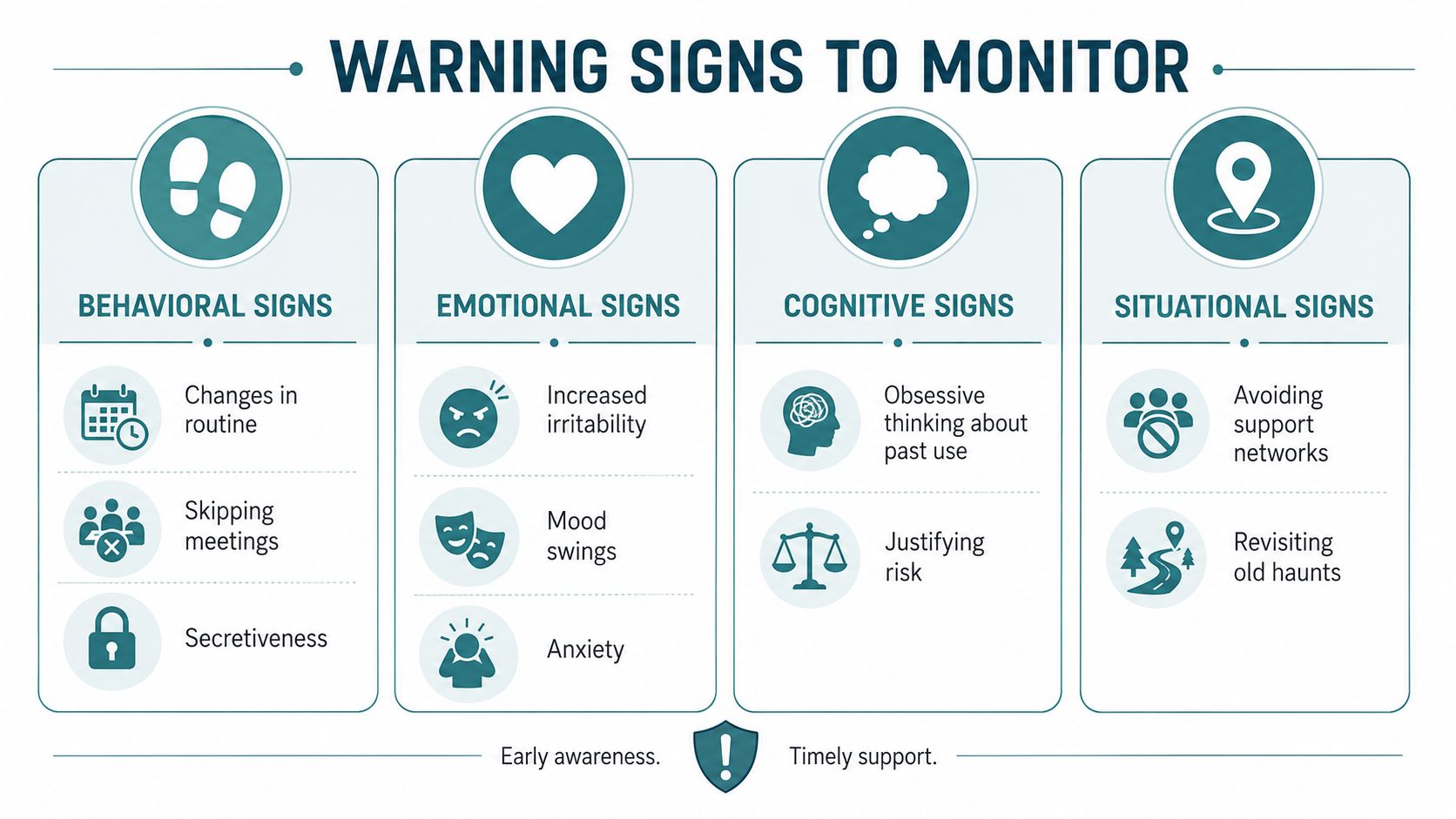
Relapse is easier to understand when you stop treating it like a single bad choice. In substance use recovery, the common clinical model moves through emotional relapse, mental relapse, and physical relapse, and that sequence matters because the warning signs show up before use resumes. The historical shift in treatment was the recognition that early signs often appear days or weeks before the actual event, which makes detection and intervention the real work.
Emotional relapse comes first
Emotional relapse usually shows up as erosion. Sleep slips, self-care falls apart, and social contact shrinks. The person may not be thinking about using yet, but the supports that kept recovery steady are already thinning out. In practice, that's when people stop resting, stop connecting, and stop taking care of the basics that keep judgment intact.
Mental-health relapse often looks different. The warning pattern is more of a downward cascade in sleep, appetite, affect, concentration, motivation, and daily functioning, rather than a pathway toward substance use. A useful way to think about it is weather shifting before a storm, not a sudden flood.
Mental relapse changes thinking
Mental relapse is the stage where the mind starts arguing with itself. Cravings increase, people and places linked to past use become more salient, prior consequences get minimized, and the person starts bargaining. In the clinical literature, this sequence includes craving, preoccupation, minimizing consequences, lying, planning, and romanticizing past use, with research on mental relapse patterns describing these shifts as a transition in cognition and behavior rather than just emotional distress.
That's why “romanticizing” is such a high-yield warning sign. When someone starts mentally rehearsing access to substances, the decision has already started to move.
Physical relapse is the last stage
Physical relapse is actual use. By that point, the earlier warnings were already active. If a family only reacts at this stage, they've missed the window where prevention was easiest.
A second rule matters here, especially in mental health care. Track change from baseline, not just symptoms in general. A person's normal can be noisy, but sustained shifts in sleep, social engagement, and daily functioning are often more informative than any single complaint. That's the logic behind good outpatient monitoring, and it's why one-off reassurance is rarely enough.
Behavioral, Emotional, Cognitive, and Situational Warning Signs
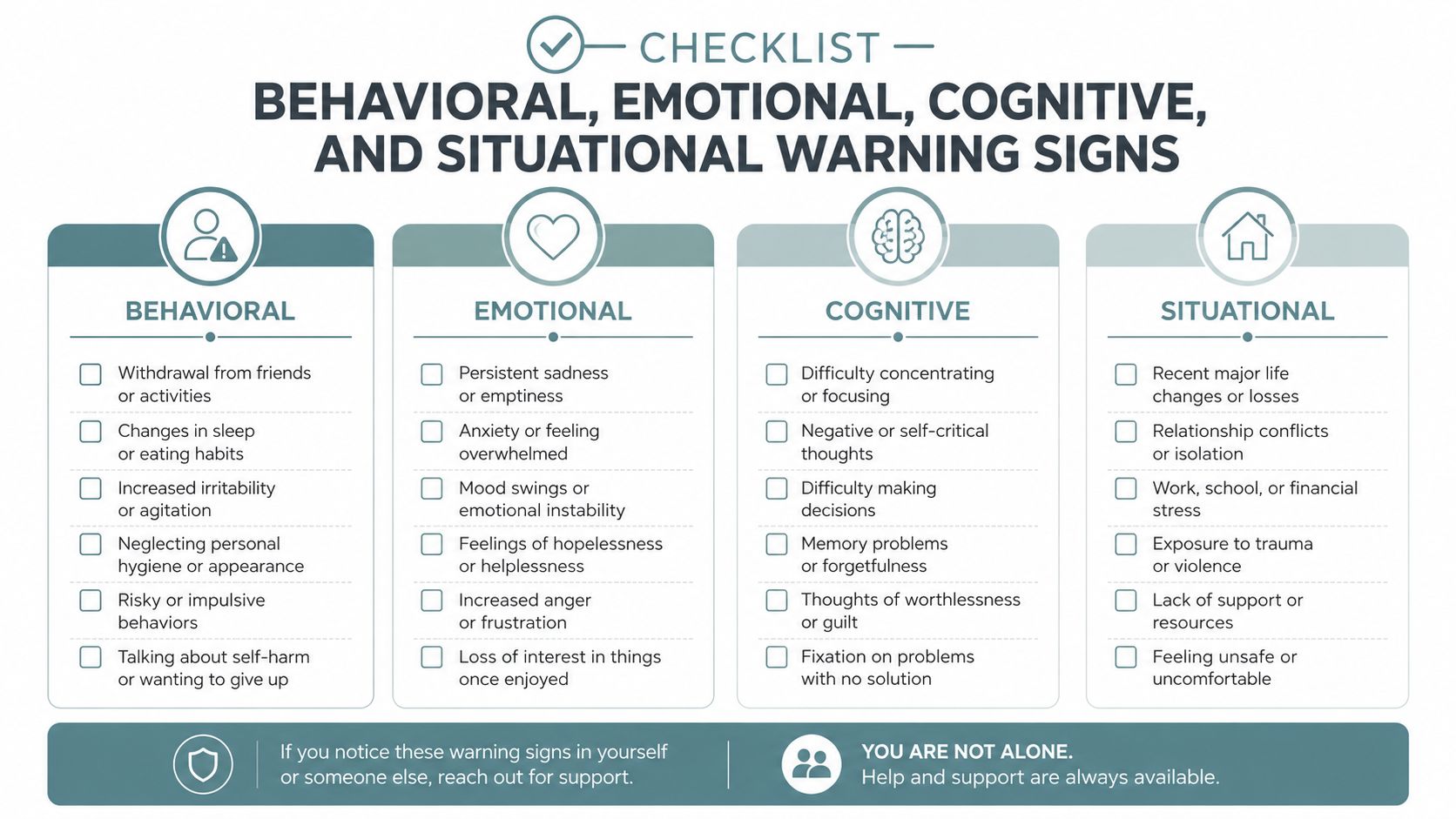
The most useful way to sort relapse warning signs is by domain. Families can observe behavior, mood, thinking, and environment, even if they can't see every craving or private thought. That's what makes this framework practical in real households.
Behavioral signs people can miss if they're moving fast
Behavioral changes often show up before anyone names relapse risk. The person cancels appointments, skips meetings, stops participating in recovery activities, or becomes harder to reach. In mental health relapse, the same pattern can look like reduced motivation, neglect of self-care, or drifting off treatment routines, which matches the warning clusters described in Priory Group's relapse guidance.
Emotional signs are often the loudest
Irritability, anxiety, low mood, restlessness, and mood swings are common red flags. In substance recovery, the VA also highlights stressors like HALT, hungry, angry, lonely, tired, along with interpersonal conflict and returning to people or places linked to use, in its guidance on reducing relapse risk. That matters because emotional depletion often lowers judgment before anyone realizes the person is sliding.
Cognitive signs are the ones families tend to underestimate
Craving is only part of it. People also start talking themselves into risk, minimizing prior consequences, lying about where they've been, or planning opportunities to relapse. Once “maybe this time is different” shows up, the thinking has already become more permissive.
Situational signs are about exposure, not just mood
Old haunts, old contacts, old routines, and unresolved stress can all reactivate risk. Dual-diagnosis cases make this more complicated because trauma symptoms, anxiety, depression, or medication nonadherence can all become part of the same destabilizing picture.
| Domain | Substance Relapse | Mental Health Relapse |
|---|---|---|
| Behavioral | Skipping meetings, pulling away from support, changing routines | Missing therapy, neglecting self-care, dropping daily structure |
| Emotional | Irritability, restlessness, tension, shame | Anxiety, low mood, emotional flattening, agitation |
| Cognitive | Craving, romanticizing use, bargaining, lying, planning access | Negative spirals, hopeless thinking, concentration problems, reduced follow-through |
| Situational | Returning to people, places, or patterns tied to use | Stress overload, conflict, disrupted routines, treatment nonadherence |
A quick self-screen helps. Ask: what's changed this week in sleep, contact with support, honesty, and follow-through? If several answers are different from baseline, the pattern deserves attention.
How Substance and Mental Health Relapse Differ
Substance relapse and mental-health relapse can overlap, but they don't follow the same pathway. That distinction matters because the wrong monitoring strategy can miss the core problem. A family can watch for mood changes when the bigger issue is craving and access, or focus on substance cues when the person is spiraling through depression, anxiety, or trauma symptoms.
Two different paths, one shared vulnerability
Substance relapse is often organized around cues, cravings, and decision-making. The person starts revisiting people, places, and thoughts linked to use, then moves toward planning and justification. Mental-health relapse usually begins with changes in sleep, appetite, concentration, motivation, and treatment adherence, and then those changes spill into functioning. The two pathways can interact, but they do not look identical.
| Domain | Substance Relapse | Mental Health Relapse |
|---|---|---|
| Starting point | Cravings and cue-driven thinking | Sleep, mood, appetite, concentration, functioning |
| Main risk driver | Access, permission-giving thoughts, return to old settings | Downward symptom cascade, reduced coping, reduced adherence |
| What families notice | Secrecy, rationalizing, reconnecting with old contacts | Withdrawal, fatigue, poor follow-through, emotional strain |
| What often helps | Removing access, increasing accountability, tightening structure | Restoring routine, reinforcing treatment, clinical reassessment |
Dual diagnosis makes the picture less tidy
In dual-diagnosis care, both pathways can be active at once. The person may stop taking a prescribed medication for an addictive disorder, withdraw from care, and reconnect with old using contacts. At the same time, they may be dealing with depression, anxiety, or trauma symptoms that make everything harder to manage. The VA's guidance specifically flags stopping medication, returning to people and places linked to use, and HALT-related stressors as relapse risks, which is why medication adherence matters so much in these cases.
That's also where consumers sometimes get misled. A person may not be “choosing badly” in a simple sense. They may be navigating a mixed clinical picture where anxiety, mood instability, and substance cues are feeding each other.
Monitoring should match the likely pathway
If the main concern is substance relapse, pay close attention to secrecy, access, bargaining, and old environments. If the main concern is mental-health relapse, focus on sleep timing, appetite shifts, withdrawal, concentration problems, and treatment follow-through. If both are in play, the safest assumption is that the risk is broader than either story alone.
Immediate Steps for Individuals and Family Members
When warning signs start showing up, speed matters more than perfect wording. The goal is to reduce momentum before the person is too dysregulated, too isolated, or too far into justification to engage. Calm action usually works better than confrontation.
If you're the one noticing the signs in yourself
Start with a HALT check. Are you hungry, angry, lonely, or tired? Those states don't cause relapse by themselves, but they make self-control thinner and old coping habits louder.
Then do three concrete things within the next day. Tell one safe person, review your relapse prevention plan, and remove yourself from settings that make use or avoidance more likely. Don't wait to feel “ready,” because readiness often comes after the first stabilizing action, not before.
If you're the family member
Name what you're seeing without judgment. “I've noticed you've been sleeping less, missing plans, and pulling away from group meetings” is more useful than “You're slipping again.” The first sentence invites truth. The second usually invites defense.
Keep the conversation short, specific, and calm. Long lectures tend to turn into shame, and shame tends to drive secrecy.
The family piece is also about protecting structure. Keep routines steady, don't interrogate for proof, and encourage treatment attendance instead of trying to become the treatment team at home. Casa Recovery's guidance on how to act when a loved one relapses and comes home fits this approach, especially when the household needs boundaries without escalating conflict.
When the situation needs same-day help
Active suicidal ideation, return to use, or sudden medication discontinuation need immediate clinical contact. So do abrupt increases in paranoia, severe depression, or a person becoming unreachable while warning signs are clearly stacking. If you're unsure whether the change is “bad day” or destabilization, treat the pattern seriously and reach out.
Monitoring and Prevention Strategies That Actually Work
The best prevention plans aren't dramatic. They're boring, repeatable, and visible. In outpatient care, what works is usually the stuff people can keep doing when motivation drops, not the stuff that only looks good on paper.
Track the pattern, not just the crisis
Weekly check-ins work well when they stay simple. Look at sleep, mood, social contact, treatment attendance, and whether the person is sticking to the plan they agreed to. The point is to catch a deviation from baseline early enough to respond before the person has to be rescued from a bigger problem.
A short written check-in can be enough:
- Sleep: Is bedtime drifting later, or is the person waking up more irritable?
- Mood: Has anxiety, flatness, or irritability become more constant?
- Connection: Are meetings, therapy, or family contact getting skipped?
- Follow-through: Is medication, if prescribed, being taken consistently?
Use structure as a protective tool
Consistency is the point. Regular meetings, accountability contacts, and clinician check-ins during higher-risk windows are more useful than waiting for a crisis to force action. The early period after treatment, especially the first 90 days noted in the earlier data, is one of the times when structure matters most, because warning signs often show up before the person has the confidence to ask for help.
Practical rule: if life gets less predictable, supports need to get more predictable.
Design the environment with relapse risk in mind
Old people, old places, and old routines deserve more respect than families sometimes give them. It's not about becoming hypervigilant, it's about reducing easy access to the conditions that repeatedly preceded trouble. Anniversaries, holidays, and relationship changes are common stress points, so those periods deserve a clearer plan, not just hope.
For some families, outpatient step-down support is enough. For others, the environment needs more containment than home can provide, especially right after residential treatment or during a rough patch that isn't stabilizing on its own. That's where routine, contact, and honest reassessment do more than reassurance ever can.
When and How to Get Professional Help
PHP is a good fit when someone needs full-day structure, recent stabilization off residential care, or a level of support that isn't safe to manage at home. IOP fits when the person still needs multiple sessions per week but can handle parts of daily life outside treatment. In both cases, dual-diagnosis care matters when anxiety, depression, trauma symptoms, and substance risk are intertwined.
What to ask for
Ask whether the program can assess both substance-use and mental-health relapse pathways together. If medication management is part of the picture, onsite psychiatric evaluation helps keep the plan coordinated instead of fragmented. Evidence-based modalities like CBT, DBT, EMDR, and Brainspotting can be useful when the clinical team matches them to the person's symptoms and history.
Why family involvement changes outcomes
A formal family program can keep home conversations from drifting into blame, denial, or mixed messages. That matters in outpatient care because families are usually the first people to notice the drift and the first ones trying to decide how serious it is. When everyone is aligned, the person gets fewer accidental loopholes and more consistent support.
Casa Recovery offers PHP, IOP, integrated dual-diagnosis treatment, psychiatric evaluation, family programming, and supportive living coordination for out-of-area clients in Orange County. That kind of step-down structure is often what helps people move from warning signs back into stability without pretending the situation will fix itself.
If you're seeing these patterns at home, don't wait for the situation to become louder. Reach out to Casa Recovery to ask about PHP, IOP, dual-diagnosis support, and family involvement, especially if the warning signs are showing up across sleep, mood, and accountability. A short conversation with the right outpatient team can make the next step clearer before the window narrows.