You've probably had this thought after a few rough weeks of anxiety, a few unfinished coping attempts, and one more night spent searching treatment options online, maybe group therapy could help, but maybe sitting in a room with strangers would feel worse. That hesitation is normal. Most adults who consider group therapy for anxiety are trying to answer the same practical question, can a structured group help, or is it just a softer version of individual therapy with more people in the room?
The honest answer is that group treatment is a real clinical tool, not a consolation prize. For the right person, at the right level of care, it can give structure, practice, and feedback that are hard to recreate alone. For someone with escalating anxiety, medication uncertainty, or mixed symptoms that spill into sleep, work, or relationships, a good group can become one part of a larger outpatient plan, not the whole plan.
Table of Contents
- Why Someone Might Choose a Room Full of Strangers
- What Group Therapy for Anxiety Is
- The Therapeutic Models Used in Anxiety Groups
- What a Typical Session Looks Like
- What the Evidence Says About Outcomes
- Where Group Therapy Fits in PHP, IOP, and Dual-Diagnosis Care
- How to Choose the Right Program
- Taking the Next Step with Casa Recovery
Why Someone Might Choose a Room Full of Strangers
A lot of people arrive at the same crossroads. They've tried breathing exercises, podcasts, apps, maybe a few sessions of solo therapy, and the anxiety still keeps intruding at work, in traffic, or when they try to fall asleep. They may be unsure about medication, or they may already be taking it and still feel stuck.
That's usually when the question changes from “What can I do on my own?” to “What kind of treatment fits how this is showing up?” Group therapy enters that conversation because anxiety often pulls people into isolation, and isolation makes symptoms feel bigger than they are. A carefully structured group can interrupt that loop without asking someone to explain every detail from scratch in a one-to-one room.
Practical rule: if anxiety is making you avoid people, places, or tasks, a group can be part of the treatment that helps you practice re-entering them in a supported way.
People also worry about the social part. They picture being judged, having to speak before they're ready, or sitting while everyone else seems more put together. Those concerns are understandable, and a skilled therapist doesn't treat them as resistance, they treat them as part of the clinical material.
The key thing is that group treatment isn't chosen because it's easier. It's chosen because, for some people, it offers a different mechanism of change. You hear how other adults describe the same fear, you see what avoidance looks like in someone else's life, and you get feedback in real time instead of only between appointments. That's a distinct advantage, especially when anxiety has started to shrink daily life.
What Group Therapy for Anxiety Is
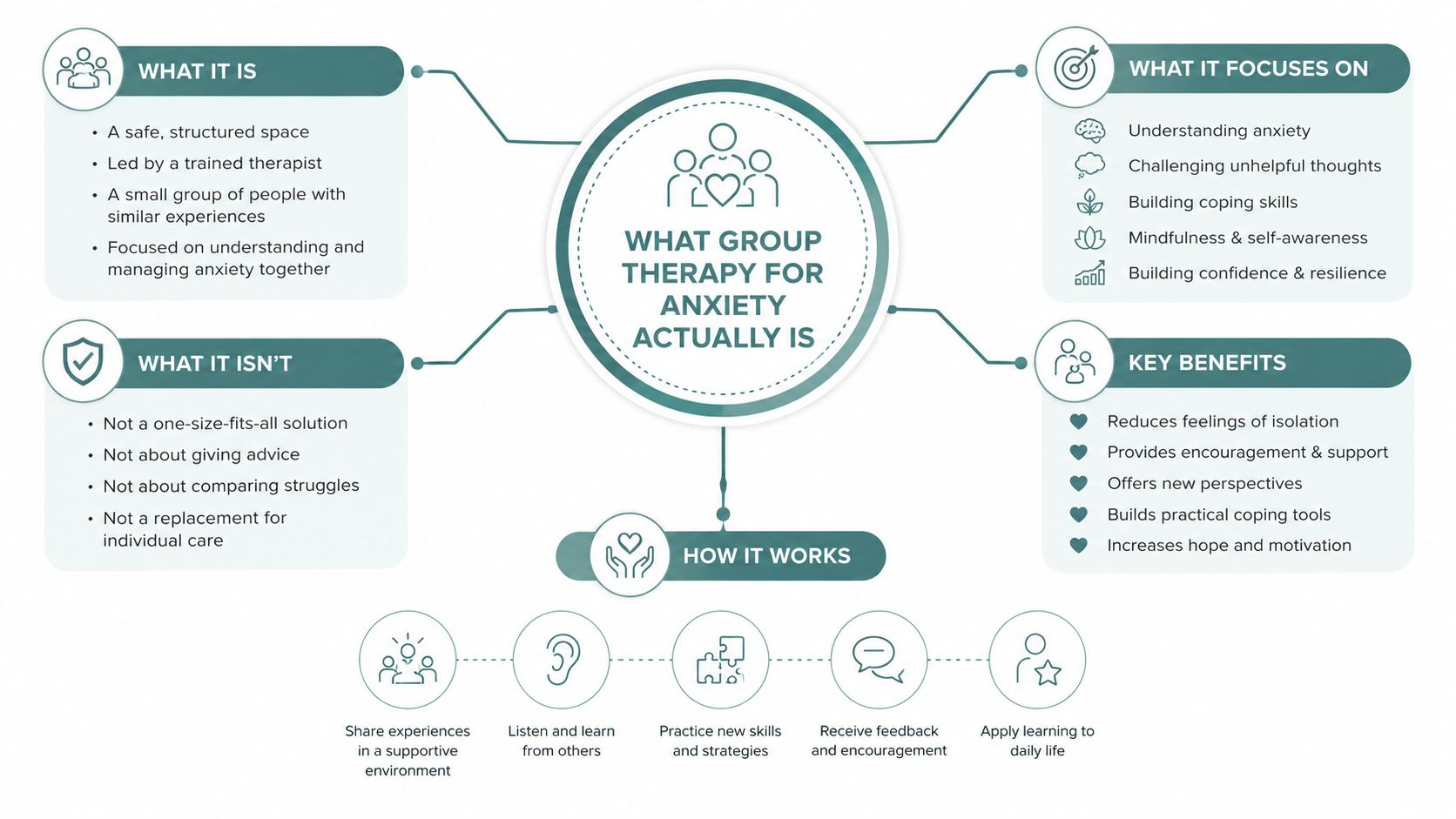
Group therapy for anxiety is a structured psychological treatment led by a trained clinician. It is usually time-limited, goal-directed, and built around exercises that help people notice anxious thinking, reduce avoidance, and practice new responses. It is not a casual discussion circle, and it is not a place where people compare symptoms and hope for improvement.
A gym for emotional and social skills is a useful comparison. A person does not build strength by watching one video and calling it training, and anxiety work usually improves the same way, through repeated practice, coaching, and small corrections. In a group, that practice may include sharing a thought record, trying an exposure exercise, or speaking up when anxiety says to stay quiet.
A therapy group is different from a support group. In a therapy group, a licensed clinician guides the process, uses a treatment model, and keeps the work tied to measurable goals. The interactions between members matter, but they are not random. They are part of the intervention itself.
What makes it therapeutic
- A defined method: The group follows a clinical framework, not open-ended conversation.
- A clinician in charge: The therapist shapes the pace, redirects unhelpful spirals, and keeps the room safe.
- A target problem: Anxiety, panic, social fear, or related symptoms are the focus.
- Practice, not just talking: Members rehearse skills, test assumptions, and get feedback.
That structure matters because anxiety often thrives on ambiguity. A person walks into a group wondering whether they will be pressured to share too much, and instead finds clear ground rules, predictable sequencing, and a therapist who sets the tone. For many people, that predictability is calming in itself.
Group therapy also works well as part of a larger outpatient plan. At Casa Recovery, it can sit alongside individual therapy, medication management, and, when needed, a skills-based resource such as anxiety coping skills for adults. In PHP or IOP, the group is not a side activity. It is one of the places where people rehearse new responses while still having daily structure and clinical support. In dual-diagnosis care, that matters even more because anxiety rarely shows up alone. It often arrives with depression, substance use, trauma symptoms, or all three, and the group gives the team a place to work with those overlaps in real time.
The Therapeutic Models Used in Anxiety Groups
The model behind a group changes what the group does. A person whose anxiety is tied to panic and avoidance needs a different structure than someone whose anxiety arrives with emotional volatility, self-harm risk, or substance use. “Group therapy for anxiety” is a broad label, but the clinical method determines whether the room is focused on skill practice, emotional regulation, exposure work, or insight into relationship patterns.
The main formats
Cognitive Behavioral Therapy, CBT groups focus on identifying anxious thoughts, checking them against evidence, and rehearsing new behaviors between sessions. The format is usually structured, with worksheets, homework, and repeated practice. That structure fits adults who want a concrete, skills-based approach, especially when anxiety tends to spiral through predictions and avoidance.
Dialectical Behavior Therapy, DBT skills groups focus on emotion regulation, distress tolerance, mindfulness, and interpersonal effectiveness. These groups are often a better fit when anxiety shows up with intense mood shifts, impulsive behavior, or a history of self-harm. The aim is less about debating thoughts and more about helping a person stay steady enough to respond instead of react.
Exposure-based groups bring members into contact with feared situations in a planned, graded way. That can matter for social anxiety, phobias, or OCD-related avoidance. The work is not about flooding someone with fear. It is about repeated, supported contact with what is feared so the nervous system can learn that anxiety rises, peaks, and falls without controlling every decision.
Psychoeducation and process-oriented groups usually work best as add-ons rather than standalones. Psychoeducation explains how anxiety operates in the body and mind, which helps people make sense of symptoms that can otherwise feel mysterious. Process groups focus on the patterns that show up between people in the room, which can reveal how anxiety affects trust, boundary-setting, and communication.
The practical difference between these models is easier to see when they are placed side by side.
| Model | Core Focus | Best Fit For |
|---|---|---|
| CBT group | Thoughts, behaviors, homework, exposure practice | Generalized anxiety, panic, social anxiety |
| DBT skills group | Emotion regulation, distress tolerance, mindfulness | Anxiety with mood swings or self-harm history |
| Exposure-based group | Facing feared situations in a planned way | Social anxiety, phobias, OCD-related avoidance |
| Psychoeducation group | Learning how anxiety functions | Early stabilization, adjunct support |
| Process-oriented group | Interpersonal patterns and feedback | People who benefit from relational insight |
For people who want a plain-language example of how coping skills are taught in a structured setting, Casa Recovery's anxiety coping skills resource is a useful reference for the kind of work these groups often practice.
What a Typical Session Looks Like
A first session often feels less like a performance and more like stepping into a structured workshop. Anxiety groups are usually small enough for everyone to be heard, with group size often 6 to 12 members and sessions commonly lasting 60 to 120 minutes. Frequency depends on the level of care. In IOP, groups are often held once or twice per week, while PHP usually involves daily programming. One example of how a small-room format can support participation is Casa Recovery's small group therapy structure, which keeps the setting intimate enough for real interaction without making it feel crowded.
The usual rhythm
A session usually starts with a brief check-in. Members may rate anxiety, mention what happened since the last meeting, or say whether anything urgent came up. That opening does two things, it gives the therapist a quick read on the room, and it lets each person feel acknowledged without being put on the spot.
Then comes the teaching or skills portion. The therapist might review a CBT concept, introduce a coping strategy, or guide a mindfulness exercise. In exposure-based groups, the active practice happens here. Members might complete a worksheet, speak a feared sentence aloud, or rehearse a real-life situation in a controlled way.
The middle of the session is where the room starts to work like a rehearsal space. People hear how others describe worry, avoidance, shame, or physical tension, and that shared language can make symptoms less isolating.
The session usually closes with reflection and between-session practice. Homework might involve tracking thoughts, trying a coping tool, or preparing for a feared situation outside group. That follow-through matters because anxiety does not change only while someone is seated in the room.
Confidentiality is a core rule. Members are expected not to repeat personal material outside the group, and therapists spend time setting clear norms about respect, turn-taking, and what happens if someone becomes overwhelmed. If a crisis disclosure comes up, the clinician does not ignore it. They slow the room down, assess the risk, and make sure the next step fits the clinical situation.
People often think the hardest part is speaking. In practice, the hardest part is usually staying present long enough to notice that the feared moment passes.
What the Evidence Says About Outcomes
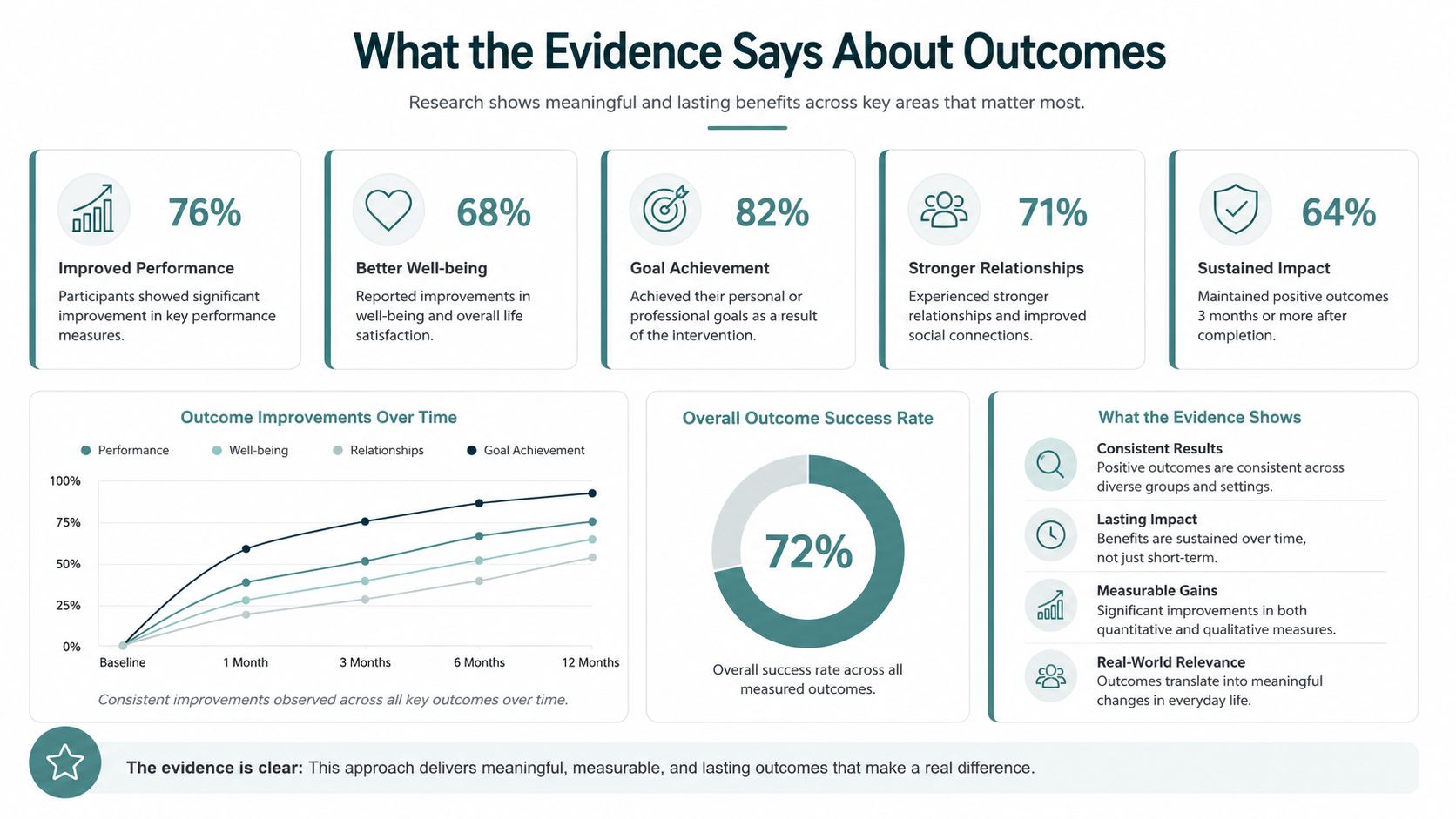
The best-supported conclusion is straightforward. Group psychotherapy for anxiety disorders is a legitimate treatment format, not a watered-down substitute for individual care. A 2020 systematic review and meta-analysis of 43 studies found a large reduction in anxiety symptoms compared with no-treatment controls, with Hedges' g = 0.92 and a 95% CI of 0.81 to 1.03 PubMed. The same review also found a smaller, but still significant, benefit over control conditions that included common non-specific treatment factors, with g = 0.29 and a 95% CI of 0.10 to 0.48 PubMed.
Direct comparisons are useful because they answer the practical question patients ask: how does group care stack up against other options? In that review, group therapy was not statistically different from individual psychotherapy, with g = 0.24 and a 95% CI of -0.09 to 0.57, or from pharmacotherapy, with g = -0.05 and a 95% CI of -0.33 to 0.23 PubMed. For outpatient planning, that means the group format can be a serious option when access, cost, or scheduling make one-on-one treatment harder to maintain.
The recovery gap still matters
A separate community-based CBT group program gives a more modest picture of real-world recovery. In that study, 43% of participants achieved reliable change and 17% met recovery criteria after treatment PubMed. That distinction matters. Symptom reduction and full recovery are related, but they are not the same endpoint.
Programs that track outcomes closely can respond to that gap instead of glossing over it. Someone may leave group with less panic, less avoidance, or better coping, yet still need more support through additional sessions, a different module, medication review, or a higher level of care. A careful outpatient plan treats that as expected clinical decision-making, not failure.
The broader review also found that outcomes were not tied closely to structural features of the group format, and diagnosis-specific groups were not clearly better than mixed-diagnosis groups PubMed. The practical lesson is plain. The therapist, the protocol, and the quality of practice inside the room appear to matter more than the exact mix of members.
Where Group Therapy Fits in PHP, IOP, and Dual-Diagnosis Care
Group therapy can work as a standalone service, but that's not always the right container. If anxiety is moderate, functioning is still intact, and someone already has support outside treatment, a focused outpatient group may be enough to start. If symptoms are more acute, if there are safety concerns, or if substance use is part of the picture, the group usually works better inside a broader program.
Standalone versus embedded care
In PHP and IOP, group therapy is often the core of treatment contact. People typically attend multiple group sessions, with individual therapy and psychiatry added around them. That structure gives the team a chance to coordinate symptoms, medication, coping, and real-life stressors without waiting a week between touchpoints.
Dual-diagnosis care changes the treatment question further. When anxiety and substance use overlap, the goal is not to treat one first and the other later. They're addressed together, because each one can fuel the other. A person may use alcohol to quiet panic, then feel more anxious the next day, then avoid group because of shame. Integrated care keeps that loop visible.
Clinical takeaway: if anxiety is tangled with substance use, recent discharge from residential care, or unstable day-to-day functioning, group therapy usually works best as part of a larger outpatient plan.
That's why location and program design matter. In Southern California, adults looking at a center like Casa Recovery are often trying to compare a general therapy group with a structured outpatient setting that can hold more complexity. The right fit depends on how much support the person needs between sessions, not just how willing they are to talk in a room.
How to Choose the Right Program
Choosing a group shouldn't be guesswork. The best programs answer direct questions clearly and don't make you decode their model from vague marketing language. If a center can't explain how it runs, it's probably not a great place to start treatment.
Questions worth asking
- Who leads the group? Ask whether the facilitator is licensed, how long they've worked with anxiety, and whether the same clinician leads each week.
- What model are you using? CBT, DBT, exposure-based work, and psychoeducation all serve different goals.
- How do you measure progress? Good programs track symptoms, attendance, and functional change instead of relying on impressions alone.
- What happens if someone is in crisis? You want to know how the team handles safety, not just routine attendance.
- Is the curriculum manualized? A defined structure usually signals more than a drop-in discussion model.
Logistics matter too. Group size, schedule, in-person versus telehealth format, and location all affect whether someone can realistically stay engaged. Insurance verification is worth checking early, including in-network status, out-of-network benefits, and whether admissions staff can help with coverage questions.
If you're comparing options, this guide on getting the most out of group therapy can help you think through what good participation looks like once you start.
Red flags are usually easy to spot once you know them. Watch for vague descriptions of the curriculum, no mention of outcome tracking, rotating therapists with little continuity, or no coordination with outside prescribers. Groups that sound more like casual support than structured treatment may still feel helpful, but they're not the same thing as a clinical anxiety group.
Taking the Next Step with Casa Recovery
For adults in Orange County who want a structured outpatient option, Casa Recovery offers PHP, IOP, and a dedicated mental health program in San Juan Capistrano. The center describes itself as private, family-owned, and established in 2009, with small group sizes and a high therapist-to-client ratio. Group therapy is part of that larger plan, alongside individual psychotherapy, EMDR, Brainspotting, DBT, CBT, and onsite psychiatry.
That matters for anxiety because many people don't need only one intervention. They need a coordinated plan that can hold symptoms, medication questions, trauma history, and day-to-day functioning at the same time. Casa Recovery also provides integrated dual-diagnosis care, which is important when anxiety and substance use are both in play rather than neatly separated.
The admissions side is practical, too. Casa Recovery lists PPO from all carriers and says Blue Shield of California/Blue Card, ComPsych, and Holman Group are in network. The center also offers insurance verification, admissions guidance, facility tours, and support for people who may need coordinated living arrangements while they stabilize in Southern California.
If you're trying to decide whether group therapy alone is enough or whether you need the added structure of PHP or IOP, start by asking how much support you need between sessions. Then ask what the group does, who leads it, and how the program measures change. That's the level of detail that turns a generic search into a treatment decision you can trust.
If you're weighing group therapy for anxiety and want a structured outpatient setting, Casa Recovery can help you compare PHP, IOP, and mental health programming with group treatment built into the plan. Reach out to verify insurance, ask about the anxiety groups offered, and take the first step toward care that fits both your symptoms and your schedule.