You're halfway through a normal morning, but your mind keeps circling the same private question. Maybe you've told yourself you're fine because you still work, answer texts, and keep up appearances, yet something about your use, scrolling, drinking, gaming, shopping, or other habit no longer feels fully under your control. If you've typed “am I addicted” into a search bar, you're not being dramatic. You're paying attention.
That question deserves a careful answer, not a label handed down in panic. A compassionate self-check looks at patterns, consequences, control, and underlying stress, not just whether life has completely fallen apart. By the end, you should have a clearer personal snapshot and a next step that fits your situation, whether the answer feels like yes, no, or maybe.
Table of Contents
- Starting the Conversation With Yourself
- What Addiction Looks Like Day to Day
- Screening Yourself With Validated Questions
- Hidden Addiction When Life Still Looks Fine
- Red Flags That Need Immediate Attention
- How PHP, IOP, and Dual Diagnosis Care Actually Work
- Family, Admissions, and Practical Next Steps
Starting the Conversation With Yourself
It usually starts in a quiet moment. You're at your desk, in the car, or standing in the kitchen, and the thought lands with more weight than you expected, I don't think this is under control anymore. That moment matters because people rarely ask am I addicted when everything feels obviously wrong. They ask it when something still works on the outside, but the inside feels harder to explain.
The brave part isn't the question itself. The brave part is admitting that your own sense of “fine” may not be enough anymore. If you need a steadier voice while you sort through that feeling, this reminder to be kinder to yourself fits this moment well, because shame usually makes the picture blurrier, not clearer.
Practical rule: if you're asking whether you have a problem, treat the question seriously even if nobody else has confronted you yet.
Think of this as a personal review, not a verdict. You're not trying to prove you're “bad enough.” You're trying to notice whether use, behavior, or coping has started to take more than it gives back. That includes substances, but it can also include habits that feel calming for a minute and costly by the end of the day.
People often get stuck because they compare themselves to a stereotype. They imagine addiction has to look like total collapse, visible chaos, or losing everything at once. In real life, many people notice the change much earlier. They just need a clear way to read what they're seeing.
What Addiction Looks Like Day to Day
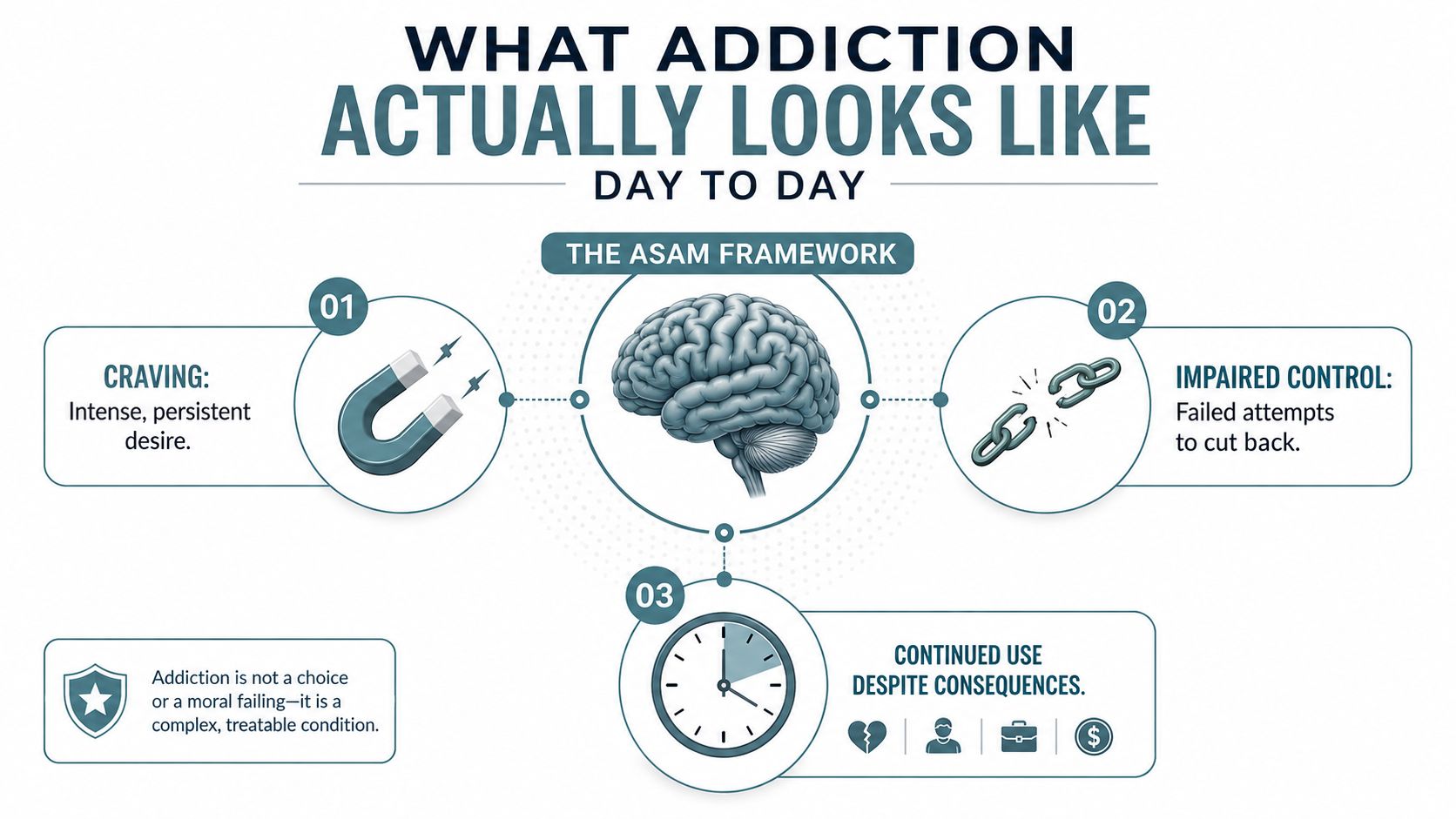
Addiction is not defined by one dramatic moment. Clinically, it shows up through craving, impaired behavioral control, inability to consistently abstain, diminished recognition of problems, and continued use despite harm, which is why a simple “yes or no” question usually misses the point. A person can still function at work and still be struggling in a way that matters.
The daily pattern that matters more than the label
Craving is more than wanting something. It can feel like a recurring pull, a mental loop, or the sense that your day will not settle until you use, check, drink, gamble, or scroll. Impaired control is what happens when you keep promising yourself “just once” or “just tonight,” then do more than you meant to.
Plain-language test: if your plan keeps changing after the urge shows up, control may already be slipping.
Continued use despite consequences is the part many people minimize. Maybe the consequence is poor sleep, a partner's concern, missed focus, money stress, or a growing sense that the habit is draining you. That does not require catastrophe to count. It only requires a real pattern of harm that keeps repeating.
The day-to-day picture often includes small revisions that add up. You start setting limits, then relax them. You tell yourself you will wait until later, then the urge makes later feel impossible. You may begin organizing your schedule around the behavior, not because you want to, but because it has become the easiest way to get relief.
Heavy use, dependence, and addiction are not identical
Heavy use can exist without full addiction, and dependence can show up before a person is ready to call the behavior addictive. The difference usually comes down to compulsion and impairment. If you can stop without distress and without your life changing much, that points in one direction. If you keep returning to the behavior even after clear costs, that points in another.
The phrase “I can quit anytime” is often less informative than the actual evidence. Ask yourself whether you have tried to cut back and what happened when you did. For alcohol-specific patterns, tools like the CAGE-style signs of drinking problems can help you organize the question, but the deeper issue is still whether use is steering your choices more than you are.
That distinction matters because two people can look similar on the outside and be in very different places. One person may be using heavily during a stressful stretch and still regain control when the stress changes. Another may keep circling back to the same behavior even after the consequences become harder to ignore. The outer picture is only part of the story.
Sometimes the clearest clue is the amount of mental space the behavior takes up. If you are spending a lot of energy planning, hiding, recovering, bargaining, or explaining, the behavior may already be crowding out other parts of life. That is a functional problem, even before it becomes visible to everyone else.
Screening Yourself With Validated Questions
A private screen works best when you separate behavior, psychosocial impact, and function. That keeps the answer grounded in what is happening, because many people can describe the habit but miss the cost it is creating. Set aside a calm 10- to 15-minute window, and answer based on the past several weeks rather than one unusually bad day.
A useful first pass is to ask whether the pattern is only present, or whether it is also shaping your choices and daily life. Addiction screening works a lot like checking a smoke alarm, because the point is not to judge the house, but to notice early warning signs before the situation grows harder to ignore.
Start with behavior, then move to impact
For alcohol, the classic CAGE questions are simple: Have you felt you should Cut down? Have people Annoyed you by criticizing your drinking? Have you felt Guilty? Have you needed an Eye-opener in the morning? If more than one of those lands hard, treat it as a signal to look more closely at the pattern, not as a reason to shame yourself.
For drug use, a DAST-style self-check asks whether the use has caused guilt, interference, or an inability to cut back. For drinking patterns, AUDIT-style questions focus on frequency, quantity, control, and consequences. The point is not to score yourself like a test you can pass or fail. The point is to see whether your pattern looks occasional, concerning, or clearly high.
If your behavior is not substance based, use parallel questions. Ask whether you keep returning to the behavior longer than planned, whether you hide it, and whether you feel irritated or restless when you try to stop. If you want a more structured way to compare those signs, this guide on signs of a drug problem can help you organize what you are noticing.
Use three domains to avoid self-deception
- Behavioral signs: Are you checking, using, or returning more than you intended?
- Psychosocial impact: Are you more isolated, more irritable, or more secretive than before?
- Functional impairment: Is sleep, work, school, parenting, or relationships taking a hit?
These three areas work together. A pattern can look mild in one area and still be serious in another, the way a cracked windshield may still let the car move while making every drive less safe.
A low pattern usually means the behavior is contained, flexible, and not driving distress. A moderate pattern means there are real warning signs, even if life still looks stable. A high pattern means the behavior is starting to organize your choices, emotions, or time in a way that deserves professional input.
Bring your answers to a licensed therapist, psychiatrist, counselor, or primary care clinician. A good screen does not end with self-labeling, it ends with a clearer conversation.
Hidden Addiction When Life Still Looks Fine
A lot of people searching am I addicted are still showing up everywhere they're supposed to be. They're answering emails, making dinner, paying bills, and holding a family together. That's exactly why hidden addiction gets missed. External functioning can stay intact long after the internal cost has become serious.
The biggest mistake is assuming addiction only counts when the outside falls apart. In reality, some people become very good at hiding the impact. They protect their job, manage their image, or stay productive while losing sleep, joy, patience, or self-respect. Social pressure can hide the problem, and stigma can make someone keep performing long after the pattern has turned painful.
Two ways hidden harm shows up
One clue is the slow erosion of ordinary life. Maybe you're not missing work, but you dread waking up. Maybe you're not blowing up relationships, but you're more distracted, defensive, or disconnected than you used to be. Those changes matter even when no one else names them.
Another clue is that stress changes the meaning of the behavior. Trauma, anxiety, depression, caregiving overload, job pressure, unstable housing, and identity-based stress can all make use look more “manageable” than it really is, or more necessary than it should be. Co-occurring mental health symptoms can also mask addiction, because the behavior starts as relief and ends as a second problem.
A good reality check is to track the pattern for 2 to 4 weeks, not just in your head, but on paper or in your phone. Notice when you use, why you use, whether you planned it, and what it costs you afterward. Ask one trusted person what they see, because outside observers often notice changes you've normalized.
If your life looks fine on paper but feels smaller, flatter, or harder to live in, that's worth taking seriously.
Red Flags That Need Immediate Attention
Some situations move beyond self-assessment and into safety. Severe withdrawal, blackouts, seizures, suicidal thoughts, confusion, or a sudden return to use after a period of abstinence can all signal urgent risk. Alcohol, benzodiazepine, and opioid withdrawal can be medically dangerous, so don't try to guess your way through it alone.
What to do in the next hour
If someone is suicidal, unresponsive, having a seizure, severely dehydrated, or unable to stay awake, call emergency services or go to the ER now. If the person is awake but clearly unsafe, confused, vomiting repeatedly, or escalating rapidly, same-day medical evaluation is the right move. If the concern is serious but not an emergency, call an outpatient program or clinician within 24 to 48 hours.
Say the facts plainly. “I'm worried about withdrawal.” “I've blacked out.” “I've been using again after stopping.” “I'm having thoughts of hurting myself.” Short, direct language helps the person on the other end triage the situation faster.
Have three things ready if you can. What was used, when it was last used, and what symptoms are happening now. That information is more useful than a perfect explanation.
How PHP, IOP, and Dual Diagnosis Care Actually Work
When outpatient help makes sense, the next question is level of care. PHP, IOP, and integrated dual-diagnosis care all serve different needs. The right fit depends on how much structure you need, how much support you have at home, and whether mental health symptoms are part of the picture.
Choosing the level that matches the problem
PHP is the most structured outpatient option. It usually fits people who need a full-day clinical schedule but do not need overnight care. IOP is lighter in intensity, with multiple sessions per week, and often fits people who are stable enough to live at home while still needing consistent support. Dual-diagnosis care matters when anxiety, depression, trauma, or another psychiatric concern is part of what's driving the use.
| Level of Care | Weekly Time Commitment | Best Fit For |
|---|---|---|
| PHP | Full-day structured programming | People needing high support without residential care |
| IOP | Multiple sessions per week | People who need step-down structure while working or parenting |
| Standard Outpatient | Fewer, scheduled appointments | People who are stable and need maintenance support |
In a program like Casa Recovery, outpatient care can include psychiatric evaluation, medication management, psychotherapy, and small-group work within one coordinated plan. That kind of setup matters when the question is not only “How much am I using?” but also “What else is going on?” If you want a side-by-side look at the difference between structure levels, this explanation of IOP and PHP is a helpful companion.
Fit matters more than intensity alone. The right program is the one you can actually attend, engage in, and build around your real life.
Family, Admissions, and Practical Next Steps
The most helpful next step is usually smaller than people expect. Start with one phone call, one honest conversation, or one assessment request. You do not need to solve the whole future before asking for help.
Make the first move concrete
If you're worried but not sure what level of care you need, ask for a confidential assessment first. A good admissions team will ask pre-assessment questions and then complete a clinical assessment to see whether the program matches your needs. Casa Recovery also provides intake guidance, insurance verification, and family involvement, and it works with PPO plans from all carriers, plus plans such as Blue Shield of California, ComPsych, and Holman Group when they're in network.
Family can help when the conversation stays specific. Try, “I'm noticing that I'm using more than I want to, and I want an outside opinion,” instead of arguing about whether the label fits. If a parent or partner gets defensive, slow the conversation down and focus on the behavior, the impact, and the next step, not on proving who's right.
Practical barriers are real. Work schedules, childcare, fear of judgment, and cost worries can stop people from reaching out even when they know they need support. A useful response is to ask directly about scheduling flexibility, family communication, and supportive living if you're coming from out of the area. If transportation, housing, or distance are part of the barrier, say that early so the team can help you plan around it.
A simple checklist for today
- Write down the main pattern you're worried about, using plain language.
- Share it with one trusted person who can tell you what they observe.
- Call for a confidential assessment and ask about PHP, IOP, or dual-diagnosis fit.
- Ask about family support, insurance, and practical logistics before you commit.
If you're still stuck at maybe, that's not a dead end. It often means you need an outside evaluation rather than more self-arguing. You do not have to wait for rock bottom to deserve care, and you do not have to sort out anxiety, depression, trauma, or substance use alone.
If you're asking whether your pattern has crossed the line, Casa Recovery offers outpatient assessment, PHP, IOP, dual-diagnosis care, family support, and coordinated psychiatric services in Orange County. If you want a calm, confidential next step, visit Casa Recovery and ask for an evaluation that helps you turn uncertainty into a real plan.