Only about one-third of people with depression receive any treatment worldwide, and even then, many don't get enough care to make a real clinical difference according to a 2021 systematic review and meta-analysis. That's the part families often miss. The first question isn't just, “Can we find help?” It's, “Can we find the right intensity of help for how much life is being affected?”
Depression treatment programs exist because depression doesn't always respond to a once-weekly conversation or a prescription alone. Some people need structure, frequent contact, medication oversight, trauma-informed therapy, family involvement, or help coordinating care around work, housing, or substance use. The difference between “some treatment” and enough treatment often determines whether someone stabilizes or keeps sliding.
Table of Contents
- Why Most People With Depression Do Not Get Enough Care
- Understanding Levels of Care in Depression Treatment
- Evidence-Based Therapies Used in Depression Programs
- Managing Co-Occurring Conditions in Depression Treatment
- What to Expect During Admissions and Your First Week
- Questions to Ask When Choosing a Depression Treatment Program
- How Casa Recovery Approaches Depression Treatment in Orange County
Why Most People With Depression Do Not Get Enough Care
A global treatment gap is still wide, but access by itself does not guarantee recovery. A 2021 systematic review found that the pooled 12-month or lifetime treatment rate for depression was 34.8% worldwide, with wide regional differences, 48.3% in high-income countries, 21.4% in middle-income countries, and 16.8% in low-income countries PubMed. Even among people who do receive care, only 40% received minimally adequate care in that analysis PubMed.
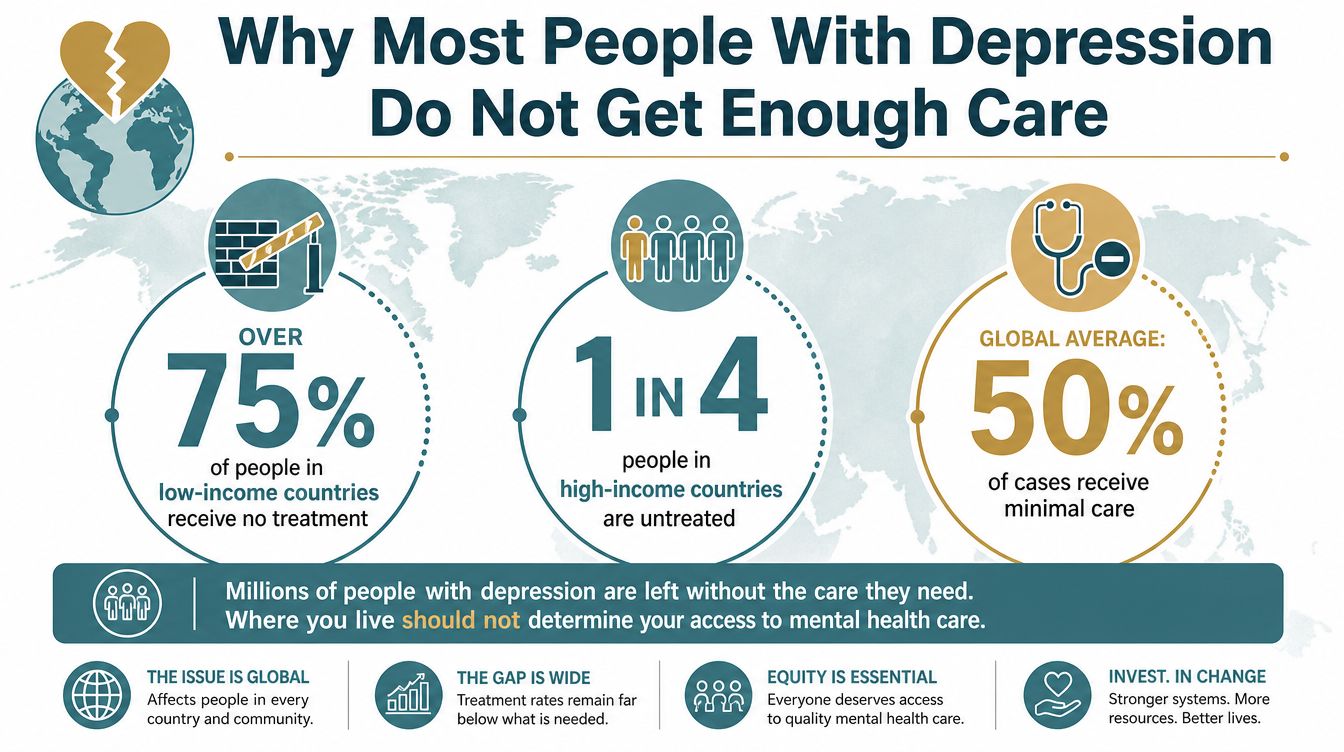
That quality gap matters because depression treatment programs are not all built the same. One person may receive supportive counseling that feels helpful in the room but does not change day-to-day functioning. Another may get a structured plan with therapy, medication management, and frequent follow-up, which is more likely to fit the severity of the illness and the realities of living with it.
Stigma makes the gap worse. Many people wait until symptoms have already affected work, parenting, sleep, or relationships, then begin with whatever care is easiest to access. If the first option is too light, too brief, or too disconnected from real life, the person can leave feeling like treatment did not work, when the bigger problem was a poor match between need and level of care.
Practical rule: if treatment does not change how someone is functioning day to day, the plan may be too shallow, even if it sounds clinically correct on paper.
A useful way to think about depression care is to separate contact from care quality. Contact means someone met with a provider. Quality means the program gave the person enough structure, enough skill-building, and enough follow-through to support change. The stigma of mental illness can delay care until people need a more intensive setting than they expected, which makes early recognition and timely matching even more important.
Understanding Levels of Care in Depression Treatment
The right level of care usually depends on how much depression is interfering with daily life, not just on the diagnosis itself. Someone who can still work, manage meals, and keep appointments may do well in standard outpatient care. Someone who's missing work, withdrawing from family, or barely keeping up with basic routines may need a more structured program.
Matching the program to functioning
Standard outpatient therapy is usually best when symptoms are present but the person can still keep a basic rhythm. Sessions tend to be spaced out, so this level works better when the patient can practice skills between visits and doesn't need daily structure. It's often the starting point for milder cases or a step-down after more intensive treatment.
Intensive Outpatient Programs (IOP) add multiple therapy contacts each week while still allowing the person to sleep at home. That makes IOP a common fit for people who need more support than weekly therapy can provide, but who don't need around-the-clock supervision. It's also useful when someone is trying to protect work, school, or caregiving responsibilities while still receiving consistent treatment. For a direct comparison, this overview of the difference between IOP and PHP can help families sort out the level of structure they're looking at.
Partial Hospitalization Programs (PHP) are more intensive still. A published depression and anxiety model described up to five 50-minute groups per day, Monday through Friday, plus two to three weekly individual CBT sessions for about two weeks, showing how PHP compresses a lot of treatment into a short, structured window PMC. That rhythm fits people who are struggling to function but don't need inpatient hospitalization.
Residential treatment becomes more appropriate when the home environment itself makes recovery unsafe or unworkable, or when the person can't maintain stability outside a highly contained setting. It's not a failure to need that level. It's a sign that the treatment need is bigger than what a lower-intensity program can safely hold.
A simple comparison
| Level of Care | Weekly Hours | Best For | Living Situation |
|---|---|---|---|
| Standard outpatient therapy | Lower, usually scheduled weekly | Mild to moderate symptoms with stable functioning | Lives at home |
| IOP | Multiple sessions per week | People who need structure but can still manage daily life | Lives at home |
| PHP | Full-day treatment on weekdays | Moderate to severe impairment without need for inpatient care | Lives at home or in supportive housing |
| Residential treatment | Highest structure | Safety concerns, severe instability, or an unsafe home environment | Lives on-site |
Good step-down care is normal. Many people move from PHP to IOP, then to weekly therapy. That change doesn't mean the treatment failed, it means the level matched the phase of recovery.
The key question isn't, “What sounds strongest?” It's, “What can this person realistically use right now?” A program that fits current functioning gives the patient a better chance to participate, which is what makes recovery possible.
Evidence-Based Therapies Used in Depression Programs
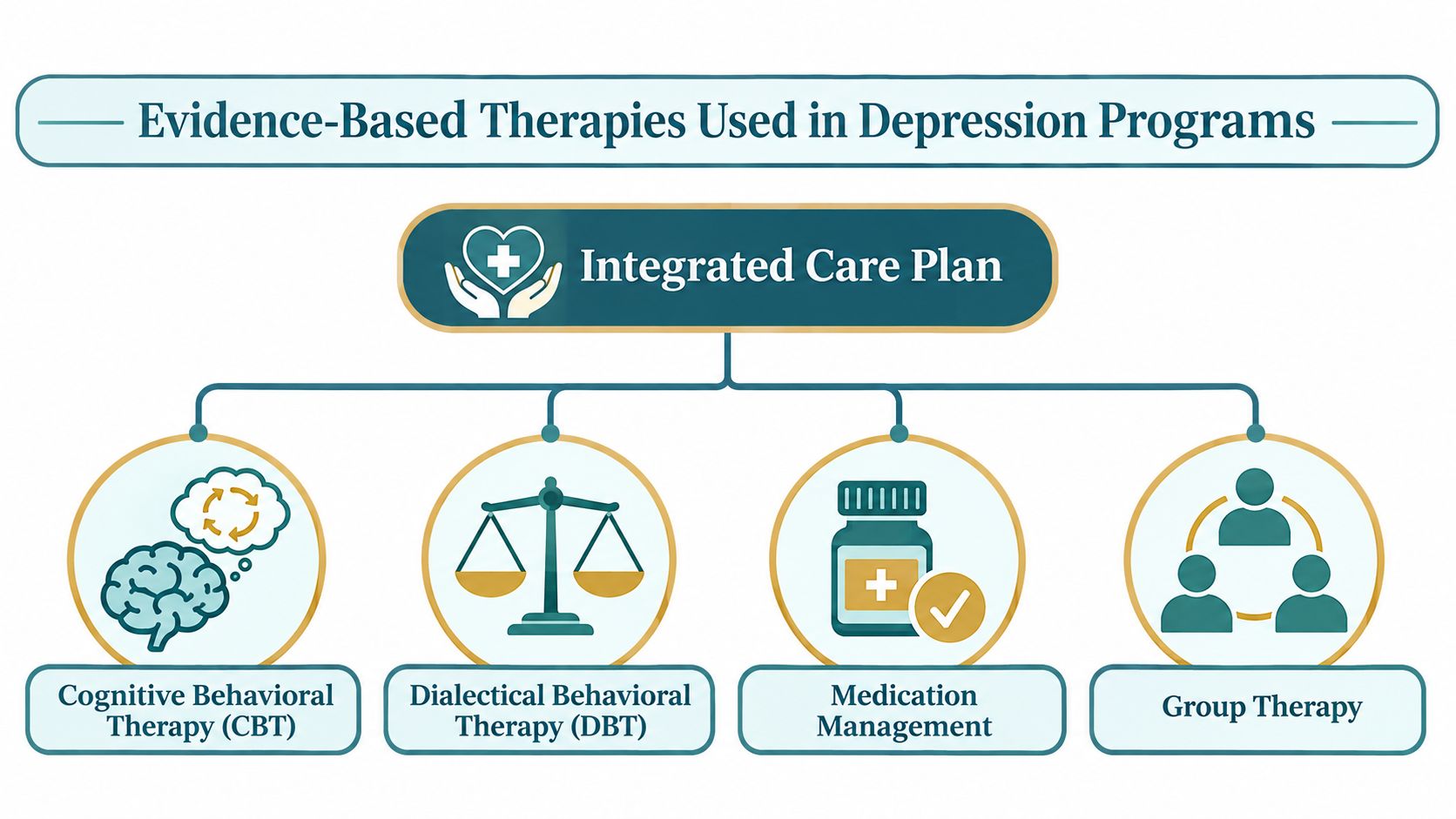
Depression treatment works best when the plan matches both symptoms and day-to-day functioning. A person who can still go to work but cannot concentrate, sleep, or follow through needs a different mix of care than someone whose depression has shut down basic routines. The APA guideline recommends second-generation antidepressants and depression-focused psychotherapies as core acute-phase treatments, and it notes that combination care is common when symptoms are more severe or complex APA.
What each modality tends to do
CBT, or Cognitive Behavioral Therapy, helps people see how thoughts, behaviors, and mood influence one another. In depression programs, it often targets withdrawal, hopeless thinking, and the loss of routine. PMC review found that multiple psychotherapy formats, including CBT and other brief structured therapies, were significantly better than treatment as usual for reducing depressive symptoms.
DBT is often used when emotion regulation, self-harm risk, or intense reactivity is part of the picture. It gives people practical skills for distress tolerance and interpersonal stability, which can matter when depression shows up alongside chaotic relationships or impulsive coping. For some patients, the issue is not only low mood, it is also the way that mood spills into behavior, conflict, and safety concerns.
Medication management helps programs track response, side effects, and dose changes over time. That matters because many patients do not improve from therapy alone, and many need psychiatric oversight to avoid stopping medication too early or staying on an ineffective dose. In a program setting, medication is one part of the plan, not the whole plan.
Group therapy adds repetition, accountability, and peer normalization. In higher-intensity outpatient programs, it can turn abstract coping ideas into practice, which is often what people need when they are stuck in avoidance. Group also helps people hear that their struggle is not unusual, which can lower shame and make follow-through easier.
Trauma-focused tools and integrated care
Some programs also use EMDR and Brainspotting, especially when depression is tied to trauma history. Those approaches are not the centerpiece for every patient, but they can be helpful when unresolved trauma keeps reinforcing low mood, numbness, or hypervigilance. The best fit depends on the clinical picture, not the therapy name alone.
Intensity matters here. If someone is dealing with panic, substance use, unstable relationships, and depression at the same time, weekly talk therapy may be too little structure to change the pattern. Programs that offer several therapy contacts, psychiatry, and skills work give people more chances to practice new responses before the next setback. That is one reason the evidence-based therapy approach described by Casa Recovery focuses on combining modalities rather than relying on a single intervention.
A program should be able to explain how therapy, psychiatry, and groups fit together. If each service operates in a silo, the patient often feels the gaps.
The question is not whether a program lists familiar therapy names. It is whether those therapies are organized into a real care plan that matches impairment, co-occurring conditions, and the demands of daily life.
Managing Co-Occurring Conditions in Depression Treatment
Depression rarely arrives alone. Trauma symptoms, substance use, anxiety, and bipolar disorder can all overlap with low mood, and if a program treats depression as a single-diagnosis issue, it can miss the primary driver of impairment. Research on under-resourced populations points to persistent depression, comorbid PTSD and substance abuse, and major gaps in access to evidence-based care PMC.
Why integrated care works better
Integrated care means the program treats the overlapping problems at the same time. That matters because someone who drinks to sleep, uses substances to numb trauma, or has unstable mood swings won't improve much if the program only addresses sadness. The person may look “noncompliant” when, in reality, the treatment plan doesn't match the full clinical picture.
Trauma-informed care is different from standard depression treatment because it assumes the nervous system may already be on high alert. Staff ask more carefully about safety, pacing, triggers, and trust. That can change everything about how therapy begins, especially for people who've had prior experiences of being misunderstood or dismissed.
Social stress is part of the treatment picture
Poverty-related stressors also shape outcomes. Housing instability, lack of transportation, food insecurity, and limited access to healthcare can all make depression harder to treat, especially when the person can't reliably show up or follow through. That's why many effective models link treatment to community supports rather than pretending the therapy room is separate from daily life.
If a program ignores the patient's living situation, it's treating symptoms in a vacuum.
The newer, community-linked direction in mental health care is also important here. Trusted community organizations, group formats, telehealth, and peer-supported interventions are increasingly used to widen access, especially for older adults, rural residents, and people who haven't felt comfortable in traditional office-based therapy PMC. That doesn't replace clinical care, but it can make care more reachable and more believable.
Families should ask directly whether a program can treat depression alongside other conditions instead of making people stabilize one problem before another. Sequential care often sounds neat on paper. Real patients usually don't live neatly.
What to Expect During Admissions and Your First Week
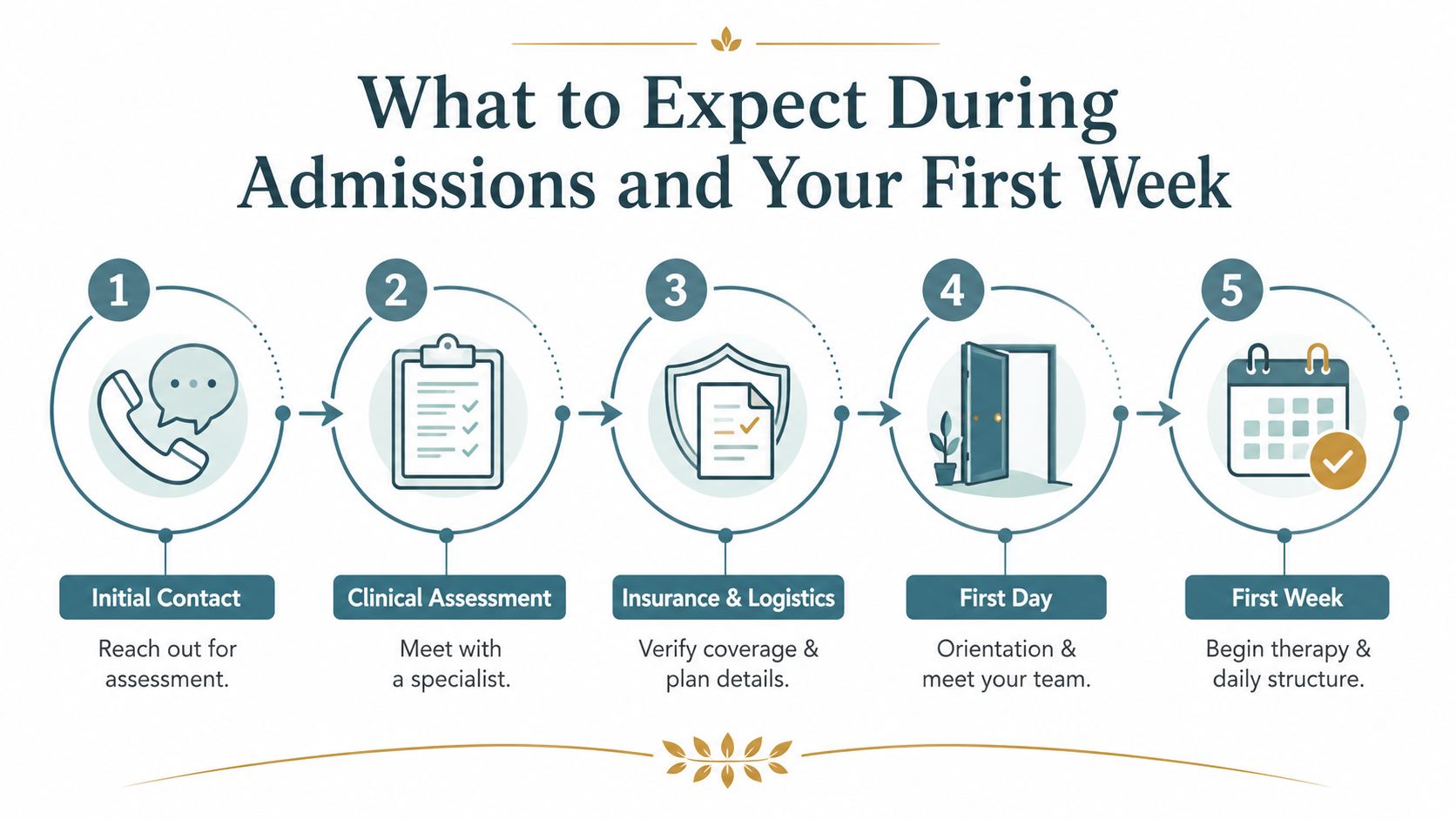
The admissions process is usually more practical than people expect. Programs want to understand symptoms, safety, current medications, insurance, work demands, and whether the person needs a lower or higher level of care. The first contact is often part logistics, part clinical sorting, because the goal is to place the person in a program that they can use.
What intake usually covers
Most programs start with a phone call or online inquiry, then move to a clinical assessment. At that point, the team may ask about sleep, appetite, concentration, safety concerns, substance use, previous treatment, and what's making daily life hard right now. They're trying to determine whether the person needs IOP, PHP, or something else entirely.
Insurance verification usually happens before the first day or alongside clinical review. That's not just administrative paperwork. It helps the family avoid surprises about coverage, copays, and what the program can realistically support for the duration of treatment.
What the first week often feels like
The first day is usually orientation, introductions, and a basic treatment map. The patient meets the team, learns the schedule, and gets a sense of how groups, individual sessions, and psychiatric visits fit together. In PHP, the day can feel full and tightly structured. In IOP, the schedule is shorter but still organized enough to create rhythm.
Medication management often starts early if psychiatry is part of the program. The team reviews current prescriptions, side effects, and whether changes are needed. Family contact may also begin early, especially if the program includes family education or communication support.
Bring a list of medications, prior diagnoses, recent providers, and any safety concerns. That makes the first visit more useful and saves time when the team is building the plan.
People also worry about time away from work or family. That concern is valid, and it's one reason structured outpatient care exists. The point isn't to remove the person from life for no reason, it's to create enough support that life becomes manageable again.
Questions to Ask When Choosing a Depression Treatment Program
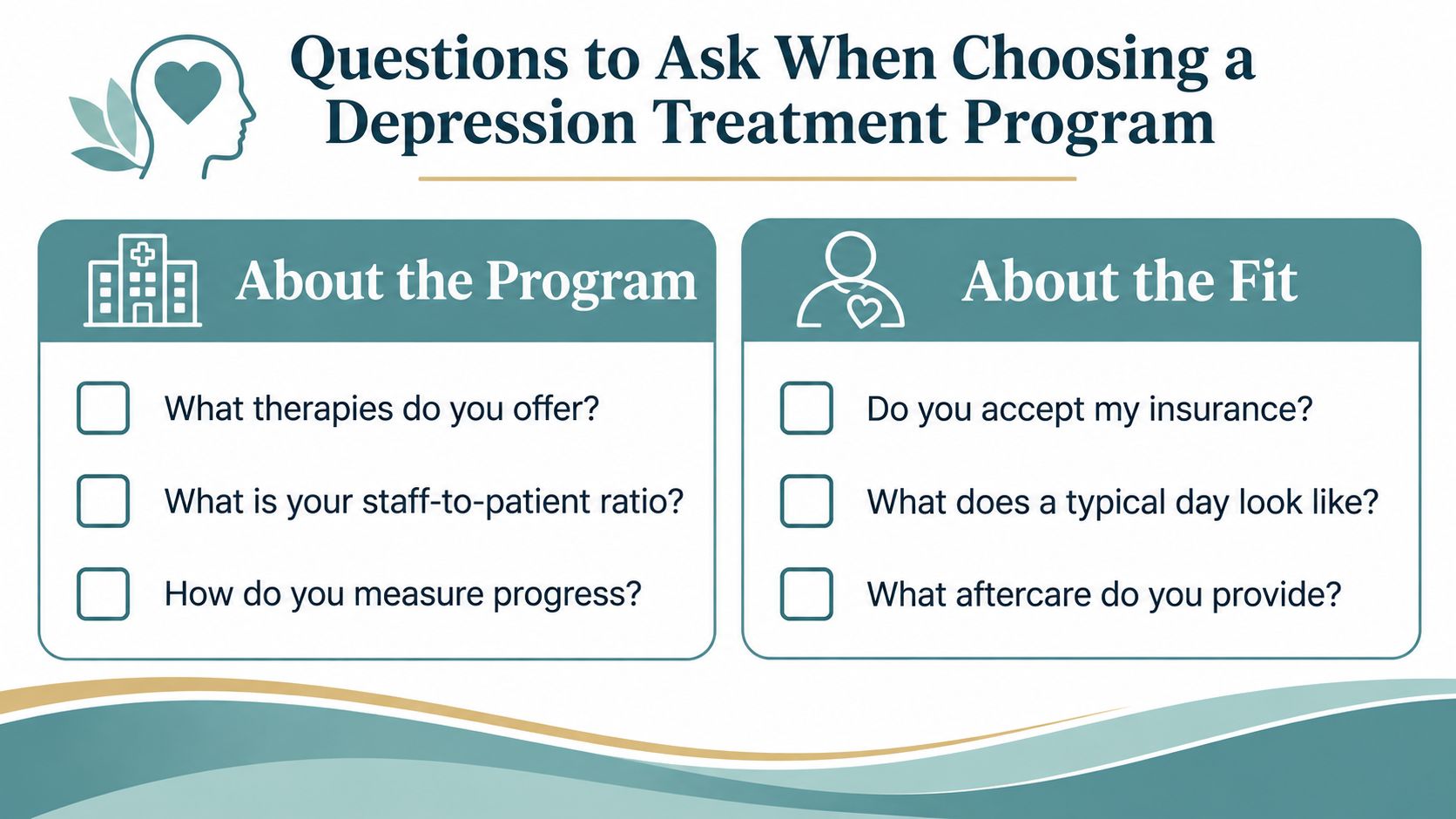
Choosing a program gets easier when you ask about fit instead of just features. A list of therapies means little if the program can't explain how those services are delivered, how progress is tracked, or how they adjust care when someone has trauma, substance use, or limited support at home. The best questions are direct and practical.
About the program
Ask, What therapies do you offer, and how are they combined? A real answer should sound like a care plan, not a list of buzzwords. Ask how often the person meets with a therapist, how psychiatry is coordinated, and whether groups are skills-based or just supportive conversation.
Ask, How do you measure progress? Good programs should be able to describe symptom tracking, functional goals, family involvement, and discharge planning. If they can't explain how they know someone is improving, they may be relying on impressions instead of structured care.
Ask, What happens if depression is tied to trauma, substance use, or another diagnosis? The answer should show comfort with dual-diagnosis care and trauma-informed practice. If the staff sound vague or evasive, that's a warning sign.
About the fit
Ask, What does a typical day or week look like? That question helps you compare the level of structure with the person's current functioning. It also reveals whether the program can realistically fit around work, school, childcare, or transportation.
Ask, What aftercare do you provide? Depression treatment shouldn't end with a discharge date and a handshake. The program should explain step-down care, referrals, and how they support continuity once the patient leaves the higher level of care.
Ask, Do you accept my insurance, and do you help people who live out of area? That's a practical question, but it matters. A clinically good program isn't much help if the patient can't get there or can't stay.
If a program only talks about “healing” but can't answer logistics, keep looking.
Families should also ask whether the program includes family education, because depression affects the whole household. A program that welcomes informed family involvement often gives everyone a clearer path through the first difficult weeks.
How Casa Recovery Approaches Depression Treatment in Orange County
Depression can look different from one person to the next. Some people can still get through the day, while others are missing work, withdrawing from family, or struggling to keep up with basic routines. Casa Recovery in San Juan Capistrano approaches that difference directly by offering outpatient care within a broader mental health and dual-diagnosis setting. The program includes PHP and IOP, psychiatric evaluation, medication management, individual psychotherapy, group therapy, and evidence-based modalities such as CBT, DBT, EMDR, and Brainspotting. Family programming and supportive living options are also part of the model for people who need more structure or who are coming from out of area.
That structure matters because a diagnosis alone does not show how much help someone needs. Two people can both have depression, yet one may still manage daily responsibilities while the other is falling behind on sleep, safety, and self-care. Casa Recovery's approach focuses on that functional gap. The program looks at co-occurring conditions, trauma history, and the practical question of whether someone needs a higher level of support to get through the week. For families, that is often the clearest way to judge whether a program fits.
In Orange County and nearby areas, a structured outpatient setting can be the right middle ground when inpatient care is more than the person needs, but weekly therapy is not enough. It works best for someone whose symptoms are affecting daily life in a way that requires more contact, more monitoring, and more treatment than standard outpatient visits can provide. If you want a program that combines depression care with psychiatric support and trauma-informed treatment, Casa Recovery is a place to start the conversation and ask whether the level of care matches the level of impairment.
If depression is interfering with work, relationships, sleep, or everyday routines, contact Casa Recovery and ask about PHP, IOP, and integrated mental health care. Their team can help you compare options, verify insurance, and decide whether structured outpatient treatment is the right next step for your situation.