If you're an adult looking at outpatient mental health care, the first question usually isn't “What is the clinical theory?” It's more basic than that. You want to know what you'd be walking into, who would be in the room, whether you'd have to talk over strangers, and whether the setting would feel steady enough to trust.
Small group therapy sits in that exact space. It gives you the structure of professional treatment with the human scale that makes real conversation possible, and it's one reason group psychotherapy has stayed central in outpatient care. One major meta-analysis found that 45 of 48 studies concluded group psychotherapy was effective for depression, and 43 of 46 studies with adequate data reported statistically significant reductions in depression. Controlled comparisons also showed strong effects versus no treatment, with a post-treatment effect size of 1.026 and a follow-up effect size of 1.178 in the cited review of depression outcomes. In plain language, this is not a casual add-on, it's a treatment format with real clinical weight. NBK68475
A lot depends on how the group is built. Size, structure, and the therapist's role all change the experience in the room. If you're trying to decide whether this kind of care fits you, the useful question isn't just “Does group therapy work?” It's “What kind of group, with what level of support, and for what clinical need?”
Table of Contents
- What Small Group Therapy Actually Is
- Why Group Size Matters More Than Most People Think
- The Main Small Group Therapy Models and Modalities
- How Small Group Therapy Fits Into PHP IOP and Dual Diagnosis Care
- What a Typical Session Actually Looks Like
- Choosing a Provider and Navigating Logistics
- Key Takeaways for Deciding If Small Group Therapy Is Right for You
What Small Group Therapy Actually Is
You've had a rough stretch. Maybe anxiety has started to take over your mornings, maybe depression has made work feel harder than it should, or maybe you know you need more support than one weekly appointment can give you. When people start looking at outpatient treatment from that place, small group therapy is often the first group format that feels imaginable, because it sounds personal enough to be safe and structured enough to be useful.
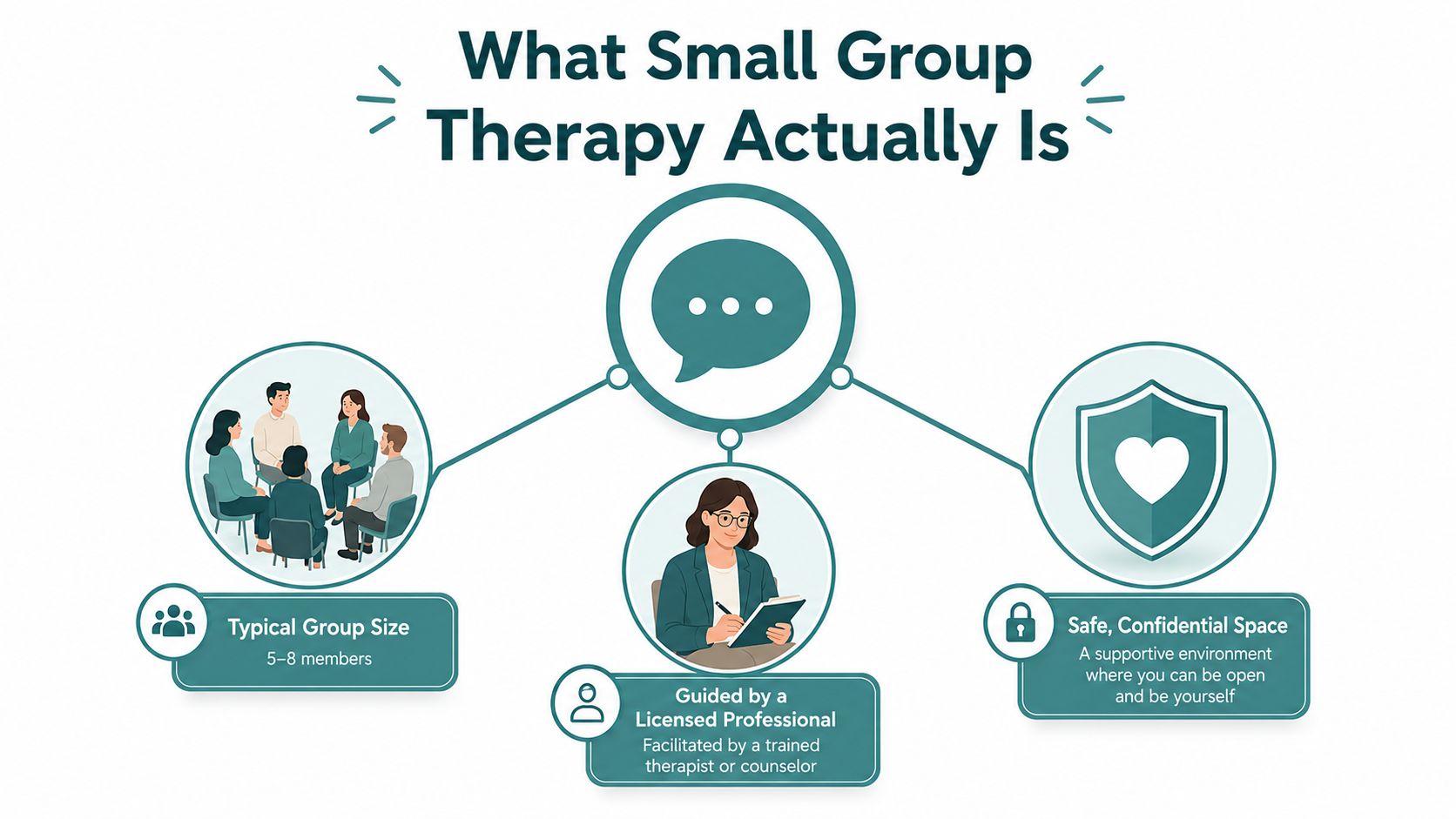
At its simplest, small group therapy means one or two licensed clinicians working with several clients together in a planned therapeutic setting. The APA describes psychotherapy groups as usually ranging from about 5 to 15 patients, often meeting for 1 to 2 hours weekly. That size matters because it creates enough room for each person to speak, get feedback, and observe other people working through similar issues without the room becoming chaotic. APA group therapy overview
How it differs from other group formats
The easiest way to understand it is to separate it from two things people often confuse it with. Individual therapy is one clinician with one client. Peer support groups are usually mutual-help spaces led by members, not licensed therapists, and their purpose is shared encouragement rather than clinical treatment. A clinician-led small group is different because the therapist is actively shaping the session around therapeutic goals, not just holding space for conversation. Support groups vs group therapy
Practical rule: if the group has a clear treatment goal, a licensed facilitator, and a plan for what happens each session, you're looking at therapy, not just a meetup.
Trauma-informed outpatient programs tend to build small groups with that structure on purpose. The room usually has rules about confidentiality, respectful turn-taking, and how to step out if something becomes overwhelming. That doesn't make the setting sterile. It makes it more predictable, which matters when someone has a history of feeling unsafe in groups, families, or institutions. Casa Recovery's overview of individual vs. group psychotherapy is a helpful example of how programs explain that distinction to adults comparing options. Casa Recovery individual vs group psychotherapy
Why Group Size Matters More Than Most People Think
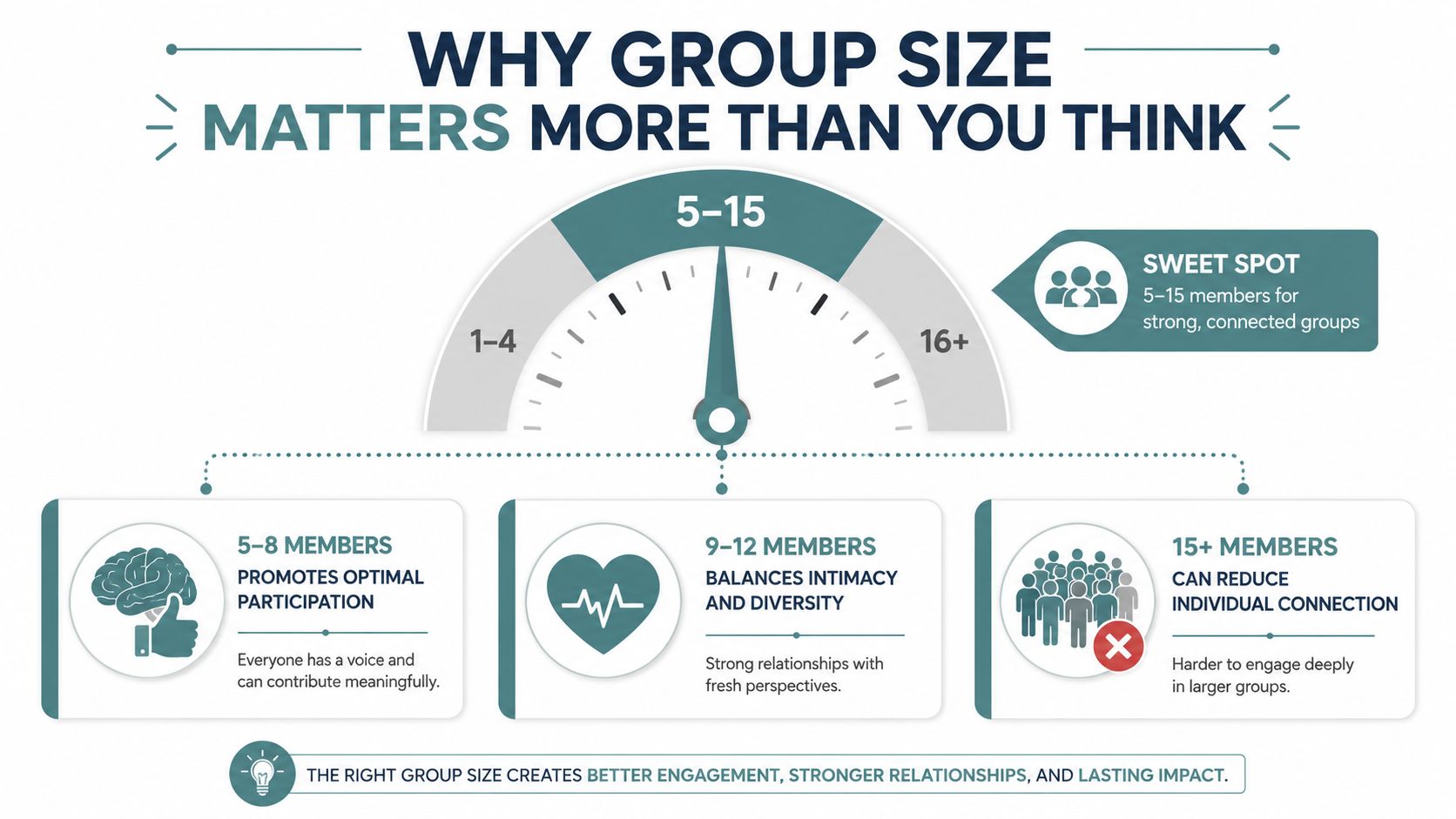
Group size sounds like a scheduling detail, but in practice it shapes almost everything a patient feels. In a compact room, people usually get more speaking time, more direct feedback, and fewer chances to disappear into the background. In a larger room, the pace can feel easier at first, but the therapeutic work often gets thinner because there's less room for each member to be known.
What the evidence actually says
The APA's overview describes the typical psychotherapy group as roughly 5 to 15 patients, and that range is the operational zone most outpatient programs work within. A 2025 systematic review found that evidence for an ideal size is inconsistent, but among studies showing significant effects, 5 of 7 favored smaller groups. The review also noted a slight overall trend toward more favorable outcomes in groups with fewer than 9 members, especially in process-oriented groups and in clinical settings rather than university or community settings. APA group therapy overview, 2025 systematic review on group size
That doesn't mean a smaller group automatically wins. It means size interacts with purpose. A psychoeducational group can sometimes hold a little more density because the work is content-heavy. A process group or trauma-focused group often needs more space, because the therapist has to watch the room closely, track interaction patterns, and intervene when somebody gets flooded or shut down.
Why compact groups can feel different in the room
A smaller group often means fewer interruptions and more precise feedback. If you're trying to learn a coping skill, rehearse a boundary statement, or talk through a triggering situation, the therapist can observe the exact moment the pattern shows up. That's especially useful when the goal is cohesion, participation, and individualized feedback.
Clinical takeaway: smaller groups aren't magically better, but they're often a defensible default when the work depends on fast correction, careful monitoring, or repeated practice.
That's part of why many outpatient programs use compact groups for higher-acuity care. In PHP, IOP, trauma stabilization, and dual-diagnosis treatment, the point is not just to have people in a room together. The point is to create a setting where the therapist can see who's withdrawing, who's overtalking, who's dissociating, and who needs the discussion slowed down before the group loses safety.
The Main Small Group Therapy Models and Modalities
Not every group works the same way, even when the room size is identical. The most useful way to think about small group therapy is by model, because the model determines what members do, what the therapist listens for, and what kind of change the group is trying to produce. SAMHSA TIP 41 identifies five evidence-based group models that matter most in substance use and dual-diagnosis care, and those same models are commonly used in outpatient mental health settings too. SAMHSA TIP 41
Five evidence-based group models
| Group Model | Primary Goal | Best Fit For |
|---|---|---|
| Psychoeducational | Teach illness insight, coping concepts, and treatment information | Adults who need clarity about symptoms, relapse risk, or treatment expectations |
| Skills development | Rehearse concrete behaviors and coping tools | Anxiety, emotion regulation, interpersonal effectiveness, and relapse prevention |
| Cognitive-behavioral or problem-solving | Target triggers, distorted thinking, and behavior loops | Depression, anxiety, substance use, and co-occurring disorders |
| Support | Reduce isolation through peer feedback and encouragement | People who benefit from shared experience and normalization |
| Interpersonal process | Change interpersonal patterns in the room itself | Trauma, relationship difficulties, shame, and avoidance |
Psychoeducational groups are structured and direct. A therapist teaches a concept, the group discusses it, and members connect it to their own lives. Skills groups are more practice-heavy, which is where CBT and DBT tend to show up most clearly. People might work on a thought record, rehearse distress tolerance, or practice a boundary script with feedback from the therapist and peers. SAMHSA TIP 41
Where common modalities fit
CBT is often used when the group is trying to interrupt automatic thoughts and unhelpful behavior loops. DBT fits well when emotion regulation, distress tolerance, or interpersonal effectiveness are the main targets. Trauma-focused groups may also use approaches such as EMDR, Brainspotting, Motivational Interviewing, or art therapy inside a broader outpatient plan, depending on the program and the patient's readiness. Casa Recovery's description of its therapeutic modalities gives a practical example of how those approaches can sit inside one integrated program. Casa Recovery therapeutic modalities
The key question is fit, not buzzwords. If you need stabilization, a highly structured CBT or skills group may make more sense than an open-ended process group. If your main problem is isolation, shame, or repeating the same relationship patterns, a support or interpersonal group may be the better match. When someone is too acute for group work, though, the safer choice is often individual treatment or a higher level of care first.
How Small Group Therapy Fits Into PHP IOP and Dual Diagnosis Care
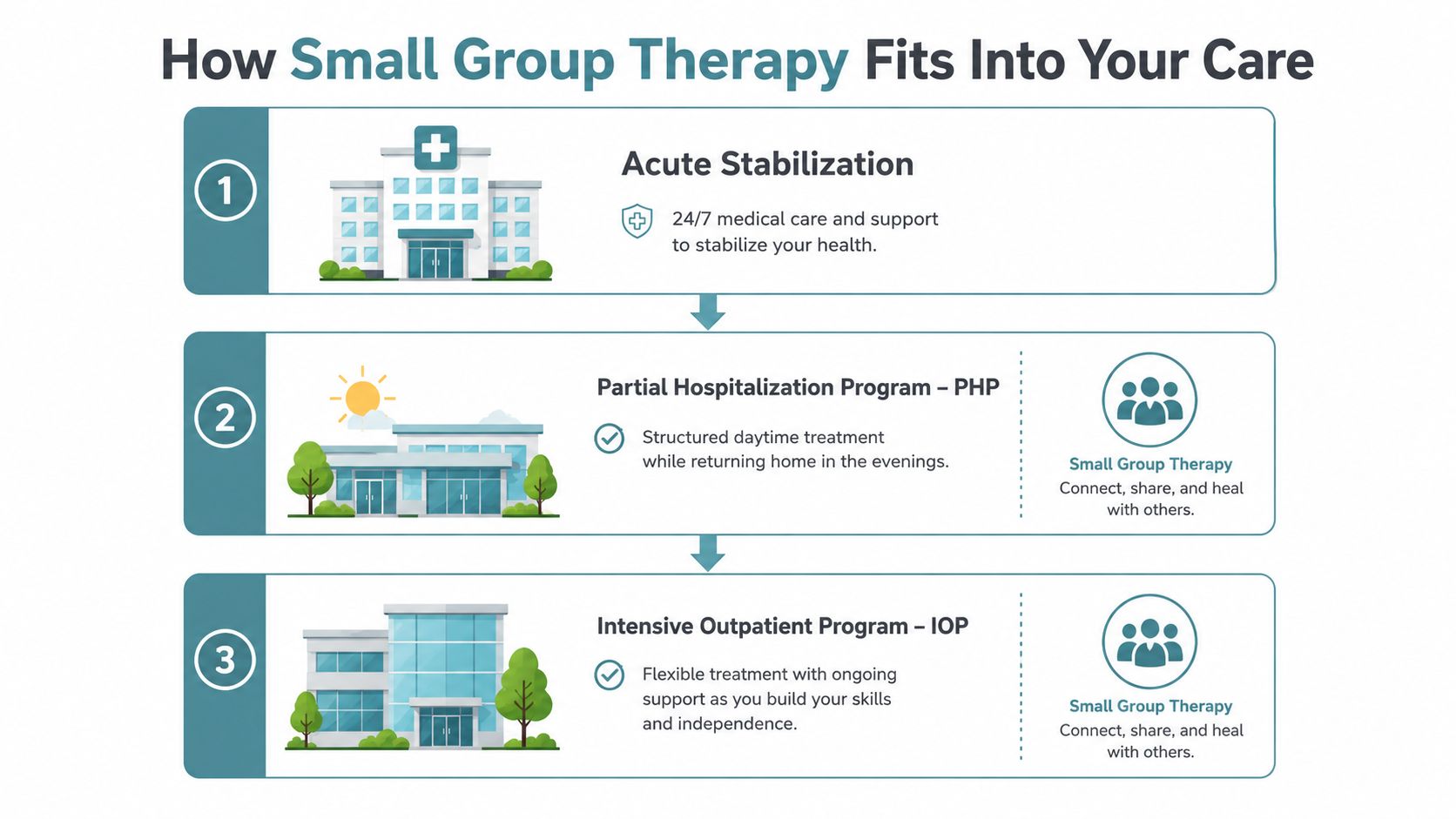
Outpatient care works best when the pieces fit together. In PHP and IOP, small group therapy usually isn't the whole program, it's the backbone that runs alongside individual therapy, psychiatric care, and family work. That matters because adults coming into these programs often aren't dealing with just one problem. Depression, anxiety, trauma, and substance use can all sit in the same clinical picture, and SAMHSA's guidance emphasizes integrated treatment rather than treating those issues as separate lanes. SAMHSA TIP 41
PHP and IOP change the intensity, not the purpose
PHP, or Partial Hospitalization Program, is the more intensive end of outpatient care. It gives people a full-day structure without requiring inpatient hospitalization. IOP, or Intensive Outpatient Program, keeps the support in place but reduces the weekly intensity so the person can work, parent, or gradually re-enter routine life. Small group therapy fits both levels because it gives repeated contact with a therapist and repeated practice with other adults who are dealing with similar issues.
Dual-diagnosis care raises the stakes further. A program can't treat mood symptoms in one lane and substance use in another and expect the whole picture to hold. The clinical work needs to happen together, because triggers, shame, withdrawal, relapse risk, and anxiety often show up in the same day. SAMHSA's five model framework is especially useful here because it lets a program match the group to the clinical task instead of forcing everyone into a single discussion format. SAMHSA TIP 41
Practical rule: if a program can explain how group therapy, psychiatry, and family support connect across the week, it usually has a clearer outpatient structure.
How the rest of the week is usually organized
A solid PHP or IOP plan usually includes more than groups. Psychiatric evaluation and medication management help align the symptom picture with the therapy plan. Family programming keeps loved ones from being left out of the recovery process, especially when communication patterns at home are part of the stress. That's the kind of coordination adults often miss when they only compare programs by the number of hours listed on a website.
For readers who want to see how structured scheduling shows up in another clinical setting, the guide on corporate training for L&D teams is a surprisingly useful comparison point, because it shows how an organized curriculum depends on pacing, repetition, and role clarity. The therapy context is different, of course, but the logic of sequencing still matters.
A program like Casa Recovery's PHP and IOP structure is built around that kind of integration, with small groups, psychiatric support, family involvement, and trauma-informed outpatient care working together rather than separately. In real life, that means a patient may spend part of the week in skills groups, part in individual work, and part in medication or family sessions, all under one treatment plan.
What a Typical Session Actually Looks Like
A first small group session is usually less dramatic than people fear. The therapist sets expectations, names confidentiality, and keeps the room moving without making it feel rushed. Most adults relax once they see that nobody is forced to perform or tell their life story on demand.
A representative CBT or DBT group session
The session often starts with a brief check-in. Each member says how they're doing, what's showing up for them that day, and whether anything urgent needs the therapist's attention. Then the group moves into a structured skill, maybe a CBT thought record, a DBT grounding practice, or a short discussion tied to the week's theme.
After that, members practice. One person might role-play a boundary, another might map out a trigger chain, and someone else may describe how they used a coping skill since the last session. The therapist doesn't just listen for participation, they listen for the exact point where a member gets stuck, then they slow the room down and work that moment clinically.
The end of session usually includes homework. That can mean trying a skill once before the next meeting, noticing a thought pattern in real time, or coming back with a brief reflection on what happened. Casa Recovery's sample weekly schedule is a helpful reference for how a structured outpatient rhythm can be organized across the week.
What safety and repair look like
Confidentiality gets named early, but trauma-informed groups also talk about what happens when someone feels exposed, defensive, or misunderstood. The therapist watches for ruptures, addresses them without embarrassment, and helps the group repair instead of pretending nothing happened. That's one reason patients often feel safer in a well-run small group than they expected to.
People don't usually heal because a room feels perfect. They heal because the room stays steady when it gets awkward.
Group psychotherapy can also improve access and efficiency while remaining clinically active. A recent NIH review noted that group psychotherapy can be as effective as individual psychotherapy while improving access and cost-efficiency, which is part of why outpatient programs rely on it so heavily. NIH review of group psychotherapy
The therapist-to-client ratio matters here, too. A lower ratio usually means more observation, more precise feedback, and faster correction when someone is overwhelmed or disengaging. In a small group, that closeness is often what makes the session feel contained rather than crowded.
Choosing a Provider and Navigating Logistics
Choosing a provider gets easier when you stop asking only about “therapy style” and start asking how the program runs. A small group can be clinically excellent on paper and still be a poor fit if the intake is vague, the schedule is unstable, or the staff can't explain how they screen for trauma, substance use, or safety concerns. That's why the operational questions matter as much as the therapeutic ones.
What to ask before you enroll
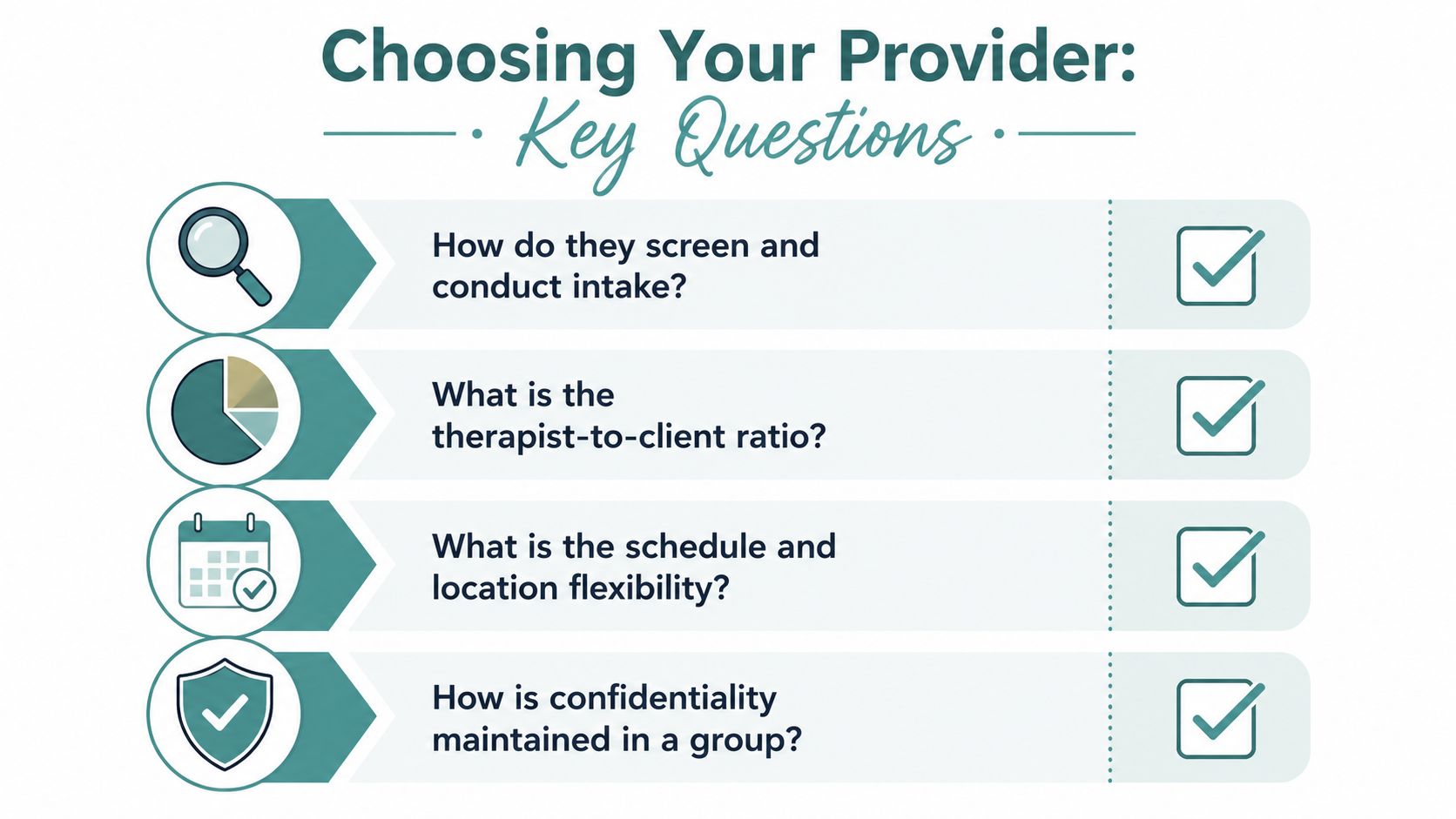
The most useful calls are specific. Ask how the program screens members, what the therapist-to-client ratio looks like, how confidentiality is maintained, and whether the group is built for trauma-informed or dual-diagnosis care. If you're considering a program with family involvement, ask how often family communication happens and whether the family component is education, therapy, or both.
A few logistics matter more than people realize:
- Screening and fit: Ask how the program decides who belongs in a group and who needs individual stabilization first.
- Schedule consistency: Ask how many sessions happen each week and whether the structure changes during step-down.
- Location flexibility: Ask whether the program supports local attendance only or has options for out-of-area clients who need supportive living.
- Medication coordination: Ask whether psychiatry is onsite or coordinated externally, because that affects continuity.
Insurance also deserves a direct question. Casa Recovery notes accepted plans including PPO from all carriers and in-network arrangements with Blue Shield of California/Blue Card, ComPsych, and Holman Group, so benefit verification is part of the admissions process rather than an afterthought. That kind of administrative clarity matters because a good clinical fit still has to be financially workable.
If you're comparing programs, the guide for telehealth privacy rules is a useful reminder that privacy and disclosure policies should be understandable, not buried in legal language. Even in in-person outpatient care, the same principle applies. You should know what's confidential, who can receive information, and how the program handles communication with families or referring clinicians.
Key Takeaways for Deciding If Small Group Therapy Is Right for You
If you need steady structure, repeated practice, and direct feedback from a clinician who can read the room, small group therapy can be a strong fit. It's especially worth considering if you're stepping down from a higher level of care, managing co-occurring symptoms, or looking for a format that combines skills, support, and accountability without losing the human scale.
The best fit usually depends on three things. First, your current acuity. Second, whether you need a psychoeducational, skills, CBT/problem-solving, support, or interpersonal process model. Third, whether the program can explain how it handles trauma, confidentiality, family involvement, and psychiatry in the same plan. If a provider can't answer those questions clearly, keep looking.
If you're comparing options in Orange County or considering structured outpatient care in Southern California, Casa Recovery in San Juan Capistrano is one program to review alongside others. A strong admissions call should leave you with a clear sense of the group size, the clinical model, and the way PHP or IOP supports your day-to-day life.
A CTA for Casa Recovery.