You're in the middle of a conversation that keeps going off the rails. One person feels hurt by a delayed text, the other feels accused, the tone shifts fast, and suddenly the original issue is gone. Later, the apology is intense, the closeness returns, and both of you are left wondering how a small moment became such a big rupture.
That pattern can happen in any relationship, but with BPD and relationships, the speed and intensity often feel confusing in a different way. The challenge is not just naming the diagnosis, it's learning how to stay compassionate without getting pulled into a cycle that wears both people down. For many Orange County adults and families, the practical questions are who is responsible for what, how do we tell if treatment is helping, and what kind of care includes the relationship system instead of treating one person in isolation.
Table of Contents
- A Familiar Scene Before the Language of BPD
- What BPD Actually Means in a Relationship
- The Relationship Patterns Most Couples Notice First
- Supporting a Partner Without Becoming Over-Responsible
- Communication and Boundary Skills That Actually Help
- What Progress Actually Looks Like in a Relationship
- Treatment Options and Levels of Care in Orange County
- Next Steps for Orange County Adults and Families
A Familiar Scene Before the Language of BPD
She says she only needed a little reassurance. He says he already answered twice. The conversation starts over a weekend plan, then turns into a larger accusation, then into tears, then into an urgent promise that things are fine now and always will be. By the next morning, both people are exhausted, and one of them is already bracing for the next shift.
That kind of cycle can feel like two relationships living inside one house. In one moment there's closeness and relief, then a small disappointment lands like rejection, and the emotional temperature changes so quickly that the other person can't keep up. In BPD and relationships, this isn't about someone being “too much” or “bad at love,” it's about a real pattern of intense attachment, fear of abandonment, and unstable closeness that can make ordinary conflict feel threatening.
A useful way to hold that picture is to think of the relationship as a room with an emotional thermostat that resets too fast. The room didn't become unsafe, but the nervous system inside the room reacted as if it did. That's why a missed call, a change of tone, or a request for space can trigger a response that seems out of proportion to the event.
The good news is that this is understandable, and it's treatable. A 2024 review found BPD is not rare in specialty care, with lifetime prevalence of 0.7% to 2.7% in the general adult population, about 12% in outpatient psychiatric services, and 22% in inpatient psychiatric services (PMC review). That matters because many couples and families first encounter these patterns in the same settings where relationship counseling, trauma care, and dual-diagnosis treatment happen.
What BPD Actually Means in a Relationship
The relationship pattern underneath the diagnosis
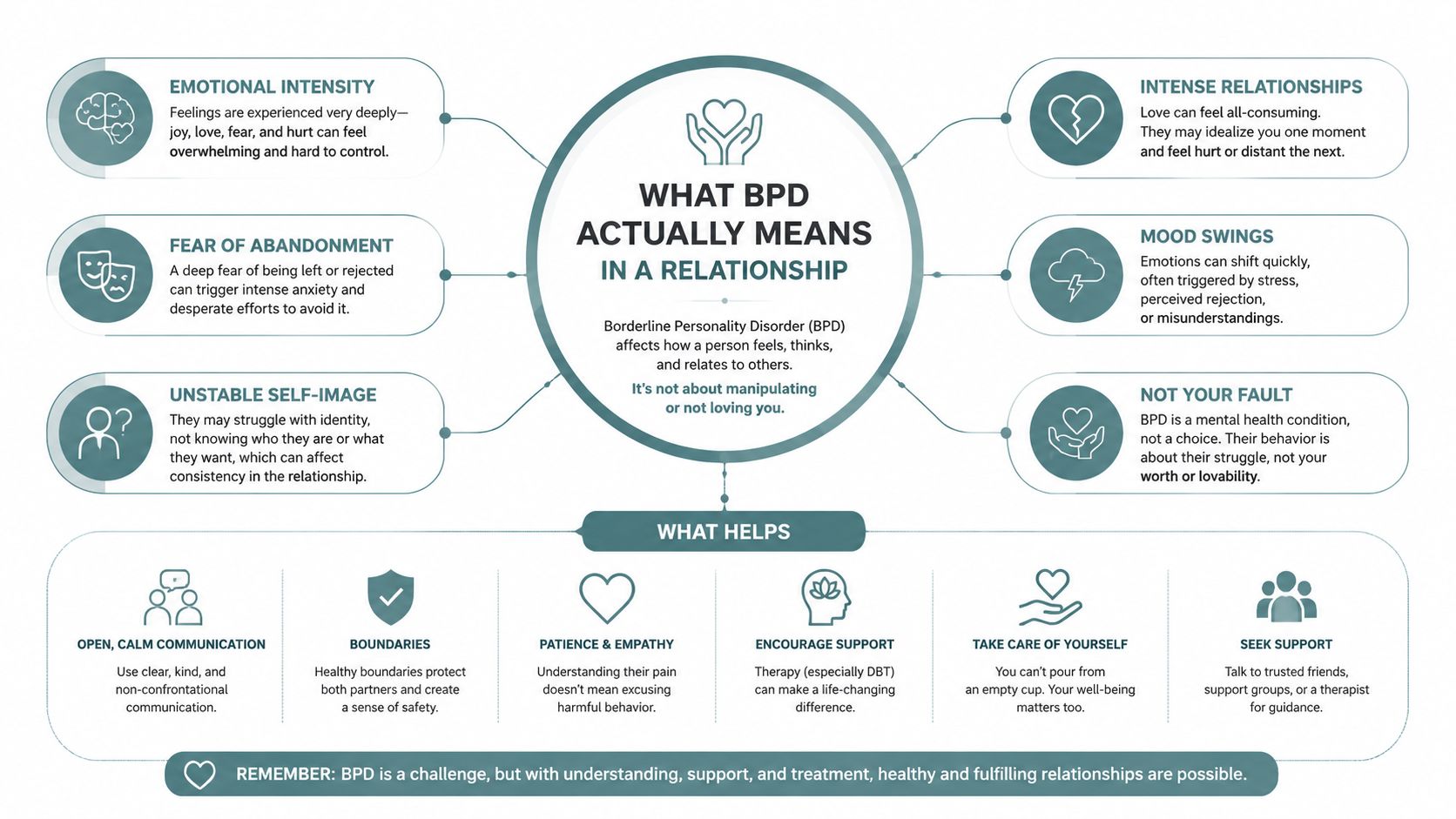
Borderline personality disorder is easiest to understand in relationship language. The person often fears abandonment intensely, experiences closeness as fragile, and can swing between wanting reassurance and pushing the other person away. That doesn't mean every conflict is caused by BPD, but it does mean the relationship may get organized around threat detection instead of steady trust.
A family member may experience this as “I can never get it right.” A partner may feel that affection changes shape overnight. Someone with BPD may feel that one missed text means disinterest, while the other person sees only a minor delay. The gap between those interpretations is where the pain starts.
Attachment helps explain why it feels so personal
Insecure attachment, especially preoccupied and fearful-avoidant patterns, often sits behind these relationship swings. That backdrop helps explain why reassurance can feel urgent, why distance can feel like danger, and why conflict can seem bigger than the actual topic. The person isn't inventing the distress, they're reacting through a relationship system that learned to expect instability.
Practical rule: if a reaction seems huge, ask first, “What did this moment mean to them?” before asking, “Why are they overreacting?”
The point is not to excuse harmful behavior or to reduce everything to diagnosis. It's to recognize that BPD and relationships often involve a fast-moving emotional system, not a simple communication problem. Once you can see that, the next step is learning what the most common patterns look like in daily life.
The Relationship Patterns Most Couples Notice First
Push-pull cycles, idealization, and devaluation
One day the partner feels idealized, understood, almost uniquely safe. Then a disappointment lands, and the same person can seem uncaring, selfish, or impossible to trust. That swing is often described as splitting, and it can make both people feel as if the relationship has whiplash.
The trigger is usually not a huge event. It might be a boundary, a late arrival, a neutral facial expression, or a plan changing. The emotional driver is often shame, fear, or perceived rejection, and the partner experience is usually exhaustion mixed with self-doubt, because the rules of the relationship seem to change without warning.
Conflict that grows larger than the original issue
A review of romantic relationships in BPD found that people with BPD or BPD traits tend to have more romantic relationships overall, but those relationships are less prolonged, less satisfying, and more hostile than those of people without BPD, with insecure attachment and passive-aggressive communication also showing up in the pattern (Karger review). That doesn't mean every couple with conflict fits the pattern. It does mean repeated rupture and repair problems are common enough to take seriously.
A partner may notice withdrawals, repeated accusations, or sudden arguments that seem disproportionate to the topic. A person with BPD may feel flooded and then ashamed, which can make the cycle sharper. Ordinary stress can look similar, but the difference is usually the intensity, the speed of the shift, and the way closeness itself becomes part of the conflict.
When a relationship keeps cycling through rupture and reunion, the issue usually isn't just the topic being discussed. It's the fear underneath the discussion.
Early adolescence can already show the pattern
Relationship impairment doesn't wait until adulthood. A longitudinal study found that higher BPD symptoms at age 15 predicted increases in antagonism, verbal aggression, and physical aggression from ages 15 to 19, while higher perceived relationship support at age 15 predicted steeper increases in BPD symptoms over the same period (PMC study). That finding matters because it shows the pattern can be early, measurable, and persistent.
For couples, the takeaway is simple. If every disagreement turns into a crisis, you're not dealing with “normal communication issues” anymore. You're dealing with a relationship pattern that likely needs skills, structure, and often formal treatment.
Supporting a Partner Without Becoming Over-Responsible
Validation is not the same as carrying the whole load
Supportive partners often try to calm everything down. They explain, reassure, answer messages faster, cancel their own plans, and keep track of mood so closely that the relationship starts to feel like a full-time emotional job. At first that can look caring. Over time, it becomes over-functioning, and it teaches both people that one partner has to regulate the other.
Validation works differently. It says, “I can see this hurts,” without saying, “I will fix this for you.” That difference matters because it keeps care from turning into rescue. One supports the bond, the other drains it.
A simple boundary map that keeps the relationship sustainable
Use three categories when deciding what to do next.
- What is mine: my tone, my timing, my limits, my safety.
- What is yours: your feelings, your choices, your treatment work.
- What is ours: the shared rules for conflict, repair, and respect.
That map helps when the urge is to absorb everything. It also makes it easier to see when a partner's anger or impulsivity crosses into emotional or physical abuse, because safety comes before closeness. A plain-language guide on how to tell when help becomes pressure or control can help separate care from coercion. For added clarity on day-to-day boundaries, see PartnerScanX on relationship boundaries.
Mutual sustainability is the goal
The healthiest version of support is not one person holding the whole system together. It is two people, or a family system, learning how to lower escalation, protect dignity, and keep boundaries clear even during distress. That matters especially in outpatient care, where change has to hold up in ordinary life, not just inside a therapy hour.
Boundary language matters: “I want to talk about this, and I'm not staying in a conversation with yelling. I'll come back in 30 minutes.”
The goal is to keep the relationship livable. When support, accountability, and limits stay in balance, care can stay steady without turning one partner into the manager of everyone else's emotions.
Communication and Boundary Skills That Actually Help
A hard conversation can feel like trying to steer a car on ice. The wheel still turns, but every quick move makes the slide worse. For BPD and relationships, that means the first skill is often slowing the exchange before anyone tries to solve it.
Start with how to ask without escalating
DBT gives couples a practical language for conflict. DEAR MAN is a clear place to start, because it helps a person ask directly, stay on topic, and keep the request specific. A request like, “I need us to talk after dinner, not during work hours, and I want us both off our phones,” is much easier to respond to than a long, shifting complaint. For a fuller overview of the treatment model behind that skill set, Casa Recovery's guide to dialectical behavior therapy explains how DBT is used in practice.
GIVE helps you stay respectful while you're talking. That means using a gentle tone, showing interest in the other person's view, validating what you can validate, and keeping an easy manner. FAST protects self-respect, so you do not agree just to stop the tension. A simple version sounds like, “I care about you, and I'm not agreeing to something that makes me feel unsafe.”
Use distress skills before the argument runs the house
When emotion spikes, the goal is not to solve the problem immediately. The first task is getting the nervous system back into a range where a real conversation is possible. Check the facts before assuming the other person meant harm. Opposite action matters when the impulse is to attack, storm out, or vanish. TIPP skills, like changing body temperature, moving intensely, paced breathing, and muscle relaxation, can help a person ride out acute distress without making the partner the emergency room.
That is one reason these skills matter in ordinary life. They give a couple a pause button.
A practical picture helps here. If one partner sends a sharp text, the other can wait, breathe, and check whether the message is hostile or just clumsy. That small pause can keep a rough moment from turning into a full rupture. For readers who want a privacy-focused lens on everyday limits, PartnerScanX on relationship boundaries can help clarify how autonomy and trust fit together.
Say the limit, then hold it
A boundary works when it is clear and repeatable. Try this structure, “I'm willing to talk about this, I'm not willing to be insulted, and if it keeps going that way I'll step away and return later.” Then return later if it is safe to do so. That last part matters, because boundaries are not punishments, they are the structure that lets repair happen.
The skill is in both parts, the statement and the follow-through. If the limit changes every time, the other person has no stable frame to work within. If the limit is stated once and never revisited, the door to repair stays shut. A consistent boundary says what the conversation can hold, and what it cannot.
The best conversations are not perfect, they are contained enough that both people can stay in them.
What Progress Actually Looks Like in a Relationship
The first signs are usually small
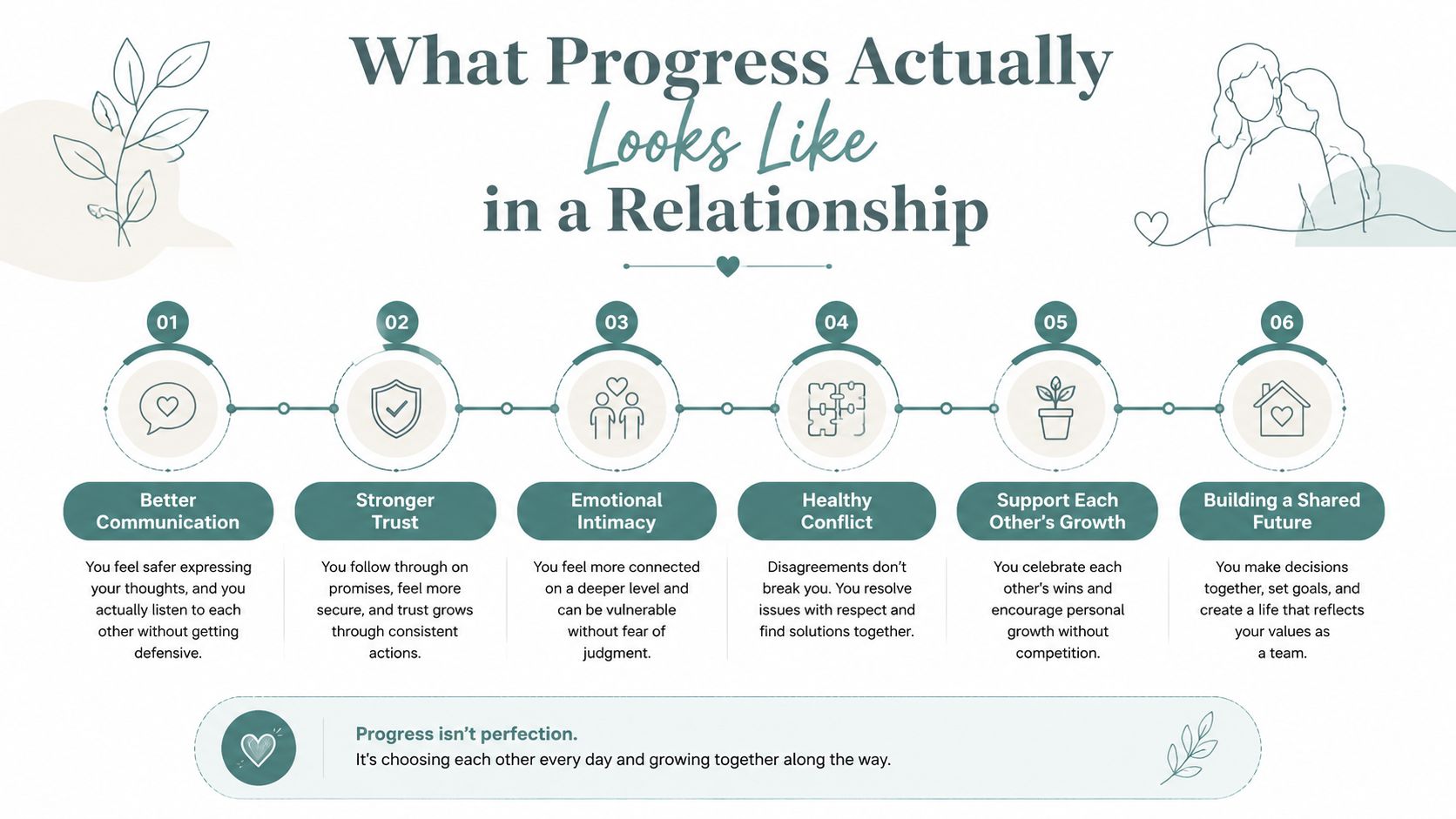
People often expect recovery to look dramatic. In real relationships, the early signs are quieter. A person may pause longer before reacting, send one thoughtful message instead of ten urgent ones, or come back after a break without turning the break into a breakup. Those are meaningful shifts, because they show more space between feeling and action.
A dyadic longitudinal study found that greater BPD severity was associated with lower relationship satisfaction in both partners, and it predicted worsening satisfaction over 12 months. The same study linked BPD to a lower positive-to-negative interaction ratio and more defensive behavior, which points to a bidirectional feedback loop rather than one person causing all the damage (PMC study).
Mixed signals do happen during treatment
Improvement is not linear. A partner can be doing real work and still have a bad day, a relapse in communication, or a temporary return to old habits. That doesn't mean treatment isn't working. It does mean the relationship should be measured by trends, not by one fight or one peaceful week.
What tends to change first is reactivity. What tends to take longer is trust, identity stability, and the sense that closeness no longer feels dangerous. If a relationship becomes less volatile but still lacks repair, the work is incomplete. If it gets calmer and kinder over time, that's a better sign than perfect behavior on one weekend.
Progress is not “we never fight.” Progress is “we recover faster, we hurt each other less, and we know what to do when things go sideways.”
That's why partners should watch for better repair, not just fewer conflicts. The evidence supports hope, but it also supports patience and honest tracking.
Treatment Options and Levels of Care in Orange County
Match the level of care to the level of strain
Orange County families usually hear a few program names first, and they matter for different reasons. A Partial Hospitalization Program (PHP) gives full-day structure and is often used when someone needs intensive stabilization, while an Intensive Outpatient Program (IOP) offers multiple sessions each week and more flexibility for work, parenting, or school. Step-down care matters after a crisis or residential stay because the relationship system often needs help re-entering ordinary life without collapsing back into the same cycle.
Casa Recovery is one outpatient option in San Juan Capistrano that offers PHP, IOP, psychiatric evaluation, medication management, dual-diagnosis care, family programming, and trauma-informed treatment for adults, including personality disorders. That combination matters when the problem is not just symptoms inside one person, but the relationship system around them.
What the common modalities actually do
DBT focuses on emotion regulation, distress tolerance, interpersonal effectiveness, and mindfulness. CBT helps people notice and test the thoughts that drive reactions. EMDR and Brainspotting are trauma therapies that can help process unresolved experiences that keep getting activated in present-day relationships. Motivational Interviewing helps someone move from ambivalence into action without turning treatment into a power struggle.
If substance use is part of the picture, integrated dual-diagnosis care is important because relapse risk and relationship instability tend to feed each other. A family program also matters because the couple or family often needs shared language, not just separate coping plans. For a deeper look at engagement barriers, Casa Recovery's piece on reducing non-compliance in BPD treatment is useful context.
A quick matching guide
| If the main concern is… | Start with… | Why this level fits |
|---|---|---|
| Crisis-level volatility or recent safety concerns | PHP | Strong structure and daily clinical support |
| Repeated conflict, but the person can still live at home safely | IOP | Frequent support with more real-world practice |
| Trauma triggers that keep hijacking relationships | EMDR or Brainspotting within a trauma-informed plan | Targets unresolved material that fuels reactivity |
| Mixed mental health and substance use concerns | Integrated dual-diagnosis care | Treats both issues together |
| The whole family feels pulled into the cycle | Family program plus individual care | Gives everyone shared boundaries and language |
Next Steps for Orange County Adults and Families
Start with one clear admissions conversation
The first call should not be a vague “Do you help with this?” Ask what level of care they recommend, whether they offer PHP or IOP, how they involve families, and whether they can coordinate psychiatry and therapy in the same plan. If you're comparing options, ask whether the program treats personality disorders, trauma, and co-occurring substance use together or in separate tracks.
Insurance questions matter too. Verify whether the program is in-network, what plans it accepts, and whether benefits need preauthorization. If you're outside Orange County, ask about supportive living coordination and how family participation works when travel is involved. For a general guide to deciding when psychiatric evaluation is appropriate, this telepsychiatry guide for Pennsylvanians is a practical example of how access questions can be framed, even if your care is local.
What a strong first week usually includes
A thoughtful first week usually starts with assessment, a clear treatment plan, and early scheduling that doesn't leave the person uncontained. It should also include communication about goals, safety, family involvement, and what to do if conflict spikes at home. The point is to reduce guessing.
For families, safe involvement means staying informed without policing every interaction. For children, involvement should be age-appropriate and guided by the treatment team. For adult relatives, the best role is often to support structure, encourage attendance, and avoid becoming the only emotional regulator in the house.
Common questions families ask
- Can couples attend together? Sometimes, but it depends on safety, stability, and the treatment plan.
- What if there's also substance use? Integrated dual-diagnosis care is usually the cleaner starting point.
- How do we know outpatient isn't enough? If safety, daily function, or repeated crises keep breaking through, a higher level of care may be needed.
- Should children be told everything? No, children should get honest, age-appropriate information, not adult-level detail.
If you're in Orange County and trying to sort out whether PHP, IOP, or a broader outpatient plan makes sense, Casa Recovery offers a structured way to start that conversation with an admissions team that can also discuss family participation and supportive living options.
If you're trying to make sense of BPD and relationships, Casa Recovery offers outpatient treatment that combines trauma-informed therapy, family support, psychiatry, and step-down structure for adults. If your relationship feels stuck between compassion and burnout, visit Casa Recovery to ask about PHP, IOP, and treatment options that address both the person and the relationship system.