Most self-pay partial hospitalization programs run about $350 to $450 per day, or roughly $10,500 to $13,500 for a 30-day program. If the stay stretches to the common 30 to 45 days, the total can land around $9,000 to $22,500 depending on what's included and how long you stay.
That's the number families need to hear first, because the bill usually starts there and then moves in two directions, down with insurance and up with add-ons. A parent sits at the kitchen table, a spouse is on hold with admissions, and the question is never just “Can we afford treatment?” It's “What exactly will this cost us by the end of the month?”
Table of Contents
- What a Partial Hospitalization Program Costs in 2026
- The Clinical Components That Make Up the Bill
- How Insurance Changes the Real Number You Will Pay
- PHP vs IOP vs Residential Treatment
- Three Realistic Out-of-Pocket Scenarios
- Financing and Payment Options That Soften the Bill
- Why Local Orange County Readers Often Compare Casa Recovery
- Practical FAQs and a Short Pre-Admissions Checklist
What a Partial Hospitalization Program Costs in 2026
A Partial Hospitalization Program cost makes sense only when you treat it like a formula, not a sticker. Start with the daily rate, multiply by the number of days, then subtract what insurance really covers. That is the number families should focus on, and it is the number every program should be willing to explain.
The sticker price families usually see
Self-pay rates in the U.S. often land in the $350 to $450 per day range, which puts a 30-day program at roughly $10,500 to $13,500 (Harmony Recovery Group cost overview). Other pricing guides place PHP closer to $250 to $600 per day and about $9,000 to $18,000 per month (Better Addiction Care PHP pricing). A longer stay, often quoted at 30 to 45 days, changes the total fast, which is why two families can hear the same daily rate and still end up with very different bills.
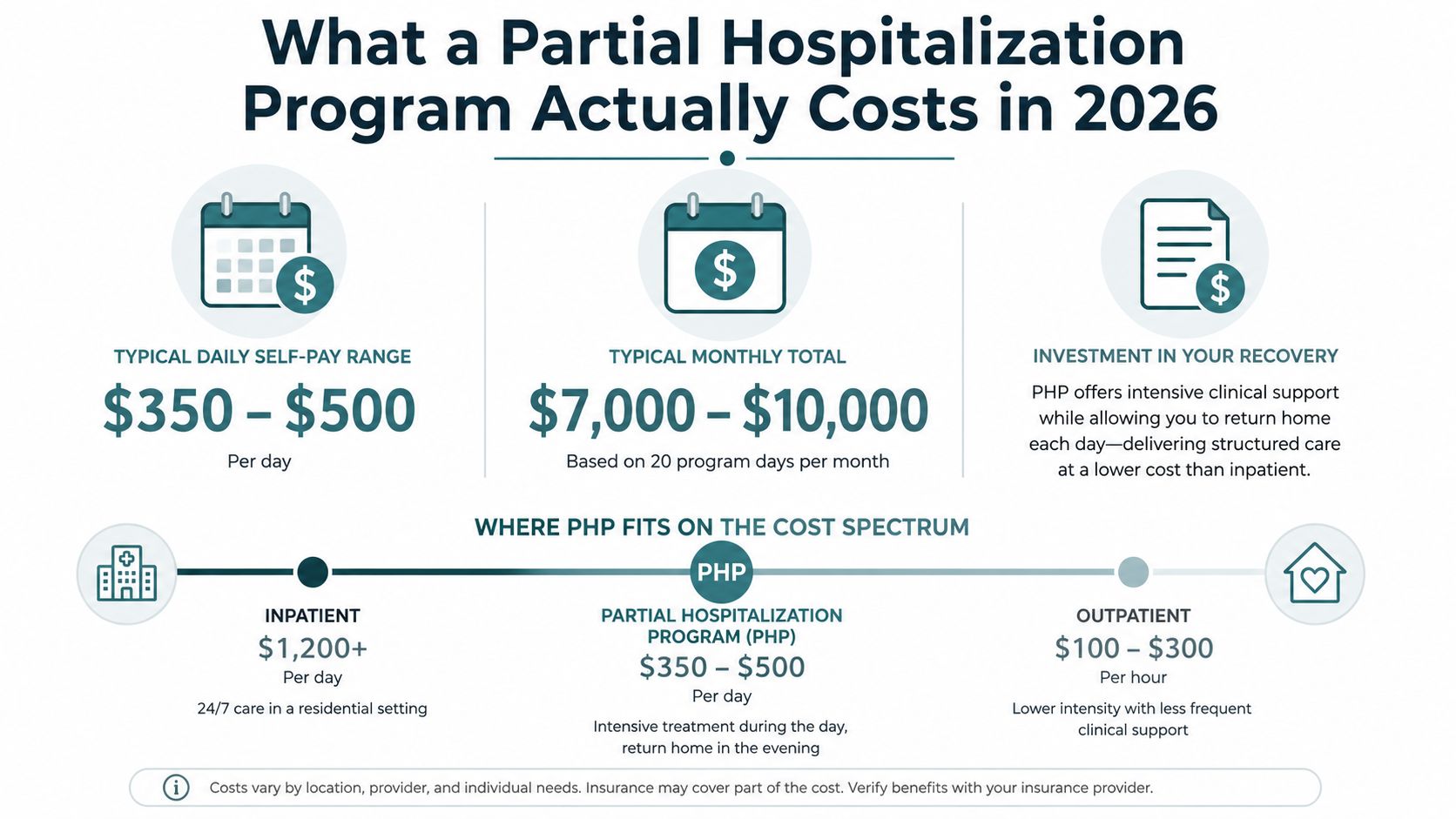
PHP costs less than residential treatment because you are not paying for an overnight bed, but it costs more than ordinary outpatient therapy because the program runs for several hours a day with a higher level of clinical support. That spread makes sense. If a program cannot tell you what is driving its rate, you are not looking at a clear estimate.
Families also need to ask what sits outside the quoted number. Some facilities include a lot, while others separate out medication visits, lab work, drug screening, transportation help, meals, family sessions, or discharge planning. If a treatment center says the program is “all-inclusive,” ask for the written list of what that includes, not a sales pitch.
For a useful model of how itemized billing should look, the detailed cost breakdown example from LifeBack Law Firm, P.A. shows the kind of line-by-line clarity families should ask for before they sign anything.
Practical rule: if a program will not give you the daily rate, the expected length of stay, and the separate charges in writing, you do not have a real estimate yet.
The Clinical Components That Make Up the Bill
PHP looks like one number on a brochure, but the bill is really a bundle of services. If you compare two programs by sticker price alone, you're comparing apples to a grocery bag full of apples, pears, and a few things you didn't know were inside.
What the daily rate usually covers
At minimum, a PHP day usually includes group therapy, individual therapy, and some level of clinical supervision. Many programs also build in psychiatric evaluation, medication management, psychoeducation, family therapy, case coordination, and aftercare planning. That bundle is what makes PHP more intensive than standard outpatient therapy and more expensive than a lighter touch schedule.
The service mix matters because the clinical staff mix drives the price. A day with multiple therapists, a psychiatrist, and structured groups costs more to run than a day built mostly around groups alone. When a program says it includes trauma work, dual-diagnosis support, or family programming, you should assume that staffing and scheduling are part of the value you're paying for.
What families get surprised by
The part most admissions pages skip is what can still show up separately. Ask directly whether the quoted rate includes medication visits, lab work, drug screening, transportation help, meals, family sessions, or discharge planning. If a facility says “all-inclusive,” make them define all.
Ask for a line-item answer, not a smile and a promise. A good admissions coordinator can tell you what is covered and what is not without guessing.
That question gets even more important when a program offers extra services for co-occurring disorders or trauma. A higher quote may be cleaner if it bundles more of the care you need. A lower quote can become expensive fast if you later discover that psychiatry, family work, or testing sits outside the daily rate.
How Insurance Changes the Real Number You Will Pay
Insurance is where the sticker price stops being useful and the math starts. I've seen families panic over a posted rate, then discover their actual out-of-pocket bill is far smaller. I've also seen the opposite, where the program sounded affordable until the deductible and coinsurance landed.
The benefit check you need before admission
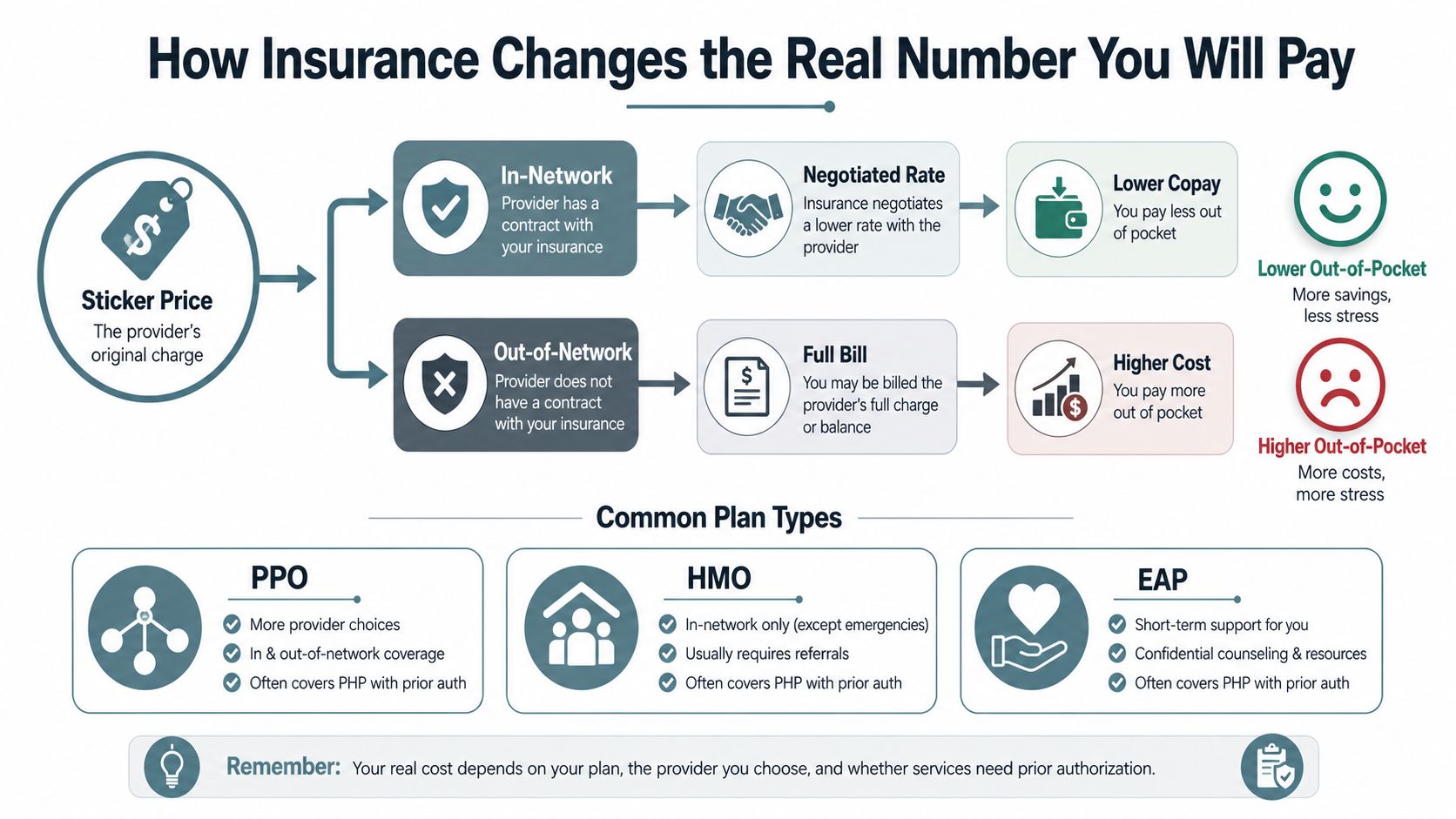
Start with one question, Is this in-network or out-of-network for my plan? In-network care usually means a negotiated rate and lower patient responsibility. Out-of-network care can leave you carrying a much bigger share of the bill, depending on your plan rules.
The plan type matters too. PPOs are often more flexible, HMOs usually require tighter authorization pathways, and EAPs may provide a short bridge into treatment or direct support through an employer benefit. If you want a practical step-by-step on verifying coverage for mental health treatment, Casa Recovery's insurance coverage guide for mental health is a useful reference point for what admissions teams should check before anyone commits.
Medicare has its own math
For Medicare, PHP is billed as a per-diem outpatient benefit, and beneficiaries typically owe the remaining deductible plus 20% coinsurance (American Addiction Centers overview, Medicare note in verified data). That's a very different structure from a private self-pay quote, so nobody should assume the posted rate tells them what they'll owe.
What to ask before signing
- Is prior authorization required? If yes, get the approval in writing.
- What is the contracted daily rate? Don't accept a verbal estimate.
- What counts toward my deductible? Ask before the first day starts.
- What does coinsurance apply to? Some families misunderstand this and budget wrong.
- What services are separate? Ask specifically about psychiatry, labs, and family sessions.
For families comparing coverage structures, the most useful mindset is simple. Don't ask, “Does insurance cover PHP?” Ask, “What does this plan pay for after authorization, and what am I responsible for?”
PHP vs IOP vs Residential Treatment
PHP is not the right fit just because it sounds structured. The primary concern is severity, safety, and stability. Price matters, but it should never choose the level of care for you.
Compare the levels before you compare the invoices
| Level of Care | Typical Intensity | Typical Cost | Best Fit For |
|---|---|---|---|
| PHP | Several hours of treatment during the day, usually on weekdays | $350 to $450 per day self-pay, with broader market quotes sometimes higher | People who need strong daily structure but not overnight supervision |
| IOP | Fewer treatment hours and more scheduling flexibility | Usually less than PHP | People who can stay safe and functional with lighter clinical intensity |
| Residential treatment | Full-time live-in care | Often higher than PHP, with a standard 30-day inpatient rehab commonly quoted at $5,000 to $30,000 (Thoroughbred BHC cost analysis) | People who need 24/7 containment, monitoring, or a more protected setting |
PHP often sits between residential care and IOP. It is a step-down from a more restrictive setting, or a step-up when a lighter schedule is not enough. The psychiatric review cited in the verified data is direct on the point, PHP can be as effective as inpatient treatment for all but the most seriously ill patients and is more cost-effective. Families need to hear that because “less intensive” does not mean “less appropriate.”
What I tell families to do
If someone is unsafe, highly unstable, or cannot keep a sober home environment, start with the higher level. If they can live at home safely and need daily clinical momentum, PHP often makes sense. If they are stable enough to work around other responsibilities and still need support, IOP can be the smarter bill.
The fastest way to sort this out is to compare structure, not just price. A clear PHP vs IOP comparison from Casa Recovery helps families see where the day-to-day demands really differ.
One good internal question is whether the person is moving down from more restrictive care or trying to avoid escalation. That answer tells you more than the posted price ever will.
Three Realistic Out-of-Pocket Scenarios
The same PHP can produce very different bills. Families get tripped up because the quote they hear on the phone is only one part of the equation. The actual number comes from the daily rate, the length of stay, what insurance pays, and the separate items the program bills outside the base charge.
A fully insured PPO member
A person with a solid PPO, prior authorization, and a manageable deductible may end up paying only a modest amount each day after the plan starts covering care. In one cost analysis, insured adults were often paying tens to low hundreds of dollars per day after deductible obligations, and a typical 5- to 10-day episode landed in the low hundreds to low thousands total. That is the kind of outcome families hope for, and it is achievable when the benefit design is favorable.
A high-deductible plan holder
People get blindsided here. A high-deductible plan can make a PHP look close to self-pay at the start, because the patient absorbs more of the early charges until the deductible is met. The program may still be in-network, but the cash flow pain hits before the plan becomes generous.
That is the part admissions teams should spell out clearly. Ask whether the deductible has been met, whether coinsurance starts right away, and whether separate services such as labs, psychiatric visits, or medication management are billed outside the daily rate. If those items are not included, the estimate is too low.
A self-pay client
If there is no usable insurance, the math is simple and unforgiving. Multiply the daily rate by the number of treatment days, then add any separate line items the program bills on top. At the common $350 to $450 per day range, a 30-day stay generally lands near $10,500 to $13,500. A separate overview from Harmony Recovery Group shows how quickly that price adds up when the full stay is paid out of pocket.
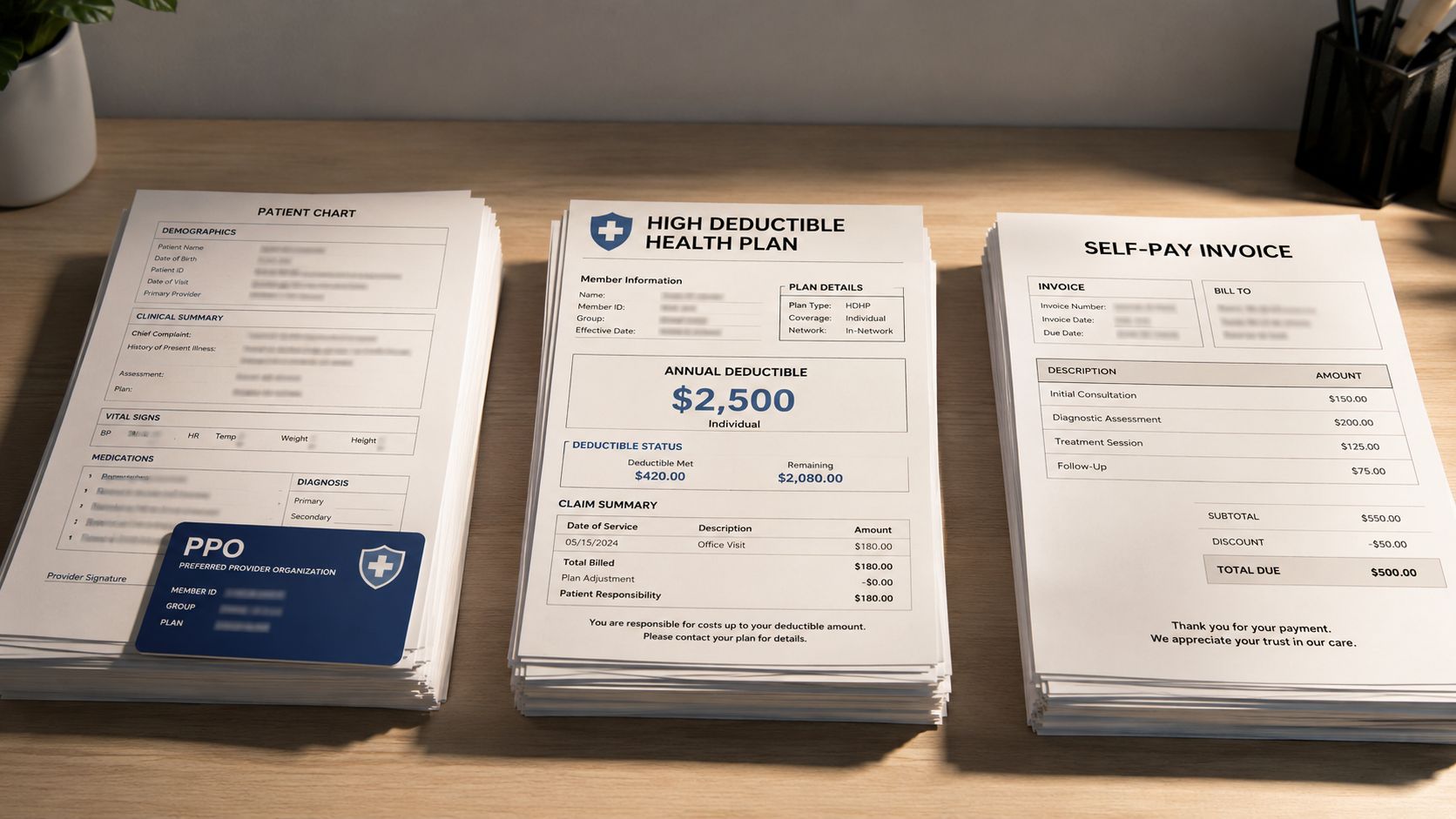
The lesson is simple. The posted rate matters, but the benefit design matters more. If you do not know your deductible status, coinsurance, and authorization requirements, you do not know your actual bill. For families trying to spread the cost without stalling care, secure treatment payment plans can give them a workable path instead of a hard stop.
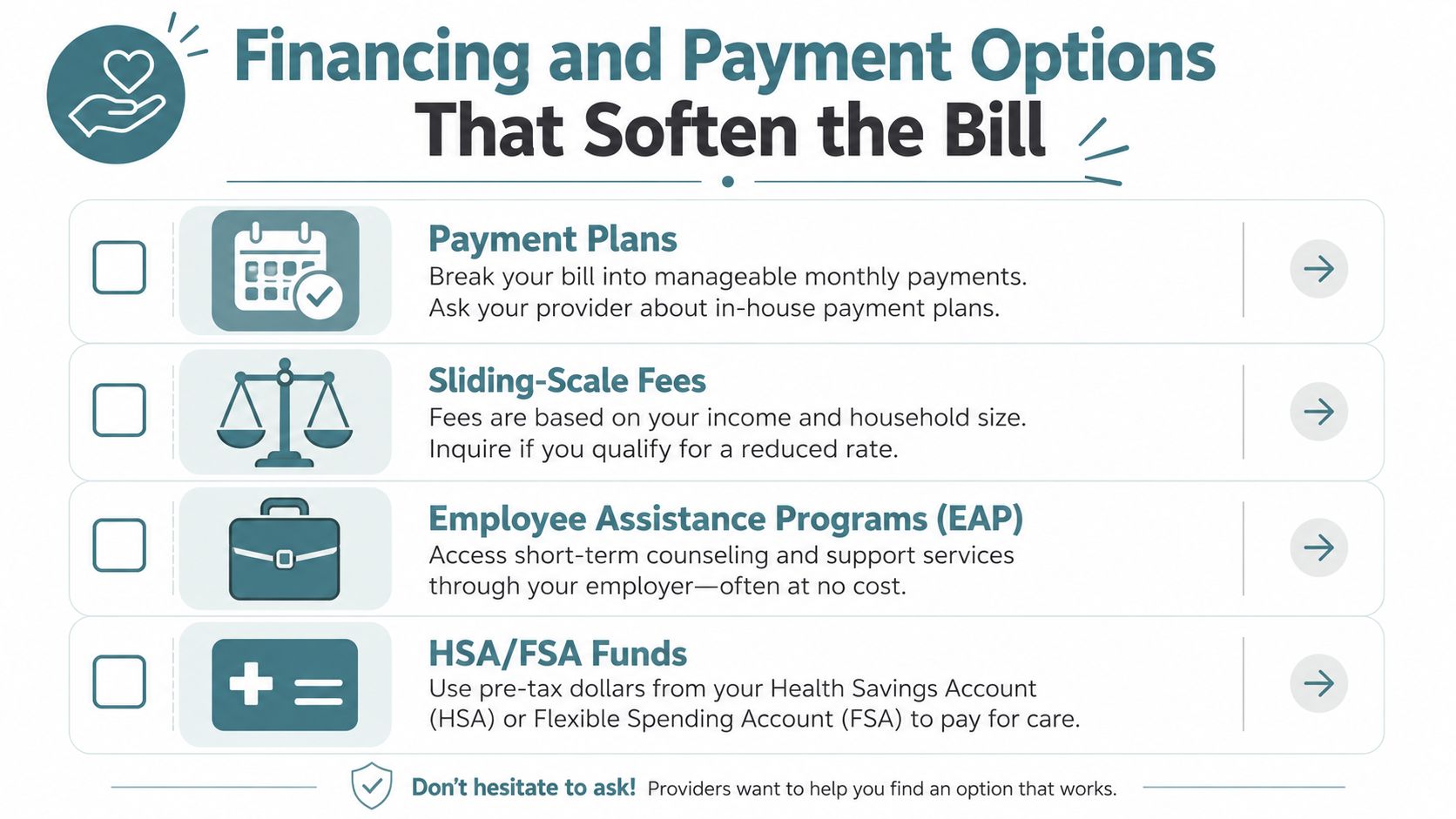
Financing and Payment Options That Soften the Bill
Families don't always have the cash, and they shouldn't pretend otherwise. The practical question is how to make treatment possible without letting the invoice become a second crisis.
Tools that actually help
Start with payment plans and ask for them in writing. Many programs will spread the cost out over time, which can be the difference between starting this week and delaying treatment another month. If a program offers a sliding scale, ask what documentation it needs and how it decides eligibility.
Use every benefit bucket you already have. HSA and FSA funds can reduce the sting because they're built for qualified medical spending. Employee Assistance Programs can also help families find a lower-friction path into care, especially when a workplace benefit includes counseling or referral support.
For a straightforward example of how treatment financing can be structured, Zoe Behavioral Health's page on secure treatment payment plans shows the kind of arrangement families should ask about before they assume they have to pay all at once.
What to ask admissions before you commit
- Can I get a written good-faith estimate? Ask for it before admission.
- Do you offer payment plans or scholarships? Don't wait until discharge to ask.
- Can I use HSA or FSA funds here? Confirm how payment is processed.
- Is there a discounted rate for bundled services? Sometimes there is, sometimes there isn't.
If a program won't put the estimate in writing, that's a problem. You should not have to decode a vague quote while your family is already under stress.
Why Local Orange County Readers Often Compare Casa Recovery
Orange County families usually aren't just comparing prices, they're comparing logistics, clinical fit, and whether the program can absorb the person's needs without sending them all over town. That's where Casa Recovery becomes a practical benchmark, because it's a San Juan Capistrano outpatient center with PHP, IOP, and a dedicated mental-health track, plus integrated dual-diagnosis care for co-occurring mental health and substance use issues.
What to evaluate if you're comparing local programs
Casa Recovery lists PPO acceptance from all carriers, plus in-network status with Blue Shield of California/Blue Card, ComPsych, and Holman Group. That matters because network status can change the final bill more than a glossy brochure ever will. It also offers onsite psychiatric evaluation and medication management, which is the kind of detail families should ask every PHP about, not just this one.
Its clinical model is also specific enough to judge. The center names EMDR, Brainspotting, DBT, and CBT among its trauma-informed approaches, and it emphasizes small-group sizes and a high therapist-to-client ratio. That combination tells you more about what a day in treatment feels like than the daily rate alone.
For local readers deciding whether to stay close to home or travel, Casa Recovery's South Orange County comparison page is useful because it frames the local-versus-out-of-county decision in practical terms.
The compliance and coordination angle
Families also need a program that handles the paperwork cleanly. A good treatment center should be able to coordinate benefits, explain authorizations, and communicate clearly with families and referring professionals. That's not just convenience, it's a compliance issue, and FaxZen's healthcare compliance guide is a good reminder that healthcare operations have real administrative standards attached to them.
If a local program can't explain network status, therapy structure, and how dual-diagnosis care is coordinated, keep looking.
The right local benchmark is not “What's the cheapest PHP?” It's “Which program gives me the clearest benefit picture and the most coherent clinical plan?”
Practical FAQs and a Short Pre-Admissions Checklist
The questions families ask at the end are usually the right ones. They're just asked too late, after someone has already gotten attached to a program or scared themselves with the first estimate.
The four questions that matter most
How long does PHP usually last? Verified data points to 30 to 45 days as a common range, though some patients need less and others need more (Harmony Recovery Group).
What if insurance denies coverage? Ask the admissions team to recheck authorization, clarify the reason for the denial, and give you a self-pay estimate before anyone starts treatment.
Is PHP tax-deductible? That depends on your tax situation and whether the expense qualifies under current tax rules, so don't assume, confirm with a tax professional.
How soon can someone start? Often quickly, once benefits are verified and the clinical intake is complete, but the bottleneck is usually paperwork, not clinical readiness.
Six things to confirm before admission
- Verify benefits in writing.
- Request a line-item estimate.
- Confirm psychiatry is included.
- Ask about step-down options.
- Clarify family-program costs.
- Confirm trauma-informed modalities.
That checklist keeps families from buying a vague promise instead of a treatment plan. It also forces the program to show its work, which is exactly what you want when the bill could shift by thousands.
Take the estimate, ask for the breakdown, and don't sign until you understand what each day includes. If you're ready to compare PHP options in a way that's grounded in cost, coverage, and clinical fit, contact Casa Recovery and ask for a written benefits check before you commit.