You're trying to decide something bigger than “Do I want therapy?” You're trying to figure out what level of care fits the week you're having. Maybe you've been holding it together with one appointment a week and now that's not enough. Maybe you're leaving residential treatment and need a step-down plan that won't leave you adrift. Maybe anxiety, depression, trauma, and drinking have started feeding each other, and you want a program that treats the whole picture instead of one piece at a time.
That is where an outpatient mental health therapist comes in. In modern outpatient care, the question isn't just who is licensed to help, it's whether the structure matches your symptoms, your safety, your work and family demands, and the amount of support your week needs. Adults often get stuck because they think the choice is binary, either weekly therapy or a hospital. It isn't.
Table of Contents
- A Tuesday Night Decision Most Adults Eventually Face
- What an Outpatient Mental Health Therapist Does
- Outpatient Levels of Care From Weekly Sessions to Full Day Programs
- Evidence-Based Modalities You Will Hear About in Session
- Integrated Dual Diagnosis for Co-Occurring Mental Health and Substance Use
- What Intake and the First Weeks Actually Look Like
- Insurance, Coverage, and the Questions Worth Asking
- Choosing the Right Outpatient Program in Orange County
A Tuesday Night Decision Most Adults Eventually Face
The phone is on the kitchen counter, and you've read the therapist's voicemail twice. You're supposed to return to work tomorrow, keep the kids on their routine, and act like you're fine. But your sleep has been broken for weeks, the drinking that started as a way to “take the edge off” is no longer quiet, and the one-hour session you've been using doesn't seem to move anything.
That's the sort of night when adults start asking whether standard outpatient therapy is still enough.
Three common turning points
One person is stepping down from residential treatment and knows they can't go from constant support to almost no structure without wobbling. Another has been in weekly therapy for months, but mood and motivation have drifted lower, and the therapist has started talking about a higher level of care. A third is managing depression and alcohol use together, and each problem seems to make the other harder to treat.
Practical rule: if your week is becoming less stable, your treatment should usually become more structured, not less.
That's the core decision point most families miss. An outpatient mental health therapist isn't just a person who listens well. In a strong program, the therapist helps match the level of contact to the level of strain, then keeps changing the plan as symptoms change. The right fit might be weekly outpatient therapy, an IOP, or PHP, depending on how much support your life can absorb and how much support your symptoms require.
This article is built around that choice. By the end, you should be able to tell the difference between standard outpatient care, Intensive Outpatient Program (IOP) care, and Partial Hospitalization Program (PHP) care, and you should know what integrated dual-diagnosis and trauma treatment look like when a program is set up to do them.
What an Outpatient Mental Health Therapist Does
An outpatient therapist works with you while you live at home, sleep in your own bed, and keep as much of your normal life as you can manage. The setting is clinic care, not hospital containment. A hospital contains a crisis. Outpatient care helps you recover inside daily life, where stress, relationships, work, and habits are still part of the picture.
Who this role includes
In practice, “outpatient mental health therapist” usually refers to licensed clinicians such as LCSWs, LMFTs, psychologists, and LPCs. They may see you one-on-one, lead groups, involve family members when that helps, and coordinate with psychiatry when medication is part of the plan. In many programs, they also help translate symptoms into a workable schedule, because treatment only helps if it fits into the week you have.
What they do in the room
A good outpatient therapist does more than offer encouragement. They assess symptoms, track change, teach coping skills, notice when treatment is stalling, and adjust the plan before problems harden. In settings that use measurement-based care, repeated score tracking becomes part of the clinical workflow, so progress is not just a feeling or a story. It becomes something the team can see, discuss, and respond to.
That matters because outpatient care is designed for daily life, not for perfect conditions. People miss sessions. Panic spikes before work. Trauma memories surface after a family argument. The therapist's job is to help you keep moving when those things happen, not to pretend they will not.
If you had to explain it to a family member in two sentences, you could say this. Outpatient therapy is treatment you receive while continuing to live your life. It can include individual sessions, groups, family work, and psychiatry, and the therapist's role is to help you recover without pulling you out of daily life unless the situation calls for more.
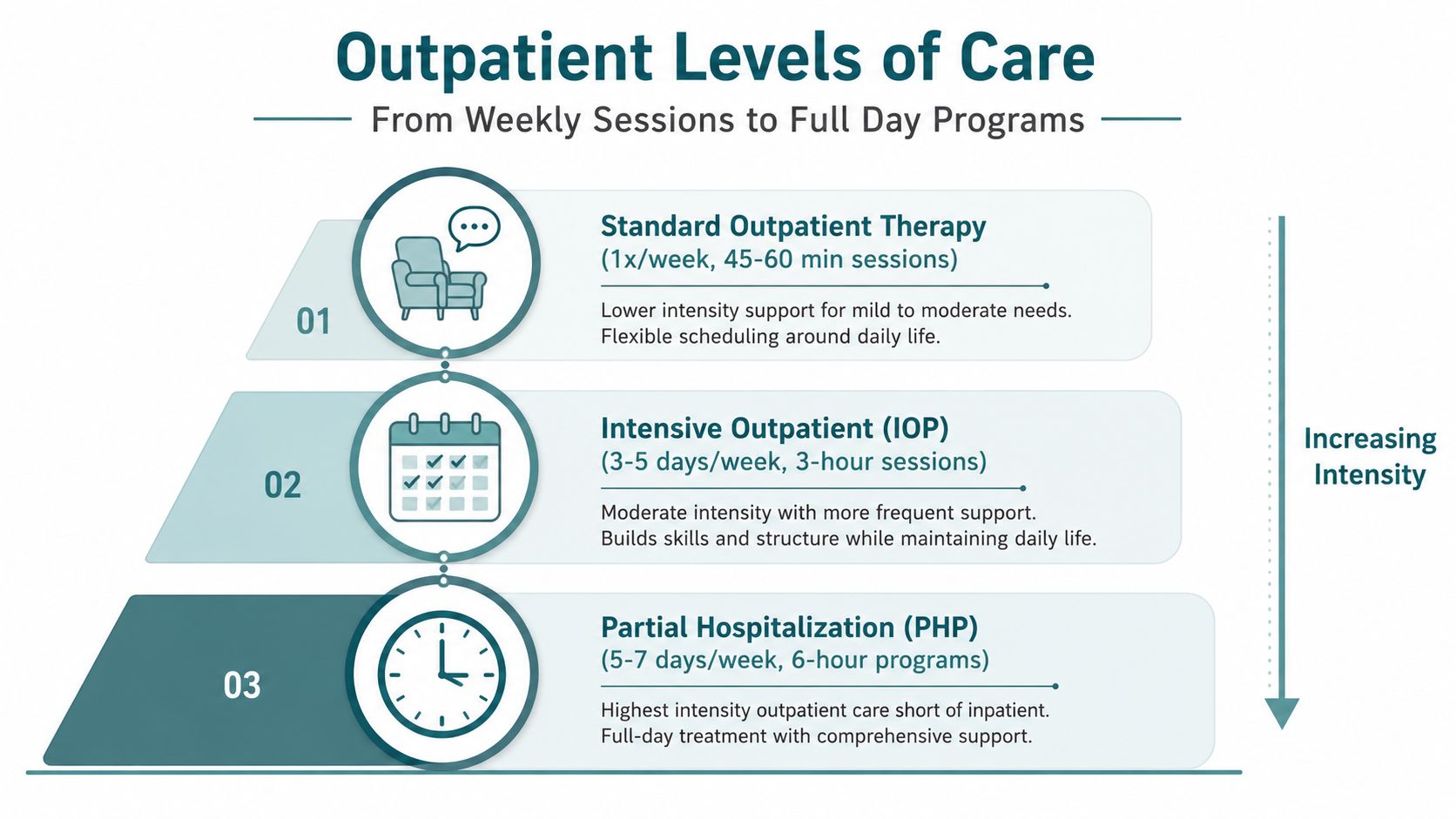
Outpatient Levels of Care From Weekly Sessions to Full Day Programs
A lot of confusion disappears once you stop thinking of treatment as a yes-or-no decision. It's better to think of it as a volume dial. The dial turns up when symptoms, safety concerns, or functioning get worse, and it turns down when the week gets steadier.
Standard outpatient, IOP, and PHP side by side
Standard outpatient therapy is the familiar option, usually one session a week. It fits a week where you're functioning, but need help with insight, skills, maintenance, or a specific issue that isn't spiraling. It's also the most flexible option for work and caregiving.
IOP adds more touchpoints. It often means several days a week with a mix of group and individual support, which gives you more structure without removing you from home and community life. This can be a strong fit when things are slipping, but you're not in immediate crisis.
PHP is the most structured outpatient setting. It usually means full-day programming on weekdays, then going home each evening. That works best when symptoms are unstable enough that weekly care would be too thin, but inpatient containment isn't necessary.
| Level | Typical Time Commitment | Best Fit For |
|---|---|---|
| Standard outpatient therapy | Usually one weekly session | Stable weeks, maintenance, skill-building, and lower structure needs |
| IOP | Several days per week with multiple hours of treatment | Escalating symptoms, step-down care, or a need for more accountability |
| PHP | Full-day weekday programming | Higher instability, rapid support needs, or step-down from inpatient/residential care |
The shortest way to think about it is this. Standard outpatient is for a week you can mostly manage. IOP is for a week that's getting harder to manage. PHP is for a week that's hard enough to need daily structure, but not a hospital bed.
For a deeper comparison between the middle and higher outpatient levels, see Casa Recovery's overview of IOP and PHP.
Clinical shortcut: if missed appointments, worsening symptoms, or repeated setbacks are piling up, the issue may not be motivation. It may be that the current level of care is too light.
Evidence-Based Modalities You Will Hear About in Session
People often get lost in the alphabet soup. CBT, DBT, EMDR, Brainspotting. The names sound technical, but each one is really just a way of matching a method to a symptom pattern. The point isn't to collect acronyms. The point is to use the right tool for the right problem.
What each modality is trying to do
CBT, or Cognitive Behavioral Therapy, is the workhorse for anxious and depressive thought loops. It helps people notice the link between thoughts, feelings, and actions, then test the stories their minds keep repeating. When a person says, “I know it's irrational, but I still believe it,” CBT is often the first place a therapist starts.
DBT, or Dialectical Behavior Therapy, is more like a skills curriculum. It's often used when emotions come on fast, relationships get stormy, or distress tolerance is thin. In outpatient settings, DBT can be useful when someone needs help staying regulated long enough to use the rest of treatment.
EMDR is a trauma-processing approach that doesn't require someone to tell every detail of a painful event over and over. That makes it easier for many people to work with trauma without getting trapped in re-experiencing. Brainspotting is another trauma-focused approach that is often paired with EMDR in trauma-informed programs.
How a program chooses a modality
The important question is not, “Which therapy is best?” It's, “Which therapy fits this symptom pattern right now?” Someone whose anxiety is driven by catastrophic thinking may need a different approach than someone whose panic is tied to unresolved trauma, and both may need different support again if substance use has become part of the picture.
Many outpatient programs also use Motivational Interviewing, art therapy, and denial management. Those tools matter because people don't always arrive ready to change neatly. They arrive ambivalent, exhausted, and often embarrassed. A skilled program doesn't punish that. It works with it.
Casa Recovery's evidence-based therapy overview shows how these modalities can be organized inside a coordinated outpatient plan rather than scattered across separate providers.
Integrated Dual Diagnosis for Co-Occurring Mental Health and Substance Use
A lot of adults don't have one clean problem. They have depression and drinking, anxiety and stimulant use, trauma and cannabis, bipolar symptoms and substances that make sleep or mood less predictable. If you treat only one piece, the other piece keeps pushing on the same system.
Why integrated care matters
That's why integrated dual diagnosis is so important. Instead of sending someone to one team for mental health and another team for substance use, the same program treats both at the same time. The logic is simple. If alcohol is making sleep worse, and poor sleep is making depression worse, you don't want two separate plans that never meet.
Older sequential thinking falls short when people are often told to “get sober first” and then work on the emotional side later, or to focus on mental health while minimizing the role substances play. In real life, that split can keep people stuck. Integrated care gives the team one treatment plan and one shared view of what's driving setbacks.
What it looks like day to day
Integrated outpatient care usually includes coordinated psychiatric medication management, psychotherapy, and groups that speak to both sets of symptoms. Relapse prevention isn't just about triggers to use. It also includes mood triggers, shame loops, isolation, and the routines that fall apart when depression deepens.
If the mood problem and the substance problem keep showing up together, treating them together usually makes the plan clearer.
For adults in Orange County looking for a single team approach, Casa Recovery is one example of a center that offers integrated dual-diagnosis outpatient programming, along with trauma-informed care, onsite psychiatry, and step-down options. That kind of structure matters when one provider needs to understand both the emotional symptoms and the behavior patterns that keep the cycle going.
A practical way to think about it
Two weather systems can feed the same storm. One may be emotional pain, the other may be substance use. If you only track one, you miss the fuel source. Integrated treatment is built to read the full weather map, not just the part that's easiest to label.
What Intake and the First Weeks Actually Look Like
The first call is usually more practical than people expect. Someone checks your insurance, asks what's going on, screens for immediate safety concerns, and looks at whether standard outpatient, IOP, or PHP makes sense. It can feel formal, but that's because the program is trying to avoid guessing.
The first appointment
Intake is often a longer assessment that covers history, current symptoms, safety, medications, substance use, and what you want life to look like if treatment works. You may answer the same questions more than once, and that repetition is intentional. It helps the team build one shared picture instead of five partial ones.
The early rhythm often looks like this. Orientation first, then group placement, then psychiatric evaluation if medication is part of the plan, then a written treatment plan. After that, care usually settles into a pattern of individual sessions, group work, and family involvement when it's clinically useful and appropriate.
What to bring and what to expect
Bring a medication list, the names of any current providers, and a plain description of what's been hardest lately. If substance use is part of the story, say that directly. If trauma history is part of the story, expect to be asked about it. A good outpatient team needs the truth, not a polished version of it.
You may also notice measurement tools being used repeatedly. That can feel repetitive, but it's part of a data-informed workflow. Scores help the team decide whether to intensify care, shift the modality, or update the plan before non-response becomes the default.
The best onboarding feels steady, not dramatic. You should leave intake knowing who your therapist is, how often you'll be seen, what the next week looks like, and what happens if symptoms spike before the next appointment.
Insurance, Coverage, and the Questions Worth Asking
Money delays care more often than people admit. The first thing to understand is that insurance language is about access rules, not just paperwork. A PPO often gives more flexibility with out-of-network reimbursement, while an HMO or EPO usually asks you to stay in network and follow authorization rules.
What to ask before you start
- Are you in network with my plan? If not, ask how out-of-network benefits work and what you'd need to submit.
- Do you verify benefits before admission? That saves a lot of confusion later.
- Does my behavioral health benefit cover IOP or PHP? Those programs usually need prior authorization and a documented clinical need.
- What will I likely owe out of pocket? Ask for the range, not a guess.
- Do you coordinate with my psychiatrist or prescribing provider? That matters if meds are part of your care.
For a plain-language guide to coverage basics, Casa Recovery's insurance overview for mental health treatment is a useful reference point. Their admissions process also illustrates how transparent benefit verification can work in practice, especially for people who need outpatient structure but don't want to discover billing details after they've already started.
A quick comparison
| Level | Typical Time Commitment | Best Fit For |
|---|---|---|
| Standard outpatient | Weekly visits | Maintenance, mild-to-moderate support needs, and ongoing therapy |
| IOP | Multiple weekly sessions | More structure, relapse prevention, and step-down support |
| PHP | Full-day programming | Stronger support needs, stabilization, and intensive step-down planning |
If you're calling around, the best question is often not “Do you take my insurance?” It's “How will you help me understand what my plan covers before I start?” That answer tells you a lot about how the program handles real-world friction.
Choosing the Right Outpatient Program in Orange County
A thoughtful intake call should leave you with clear answers, not vague reassurance. If a program can't answer the basics, that's a signal in itself.
Questions worth bringing to any provider
- Is care trauma-informed across the full program, or only in the brochure?
- Are co-occurring disorders treated together, or sent to different tracks?
- Is psychiatry integrated with therapy, or siloed from it?
- How large are groups, and how many clients does each therapist carry?
- Is family support active and ongoing, or just a one-time check-in?
- Can I step down from PHP to IOP to standard outpatient within the same team?
Those questions matter because outpatient care is supposed to help people move, not just attend. If the program can't adapt as you improve, or if the structure is too light for your current week, you end up with more friction and less follow-through.
In Orange County, one example of a center built around those criteria is Casa Recovery, a family-owned program established in 2009 in San Juan Capistrano. It offers PHP, IOP, dedicated mental health care, integrated dual-diagnosis treatment, onsite psychiatry, small-group programming, and a formal family program. It also works with PPO plans from all carriers and is in network with Blue Shield of California/Blue Card, ComPsych, and Holman Group.
The best fit isn't always the biggest program or the most polished website. It's the one that can match the level of care to the kind of week you're having, then adjust as the week changes. If you're weighing outpatient therapy, step-down treatment, or dual-diagnosis support, visit Casa Recovery to see how their outpatient programs are organized and whether they match the structure you need right now.