You may be sitting in your car after another hard week, phone in hand, trying to decide whether weekly therapy is enough anymore. Maybe you're still going to work in Orange County, still answering texts, still keeping things moving, but the strain keeps building and you know you need more support than a standard appointment can give. Voluntary mental health admission is often the doorway people use when they want real structure, more clinical attention, and a treatment setting they chose for themselves.
Table of Contents
- What Voluntary Mental Health Admission Actually Means
- Voluntary Versus Involuntary Admission
- The Clinical and Administrative Steps You Will Actually Go Through
- Choosing the Right Level of Care
- What to Expect Before, During, and After Admission
- Insurance, Documentation, and Money Questions
- Common Misconceptions About Voluntary Admission
- Your Next Steps and Frequently Asked Questions
What Voluntary Mental Health Admission Actually Means
A lot of adults first think about admission after they've already tried the usual supports. Therapy once a week helps a little, but not enough. Sleep is off, concentration is slipping, or safety feels shaky. That is often the moment when voluntary admission becomes a practical option instead of a dramatic last resort.
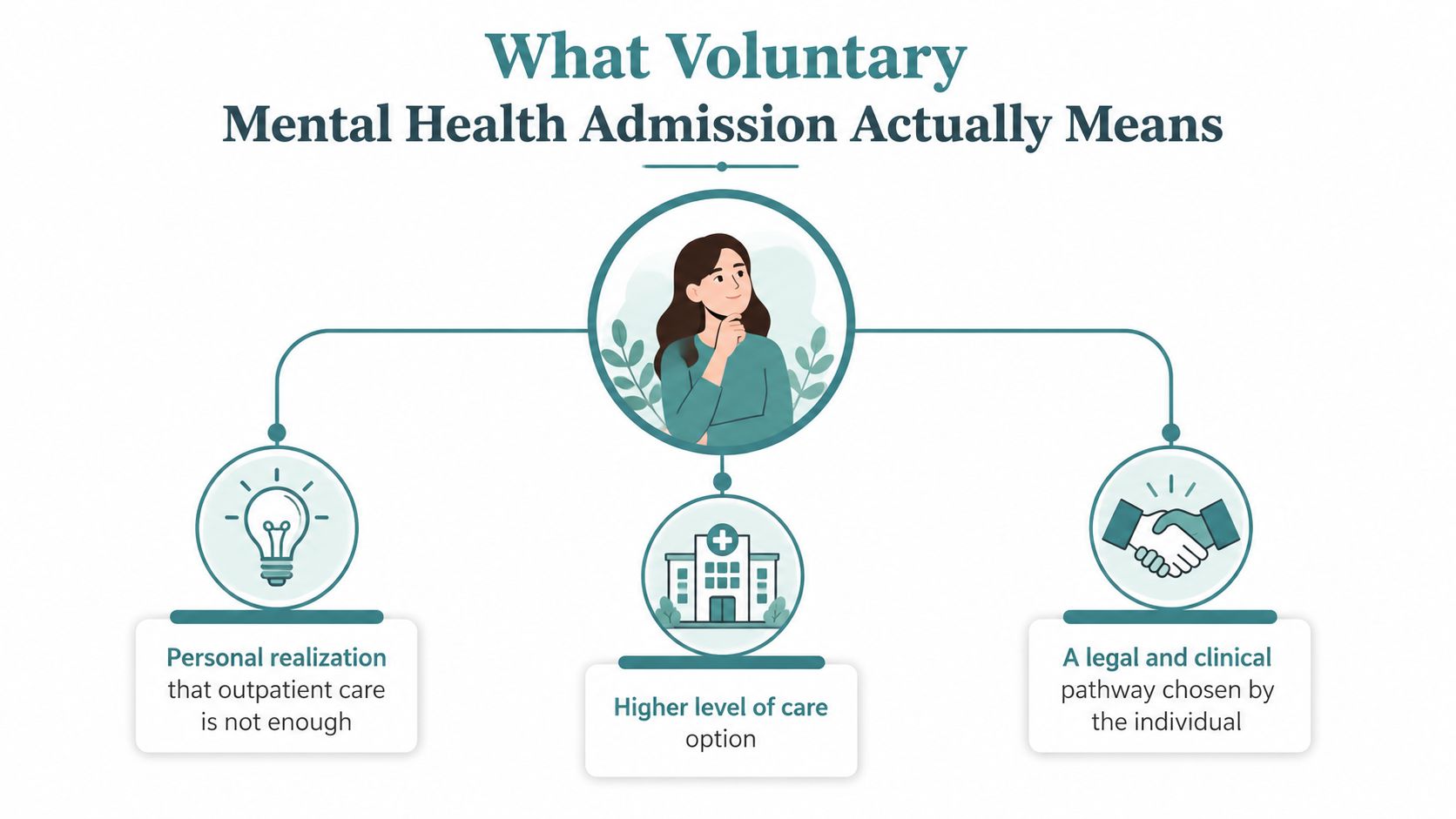
In plain English, voluntary mental health admission means a competent adult chooses to enter treatment. In many systems, that starts with a written application and a clinical evaluation to confirm that care is needed. The key feature is consent, you are asking for treatment instead of being forced into it. This admissions guide for competent adults describes that process in straightforward terms.
Practical rule: if you are choosing the admission, participating in the intake, and agreeing to the plan, you're in the voluntary pathway.
That is also why voluntary admission is more common than many people assume. A 2020 systematic review and meta-analysis of schizophrenia admissions, covering 35 studies and 134,100 patients, found an overall voluntary admission rate of 61.9% and an involuntary admission rate of 43.0% (PubMed). The point isn't that every person needs inpatient care. The point is that self-directed entry into treatment is a normal, widely used route in mental health systems.
If you're comparing options and trying to understand what fits, it can help to explore mental health solutions with the idea that admission is one tool, not the whole plan. For many adults, it's the beginning of more organized care, not the end of choice.
Voluntary Versus Involuntary Admission
A first call for help often turns on one practical question, who is making the choice to enter treatment. In voluntary admission, the adult says yes and signs in. In involuntary admission, clinicians, and in some systems courts, move the process forward because they believe the person needs treatment and may not be able to choose safely on their own.
Here is the comparison many adults wish they had before that first intake call.
| Dimension | Voluntary Admission | Involuntary Admission |
|---|---|---|
| Trigger | The person asks for care and signs in | Clinicians, and sometimes courts, start the process |
| Consent | The patient agrees to treatment | The patient's agreement is not the deciding factor |
| Legal status | Choice remains with the patient | Legal authority shifts away from the patient |
| Typical use | A person wants care, support, or stabilization | A person is thought to need protection or urgent intervention |
| Experience | More collaborative and self-directed | More controlled and more restrictive |
That difference shows up in day-to-day care, not just in paperwork. A 2019 meta-analysis on severe mental illness found an overall voluntary admission rate of 30.3% and an overall involuntary admission rate of 32.3%, and it also reported a rise in voluntary admission rates between 1998 and 2018. The same legal label can look very different from one setting to another, which is why the decision path matters as much as the diagnosis itself (Psychiatry Online PDF).
The setting matters too. The U.S. Substance Abuse and Mental Health Services Administration reported in its 2020 National Mental Health Services Survey that public psychiatric hospitals had the highest proportion of involuntarily admitted clients at 89%. That finding shows why one facility can feel very different from another even when the clinical need is similar. The place you choose shapes how much control stays with you during admission.
For adults trying to match intensity to need, voluntary admission is not always the same as going straight into a locked or fully inpatient setting. Some people need inpatient stabilization. Others need structure without that level of restriction, and a step-down option such as PHP near me can fit that need. The same door into care can lead to a more supported outpatient path when the situation allows it.
A good initial mental health intake helps sort those options without making the process feel confusing. It asks the basic questions needed to decide whether voluntary admission, inpatient care, or a structured outpatient level of care makes the most sense.
The Clinical and Administrative Steps You Will Actually Go Through
A first call for voluntary mental health admission often feels simpler than people expect. You reach out, describe what has been happening, and the staff starts sorting out whether the level of care fits your situation. The point is not to test you, it is to match your symptoms, safety needs, and daily functioning with the right kind of support.
The process usually begins with a call, a referral, or a direct request for help. Staff will want a clear picture of what you are dealing with, what symptoms are showing up, whether there are safety concerns, and what kind of support you need right now. That first conversation works like the opening checkpoint on a road trip, it does not decide the whole route, but it tells the team which direction makes sense.
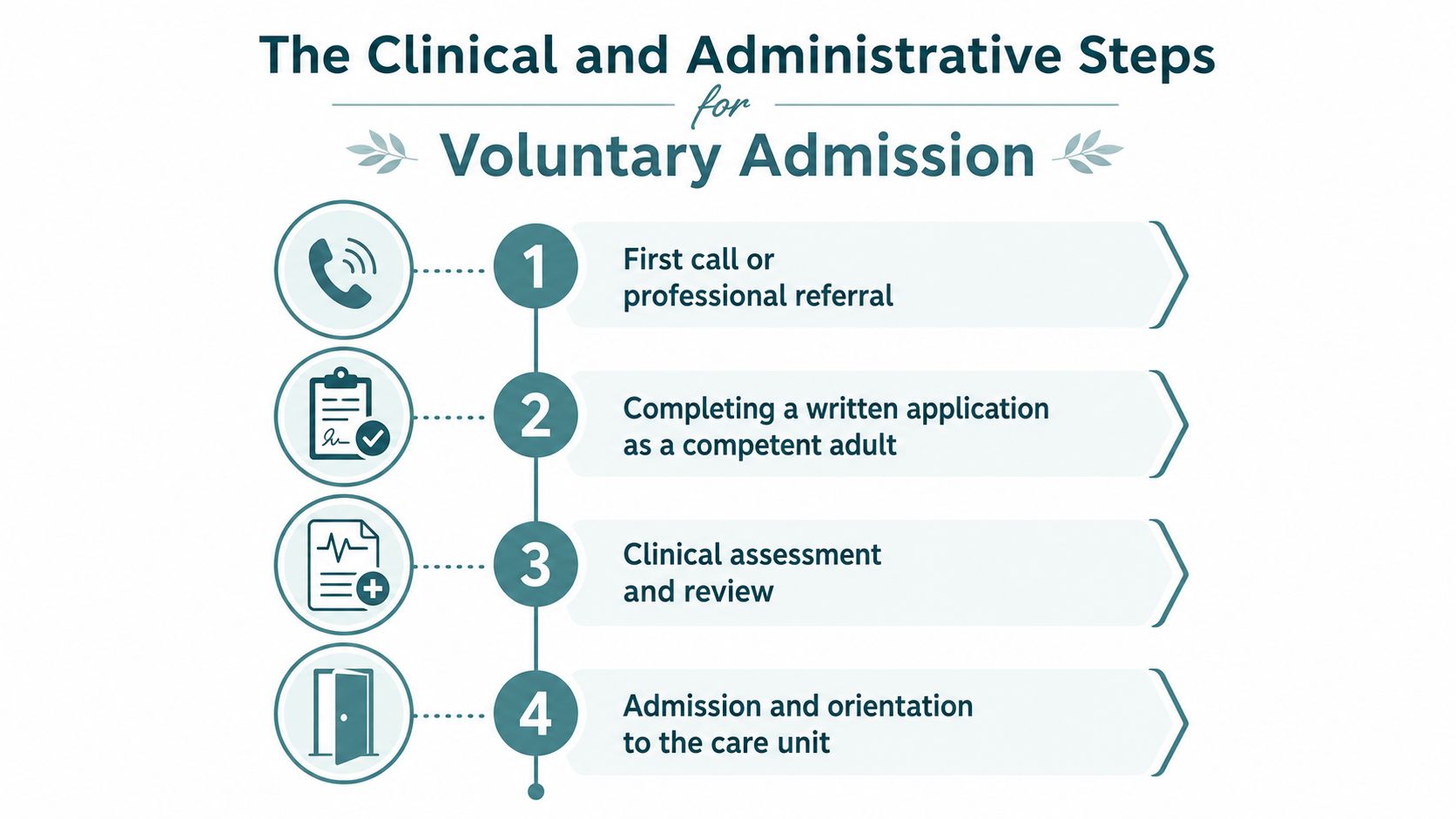
The usual sequence
- First contact. You or a family member calls, emails, or is referred by a clinician.
- Written application. As a competent adult, you complete the admission paperwork.
- Clinical evaluation. A clinician reviews symptoms, history, and current need for care.
- Admission and orientation. If the program is appropriate, you're admitted and shown how the unit or program works.
In many systems, there is no judicial review at the moment of admission because you are entering voluntarily. That does not make the process casual. It means your consent, rather than a court order, is what allows the admission to begin.
The practical side matters too. You will usually be asked for identification, insurance information, a medication list, and contact details for emergency supports. If you are trying to understand learn about initial mental health intake screening procedures before you commit, that phrase points to the screening step most programs use before admission.
Good admissions work saves time later. Clear insurance review, medication history, and recent treatment records help the team build a plan that makes sense on day one.
A strong admissions process also helps people sort out intensity without adding confusion. Some adults need inpatient stabilization. Others need structure and clinical oversight, but they do not need to stay overnight in a locked setting. In that case, the same admission process can point toward outpatient support, including a step-down path such as admissions steps that lead into voluntary treatment, when the situation allows it. For many adults in Orange County, that is the real decision, whether voluntary admission is the right doorway into inpatient care or into a more structured outpatient level of care.
Choosing the Right Level of Care
A lot of adults begin with the wrong question. They ask whether they should go inpatient or stay home and hope things settle down. Voluntary admission usually works better as a question of matching intensity to need. Some people need 24-hour observation, medication changes, or a protected setting because symptoms are too hard to manage at home. Others need a fuller schedule, regular clinical contact, and enough support to stay steady, but they do not need to sleep on site.
A helpful way to set expectations is to look at how voluntary hospitalization is often described in public hospital guidance. One University of Baltimore law school summary of public hospital guidance notes that voluntary stays often average about 1.5 to 2 weeks. That figure does not describe every admission, and it is not a promise. It shows that admission is usually meant to fit the clinical need in front of you, then move toward discharge when the person is stable enough for the next step.
When inpatient makes sense
Inpatient or hospital-based care fits best when someone needs close monitoring, quick medication adjustments, or a protected place to get through a short period of instability. It also makes sense when symptoms are escalating faster than outpatient support can keep up. The goal is containment and careful assessment, not punishment or loss of dignity.
Families often hear the word “hospital” and assume it means the most restrictive path. Sometimes it does. In practice, it can also be the shortest route to getting a clearer diagnosis, a safer medication plan, and a calmer baseline before stepping down.
When PHP or IOP may fit better
Partial Hospitalization Programs, or PHP, provide full-day structured treatment without overnight stays. Intensive Outpatient Programs, or IOP, usually offer several sessions each week with more flexibility. For adults in Orange County who do not need 24-hour supervision, those options can protect work, school, and home routines while still giving them a higher level of clinical support.
That choice can feel a little like choosing the right size of support, not the right “strength” of care. PHP is closer to a day-long clinical container, while IOP gives more room to live at home and still stay in treatment. If you are trying to sort out that difference, the level of care guide can help you compare the options in plain language.
Casa Recovery's outpatient model includes PHP and IOP, along with psychiatric evaluation, medication management, and individual psychotherapy. That kind of step-down care matters when someone is leaving a higher level of care or when inpatient treatment would be more than they need. For adults who want to keep treatment structured without giving up home life, Cedar Hill same-day admissions can also be part of the conversation when timing is tight and the situation allows it.
What to Expect Before, During, and After Admission
The easiest way to understand admission is to follow one ordinary day. A person calls in the morning, shares what's been happening, and completes screening questions. Later that day, they speak with admissions staff, sort out logistics, and decide whether the program fits. That first stretch is often where family members feel the most nervous, because everything still feels unfamiliar.
Before admission
Before you arrive, staff may ask about symptoms, medications, recent hospitalizations, and support at home. Families often use this time to arrange work leave, childcare, rides, and a few essentials to pack. If the admission is same-day, as described in Cedar Hill's same-day admissions information, the pace can feel brisk, which makes clear communication even more important.
During the stay or program
Once admitted, the day usually has a rhythm. There may be psychiatric evaluation, medication management, individual therapy, group sessions, and psychoeducation. Casa Recovery describes a program with four or more one-on-one sessions per week, along with small-group therapy and modalities such as CBT, DBT, EMDR, Brainspotting, and Motivational Interviewing. The structure is meant to keep care active, not passive.
After admission
Discharge planning starts before the last day. A good plan usually includes a step-down path, often to PHP, IOP, or standard outpatient care depending on what the person still needs. Families may be invited into ongoing communication through a formal family program, and out-of-area clients may need supportive living arrangements while they stay in Southern California. That aftercare piece matters because treatment should end with a bridge, not a cliff.
Insurance, Documentation, and Money Questions
Money questions often decide whether someone follows through, so they deserve a direct answer. Before admission, the program usually verifies insurance, checks benefits, and looks at what level of care the plan will support. A PPO often gives more flexibility in where you can go, while HMO plans can be more restrictive and may require referrals or in-network coordination, so the first call should always include a benefits check.
Casa Recovery states that it accepts PPO plans from all carriers, and that Blue Shield of California/Blue Card, ComPsych, and Holman Group are in network. They also offer insurance verification during admissions, which helps people avoid guessing games before they commit to a program. That kind of guidance is especially useful when you're weighing PHP or IOP and need to know what is realistically available.
You'll usually be asked for a few basics:
- Photo identification so staff can verify who is being admitted.
- Insurance card so benefits can be checked early.
- Medication list so the clinical team knows what you're taking.
- Recent records if you've seen other providers.
- Emergency contacts so the team can communicate safely and appropriately.
A trauma-informed intake also matters here because the financial conversation shouldn't feel like a barrier test. The treatment plan should reflect your diagnosis, history, and functional goals, not just what is easiest to bill. If you want to compare the facility in person and ask questions face-to-face, ask about a tour and direct admissions contact before making a final decision.
Common Misconceptions About Voluntary Admission
Many adults avoid care because they are worried about what admission will mean. The worry is understandable, especially if the only examples they have heard are extreme or confusing. In practice, voluntary admission is usually a structured path into care, with choices, questions, and discharge planning built into the process.
Myth and reality
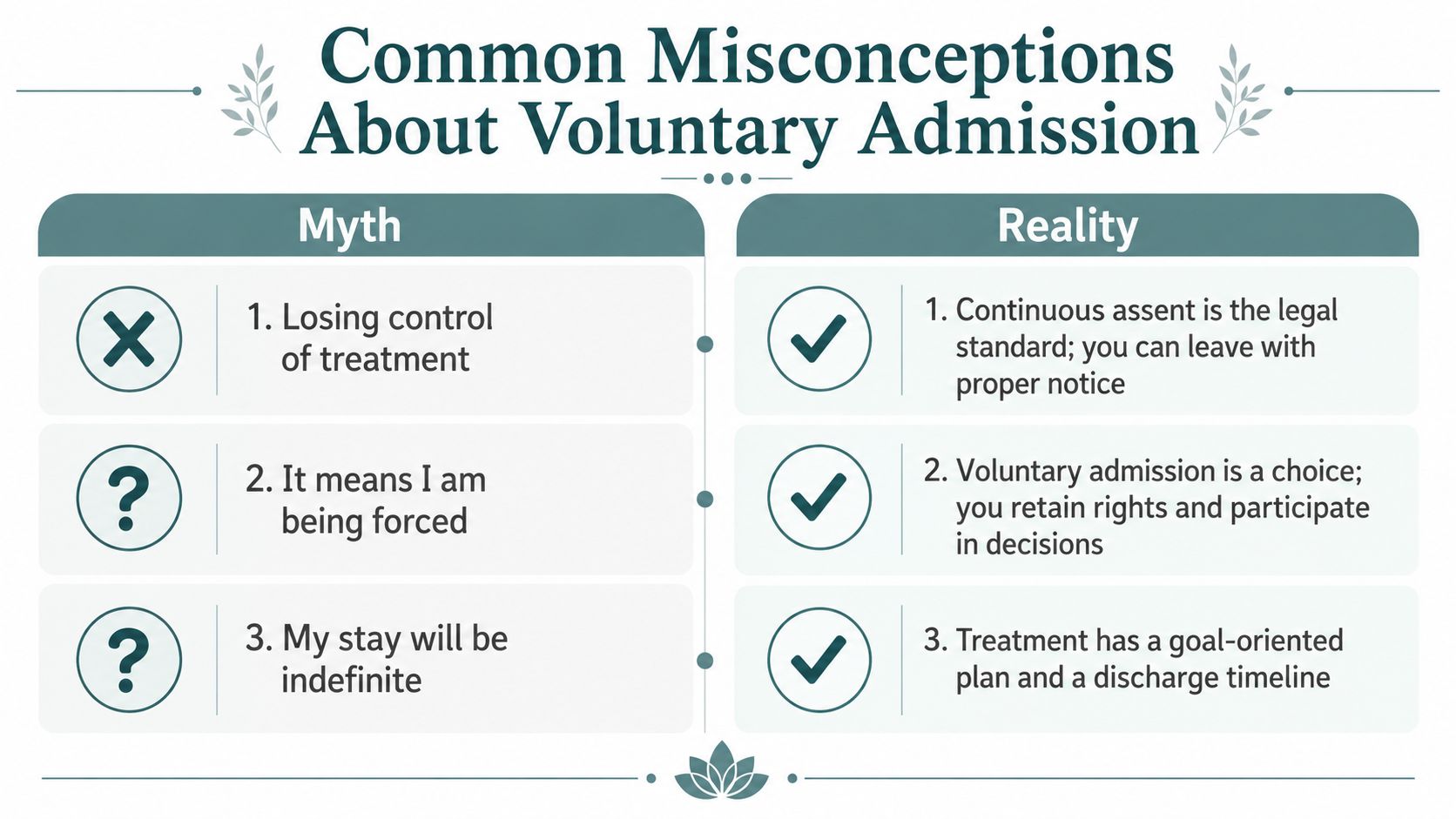
| Myth | Reality |
|---|---|
| Losing control of treatment | Continuous assent is the legal standard, and you take part in decisions about care. |
| It means I'm being forced | Voluntary admission is a choice, and you still have rights within the process. |
| My stay will be indefinite | Treatment is goal-oriented, and discharge planning begins early. |
Another myth is that voluntary admission only applies to psychosis or schizophrenia. In actual program settings, people enter voluntarily for depression, anxiety, trauma, bipolar disorder, and dual diagnosis care as well. That wider use makes sense because admission is usually about current functioning and safety, not just a diagnosis label. A person who needs more support for a period of time may start in a higher level of care and then step down into PHP or IOP once the immediate pressure eases, which is often how treatment becomes more manageable in everyday life.
The idea that voluntary always means “short and simple” can also be misleading. The length of treatment depends on clinical need and the next appropriate level of care. If a person does not need 24-hour containment, PHP or IOP can provide structure while leaving more room for home, work, and family responsibilities. That is why voluntary matters, it points to a treatment doorway, not a one-way inpatient path.
Your Next Steps and Frequently Asked Questions
If you're an Orange County adult or helping one, start with the most concrete step, call for admissions guidance and insurance verification. Ask whether a facility tour is available in San Juan Capistrano, whether PHP or IOP is offered, whether there's a dedicated mental health track, and how family communication is handled. If the person is coming from outside the area, ask about supportive living options so the transition is manageable.
The main idea here is simple. Voluntary mental health admission can be the entry point into a structured continuum of care, not a one-time inpatient event. For many adults, the value is the bridge it creates between crisis and routine, with therapy, psychiatric support, and family involvement built in.
How quickly can voluntary admission be arranged?
It depends on the program's screening process, clinical need, and whether the paperwork and insurance verification are ready. Some admissions move quickly, especially when the referral is clear and the person is prepared.
Can a voluntary admission become involuntary?
Yes, in some settings it can if staff believe the person now meets criteria for a higher level of legal protection or cannot safely leave. The exact rules depend on the facility and the state.
How is substance use handled if it's part of the picture?
Integrated dual-diagnosis care is the right model when mental health and substance use overlap. That allows the team to treat both together instead of making the person bounce between separate programs.
If you're weighing voluntary admission, reach out to Casa Recovery and ask how their PHP, IOP, psychiatric support, and family program fit your situation. A calm first call can turn a confusing decision into a clear next step, and it can help you choose care that matches your needs without jumping straight to a level that's more than you require.