When a loved one is struggling with their mental health, it can feel like your entire family is caught in a storm without a map. Confusion, frustration, and a sense of helplessness are common. This is where family psychoeducation comes in—it’s not about assigning blame, but about providing the knowledge and tools your family needs to navigate the storm together.
This approach gives you a clear understanding of your loved one's condition and a practical set of skills to support their recovery. It transforms the family from feeling like bystanders to becoming essential, confident partners in the healing process.
Table of Contents
- What Is Family Psychoeducation and Why Does It Matter?
- What an Effective Family Program Actually Looks Like
- The Measurable Benefits for Patients and Families
- Practical Tools for Healthier Family Communication
- What to Expect in a Family Program at Casa Recovery
- Frequently Asked Questions About Family Psychoeducation
What Is Family Psychoeducation and Why Does It Matter?
Think of psychoeducation as the training you need to become an effective first responder for your loved one. It provides the essential information about their diagnosis, the symptoms they experience, and the most effective ways to help. But it goes far beyond a simple information session.
The real goal is to empower you. It’s about turning textbook knowledge into real-world action, creating a home environment that actively supports healing rather than unintentionally adding to the stress.
From Understanding to Practical Skills
Psychoeducation isn’t a lecture; it's a collaborative workshop with a clinical team. The guiding principle is simple: when you understand the “why” behind your loved one’s behaviors, you can respond with compassion and strategy instead of frustration. For instance, learning that sudden irritability is a classic symptom of depression—not a personal attack—can completely change how you approach a difficult conversation.
This foundation of knowledge is where you start building crucial skills:
- Healthier Communication: You’ll learn how to stop walking on eggshells and start communicating openly, using "I" statements to express your own needs without triggering conflict.
- Effective Problem-Solving: Together, you can identify triggers and develop concrete plans to manage challenging situations, turning daily hurdles into opportunities for growth.
- Stronger Boundaries: Setting and holding firm, respectful boundaries is vital. It protects the well-being of every family member and is one of the best ways to prevent caregiver burnout.
These skills are invaluable for any family, but they become absolutely critical when a loved one is in a Partial Hospitalization (PHP) or Intensive Outpatient (IOP) program. Because the individual comes home every day, the family environment becomes a direct part of the treatment plan. A family that understands the process can reinforce the therapeutic work, creating a consistent, supportive space that helps accelerate recovery.
These are the same foundational skills that help in developing kids' self-awareness and resilience, and they are just as vital for adults. We go into more detail on our blog where you can learn more about how psychoeducation is used in treating mental illness.
Proven to Reduce Relapse
The benefits aren't just theoretical; they are backed by decades of research. Studies consistently show that when families are actively involved through psychoeducation, relapse rates can decrease by a staggering 20% to 50%.
Pioneered in the 1980s by experts like Carol M. Anderson, this model was developed specifically to give families the information and support they were missing. It recognizes that an informed, skilled, and supported family is one of the most powerful forces for creating lasting stability.
What an Effective Family Program Actually Looks Like
To really get a handle on why psychoeducation for families works so well, it helps to peek behind the curtain and see how these programs are put together. These aren't just informal chats; they're thoughtfully designed to give families a specific set of tools and a new understanding. Think of it like a masterclass in supporting your loved one—and yourself. Each part builds on the last, creating a strong, resilient family unit.
A great program is built on four key pillars. Each one is designed to meet you where you are, guiding your family from essential knowledge to practical, hands-on skills. It’s a step-by-step process that ensures you’re not just told what to do but are actually shown how to do it.
The Four Pillars of Family Support
At their core, these programs blend education with practical skills training, collaborative problem-solving, and a solid crisis plan. This powerful combination is what helps a family shift from constantly reacting to crises to feeling confident and proactive. The whole point is to build a toolkit that works in the real world, not just in a therapist’s office.
Here are the four core components you'll find in a well-structured program:
- Education: This is where everything starts. You get clear, easy-to-understand information about your loved one's specific mental health condition, including symptoms, proven treatments, and what the recovery journey can look like. It’s all about replacing fear and confusion with facts.
- Skills Training: You’ll learn practical techniques for healthier communication, setting boundaries, and resolving conflict. This is where families learn to stop the blame game and start using supportive language, like swapping accusations for "I" statements.
- Problem-Solving: This component teaches you how to work together as a team to manage daily challenges and navigate triggers. You’ll develop strategies for tackling difficult situations collaboratively, so no one feels like they’re carrying the burden alone.
- Crisis Management: You and your family will create and even rehearse a clear plan for what to do if—or when—a crisis hits. Having a plan in place ahead of time is a game-changer; it dramatically reduces panic and ensures everyone can respond quickly and supportively.
This is how these different pieces come together to create a powerful support system for the entire family.
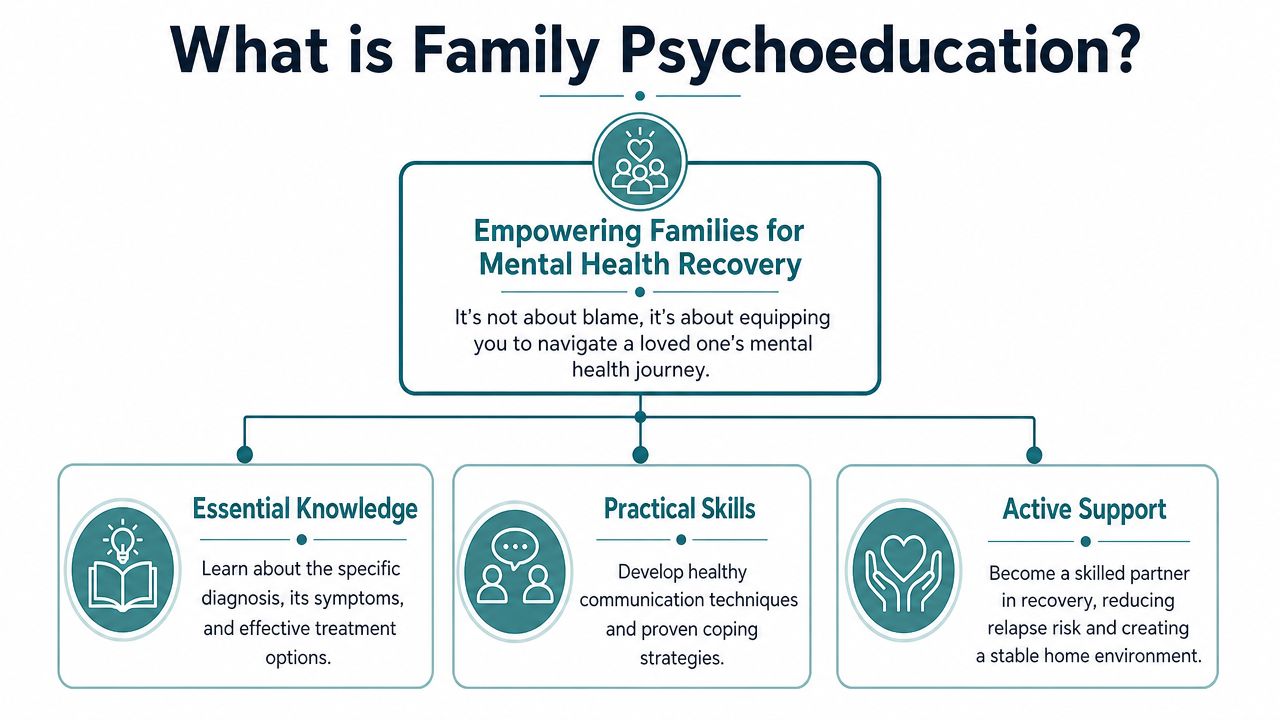
The focus is always on equipping your family with both the knowledge and the practical skills to become active, effective partners in the healing process.
To give you a clearer picture, this table outlines the main components of a family psychoeducation program and what families can expect to gain from each part.
Key Components of Family Psychoeducation Programs
| Component | Focus Area | Family Outcome |
|---|---|---|
| Education | Understanding the diagnosis, treatment, and recovery process. | Reduced fear and stigma; increased empathy and realistic expectations. |
| Communication Skills | Learning active listening, "I" statements, and validation. | Fewer arguments and less criticism; more open and supportive conversations. |
| Problem-Solving | Identifying challenges and creating collaborative solutions. | Increased family teamwork and a sense of shared responsibility. |
| Crisis Planning | Developing a step-by-step plan for managing acute episodes. | Greater confidence and less panic during a crisis; improved safety. |
Each element is designed to build on the others, creating a comprehensive support structure that empowers everyone involved.
Turning Concepts into Action
So, what does this look like in day-to-day life? It starts with education. The moment you learn that your loved one’s silence isn’t a personal rejection but a common symptom of their depression, your whole perspective can shift. That newfound understanding opens the door to compassion instead of frustration.
From there, you build skills. Instead of saying, “You always shut me out,” a communications module might teach you to say, “I’m feeling worried because we haven’t connected today. Could we find a good time to talk later?” It’s a small change, but it can completely de-escalate a tense moment and invite connection.
Psychoeducation isn't about finding fault. It’s about building a shared toolbox so that when challenges arise, every member of the family has what they need to help build a bridge rather than another wall.
Finally, problem-solving and crisis management bring it all together. You might sit down as a family to identify the early warning signs of a relapse or a severe depressive episode. Together, you’d create a clear plan: who to call for support, what coping strategies to try first, and how to keep everyone safe. This process of sharing responsibility is incredibly powerful. It lifts the weight off any one person’s shoulders and reinforces the simple, vital truth that you are all on the same team.
The Measurable Benefits for Patients and Families
When a family gets involved in psychoeducation, they’re doing more than just hoping for the best—they’re getting the tools to help build a better future. The benefits aren't just vague feelings of improvement; they show up in real, measurable ways that change how the entire family works together. For the person in treatment, having this kind of educated support system is a game-changer, leading directly to better follow-through with their care plan and a much lower risk of relapse.
When a family learns to function as a team, the entire atmosphere at home begins to change. The constant feeling of walking on eggshells or lurching from one crisis to the next starts to disappear, replaced by a shared sense of purpose. This does more than just make daily life calmer; it creates a foundation for lasting recovery.
From Crisis Mode to a Unified Team
Perhaps the biggest change we see is in the family members themselves. Psychoeducation helps dramatically reduce the stress and burnout that so often come with caring for a loved one. By arming them with knowledge and practical skills, these programs help family members stop feeling like helpless spectators and start feeling like capable partners in recovery.
The ripple effect on the family unit is undeniable:
- Reduced Family Burden: Families tell us they feel less overwhelmed and more in control, which brings down the stress level for everyone in the house.
- Improved Family Cohesion: Learning to communicate effectively and solve problems together strengthens bonds and creates a genuine sense of teamwork.
- Increased Confidence: Caregivers feel more prepared to handle tough situations because they have a plan and the skills to navigate them.
This shift helps turn a home from a source of tension into a safe harbor—the stable environment that is so critical for recovery to take hold.
The goal is to move a family from a group of individuals constantly reacting to problems to a unified team that can proactively manage the ups and downs of the recovery journey together.
Evidence of Lasting Change
And this isn't just based on feel-good stories—the research backs it up. Clinical trials confirm that when families participate in structured psychoeducation, they see faster improvements and greater reductions in depressive symptoms than with standard care alone.
One landmark study on Family-Focused Therapy (FFT) for bipolar disorder drove this point home. After 12 months, individuals whose families participated in FFT had a 71% survival rate without relapsing. That's a huge jump compared to the 47% rate for those who only received individual case management. You can find out more about this research on family psychoeducation to see the data for yourself.
Practical Tools for Healthier Family Communication
While understanding a diagnosis is a critical first step, it’s the practical skills you learn that truly create change at home. Effective psychoeducation for families is all about equipping you with communication tools you can use right away. These strategies help lower the temperature in tense moments, encourage honesty, and transform difficult conversations into chances to connect.
Changing old communication habits begins with small but very deliberate shifts in how you speak. The aim is to express your own feelings and needs without making your loved one feel cornered, blamed, or attacked. It’s a subtle change, but it can be the difference between a productive dialogue and another painful argument.
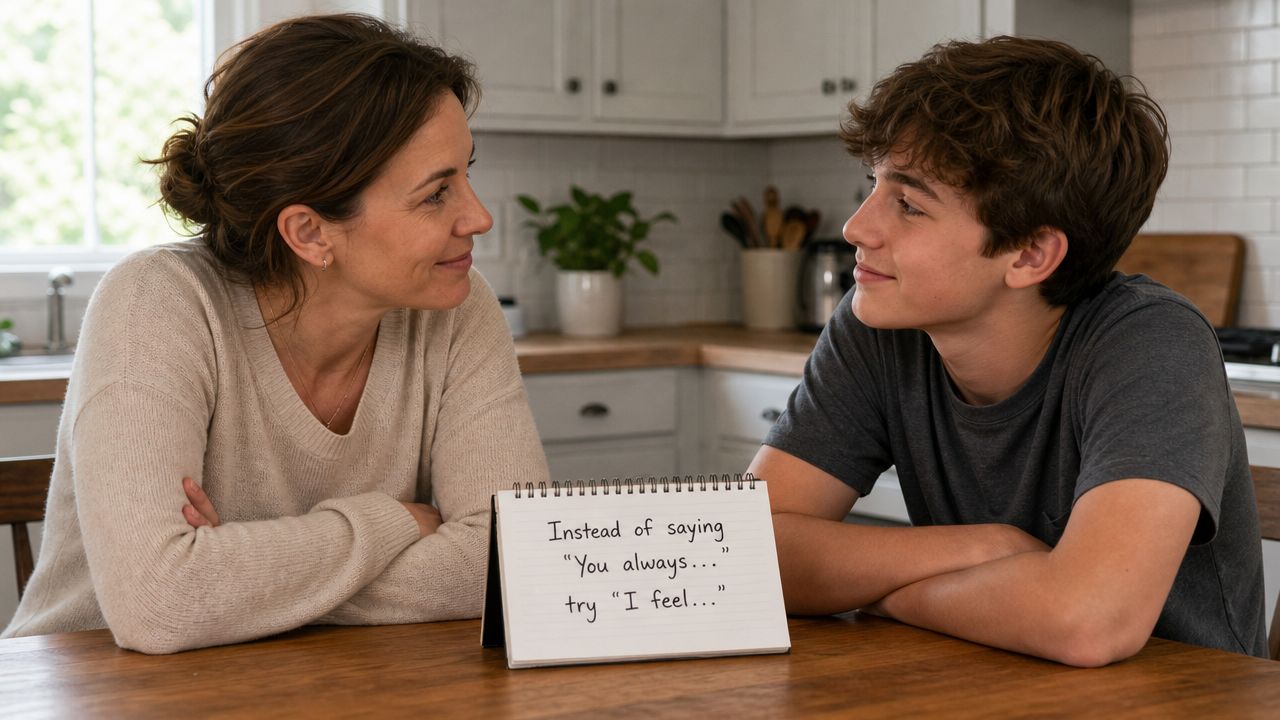
From Judgment to Validation
One of the most powerful skills you’ll learn is how to validate your loved one’s feelings—even when you don’t agree with their actions or point of view. Validation isn’t approval. It’s simply acknowledging that their emotions are real for them, which is the key to creating emotional safety.
Here are a few before-and-after examples that show what this looks like in practice:
- Instead of saying: "You're overreacting. It's not a big deal." (This dismisses their feelings.)
- Try saying: "It sounds like that was really overwhelming for you. Can you tell me more about it?" (This acknowledges their emotion and opens the door for conversation.)
Expressing concern is another common flashpoint. Your intentions might be good, but the words can easily come across as an accusation.
- Instead of saying: "You never get out of bed anymore. What's wrong with you?" (This sounds like a personal attack.)
- Try saying: "I've noticed you've been staying in your room more lately, and I'm worried about you. I'm here if you want to talk." (This focuses on observable behavior and expresses your own feelings.)
Mastering these small shifts is a huge part of what we work on when introducing communication techniques in family therapy.
Setting Boundaries with Compassion
Setting boundaries isn't about punishment or control; it’s about protecting the emotional health and stability of the entire family—including yourself. For a boundary to be healthy, it needs to be clear, consistent, and communicated with respect, not anger.
A boundary is a statement about what you will or will not do. It is not a demand for someone else to change their behavior, but a way to protect your own emotional and physical health.
For instance, if your loved one’s substance use is causing chaos at home, an ineffective boundary would be, “You have to stop using.” A much healthier and more effective boundary sounds like this:
- State the boundary clearly: "If you are under the influence, I will not be able to have you in our home."
- Explain the reason simply: "It's too stressful and unsafe for me and the rest of the family."
- Offer a positive alternative: "When you are sober, I would love to spend time with you and support you in your recovery."
This approach communicates love for the person while holding a firm, non-negotiable line against the destructive behavior. Learning to script and rehearse these conversations in a safe, guided setting is a core element of family psychoeducation. It empowers you to act with intention rather than just react in the heat of the moment.
What to Expect in a Family Program at Casa Recovery
It's one thing to read about psychoeducation for families, but it’s another thing entirely to see how it works in a real-world program. At Casa Recovery, we don’t treat family support as an optional add-on. It's a central part of our Partial Hospitalization (PHP) and Intensive Outpatient (IOP) programs for adults navigating mental health conditions and co-occurring disorders. From our years of experience, we know that lasting recovery happens when the family heals together.
Your journey with us begins from the very first phone call. That initial family intake conversation is a crucial first step, giving our clinical team a chance to understand your family's specific challenges and answer your questions. More importantly, it helps everyone feel seen and heard right from the start, building a foundation of trust for the work ahead.
A Trauma-Informed and Collaborative Approach
Our entire approach is grounded in a trauma-informed perspective. We recognize that family dynamics are often deeply affected by trauma—both past and present—and we work hard to create a space that feels safe for everyone. This is supported by our high therapist-to-client ratio, which ensures both your loved one and your family get the focused, personal attention you deserve.
True collaboration is key. Your family’s primary therapist works in lockstep with your loved one's individual therapist and our on-site psychiatric team. This integrated model means everyone is on the same page, sharing insights and coordinating care. The breakthroughs you have in family sessions will directly support the progress your loved one is making in their individual therapy, creating a consistent and powerful healing environment. You can find more details about our dedicated family program at Casa Recovery on our website.

What Family Sessions Look Like
Family therapy at Casa Recovery is active and practical. We use proven, evidence-based methods like Cognitive Behavioral Therapy (CBT) and Dialectical Behavioral Therapy (DBT) to give your family real tools you can start using immediately.
The goal of each session is to move beyond simply talking about problems and start actively building solutions. We focus on teaching practical skills for communication, boundary setting, and conflict resolution that you can implement immediately.
In a typical session, your family might work on:
- Identifying and changing unhelpful communication patterns: This could involve learning to swap out criticism for validation or replacing blame with "I" statements.
- Creating a unified crisis response plan: You'll work together to decide on specific, concrete steps to take during a difficult moment to ensure everyone stays safe and supported.
- Practicing boundary-setting conversations: A therapist can guide you through role-playing exercises on how to state your needs clearly and respectfully.
This process helps transform the family from a potential source of stress into an incredible source of strength. Through ongoing therapy, education, and close collaboration with the entire clinical team, we help empower your family to become a positive, healing force in your loved one’s recovery.
Frequently Asked Questions About Family Psychoeducation
It’s completely normal to have questions when you’re starting something new, especially when it involves your family’s health and well-being. The term “psychoeducation for families” can sound a bit clinical or even intimidating at first, so let's clear up what it really means and what you can expect.
One of the first things people wonder is how this is different from regular family therapy. While they both play a role in healing, they have different jobs. Family therapy often digs into the emotional history and complex dynamics of a family to resolve long-standing conflicts. Psychoeducation, on the other hand, is all about learning. Think of it less like a therapy session and more like a highly practical class where your family gets the tools and information you need to navigate a diagnosis, communicate better, and build effective coping skills together.
Addressing Common Concerns
We hear a lot of the same worries from families just starting out, and they're all valid. Let's tackle a few of the big ones.
A common fear is that the program will be about placing blame—that you'll be told you are somehow responsible for your loved one's struggles. I want to reassure you: that couldn't be further from the truth. The entire approach is built on a no-blame model.
The core belief of psychoeducation is that families are a resource for recovery, not the cause of the illness. The goal is to equip and empower you as allies, not to find fault.
This non-judgmental foundation is what makes the process work. It creates a safe space where everyone can learn and contribute without feeling the need to be defensive. The focus is always on looking forward and figuring out how to work as a team.
Another very practical question is about the time commitment. Life is already hectic, especially when a loved one is in a Partial Hospitalization (PHP) or Intensive Outpatient (IOP) program. A well-designed psychoeducation program gets that. Sessions are usually just once a week and often scheduled in the evenings to work around everyone's commitments. That small investment of a few hours each week makes a world of difference in creating a stable, supportive home life that truly reinforces the healing happening in treatment.
What if My Loved One Is Resistant?
This comes up a lot. It's not at all unusual for someone to feel resistant to having their family involved, whether it's from embarrassment, anger, or just feeling overwhelmed. So, what do you do then?
- Start with empathy. Try framing it as something for you. You could say, "I really want to understand what you're going through and be a better support for you. This program has a family component that I think could teach me how to do that."
- Focus on your own participation. You can—and should—attend even if your loved one isn't ready to. The skills you learn will immediately start to benefit the family dynamic, whether they are in the room or not.
- Lead by example. When your family member sees you using healthier communication and managing your own stress better, it often lowers their defenses. Your positive changes can be the very thing that encourages them to join in.
The most powerful thing you can do is simply show up for yourself. When you learn how to set healthy boundaries, manage your own stress, and communicate with more clarity and less reactivity, you improve your own well-being. That, in turn, begins to shift the entire family environment for the better, opening the door for your loved one when they feel ready to walk through it.
At Casa Recovery, we see firsthand how vital family involvement is for lasting healing. Our integrated family program is built to give you the specific tools and support your family needs to walk the recovery path together. Learn how we can help your family heal by visiting us at casarecovery.com.