You may be out of the relationship, but your body may still be living in it.
Maybe you wake up already tense. Maybe calm moments make you uneasy instead of relieved. Maybe you keep replaying conversations, wondering whether you were too sensitive, too angry, too needy, or wrong about what happened. Then there are the symptoms that seem unrelated. Trouble sleeping. Headaches. A stomach that never feels settled. Exhaustion that rest doesn't fix.
Many survivors think, “If it's over, why do I still feel like this?”
That question makes sense. The long term effects of narcissistic abuse often continue long after contact ends, because this kind of harm doesn't only affect mood. It can alter your stress response, your sense of self, your ability to trust, and even the way your body reacts to ordinary life. What feels confusing is often a very understandable response to chronic emotional injury.
If that's where you are, you aren't imagining it, and you aren't weak. You may be dealing with the aftereffects of prolonged trauma.
Table of Contents
- Introduction The Lingering Echoes of Abuse
- Understanding the Invisible Wounds
- The Hidden Physical and Psychological Toll
- Why It Feels Like Brain Damage C-PTSD and Neurobiology
- Relearning Relationships The Dog in the Fence Effect
- A Roadmap to Recovery Evidence-Based Treatment Options
- How to Start Healing Today Practical Steps and Local Help
Introduction The Lingering Echoes of Abuse
Some people leave a narcissistic relationship and expect to feel immediate relief. Instead, they feel foggy, reactive, numb, or frightened by how changed they seem. They may sit in a quiet room and still feel braced for criticism. They may hear a neutral tone from a friend and instantly assume rejection. They may have trouble answering simple questions like, “What do you want?” because they spent so long organizing themselves around someone else's moods.
That aftermath can be profoundly disorienting.
You might know, logically, that the crisis has passed. But your nervous system may still be scanning for danger. Your thoughts may still loop around what happened. Your body may still carry the stress of trying to predict, prevent, and survive another person's manipulation. That mismatch often leaves survivors feeling as if they're failing at recovery.
They're not.
Long-term exposure to narcissistic abuse frequently results in PTSD or Complex PTSD, with approximately 50% to 60% of survivors developing one of those trauma conditions according to Montare Behavioral Health's discussion of the long-term effects of narcissistic abuse. The same source describes common effects such as hypervigilance, emotional dysregulation, helplessness, disrupted sleep, chronic headaches, and muscle tension.
You can be physically safe and still feel internally unsafe. Trauma often works that way.
A lot of readers get stuck here. They think, “Maybe I should be over this by now.” But abuse that unfolds through repeated invalidation, gaslighting, control, and unpredictability doesn't vanish just because the relationship ended. It leaves echoes. In your thoughts. In your body. In your relationships. In your ability to trust yourself.
Healing is possible, but it usually starts with one important shift. You stop treating your symptoms like proof that you're broken, and start understanding them as evidence that your system adapted to survive something harmful.
Understanding the Invisible Wounds
Narcissistic abuse rarely looks dramatic every day. More often, it works through accumulation. A cutting remark that gets brushed off. A denial of something you clearly remember. A moment of warmth followed by punishment. A pattern of being blamed for the other person's moods. Over time, these experiences can feel like death by a thousand paper cuts.

That matters because survivors often minimize what happened. They say, “There wasn't always screaming,” or “Nothing looked that bad from the outside.” But repeated emotional distortion can be profoundly destabilizing. If you'd like a broader look at how emotional trauma lingers, this overview on recovering from emotional trauma gives useful context.
Why this abuse cuts so deeply
In a healthy conflict, two people may disagree, feel upset, then repair. In narcissistic abuse, repair is often missing. The goal shifts toward control, domination, image management, or emotional extraction. Your reality gets challenged so often that you begin to question your own perceptions.
A survivor might think:
- “Maybe I misheard.” Even when they remember the conversation clearly.
- “Maybe I am too sensitive.” Even when the comment was cruel.
- “Maybe if I explain better, this will stop.” Even though the issue isn't misunderstanding. It's manipulation.
- “Maybe the good version of them will come back.” Even though that good version appears mainly when control is slipping.
That pattern erodes self-trust. It also creates confusion about what abuse is. Many people think abuse must be loud, obvious, or constant. Narcissistic abuse is often inconsistent. The inconsistency is part of what makes it so hard to name.
The cycle that trains self-doubt
The abuse often follows a recognizable sequence. Not every relationship looks identical, but many survivors describe the same broad rhythm:
| Phase | What it can feel like |
|---|---|
| Idealization | You feel unusually seen, chosen, or intensely valued |
| Devaluation | Criticism, blame, contempt, or subtle put-downs start taking over |
| Discard or withdrawal | Love, contact, or approval gets pulled away |
| Return or renewed charm | Warmth reappears, often enough to restart hope |
This cycle doesn't just hurt emotionally. It teaches your body to stay alert. Relief becomes mixed with fear. Affection becomes tied to instability. Love stops feeling safe.
Practical rule: If you spent the relationship constantly monitoring tone, timing, facial expressions, or hidden meanings, your system likely learned that unpredictability was dangerous.
That's why the long term effects of narcissistic abuse can feel so stubborn. You're not only grieving the relationship. You're unwinding a whole pattern that trained you to override your own instincts.
The Hidden Physical and Psychological Toll
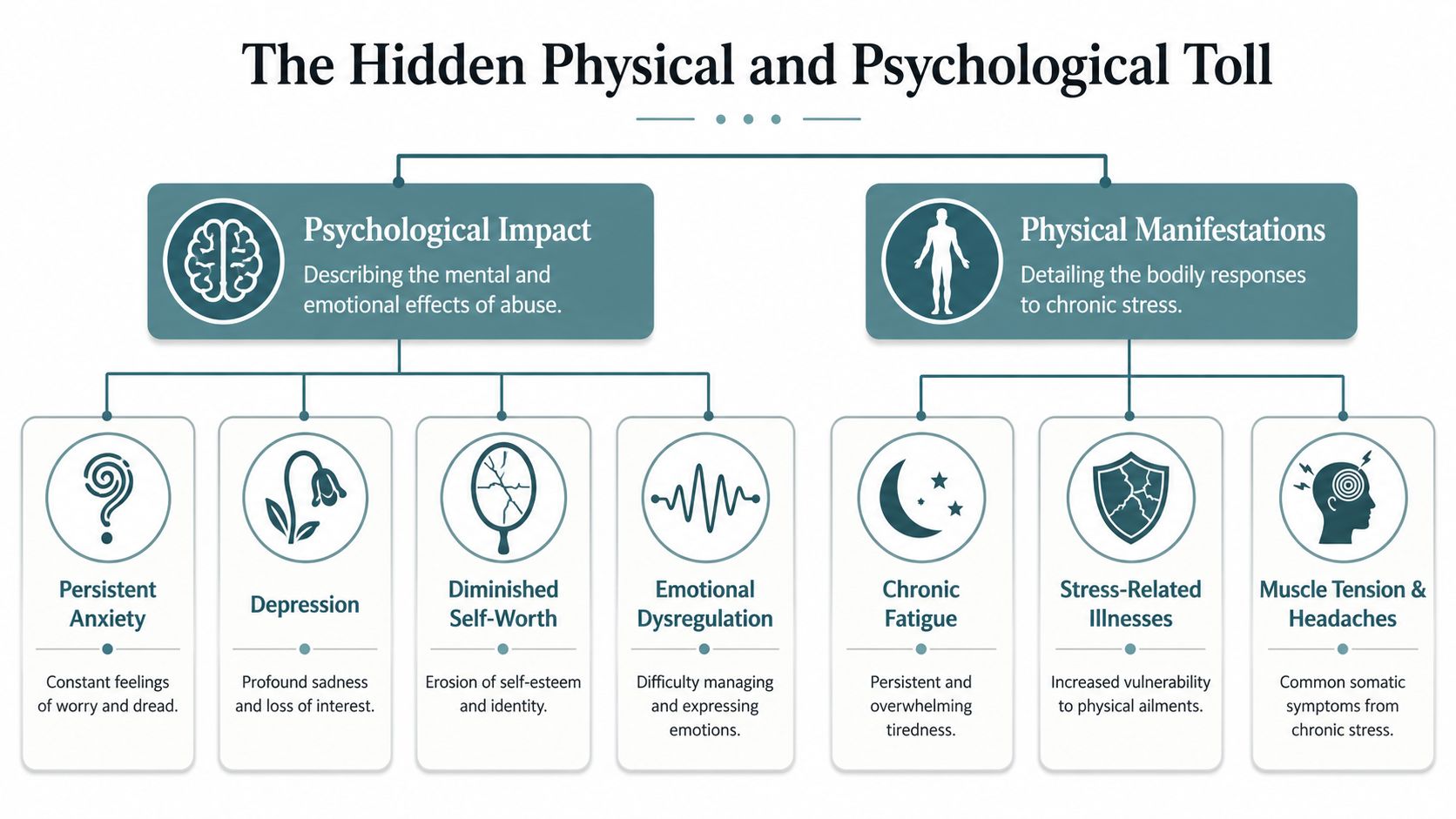
Survivors often search for one symptom that explains everything. Usually there isn't just one. The impact tends to show up in three connected areas. Your mind, your body, and your relationships.
What happens emotionally and mentally
A person can leave the relationship and still feel ruled by it. They may struggle with anxiety, depression, emotional swings, shame, or a flattened sense of self. Even positive attention can feel suspicious.
Common experiences include:
- Persistent anxiety that shows up even when nothing is obviously wrong
- Low mood or hopelessness that feels heavier than ordinary sadness
- Diminished self-worth from years of blame, comparison, or contempt
- Emotional dysregulation that makes small stressors feel huge
- Mental fog that makes decisions feel exhausting
Some survivors also experience a painful split inside themselves. One part says, “I know what happened.” Another part says, “Maybe it was me.” That inner conflict is common after prolonged gaslighting.
How trauma shows up in the body
One of the most overlooked long term effects of narcissistic abuse is that the body often carries what the mind cannot fully process. Chronic threat pushes the stress system to stay activated, and that can produce real physical symptoms.
The physiological manifestation of narcissistic abuse can present as undiagnosed autoimmune and gastrointestinal disorders, with prolonged exposure keeping cortisol surging and the stress axis on a “constant low hum,” contributing to autoimmune symptoms, IBS, hair loss, and flaring skin conditions that often return normal results on standard medical exams, as described in KDH Collective's article on narcissistic abuse as death by a thousand paper cuts.
That can be a huge relief to read, because many survivors have spent months or years thinking, “Why do I feel sick if my tests are normal?”
Physical symptoms may include:
- Exhaustion that lingers even after sleep
- Headaches or migraines that cluster around stress
- Muscle tension in the jaw, neck, shoulders, or back
- Digestive distress such as nausea, stomach pain, or IBS-like symptoms
- Sleep disruption including trouble falling asleep, staying asleep, or waking in a panic
This doesn't mean every symptom is caused by trauma. It means trauma belongs on the list of things worth considering.
Why relationships often feel harder after abuse
The aftermath doesn't stop at symptoms. It can change how closeness feels.
You may pull away from supportive people because being known feels risky. You may overshare quickly because you want reassurance. You may read neutral moments as signs that someone is upset, disappointed, or about to leave. None of that means you're bad at relationships. It means your system learned that relationships can injure.
A short comparison can help:
| After abuse reaction | What it may really mean |
|---|---|
| Avoiding people | Protection from more hurt |
| Overexplaining yourself | Fear of being misunderstood or punished |
| Difficulty trusting kindness | Past experience taught you warmth could turn quickly |
| People-pleasing | A survival strategy that once reduced conflict |
Your body isn't “making it up.” It may be sending the alarm signals it learned were necessary.
When survivors understand this mind-body connection, shame often starts to loosen. The symptoms may still be hard, but they stop feeling random.
Why It Feels Like Brain Damage C-PTSD and Neurobiology
Many survivors use strong language to describe what happened to them. They say, “I feel like my brain is broken,” or “I don't think the same way anymore.” Those statements aren't dramatic. They're often attempts to describe a real neurobiological shift.
Why your brain feels different
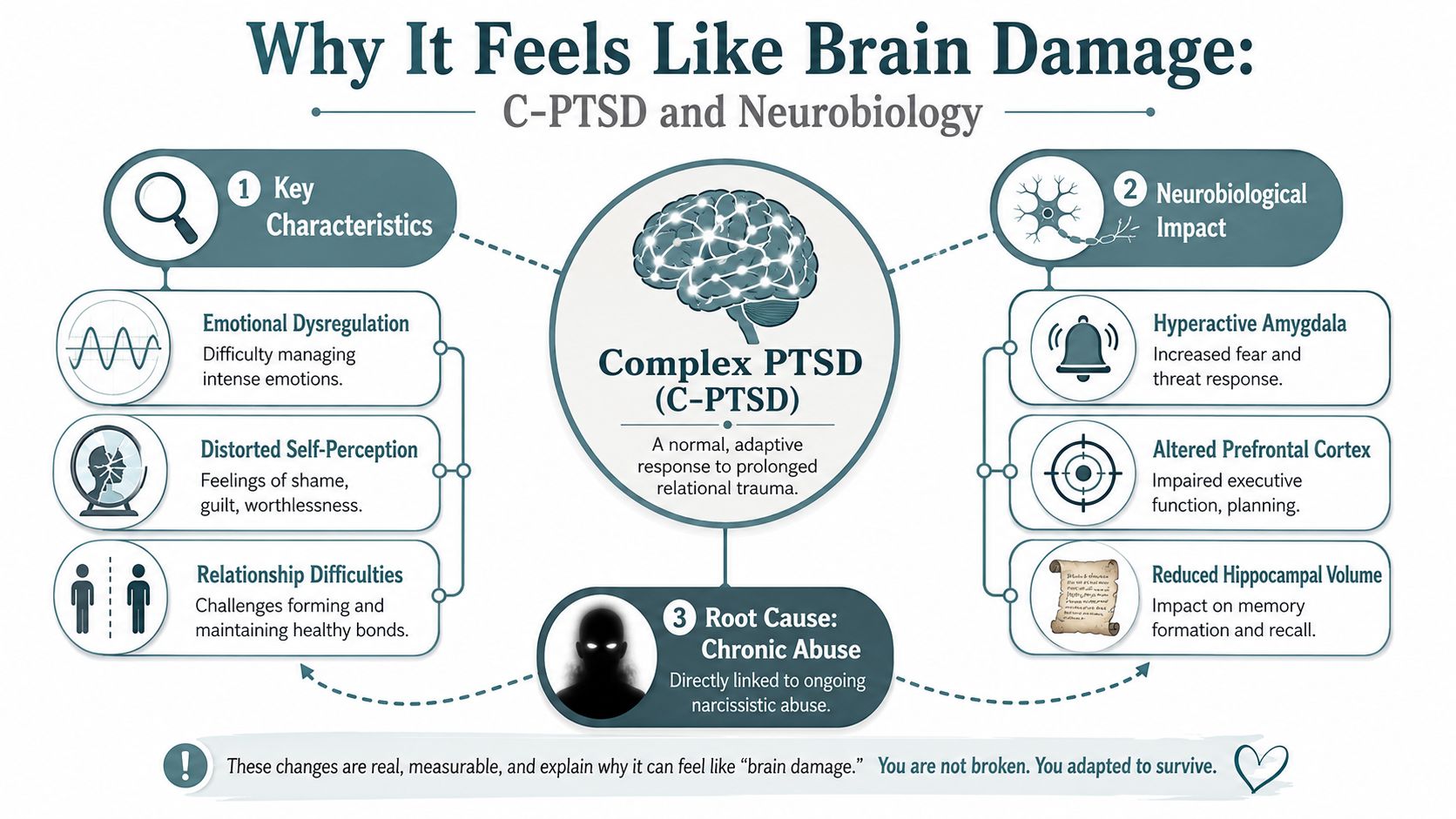
Long-term exposure to narcissistic abuse induces neurobiological dysregulation characterized by persistently high cortisol levels, which directly impair hippocampal volume and amygdala hyperactivity, resulting in a clinical presentation of Complex PTSD in approximately 73.3% of affected women, according to this discussion of brain damage from long-term narcissistic abuse. The same source connects these changes with hypervigilance, panic attacks, phobias, and sleep disturbance.
In plain language, the parts of the brain involved in threat detection, memory, and regulation can get pulled out of balance by chronic stress.
A simple way to picture it:
- The alarm system gets louder. You notice danger quickly, even when the cue is small or ambiguous.
- Memory can feel scrambled. Trauma memories may come back in fragments, sensations, or body reactions rather than a neat story.
- Clear thinking gets harder under stress. You may know you're safe and still feel hijacked.
If you want a broader mental health lens on trauma's effects, this article on how trauma impacts mental health is a useful companion.
C-PTSD is an injury pattern not a character flaw
Many readers get stuck here. They think hypervigilance means they're irrational. They think emotional swings mean they're unstable. They think memory gaps mean they're exaggerating. Trauma doesn't support those conclusions.
Complex PTSD is better understood as a chronic relational trauma response. It develops when a person has to adapt to repeated threat over time, especially in close relationships where there is no consistent safety.
Signs can include:
- Hypervigilance that keeps you scanning faces, tones, and texts for hidden danger
- Emotional dysregulation that makes feelings hit hard and fast
- Fragmented recall where pieces of the abuse are clear but the timeline feels blurry
- Shame-based self-perception such as “I ruin everything” or “I can't trust myself”
- Difficulty feeling safe with others even when people are kind
When your fear response is overactive, ordinary life can feel like an emergency drill.
The important part is this. A traumatized brain isn't a ruined brain. It is a brain shaped by survival. That distinction matters because it creates room for self-compassion and treatment. Your symptoms may be intense, but they are not proof that healing is out of reach.
Relearning Relationships The Dog in the Fence Effect
People often assume that once a controlling relationship ends, freedom will feel good right away. Sometimes it does. Sometimes it feels terrifying.
That doesn't mean you've made the wrong choice. It means your system may not know what to do with open space yet.
Freedom can feel unsafe at first
One neglected part of recovery is the rebound effect that can happen after control lifts. When the “gate is finally flung open” after years of control, survivors often show a “dog in the fence mentality,” swinging into defiance or refusing to let anyone in. This reactive behavior is often misunderstood as a lack of progress rather than a defensive over-correction to years of control, as described in this video discussion of the Dog in the Fence phenomenon.
That image helps because it captures something many survivors feel but don't know how to explain. You finally have room to choose, but instead of peace, you feel edgy, oppositional, or suspicious of everyone.
You might think:
- “No one gets to tell me what to do anymore.”
- “If I let anyone close, I'll get trapped again.”
- “I'd rather ruin it myself than be blindsided.”
These reactions can look self-sabotaging from the outside. Inside, they usually feel protective.
What reactive self-protection can look like
This phase can show up in surprisingly different ways. One person becomes intensely independent and refuses help. Another picks fights quickly because closeness feels dangerous. Another avoids dating entirely. Another starts saying yes to things that don't fit them at all, because saying no used to be impossible.
A few examples:
| Reaction | What may be underneath it |
|---|---|
| Pulling away from safe people | Fear that dependence will be used against you |
| Overcorrecting with rigid boundaries | A nervous system trying to prevent any future intrusion |
| Defiance for its own sake | A delayed response to years of control |
| Cynicism about love or friendship | Protection against disappointment and betrayal |
This stage can be confusing because it doesn't look like the version of healing people usually celebrate. It may not look calm, wise, or balanced. It may look messy.
Some forms of “not healing well” are actually protection strategies wearing new clothes.
That doesn't mean the reactions should run your life. It means they deserve understanding. With support, survivors can learn the difference between a boundary and a wall, between intuition and trauma-based suspicion, between self-protection and self-isolation.
A Roadmap to Recovery Evidence-Based Treatment Options
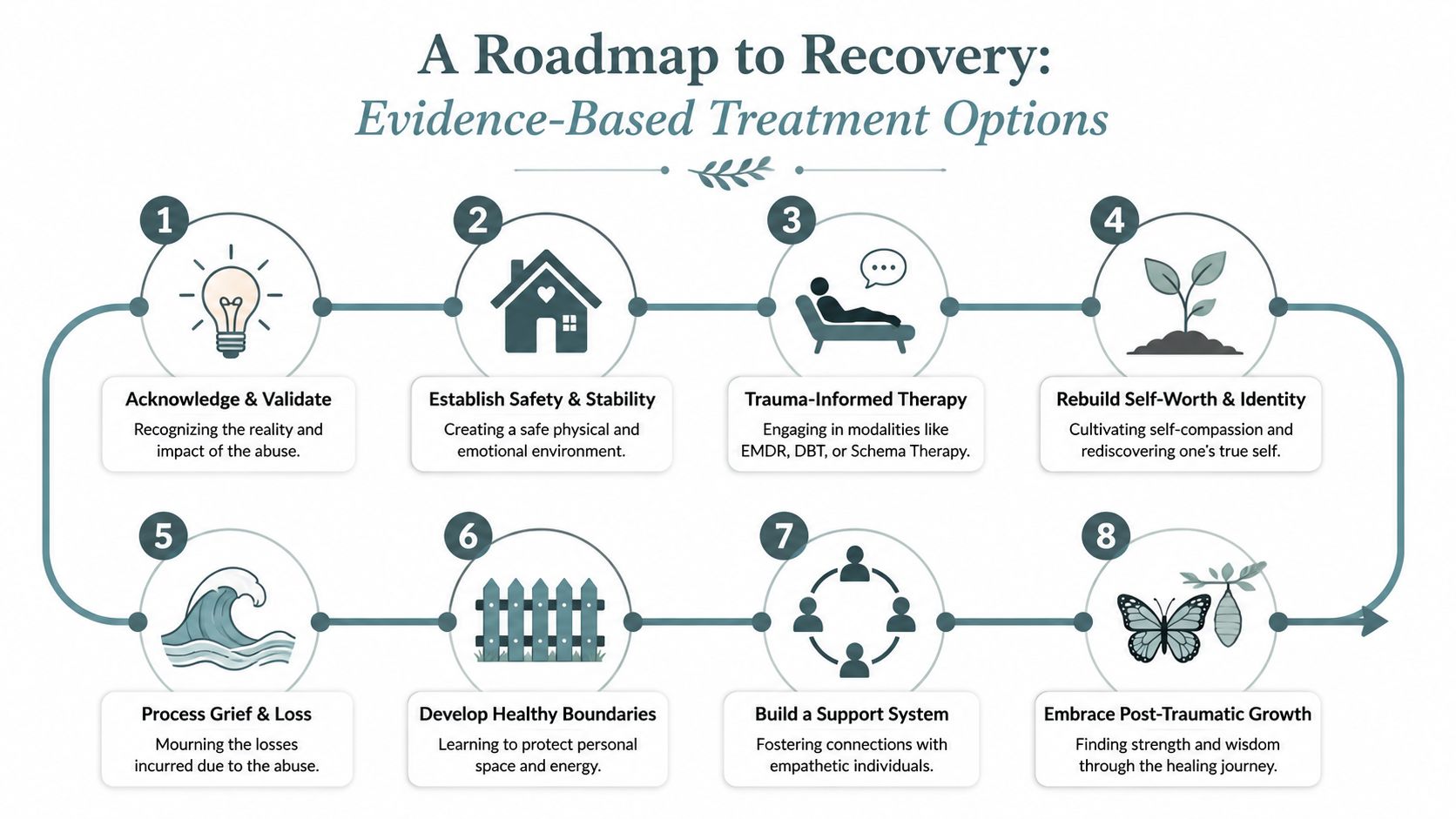
Healing usually works best when it addresses both the story of what happened and the state your body is still stuck in. Insight matters. So do nervous system skills, structure, and trauma-focused treatment.
What good outpatient care actually includes
A strong recovery plan is usually multi-modal. That means more than one kind of support working together.
Core pieces often include:
- Safety and stabilization so your body isn't in constant crisis
- Trauma-informed therapy that understands gaslighting, coercion, and chronic shame
- Skills training for emotion regulation, grounding, and boundaries
- Psychiatric support when needed for sleep, anxiety, depression, or related symptoms
- Family or support system involvement when safe and appropriate
Outpatient treatment can be especially helpful for people who need real support but also want to remain connected to work, school, or family life. One example is Casa Recovery's evidence-based mental health approaches, which include outpatient care, trauma-focused therapies, psychiatric services, and dual-diagnosis support.
How specific therapies help
Different therapies do different jobs. Survivors often hear acronyms and have no idea what they mean in practice.
Here is a plain-language guide:
| Therapy | What it can help with |
|---|---|
| CBT | Challenging distorted beliefs such as “Everything is my fault” |
| DBT | Learning distress tolerance, emotion regulation, and boundary skills |
| EMDR | Processing traumatic memories that still feel current and activated |
| Brainspotting | Working with trauma that feels stored beyond words |
| Motivational Interviewing | Supporting change when you feel ambivalent, stuck, or depleted |
Trauma-informed care matters because standard talk therapy alone may not be enough when the body is still reacting as if danger is present.
The earlier Montare Behavioral Health source notes that recovery from these long-term effects often requires trauma-informed therapies such as EMDR or CBT to help reframe negative thought patterns and rebuild self-worth.
When more structure helps
Some survivors do well with weekly therapy. Others need more support for a period of time, especially if symptoms are disrupting work, sleep, functioning, or sobriety.
More structured outpatient care can help when:
- Your days feel unmanageable. You spend large blocks of time dissociated, panicked, exhausted, or emotionally flooded.
- Triggers keep derailing you. Small interactions lead to long spirals, shutdowns, or impulsive coping.
- You need support rebuilding routine. Eating, sleeping, showing up, and staying connected all feel harder than they used to.
- Substance use entered the picture. Some survivors use alcohol or drugs to get relief from hyperarousal, insomnia, or intrusive distress.
If substance use and trauma are happening together, integrated dual-diagnosis treatment can matter a lot. Treating one while ignoring the other often leaves people stuck in the same loop.
Recovery also becomes steadier when survivors build a treatment plan around actual symptoms instead of trying to force themselves into a generic idea of “moving on.” For some, that means a therapist plus a support group. For others, it means PHP or IOP, medication support, trauma processing, and family therapy.
The right question isn't “What should a strong person need?” The right question is “What level of care helps my nervous system and daily life become workable again?”
How to Start Healing Today Practical Steps and Local Help
You don't have to solve the whole recovery process this week. Most healing starts smaller than people expect. A little more safety in the body. A little more clarity in the mind. One less hour spent arguing with yourself about whether it was really abuse.
Small practices that help you feel safer now
Start with actions that lower activation and rebuild self-trust.
Try a short daily routine like this:
- Ground through the senses. Name five things you can see, four you can feel, three you can hear. This helps orient your body to the present.
- Use paced breathing. Make the exhale longer than the inhale. That can help the body shift out of alarm.
- Write down what happened. A simple journal entry can counter gaslighting and help you trust your memory again.
- Track body cues. Notice when your shoulders tighten, your stomach drops, or your jaw clenches. Those signals often arrive before conscious thought.
- Choose one safe comfort practice. Some people respond well to gentle movement, a warm shower, or calming sound. If that appeals to you, Lucidoura's guide to sound healing offers a practical introduction to using sound-based relaxation as part of a grounding routine.
A useful journal prompt is, “What happened, what did I feel, and what do I know is true?” Keep it simple. The goal isn't perfect insight. The goal is reality contact.
How to know when it is time for professional support
Self-help can be meaningful, but some signs point to needing more than solo coping.
Consider reaching out for professional help if:
- You feel stuck in survival mode. Calm still feels impossible.
- Your body symptoms are persistent. Sleep, pain, digestion, or fatigue keep interfering with life.
- You keep returning to unsafe dynamics. Even when part of you knows better.
- You can't access your own preferences. You feel numb, blank, or unable to make decisions.
- You are using substances, food, or isolation to cope. Relief may be coming at a growing cost.
When you're looking for a therapist or program, ask direct questions. Do they understand complex trauma? Do they work with body-based symptoms, not just thoughts? Do they know how emotional abuse affects identity, trust, and nervous system regulation? Those questions can save you a lot of frustration.
If you're in Orange County or nearby areas, local outpatient options may offer a practical next step when weekly therapy isn't enough but full residential care isn't necessary.
If you're ready for more structured support, Casa Recovery offers trauma-informed outpatient mental health care in Orange County, including PHP, IOP, individual therapy, psychiatric services, and integrated dual-diagnosis treatment for adults dealing with trauma-related symptoms. A confidential consultation can help you figure out what level of care fits your needs without pressure.