You may be sitting in your car after another argument, phone in hand, typing therapy for narcissistic abuse near me and then deleting it because part of you still wonders if you're overreacting. Maybe you already left the relationship and still feel foggy, ashamed, jumpy, or oddly loyal to someone who hurt you. Maybe you're in Orange County, trying to keep work, kids, sleep, and basic functioning together while your mind keeps replaying conversations that never made sense.
That search is not small. It usually comes after months or years of being doubted, minimized, blamed, or trained to ignore your own perception. By the time someone looks for help, they're often exhausted from trying to explain the pattern to friends, family, or therapists who called it a “relationship issue” instead of what it felt like in their body: coercion, confusion, fear, and self-erasure.
The good news is that the right therapy can help. The hard part is that not every therapist who says they're trauma-informed understands narcissistic abuse well enough to treat it skillfully. In Orange County, that means your job isn't just to find someone nearby. It's to find someone who can recognize gaslighting, trauma bonding, cognitive dissonance, and the specific fallout that follows high-conflict, manipulative relationships.
Table of Contents
- The First Step Toward Finding Your Footing Again
- How to Spot a True Narcissistic Abuse Specialist
- Effective Therapy Modalities for Recovery
- Key Questions to Ask a Potential OC Therapist
- Choosing Your Level of Care PHP vs IOP
- Navigating Admissions Insurance and Your First Steps
The First Step Toward Finding Your Footing Again
People rarely start this search feeling clear and confident. More often, they start after months of hearing some version of “that never happened,” “you're too sensitive,” or “you're the problem.” Then they sit with a browser full of therapist profiles that all sound the same.
A common pattern looks like this. Someone finally books with a general therapist because the website says trauma-informed, anxiety, and relationships. In the first session, they describe the manipulation, the lies, the sudden reversals, the smear campaigns, or the way they now second-guess every memory. The therapist means well, but frames it as a communication breakdown, asks what their part was, or suggests couples counseling while abuse dynamics are still active. The client leaves feeling smaller than when they arrived.
That's why the first step isn't to find the fastest appointment. It's to get your bearings back.
If you feel confused after abuse, that confusion is not proof that nothing happened. It's often one of the injuries.
Healing starts when someone helps you organize the chaos. Not by pushing labels onto the other person, but by helping you recognize patterns, restore self-trust, calm your nervous system, and make decisions from a steadier place. For many survivors in Orange County, that means slowing down enough to ask a better question than “Who can see me this week?”
Ask this instead: Who understands this kind of harm well enough to help me recover without repeating it in the therapy room?
Why this search feels so hard
Narcissistic abuse often scrambles the exact capacities you need to choose a therapist well. You may distrust your judgment. You may feel guilty asking direct questions. You may worry about sounding dramatic. You may also be functioning on the outside while privately falling apart, which makes it easier for others to miss the severity of what's happening.
That doesn't mean you're hard to treat. It means you need a clinician who knows how to work with trauma, power imbalance, and the collapse of self-trust that follows repeated manipulation.
What solid early support looks like
Early therapy should help you do a few things quickly:
- Name the pattern: Gaslighting, blame-shifting, trauma bonding, coercive control, and chronic invalidation need to be recognized for what they are.
- Stabilize your body: If you're panicked, numb, hypervigilant, or unable to sleep, insight alone won't carry you very far.
- Reduce self-doubt: Good treatment helps you reality-test what happened without shaming you for staying, returning, or feeling attached.
- Protect the next step: If you still have contact with the person, therapy should include practical safety and boundary planning.
How to Spot a True Narcissistic Abuse Specialist
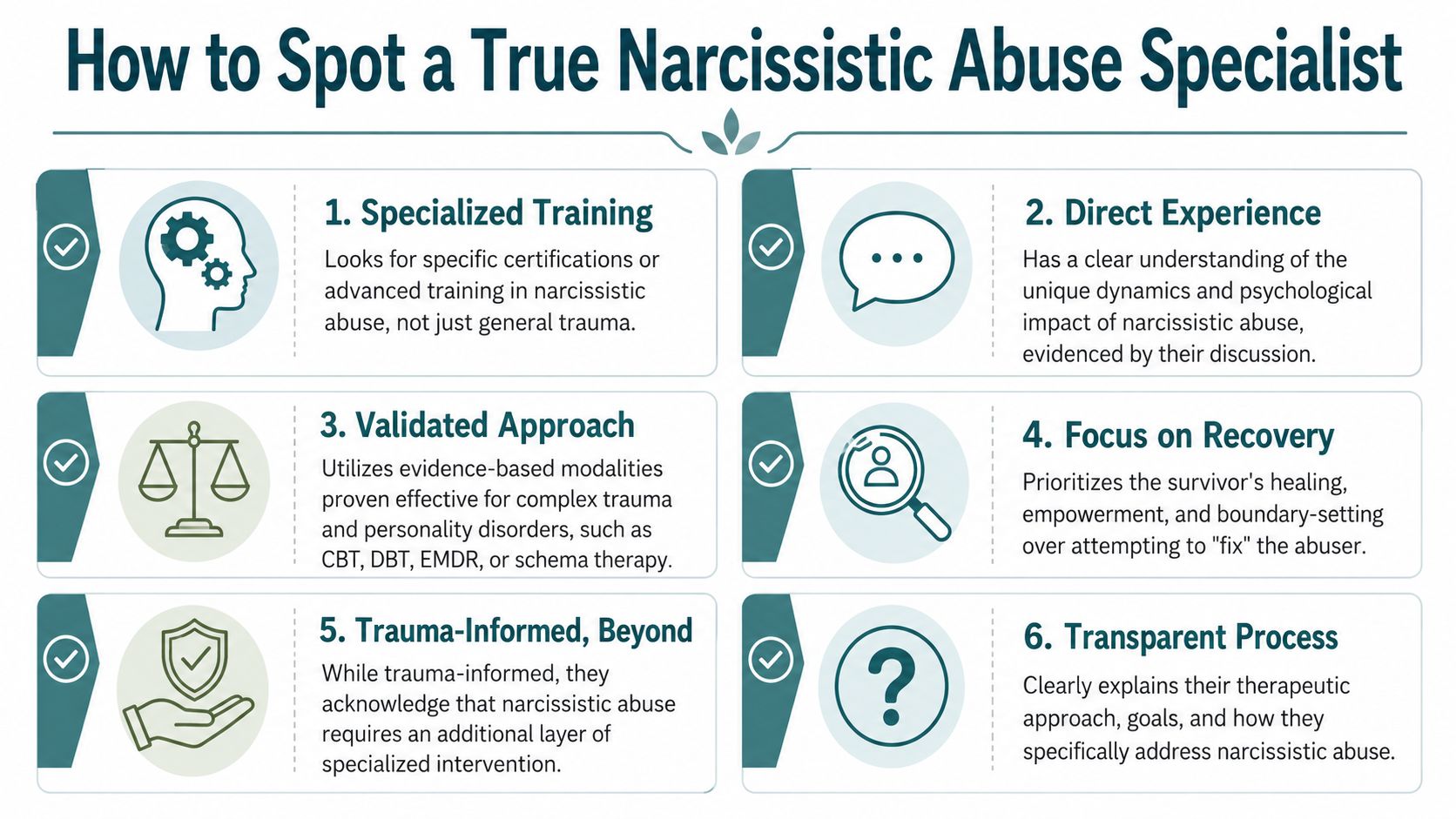
The most important filter is not zip code. It's whether the therapist has a working framework for narcissistic abuse. Experts like Dr. Ramani note that survivors are often misled by general trauma therapists who don't distinguish standard trauma from the unique psychological manipulation involved in narcissism, which can lead to ineffective treatment and prolonged recovery, as discussed in Dr. Ramani's guidance on finding a therapist who understands narcissistic abuse.
Why general trauma informed care can miss the mark
A therapist can be kind, licensed, and experienced with trauma, yet still miss the clinical picture here. Narcissistic abuse has features that require more than general empathy. The survivor may present with shame, confusion, obsessive rumination, fear of conflict, identity collapse, and intense loyalty to the person who harmed them. If the clinician doesn't recognize trauma bonding or coercive dynamics, they can accidentally mirror the abuse by minimizing the survivor's reality.
That's where the phrase trauma-informed can become too broad. It tells you the therapist may understand trauma in principle. It does not tell you whether they understand manipulation tactics, image management, intermittent reinforcement, or why a survivor may look ambivalent, emotionally attached, or “unable to move on.”
A good consultation should leave you feeling clearer, not more confused. If you want a broader fit framework, this guide on how to know if a therapist is right for you can help you think through alignment, pace, and treatment style.
Green flags and red flags during your search
Start with the therapist's website, then test what you see in the consultation.
Green flags on a website
- Specific language: They mention gaslighting, trauma bonding, cognitive dissonance, C-PTSD, boundaries, coercive control, or high-conflict relationships.
- Clear treatment approach: They explain how they work with trauma symptoms, not just that they offer support.
- Recovery focus: They center your healing, your safety, and your ability to rebuild identity and self-trust.
- Modality detail: They name actual methods, such as CBT, DBT, EMDR, or other trauma-focused work, and describe why they use them.
- Boundary-aware framing: They don't market couples work as the default answer when manipulation or abuse is active.
Red flags on a website
- Vague language only: Everything is “safe space,” “healing journey,” and “relationship issues,” but nothing names abusive dynamics.
- Heavy emphasis on communication fixes: If the message is mostly about better conflict skills, that can be a poor fit when the underlying issue is exploitation or chronic distortion.
- No explanation of process: They list many specialties but give you no sense of how treatment works.
- Pressure toward reconciliation: If the tone assumes preserving the relationship is the goal, be cautious.
Practical rule: If a therapist can't explain how narcissistic abuse differs from ordinary conflict, keep looking.
Then come the consultation cues.
Green flags in the first conversation
- They believe you without rushing you.
- They can explain trauma bonding in plain language.
- They ask about safety, contact, legal stress, family pressure, and your current level of stability.
- They don't seem impressed by the abuser's charm, status, or public image.
- They can tell you what early treatment typically focuses on.
Red flags in the first conversation
- They quickly ask, “What was your role in the dynamic?” before establishing safety and pattern recognition.
- They encourage joint sessions with an abusive or manipulative partner.
- They sound skeptical because the abuse was emotional, subtle, or hard to prove.
- They focus on forgiveness before stabilization.
- They make you feel like you need to defend your reality.
Effective Therapy Modalities for Recovery
Good treatment doesn't just help you talk about what happened. It helps you process trauma, regulate your nervous system, challenge implanted beliefs, and rebuild the parts of you that had to shrink to survive.

If you've seen a list of acronyms and felt lost, that's normal. The names matter less than the function. What matters is whether the therapy matches the injuries narcissistic abuse tends to leave behind. For a grounded overview of structured, research-based care, this page on evidence-based mental health approaches in Orange County outlines the kinds of modalities often used in outpatient treatment.
What good treatment actually targets
A strong treatment plan usually addresses several layers at once:
- Trauma activation: Flashbacks, panic, body tension, dread, sleep disruption, shutdown, or startle responses.
- Distorted beliefs: “It was my fault,” “I'm too much,” “I can't trust myself,” or “I have to keep the peace to stay safe.”
- Relational injury: Trouble setting boundaries, fear of being disliked, overexplaining, fawning, or returning to harmful dynamics.
- Identity damage: Losing track of preferences, values, voice, and self-respect.
Some clients want insight first. Others want symptom relief fast because they can't function. Most need both, but in a careful sequence.
How the main modalities help
CBT and trauma-focused CBT often provide the starting structure. According to Charlie Health's overview of therapy for narcissistic abuse, CBT and TF-CBT are foundational modalities in this work. They help identify distorted thoughts, challenge false responsibility, and reconnect emotions, thoughts, and behavior in a way that makes the aftermath feel less chaotic.
Prolonged Exposure therapy is especially relevant when the abuse has led to PTSD. The same source explains that PE uses a step-by-step process of imaginal exposure, where traumatic memories are recounted vividly in the present tense, followed by in vivo exposure, where avoided real-life situations are approached in a hierarchy. Done well, this helps the brain reprocess fear rather than staying organized around avoidance.
EMDR can be powerful when certain memories still feel electrically charged. The same clinical review notes that EMDR is clinically verified to accelerate trauma processing by reducing the physiological distress response when recalling abuse. For survivors, that often means a memory stops feeling like it's happening now.
DBT matters for reasons many people miss. Narcissistic abuse often punishes directness, boundaries, and emotional expression. The same source notes that DBT provides distress tolerance skills such as paced breathing and radical acceptance, along with interpersonal effectiveness training to rebuild communication and self-respect. In practice, this can help with not spiraling after contact, not overexplaining boundaries, and not abandoning yourself to keep the peace.
Treatment works best when it addresses both the trauma reaction and the manipulation that shaped it.
One more point matters. That same clinical guidance warns that therapy can fail when practitioners don't understand narcissistic manipulative patterns and may inadvertently gaslight survivors. Technique matters, but the therapist's framework matters just as much.
Key Questions to Ask a Potential OC Therapist
You're not being difficult when you ask direct questions. You're screening for safety and competence. That is part of recovery.
Many survivors enter consultations trying to be liked. A better stance is this: I'm interviewing this person to see whether they understand my problem well enough to help. You do not owe a therapist immediate trust. Trust grows from how they think, how they listen, and whether their answers match your reality.

Questions that reveal actual expertise
Bring a short list. You don't need to ask everything at once, but a few targeted questions can tell you a lot.
What experience do you have working with narcissistic abuse, covert narcissism, or high-conflict relationships?
Listen for specifics. You're not looking for buzzwords. You're listening for whether they understand manipulation, image management, and trauma bonding.How do you tell the difference between relationship conflict and an abusive dynamic?
This question cuts through generic couples-language fast.What does early treatment usually focus on for survivors like me?
Good answers often include stabilization, nervous system regulation, rebuilding self-trust, psychoeducation, and boundary work.How do you approach trauma bonding and the urge to go back, explain, or seek closure?
A skilled therapist won't shame attachment. They'll understand it as part of the bind.What modalities do you use for trauma processing, and how do you decide when someone is ready?
You want a thoughtful answer, not a canned list.How do you help clients set boundaries with someone who is manipulative or retaliatory?
This shows whether they understand that boundaries are not just scripts. They're safety decisions.
How to judge the answers
A polished answer isn't enough. You're listening for fit, depth, and clinical judgment.
Promising signs
- They speak plainly: They can explain concepts without hiding behind jargon.
- They recognize risk: They know that some confrontations, disclosures, or couples sessions can backfire.
- They respect pacing: They don't push trauma processing before you have enough stability.
- They can handle complexity: If you have anxiety, depression, substance use, or panic layered into the picture, they can talk about integrated treatment rather than treating one issue in isolation.
Reasons to pause
- They over-focus on empathy for the abuser: Clinical nuance matters, but not at the expense of your safety.
- They sound vague about process: If they can't explain what treatment would look like, that's useful information.
- They don't ask practical questions: Housing, ongoing contact, court stress, work functioning, substance use, sleep, and family pressure all affect care.
You should not leave a consultation feeling like you need to prove that emotional abuse counts.
If family is involved in your recovery, ask how the therapist handles that. Some survivors need privacy and separation. Others benefit from carefully structured family education and communication support. The key is intention. Family involvement should reduce confusion, not increase pressure.
Choosing Your Level of Care PHP vs IOP
Some survivors do well with weekly therapy. Others are too activated, depleted, or destabilized for that to be enough. If you're having trouble functioning between sessions, relapsing into unsafe contact, spiraling after triggers, or struggling with co-occurring mental health or substance use symptoms, a more structured outpatient level of care may fit better.
Clinical literature on treatment for complex personality-related presentations notes that insufficient structure after a crisis or residential stay is a common pitfall, and that PHP and IOP are designed to provide step-down clinical intensity that supports stabilization and reintegration, as reviewed in this PMC clinical overview of treatment structure and outcomes. If you want a practical overview of the differences, this guide on PHP vs IOP for trauma, depression, and anxiety can help you compare the two.
When weekly therapy may not be enough
Weekly outpatient therapy can fall short when daily life keeps knocking you out of regulation faster than one session can restore it. That might look like repeated panic after texts from the abuser, severe indecision, inability to maintain work functioning, persistent dissociation, or heavy reliance on alcohol or other substances to cope.
In those cases, more contact with a treatment team can help. You're not failing at therapy. You may just need a setting with more containment, repetition, and support.
PHP vs IOP What's the Right Fit
| Feature | Partial Hospitalization (PHP) | Intensive Outpatient (IOP) |
|---|---|---|
| Overall intensity | Higher structure with full-day clinical programming | Step-down structure with multiple sessions per week |
| Best fit for | People who need substantial stabilization and close support | People who need consistent treatment but can manage more daily independence |
| Typical goal | Contain symptoms, build stability, establish treatment momentum | Maintain progress, practice coping skills, and reintegrate into work, school, or home routines |
| Daily life impact | More of your week is organized around treatment | More room to balance treatment with outside responsibilities |
| Common use case | After crisis, after residential care, or when weekly therapy is not enough | After PHP, or when symptoms are significant but manageable without full-day care |
No table can decide this for you, but a few rules of thumb help.
If your days feel chaotic, your symptoms are intense, or your environment keeps overwhelming your coping skills, PHP may offer the stronger container. If you have some stability but still need consistent therapeutic support and accountability, IOP may be enough.
Ask yourself:
- How safe and stable am I between sessions?
- Can I use coping skills on my own, or do I keep losing access to them?
- Am I trying to recover while also dealing with depression, anxiety, trauma symptoms, or substance use?
- Do I need a treatment team, not just one therapist?
A higher level of care can also help when the problem isn't just trauma symptoms, but the aftermath those symptoms create: isolation, impaired work functioning, conflict with family, substance use, or repeated re-entry into damaging relationships.
Navigating Admissions Insurance and Your First Steps
For many people, the final barrier isn't motivation. It's logistics. They're willing to get help, but they don't know what to ask, what insurance covers, or how to begin without feeling exposed.
One practical issue in this field is that specialized care often doesn't clearly state cost or session structure upfront. That matters because survivors may assume nearby therapy will be straightforward, then discover that more specialized treatment involves longer sessions or more intensive care. As noted by Martha Digby's discussion of structured narcissistic abuse recovery services, understanding insurance options for higher levels of care such as PHP or IOP can make thorough treatment more financially accessible.
What to ask before you start
When you call an admissions team or therapist office, keep the first conversation simple. You do not need to tell your whole story.
Ask questions like these:
- Insurance verification: Can you verify my benefits before I commit, and what level of care do those benefits typically apply to?
- Clinical fit: Do you treat trauma related to emotional abuse, high-conflict relationships, and co-occurring mental health or substance use issues?
- Structure: If I need more than weekly therapy, what options are available?
- Psychiatry and medication: If sleep, panic, depression, or mood symptoms are severe, is psychiatric support available?
- Family involvement: If family contact is part of my life, how is that handled in a way that supports recovery rather than pressure?
If phone calls are hard, ask whether the practice has text, email, or digital intake support. Some clinics now use tools similar to an AI receptionist for mental healthcare to make first contact easier, especially for people who freeze up on live calls or need after-hours response options.
How to protect your privacy and stability
If you still live with the person who harmed you, or they monitor your devices, treatment planning needs to include privacy.
Consider these basic protections:
- Choose safe communication: Use an email address, phone, or portal they can't access.
- Control reminders: Turn off visible notifications if someone checks your screen.
- Plan session privacy: Think about where you can take calls or telehealth sessions without being overheard.
- Ask about documentation: If you're worried about mail, billing visibility, or insurance statements, say so early.
- Build a contact plan: If therapy stirs up pressure or retaliation, know who you can call and what your next safe step is.
This matters just as much as the therapy model. A strong program or clinician should understand that treatment doesn't happen in a vacuum. It happens in the middle of your actual life.
If you're in Orange County and ready to move from searching to speaking with someone, Casa Recovery offers confidential admissions support, insurance verification, and structured outpatient mental health care for adults who need more than generic trauma treatment. A calm, informed conversation can help you figure out whether weekly therapy, IOP, or PHP makes the most sense for where you are right now.