You may be reading this while your teeth are touching right now.
A lot of people notice it in a small, ordinary moment. You're answering emails, sitting in traffic, replaying a conversation, or trying to fall asleep. Then you catch yourself and think, “Why is my jaw so tight?” Sometimes it feels like pressure in the cheeks. Sometimes it shows up as temple pain, a dull headache, or soreness near the ears. Sometimes you don't notice the clenching until the pain has already built up.
That doesn't mean you're doing something wrong. It usually means your body is carrying stress in a very physical way. Jaw clenching anxiety is one of those mind-body patterns that can feel strange until you understand it. Once you do, it starts to make sense. It also becomes easier to interrupt.
Table of Contents
- That Aching Jaw Is Your Body Sending a Signal
- The Unspoken Link Between Your Jaw and Your Mind
- Recognizing the Signs and Understanding the Risks
- Practical Self-Help Techniques for Immediate Relief
- When Self-Help Is Not Enough Clinical Treatment Options
- Integrated Care The Key to Lasting Recovery
- Taking the Next Step Towards Relief
That Aching Jaw Is Your Body Sending a Signal
Many people describe the same pattern. They get through most of the day on autopilot, then notice their jaw feels hard, tired, or almost “stuck.” They weren't trying to clench. Their body just stayed braced for hours.
That matters, because jaw tension often isn't just a bad habit. It's a stress response. When life feels threatening, uncertain, or emotionally loaded, the body often speaks before the mind catches up. If you've ever wondered whether stress can really show up that strongly in the jaw, the answer is yes.
One striking example came during a period of widespread stress. During Israel's first COVID-19 lockdown, daytime jaw-clenching prevalence rose from about 17% to 32%, and overall temporomandibular disorder symptoms rose from 35% to 47%, with the increase linked to increased stress and anxiety levels, according to Tel Aviv University's report on stress and TMD symptoms.
Sometimes the jaw is the body's alarm bell. It tightens first, long before a person says, “I'm overwhelmed.”
If you've been wondering whether your symptoms are “real enough” to pay attention to, they are. Jaw clenching anxiety is a legitimate mind-body signal. It can happen during work stress, grief, conflict, trauma reminders, or long stretches of holding everything together.
Learning more about what stress can do to the body and mind can make this pattern feel less confusing and less scary. The key is not to shame yourself for clenching. The key is to notice that your nervous system may be asking for help.
The Unspoken Link Between Your Jaw and Your Mind
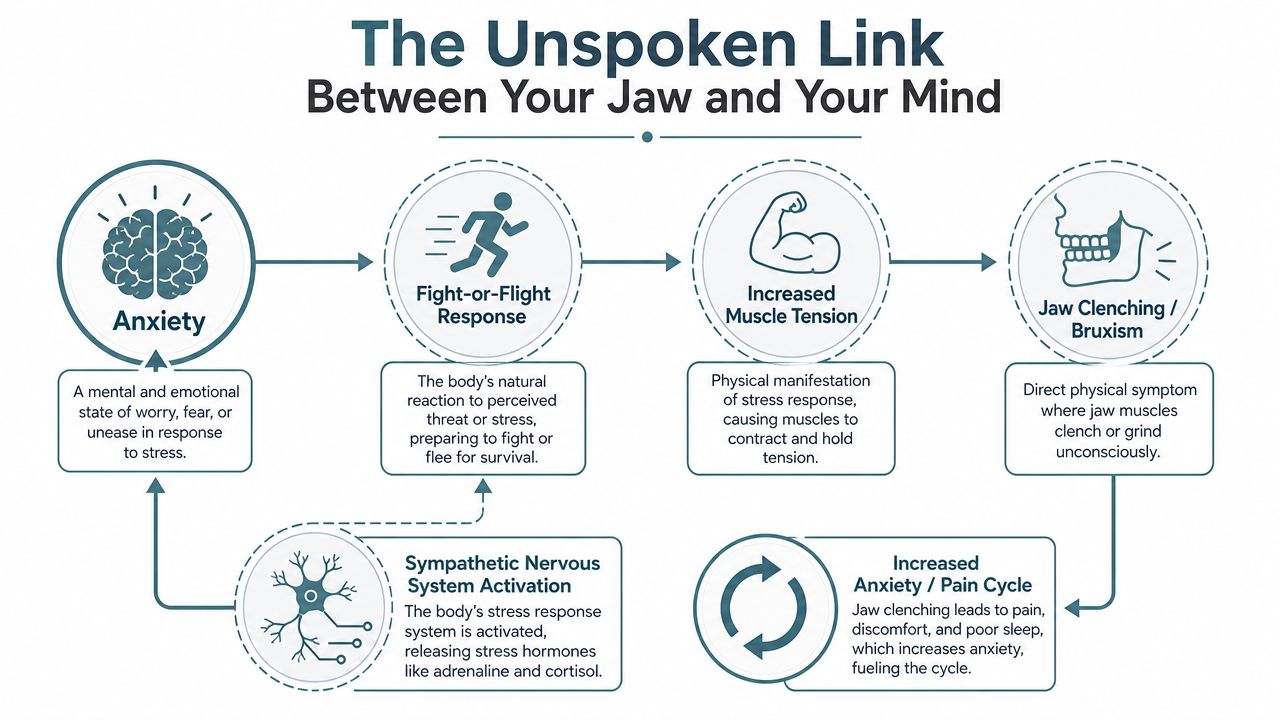
An anxious jaw isn't random. Your nervous system has a job, and that job is protection. The problem is that it doesn't always know the difference between a true emergency and a stressful email, a trauma reminder, or a day of internal pressure.
Why the jaw gets recruited
When anxiety rises, the body can shift into a fight-or-flight state. In that state, muscles prepare for action. Research described in this explanation of anxiety-related jaw clenching notes that anxiety activates the sympathetic nervous system, triggers cortisol release, and increases muscle tension in the masseter muscles, which can lead to subconscious daytime jaw contraction known as awake bruxism.
Your body may feel like it's “bracing for impact.” Your shoulders may rise. Your breathing may get shallow. Your stomach may tighten. The jaw often joins that pattern because the masseter muscles are strong and highly responsive to tension.
A lot of people feel relieved when they hear this. It means the clenching isn't a personal failure. It's a learned bodily response that can become automatic.
Awake bruxism is different from sleep grinding
People often use “teeth grinding” and “jaw clenching” as if they mean the same thing. They're related, but they're not always identical.
- Awake bruxism happens during the day. You may catch it while concentrating, worrying, or holding in emotion.
- Sleep bruxism happens when you're asleep. You may only learn about it because of morning soreness, tooth wear, or a partner hearing grinding sounds.
For people dealing with anxiety, the daytime version often tracks closely with emotional tension. That's one reason body awareness can help so much. If you can spot the jaw tightening when your mind speeds up, you get a chance to intervene earlier.
If anxiety symptoms in general feel bigger than jaw tension alone, it may help to read about common anxiety disorders and how they affect daily life. The more clearly you can name the larger pattern, the less mysterious the jaw symptom becomes.
Recognizing the Signs and Understanding the Risks
Some people know they clench. Many don't.
They come in saying they have headaches, ear pain, or sensitive teeth. They think they're sleeping wrong or maybe getting sick. Then they notice their molars stay pressed together all afternoon, or their face feels tired after stressful days.
Common signs people miss
Jaw clenching doesn't always announce itself as “jaw clenching.” It can show up as:
- Morning soreness if you tense or grind at night
- Tight cheeks or temples from overworked jaw muscles
- Headaches that seem to start around the sides of the head
- Clicking or popping in the jaw joint
- Tooth sensitivity without an obvious cavity
- Ear discomfort even when there isn't an infection
- Difficulty relaxing the face even during rest
A good rule is simple. If your jaw feels effortful when you're not eating or speaking, your muscles may be staying on when they should be off.
Practical rule: Your lips can rest together, but your teeth don't need to stay touching all day.
Research summarized in this PubMed source on anxiety, bruxism, and painful temporomandibular disorders found that a 2021 American Dental Association survey reported over 70% of dentists saw an increase in patients with stress-related teeth grinding and clenching, and that these behaviors fully mediate the relationship between anxiety and painful temporomandibular disorders. In plain language, anxiety often leads to jaw pain through the repeated act of clenching and grinding.
What can happen if it keeps going
Chronic clenching can irritate the jaw joint, strain surrounding muscles, and wear down teeth over time. It can also create a loop where pain raises stress, and stress increases more clenching.
Here is a simple way to think about the progression:
| Early pattern | What it may feel like | Why it matters |
|---|---|---|
| Mild tension | Tight jaw, pressure in the cheeks | The muscles are staying activated too long |
| Repeated strain | Headaches, popping, facial soreness | The joint and muscles may be getting overloaded |
| Ongoing clenching | Tooth wear, sensitivity, more persistent pain | The problem can become harder to ignore and harder to calm |
If headaches are part of your picture, this overview of non-surgical treatment for TMJ headaches offers a useful look at how jaw tension can contribute to head pain and what conservative care may involve.
It can also help to compare your symptoms with broader signs and symptoms of anxiety. For some people, the jaw is one symptom in a larger stress pattern that includes racing thoughts, poor sleep, irritability, or a constantly activated body.
Practical Self-Help Techniques for Immediate Relief
If your jaw has been tight for weeks or months, you don't need a perfect routine. You need a few repeatable actions that calm the body and reduce strain. Think of these as interruption tools. They won't solve every cause, but they can lower the intensity.
Start with awareness, not force
Many people try to “stop clenching” by yanking the jaw open or scolding themselves all day. That usually adds more tension. A better starting point is awareness.
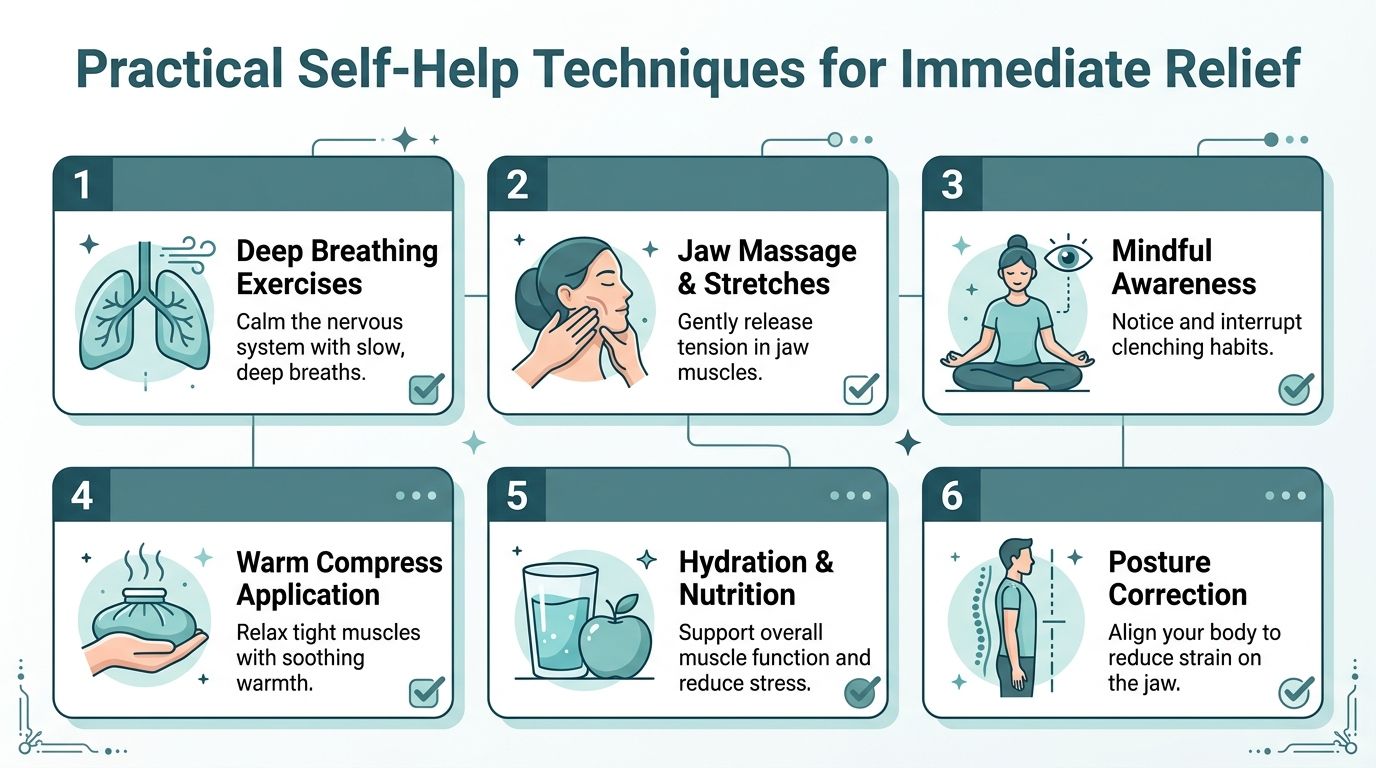
Try this phrase several times a day: lips together, teeth apart. Let your tongue rest gently and allow a small amount of space between the upper and lower teeth. The goal isn't a dramatic movement. It's a subtle release.
A few environmental cues can make this easier:
- Phone reminders set at stressful points in the day
- Sticky notes on a monitor or dashboard with the word “Jaw”
- Pairing the check-in with routines like opening your laptop or washing your hands
A short reset routine you can use today
If you want something concrete, try this sequence:
Breathe lower and slower
Put one hand on your abdomen and take slow breaths that expand the lower ribs and belly. When your breathing slows, your nervous system often lets go a little.Check the masseter muscles
Place your fingertips on the sides of your face, below the cheekbones and in front of the ears. If the muscles feel hard, gently massage in small circles.Use warmth
A warm compress on the sides of the face can help muscles shift out of a guarded state.Practice a brief release
Progressive Muscle Relaxation is one evidence-based option. Guidance described in this overview of managing stress-related bruxism includes clenching the jaw for 5 to 10 seconds and then fully releasing it, so you can feel the contrast between tension and relaxation.
Notice the first sign of clenching, not the worst sign. Early detection is easier on the body.
You can also reduce mechanical stress for nighttime symptoms. If tooth contact during sleep is a concern, learning how a custom night guard for teeth grinding works can help you understand the protective role a dentist may recommend. It won't address the anxiety itself, but it can reduce wear on the teeth.
One more reminder. Self-help works best when you treat it as practice, not a test. Missing a day doesn't mean you failed. It means your nervous system needs repetition.
When Self-Help Is Not Enough Clinical Treatment Options
Sometimes jaw tension responds well to reminders, stretching, and stress reduction. Sometimes it doesn't. If clenching is strong, painful, or tied to deeper anxiety, professional help often makes the biggest difference.

Dental protection versus root-cause treatment
A dentist may recommend a mouthguard or splint, especially if your teeth show wear or you wake up sore. That can be a smart part of care. It protects enamel and reduces direct damage from grinding or clenching.
But there's an important distinction:
| Type of help | What it mainly does | What it doesn't do by itself |
|---|---|---|
| Mouthguard or splint | Protects teeth and may reduce strain | Doesn't resolve the anxiety driving the tension |
| Mental health treatment | Works on triggers, nervous system patterns, and stress responses | Doesn't replace dental protection if your teeth are already at risk |
That difference matters because many people get partial relief and then feel discouraged. They think, “I have the guard, so why am I still clenching?” The answer is often that the body is still in a threat response.
If you're exploring dental options alongside behavioral care, this guide to Find relief for TMJ and bruxism may help you understand one of the treatment paths some dental professionals discuss for persistent jaw muscle tension.
What therapy and biofeedback can do
For anxiety-driven clenching, the strongest clinical options usually focus on changing the stress response itself. Evidence-based approaches described in the source above include Cognitive Behavioral Therapy (CBT) to identify and restructure stress triggers, and biofeedback therapy to build awareness and control over involuntary jaw muscle activity.
CBT helps people notice thoughts and situations that tighten the body. For example, a person may discover they clench hardest when they feel criticized, rushed, or responsible for everyone's needs. Once those patterns are visible, therapy can work on the thoughts, emotions, and behaviors that keep the body in overdrive.
Biofeedback is different. It gives real-time information about muscle tension, which helps a person recognize activation earlier and practice releasing it more deliberately.
Some people need one lane. Others do best with both. The key is matching the treatment to the function of the symptom. If the jaw is acting out a stress story, treatment has to address that story.
Integrated Care The Key to Lasting Recovery
Jaw clenching often gets treated in pieces. A dentist sees tooth wear. A therapist hears about anxiety. A physician hears about headaches. Each professional may be helpful, but the person in pain is left trying to connect the dots.
That split becomes even more serious when anxiety overlaps with substance use. In those cases, jaw tension may not just be a stress habit. It can be part of a larger picture involving trauma, withdrawal, emotional overload, relapse risk, or medication changes.

Why fragmented treatment falls short
When care is fragmented, each provider may address only one slice of the problem.
- Dental-only care may protect teeth while missing panic, trauma, or substance-related triggers.
- Mental health-only care may help with emotions while overlooking active jaw injury or pain patterns.
- Addiction-focused care without somatic awareness may miss jaw tension as a bodily signal that stress is rising fast.
Many people find themselves feeling unseen. They know the symptom gets worse during emotional strain, but no one is looking at the full system.
A particularly overlooked issue is the dual-diagnosis gap. According to this discussion of jaw tension, anxiety, and co-occurring concerns, individuals with co-occurring anxiety and substance use disorders experience significantly higher rates of stress-related bruxism, yet treatment is often fragmented. The same source notes that integrated care addresses both the psychological trigger and the physiological complications, viewing jaw clenching as a potential somatic marker of relapse risk or untreated trauma.
What trauma-informed integrated care looks like
Trauma-informed care asks a different question. Instead of “How do we stop the jaw from clenching?” it asks, “What is this body protecting against, and what else is happening around this symptom?”
That shift changes treatment. It may involve:
- CBT to identify trigger-thought-behavior loops that keep the body activated
- DBT to build distress tolerance and emotion regulation when overwhelm shows up fast
- EMDR or Brainspotting when trauma memories or body-based triggers keep the nervous system reactive
- Psychiatric support when anxiety, sleep disruption, mood symptoms, or medication questions complicate the picture
- Structured outpatient care such as PHP or IOP when someone needs more consistency than weekly sessions can provide
In an integrated setting, jaw clenching becomes useful clinical information. If a person's jaw tightens before they can name fear, shame, craving, anger, or grief, that physical cue can become an early warning sign. Instead of waiting for a full spiral, treatment can respond to the body sooner.
The body often tells the truth before words are available.
This is especially important for people recovering from substance use while also managing anxiety or trauma. Telling them to “just reduce stress” usually isn't enough. They need coordinated care that respects how mind, body, history, and coping patterns interact.
Lasting relief usually comes when treatment stops chasing the symptom in isolation and starts treating the whole person.
Taking the Next Step Towards Relief
Jaw clenching anxiety is not “all in your head,” and it's not something you have to tough out. It's a real body signal. For many people, it improves when they learn how anxiety shows up physically, practice interrupting the pattern, and get the right level of support.
A few signs mean it's time to reach out for professional help:
- The pain keeps returning even when you try self-help steps
- Your teeth, sleep, or eating are being affected
- Headaches, facial pain, or jaw popping are becoming routine
- You notice clenching alongside panic, trauma symptoms, or heavy stress
- Substance use and anxiety are both part of the picture
- You feel stuck in a cycle of tension, pain, and overwhelm
You don't need to wait until it's severe. Early support can protect your teeth, reduce pain, and help your nervous system stop living in a braced state. If the clenching feels tied to deeper anxiety, unresolved trauma, or co-occurring substance use, integrated care is often the most sensible next step.
If jaw clenching feels like one more sign that your nervous system is overloaded, Casa Recovery offers trauma-informed outpatient mental health and dual-diagnosis care in Orange County, including PHP and IOP levels of support. You can explore their programs, verify insurance, or request a confidential assessment to talk through what you're experiencing and what kind of help may fit best.